Sanofi(SNY)

Search documents
Sanofi's Gene Therapy for Eye Disease Gets FDA's Fast Track Tag
ZACKS· 2025-07-16 16:56
Core Insights - Sanofi has received FDA fast-track designation for its gene therapy SAR446597, aimed at treating geographic atrophy (GA) due to age-related macular degeneration (AMD) [1][7] - The fast-track status is designed to expedite the development and review of drugs addressing serious conditions and unmet medical needs [2] - GA affects approximately 1 million people in the U.S. and over 5 million globally, leading to irreversible vision loss [3] Drug Development - SAR446597 is an investigational gene therapy that aims for long-lasting complement inhibition with a single injection, contrasting with current treatments requiring frequent injections [4][7] - The therapy targets two key complement cascade pathways, potentially offering durable treatment for GA [4][5] - Sanofi plans to initiate a phase I/II study to evaluate the safety, tolerability, and efficacy of SAR446597 in GA patients [7][8] Market Context - Apellis Pharmaceuticals' Syfovre is currently the market leader in GA treatment, holding over 60% market share and generating $611.9 million in sales in 2024 [9] - Astellas Pharma's Izervay is also FDA-approved for treating GA secondary to AMD [10] Stock Performance - Year-to-date, Sanofi's shares have declined by 0.2%, while the industry has seen a slight increase of 0.4% [6]



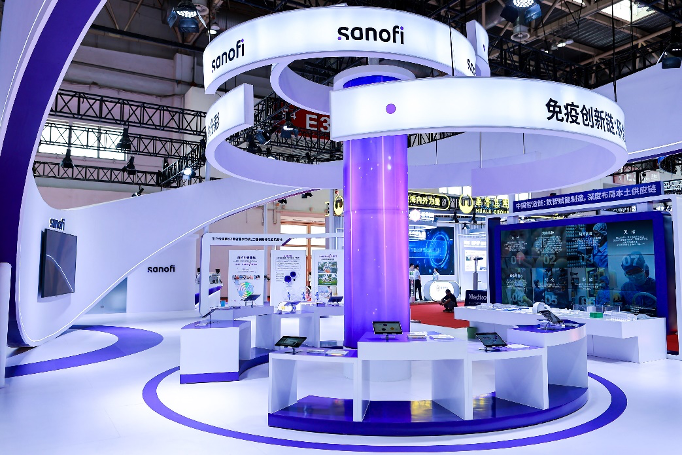
赛诺菲亮相第三届链博会 全景展示生态价值链中国实践
Zheng Quan Ri Bao Wang· 2025-07-16 10:50
Core Viewpoint - Sanofi showcased its commitment to the Chinese market and patients at the third China International Supply Chain Promotion Expo, emphasizing its achievements in high-quality manufacturing, supply chain innovation, and patient health empowerment [1][4]. Group 1: Company Commitment and Achievements - Sanofi has been deeply rooted in the Chinese market for over 40 years, establishing a comprehensive ecological value chain that includes local R&D, manufacturing, and patient services [4]. - This year marks the 30th anniversary of Sanofi's local manufacturing in China, highlighting its ongoing commitment to enhancing high-quality production capabilities and responding to market needs [4]. - The company aims to support the "Healthy China" vision by making innovative drugs and vaccines accessible to a larger population [4][6]. Group 2: Innovations and Product Development - At the expo, Sanofi presented a "traceability journey" of flu vaccine production, showcasing its global collaboration and local supply chain advantages [5]. - The company highlighted nine breakthrough products across key disease areas, including immunology, respiratory, cardiovascular, transplantation, oncology, and rare diseases, demonstrating a comprehensive "immunization innovation chain" [5]. - Sanofi has established four R&D centers in Beijing, Shanghai, Suzhou, and Chengdu, contributing to over 90% of its global synchronized development projects, including 12 potential blockbuster products [5]. Group 3: Focus on Healthcare Accessibility - In response to national policies aimed at improving drug accessibility, Sanofi is committed to promoting equitable healthcare services and building a future where everyone can enjoy health benefits [6].
Press Release: Sanofi's SAR446597 earns fast track designation in the US for geographic atrophy due to age-related macular degeneration
GlobeNewswire News Room· 2025-07-16 05:00
Core Insights - The FDA has granted fast track designation to Sanofi's SAR446597, a one-time intravitreal gene therapy for geographic atrophy due to age-related macular degeneration [1][6] - This designation aims to expedite the development and review of treatments for serious conditions with unmet medical needs [1] Product Details - SAR446597 delivers genetic material encoding two therapeutic antibody fragments that inhibit critical components of the complement pathway, potentially offering sustained complement suppression and reducing treatment burden [2] - The therapy targets the underlying pathophysiology of complement-mediated retinal diseases through long-term expression of therapeutic proteins after a single intervention [2] Clinical Development - Sanofi plans to initiate a phase 1/2 study to evaluate the safety, tolerability, and efficacy of SAR446597 [3] - Additionally, Sanofi is evaluating another gene therapy, SAR402663, for neovascular wet age-related macular degeneration in a phase 1/2 study [3] Market Context - Age-related macular degeneration affects approximately 200 million people globally, with geographic atrophy impacting around 1 million people in the US, over 2.5 million in Europe, and more than 5 million worldwide [3] - Geographic atrophy leads to permanent vision loss and significantly affects quality of life, including daily activities such as reading and driving [3] Company Focus - Sanofi aims to improve the lives of individuals with serious neuroinflammatory and neurodegenerative diseases, including age-related macular degeneration [4] - The company is exploring innovative therapies in retinal diseases, particularly those connected to immune system conditions, as part of its growth strategy [4]

Sanofi: A Solid EU Contrarian Play
Seeking Alpha· 2025-07-15 09:28
Group 1 - The pharmaceutical sector is viewed as problematic due to current geopolitical issues, tariffs, and the state of science and research [1] - The North American market is particularly affected by high drug prices, which complicates the investment landscape [1] Group 2 - The author expresses a personal investment position in specific pharmaceutical companies, indicating a long position in SNY and MRK [1]
将搅乱供应链,涉两千亿市场,美“200%医药关税”引多国警惕
Huan Qiu Shi Bao· 2025-07-14 22:48
Core Viewpoint - The U.S. government threatens to impose tariffs of up to 200% on imported pharmaceuticals to encourage "reshoring" of the industry, raising concerns among domestic pharmaceutical companies heavily reliant on imports [1][2]. Group 1: Tariff Impact on Pharmaceutical Industry - The proposed tariffs could affect approximately $200 billion worth of imported pharmaceuticals, potentially increasing drug prices for American consumers [2]. - The pharmaceutical industry is awaiting further details regarding the "232 investigation" results, which will clarify the implications of the tariffs [2]. - A significant portion of U.S. pharmaceutical imports comes from countries like Ireland ($50.3 billion), Switzerland ($19 billion), and India ($12.5 billion) [2]. Group 2: Global Response and Investment Shifts - Global pharmaceutical giants are planning to increase investments in the U.S. to avoid potential tariffs, while countries like Australia are assessing the impact of the proposed tariffs on their exports [3]. - India exports over $8.95 billion worth of pharmaceuticals to the U.S., making it a critical market for Indian pharmaceutical companies [3]. Group 3: Cost and Supply Chain Concerns - The imposition of a 200% tariff could lead to increased production costs, reduced profit margins, and potential supply chain disruptions, resulting in drug shortages and price hikes for consumers [4][5]. - The Pharmaceutical Research and Manufacturers of America (PhRMA) estimates that even a 25% tariff could raise U.S. drug costs by nearly $51 billion annually, with a potential price increase of 12.9% for consumers [4]. Group 4: Long-term Industry Implications - High tariffs may negatively impact U.S. pharmaceutical companies, which rely on imported raw materials for 90% of their production, leading to increased production costs and reduced R&D investments [5][6]. - The complexity of establishing new manufacturing facilities in the U.S. poses challenges, as the costs may exceed the future tariff burdens, hindering investment in domestic manufacturing [6][7]. - The artificial disruption of the existing pharmaceutical supply chain could lead to inefficiencies and increased production costs, ultimately harming the long-term development of the industry [7].


特朗普拟对药品进口征收200%关税 药企恐慌应对供应链重组挑战
智通财经网· 2025-07-11 23:07
Core Viewpoint - The potential implementation of a 200% tariff on the pharmaceutical industry by the Trump administration raises significant concerns regarding drug prices, company profit margins, and supply chain stability in the U.S. market [1][2]. Group 1: Tariff Impact - The proposed 200% tariff is expected to substantially increase drug production costs, compress profit margins for companies, and potentially disrupt existing supply chains, leading to drug shortages and price hikes in the U.S. market [2]. - A study by the Pharmaceutical Research and Manufacturers of America (PhRMA) indicates that a 25% tariff on imported drugs could result in an annual increase of nearly $51 billion in U.S. drug prices, with an average price increase of 12.9% [2]. Group 2: Industry Response - Major pharmaceutical companies such as Novartis, Sanofi, Roche, Eli Lilly, and Johnson & Johnson have committed to increasing their investments in the U.S. in response to the pressure from the Trump administration [3]. - However, the 12 to 18 months grace period provided by the Trump administration is deemed insufficient for companies to relocate large-scale production lines back to the U.S., as such relocations typically require 4 to 5 years [3]. Group 3: Ongoing Monitoring and Negotiations - Companies like Bayer and Novartis are closely monitoring the tariff situation and are focused on ensuring supply chain stability while minimizing potential impacts [4]. - There is hope within the industry for future trade negotiations to secure some form of exemption from the tariffs, particularly in light of recent trade agreements between the U.S. and the U.K. that mention preferential treatment for U.K. drugs and raw materials [4].
Sanofi: Information concerning the total number of voting rights and shares - June 2025
Globenewswire· 2025-07-09 16:29
Core Points - The document provides information regarding the total number of voting rights and shares of Sanofi as of June 30, 2025 [1] - Sanofi has a registered share capital of €2,452,461,656 [1] Summary by Category Voting Rights and Shares - Total number of issued shares is 1,227,756,274 [1] - The number of real voting rights, excluding treasury shares, is 1,351,296,496 [1] - The theoretical number of voting rights, including treasury shares, is 1,361,952,562 [1]


Press Release: Riliprubart granted orphan drug designation in Japan for chronic inflammatory demyelinating polyneuropathy
Globenewswire· 2025-06-30 05:00
Core Insights - The Japanese Ministry of Health, Labour and Welfare has granted orphan drug designation to riliprubart for chronic inflammatory demyelinating polyneuropathy (CIDP), highlighting its potential to address significant unmet medical needs in this rare neurological condition [1][5] - Approximately 30% of CIDP patients do not respond to standard therapies, and many who do experience incomplete responses, indicating a substantial market opportunity for riliprubart [3][5] Company Overview - Sanofi is an R&D driven biopharma company focused on improving lives through innovative medicines and vaccines, leveraging a deep understanding of the immune system [4] - The company is currently conducting two phase 3 studies for riliprubart, aiming to establish it as a first-in-class treatment for CIDP [5] Product Development - Riliprubart (SAR445088) is a humanized IgG4 monoclonal antibody that selectively inhibits activated C1s in the classical complement pathway, potentially reducing inflammation and preventing nerve damage in CIDP [3] - Long-term efficacy and safety data from a phase 2 study of riliprubart were presented, suggesting sustained benefits for CIDP patients [2] Market Context - There are approximately 4,000 diagnosed CIDP patients in Japan, with a significant portion experiencing debilitating symptoms despite existing therapies [1][3] - The orphan drug designation in Japan adds to similar recognitions in the US and Europe, reinforcing the global regulatory acknowledgment of riliprubart's potential [5]
Sanofi awards Healthy Futures Solution Fund grants to advance community-led solutions, expand equitable access to care across Massachusetts
Prnewswire· 2025-06-26 12:00
Core Insights - Sanofi has launched the Healthy Futures Solution Fund, awarding over $1 million in grants to support local nonprofits in Massachusetts focused on improving health and well-being in historically underserved communities [1][2]. Group 1: Fund Overview - The Healthy Futures Solution Fund was initiated to strategically invest in nonprofit partners with strong community ties, aiming to address root causes of health disparities [2]. - The funding will be utilized over the next year to scale programs that deliver measurable impacts for historically underserved populations [2]. Group 2: Leadership Statements - Deborah Glasser, Head of Specialty Care North America at Sanofi, emphasized the importance of community-driven health solutions and the company's commitment to supporting local organizations with deep community knowledge [3]. - Stan McLaren, CEO of Boston Health Care for the Homeless Program, highlighted that the funding will enhance access to integrated care for homeless individuals, addressing both medical and social health factors [4]. Group 3: Program Duration and Reporting - The funding period for the Healthy Futures Solution Fund runs through June 2026, with each organization required to submit an impact report at the end of the program detailing measurable outcomes and community stories [4].

Press Release: Riliprubart earns orphan drug designation in the US for antibody-mediated rejection in solid organ transplantation
GlobeNewswire News Room· 2025-06-25 05:00
Core Insights - The FDA has granted orphan drug designation to riliprubart for treating antibody-mediated rejection (AMR) in solid organ transplantation, highlighting a significant unmet need in transplant medicine [1][2] - Riliprubart is a first-in-class IgG4 humanized monoclonal antibody that selectively inhibits activated C1s in the classical complement pathway [3] - Sanofi is conducting multiple clinical studies for riliprubart, including a phase 2 study for kidney transplant recipients and two phase 3 studies for chronic inflammatory demyelinating polyneuropathy (CIPD) [2][6] Company Overview - Sanofi is an R&D driven biopharma company focused on improving lives through innovative medicines and vaccines, leveraging deep understanding of the immune system [5] - The company is committed to addressing urgent healthcare challenges and has a robust pipeline aimed at high unmet medical needs [5] Industry Context - Antibody-mediated rejection is a serious complication post-organ transplantation, where the recipient's immune system attacks the transplanted organ, leading to potential organ failure if untreated [4] - The orphan drug designation reflects the rarity of conditions like AMR, affecting fewer than 200,000 people in the US, and underscores the need for effective treatments in this area [1]