S&P Global(SPGI)

Search documents
【环球财经】2025年8月标普全球澳大利亚综合PMI继续升高
Xin Hua Cai Jing· 2025-09-03 02:29
Group 1 - The S&P Global Australia Composite PMI rose to 55.5 in August 2025, marking the highest level since April 2022, indicating continuous growth in the private sector for 11 consecutive months [1][2] - The overall new business in the Australian private sector grew at the fastest pace in 40 months, driven by the recovery of new export business [2] - The services sector's business activity index increased from 54.1 in July to 55.8 in August, also reaching the highest level since April 2022, indicating sustained expansion in the services sector [2] Group 2 - Private enterprises in Australia accelerated hiring to address backlog orders, reflecting improved business confidence compared to July [2] - Despite strong demand, the growth rates of cost prices and product prices in the services sector have moderated [2] - The data suggests a strong and broad-based growth in the Australian economy in August, increasing the likelihood of positive GDP growth in the third quarter [2]

S&P Global to Present at Barclays 23rd Annual Global Financial Services Conference on September 9, 2025
Prnewswire· 2025-09-02 20:00
Core Insights - S&P Global's President and CEO, Martina Cheung, will participate in Barclays 23rd Annual Global Financial Services Conference on September 9, 2025, in New York [1] - The session will be webcast and may include forward-looking information, with CFO Eric Aboaf and SVP of Investor Relations Mark Grant also participating in investor meetings [1] Webcast Details - The webcast will be available live and in replay on the Company's Investor Relations website, with the replay accessible for 90 days until December 7, 2025 [2] - Additional information presented during the session will be available on the Company's Investor Presentations web page [2] Company Overview - S&P Global provides essential intelligence, enabling governments, businesses, and individuals to make informed decisions [3] - The company offers credit ratings, benchmarks, analytics, and workflow solutions in global capital, commodity, and automotive markets [4]


美国关税冲击亚洲经济体 中国制造业活动逆势向好
智通财经网· 2025-09-01 07:17
Core Insights - The U.S. tariff policy is negatively impacting factory activities across Asia, overshadowing unexpectedly optimistic performance in China, which increases pressure on policymakers to support the region's fragile economic recovery [1] - Manufacturing activities in Japan, South Korea, and Taiwan contracted in August, highlighting the challenges faced by Asian manufacturers in coping with U.S. tariff impacts [1] Group 1: Manufacturing Activity - The S&P Global Japan Manufacturing Purchasing Managers' Index (PMI) recorded 49.7 in August, up from 48.9 in July, but has remained below 50 for two consecutive months, indicating contraction [1] - South Korea's manufacturing activity also shrank, with the S&P Global Korea PMI at 48.3 in August, slightly up from 48.0 in July, marking the seventh consecutive month of contraction [1] Group 2: Trade Agreements - Japan and South Korea have reached trade agreements with the U.S. that reduce tariffs, but these measures have not fully mitigated the impact on their export-dependent economies [2] - Japan's agreement includes a reduction of tariffs on automobiles from 27.5% to 15%, while South Korea's tariffs were reduced from 25% to 15%, effective August [2] Group 3: Regional Manufacturing Performance - The RatingDog China Composite Manufacturing PMI rose from 49.5 in July to 50.5 in August, surpassing market expectations and crossing the neutral line of 50 [2] - Manufacturing activities in the Philippines and Indonesia expanded in August, while India's manufacturing growth reached its fastest pace in 17 years, driven by strong demand [2] Group 4: Economic Outlook - Analysts express concerns that U.S. tariffs will lead to a slowdown in global growth, adversely affecting export-oriented economies in Asia [2] - The dual challenge of higher U.S. tariffs and competition from China poses significant risks for Asian economies, particularly for countries like Thailand and South Korea that are heavily reliant on the U.S. market [2]
【环球财经】2025年8月澳大利亚制造业PMI升至53点
Xin Hua Cai Jing· 2025-09-01 06:13
Core Insights - The S&P Global Australia Manufacturing PMI rose from 51.3 to 53 in August 2025, marking the highest level since September 2022, indicating continued expansion in the Australian manufacturing sector [1] - The index has remained above the neutral level of 50 for eight consecutive months, reflecting a significant enhancement in the pace of expansion [1] Manufacturing Activity - The increase in new export orders contributed to a faster growth in overall new orders, leading to a notable rise in factory output in August [1][2] - Manufacturing firms have increased employment for the sixth consecutive month, resulting in a decline in backlogs for the fourth month in a row [1] Procurement and Inventory - Due to the growth in new orders, procurement activities increased for the first time since April, as firms aimed to build safety stock amid extended delivery times caused by shipping delays and supply shortages [2] - The overall inventory levels in manufacturing also rose as a result of increased procurement activities [2] Pricing and Costs - Input costs slightly increased in August compared to July due to rising material prices and transportation costs, prompting manufacturers to raise product prices [2] - However, the increases in both input costs and product prices remained below historical averages [2] Business Confidence - Business confidence in the Australian manufacturing sector reached its highest level in three and a half years in August, with firms optimistic about future sales driven by new product launches and improved macroeconomic conditions [2] Future Outlook - The short-term outlook for factory output in the Australian manufacturing sector is positive, supported by rising output indices, procurement activities, and employment indicators [3] - Despite strong demand, price pressures remain low, suggesting potential for further sales growth in the near term [3]
Automotive Brand Loyalty Rates Show Mixed Results, according to S&P Global Mobility
Prnewswire· 2025-08-28 12:05
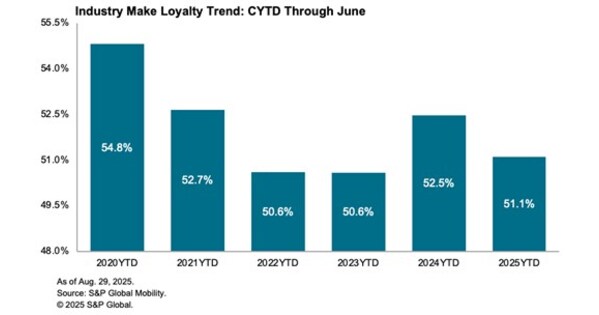
Core Insights - The industry's brand loyalty rate declined to 51.1% in the first half of 2025, down 1.4 percentage points from the same period in 2024, indicating ongoing volatility in loyalty trends post-pandemic [2][3]. Brand Loyalty Trends - More than half of all brands tracked experienced year-over-year loyalty declines of one percentage point or more, affecting both mainstream and luxury brands [3]. - The shift in loyalty rates reflects a balance between returning market volume and strong competition among brands, with households more open to cross-shopping compared to pre-pandemic levels [4]. Conquest Activity - Conquest volume increased by 7.6% among mainstream brands and 6.2% among luxury brands in the first half of 2025 compared to the same period in 2024, indicating brands that executed competitive strategies were able to capture households more effectively [4][5]. Market Dynamics - The number of households returning to the market rose by 4.2% year-over-year in the first half of 2025, marking the third consecutive year of improvement, which created more opportunities for defections as brands competed for returning customers [5]. Manufacturer Performance - General Motors led multi-brand manufacturers with a loyalty rate of 68.1%, while Ford topped all brands at 58.9%. Mini showed the highest loyalty growth, improving its rate by 4.6 percentage points year-over-year, and the Chevrolet Equinox ranked as the model loyalty leader at 42.7% [9].
标准普尔上调肯尼亚主权信用评级
Shang Wu Bu Wang Zhan· 2025-08-28 02:50
Group 1 - Standard & Poor's upgraded Kenya's long-term sovereign credit rating from "B-" to "B" with a stable outlook [1] - The key drivers for the upgrade include strong export revenues and remittance inflows [1] - The agency warned that the rating could face new pressures if reserves decrease or refinancing risks increase [1]
Coulda, Woulda, Shoulda: Are These 5 Stocks Too Overvalued to Buy Now?
Kiplinger· 2025-08-27 10:01
Group 1 - The article discusses the legitimacy of investing in overvalued stocks as a strategy to identify compelling equity ideas, challenging the traditional growth vs value dichotomy [1][4][8] - It highlights that growth stocks can trade at a premium and that there are inexpensive value stocks, emphasizing the concept of "growth at a reasonable price" (GARP) [5][6] - The article outlines specific criteria for selecting overvalued stocks, including a market value of at least $500 million, a forward P/E above the S&P 500 and sector average, and a PEG ratio above 2.9 [9][10][13] Group 2 - S&P Global (SPGI) is identified as an overvalued stock with a market value of $168.4 billion, a forward P/E of 28.7, and a PEG of 2.8, despite its strong performance in the index business [18][21][23] - Walmart (WMT) is another overvalued stock with a market value of $766.7 billion, a forward P/E of 32.6, and a PEG of 4.1, which has seen a recent sell-off despite strong earnings [28][30][32] - Mirion Technologies (MIR) is noted for its focus on radiation safety, with a market value of $4.8 billion, a forward P/E of 36.1, and a PEG of 3.6, benefiting from potential growth in the nuclear sector [39][40][38] - RadNet (RDNT) is highlighted as a leading provider of outpatient diagnostic imaging services, with a market value of $69.59, a forward P/E of 80.2, and a PEG of 6.7, showing significant revenue growth [43][45][47] - Axon Enterprise (AXON) is recognized for its law enforcement technology products, with a market value of $5.4 billion, a forward P/E of 80.2, and a PEG of 6.7, experiencing substantial stock price appreciation [49][54][56]



S&P Cotality Case-Shiller Index Records Annual Gain in June 2025
Prnewswire· 2025-08-26 15:46
Core Insights - The June 2025 results indicate a significant shift in the housing market, with national home prices rising only 1.9% year-over-year, the slowest growth since summer 2023 [2][4] - The data reveals a notable volatility in home prices, with a decline of 0.6% in the first half of the year followed by a 2.5% increase in the latter half, suggesting a pivotal change in the housing market around early 2025 [2][4] - A geographic divergence is evident, with New York leading with a 7.0% annual gain, while former high-performing markets like Tampa and Phoenix are now experiencing declines [3][9] Year-over-Year Summary - The S&P Cotality Case-Shiller U.S. National Home Price NSA Index reported a 1.9% annual gain for June, down from 2.3% in the previous month [7] - The 10-City Composite increased by 2.6%, down from 3.4%, and the 20-City Composite posted a 2.1% gain, down from 2.8% [7][8] - The Consumer Price Index rose by 2.7% from June 2024 to June 2025, outpacing the 1.9% increase in national home prices, indicating a decline in real housing wealth [4][8] Month-over-Month Summary - The pre-seasonally adjusted U.S. National Index saw a slight increase of 0.1%, while the 10-City Composite and 20-City Composite experienced declines of -0.1% and -0.04%, respectively [10] - After seasonal adjustment, the U.S. National Index fell by 0.3%, with the 10-City Composite down by 0.1% and the 20-City Composite down by 0.3% [10] Future Outlook - The current housing cycle appears to be stabilizing around inflation-parity growth rather than the rapid appreciation seen in recent years, reflecting more sustainable economic fundamentals [6] - The shift from Sun Belt markets to traditional industrial centers suggests a more stable long-term trajectory for housing appreciation [6]


S&P Global Mobility: U.S. Auto Sales Motor Along in August
Prnewswire· 2025-08-26 13:05
Core Insights - August 2025 US auto sales are projected to reach 1.43 million units, translating to a sales pace of 15.8 million units (SAAR), slightly down from July's 16.4 million units but marking the second consecutive month of sales growth [1][2]. Sales Performance - Total light vehicle sales for August are estimated at 1,431,600 units, with a SAAR of 15.8 million, compared to July's 16.4 million and August 2024's 15.1 million [3]. - Light truck sales are projected at a SAAR of 13.2 million, down from 13.8 million in July, while passenger car sales remain steady at a SAAR of 2.6 million, unchanged from July but down from 2.9 million in August 2024 [3]. Electric Vehicle Market - Battery electric vehicle (BEV) sales are expected to see volatility, with BEV market share rising to over 9% in July and potentially exceeding 10% in August. However, inventory constraints may limit momentum in September [5]. - The long-term growth of BEV sales may be impacted by the US Administration's recent budget bill, which could temper demand growth [4]. Market Dynamics - Current auto demand is supported by electric vehicle sales and increased automaker incentives, alongside signs of loosening credit conditions. However, these factors may indicate short-term boosts rather than sustained demand [2].

S&P Global Partners with Google Cloud to Expand AI-Ready Data Access to the Commodities Sector
Prnewswire· 2025-08-21 14:07
Core Insights - S&P Global has partnered with Google Cloud to integrate its AI-Ready Data portfolio with Google Cloud's data and AI infrastructure, making Commodity Insights data available in BigQuery [1][2][3] - This partnership aims to enhance customer access to S&P Global's data within their existing ecosystems, providing flexibility and options for utilizing trusted data across the AI landscape [2][4] - The integration allows customers to leverage energy and commodity data for improved productivity, data governance, compliance, and timely decision-making in dynamic market conditions [3][4] Data and Technology Integration - The AI-Ready Data format is designed for machine learning and AI applications, offering clean and structured datasets that facilitate faster model development and deployment [5] - The data packages cover essential sectors including energy, power and gas, metals, chemicals, agriculture, supply chain, and specialized markets [4][7] Strategic Commitment - S&P Global emphasizes its commitment to supporting clients in their digital transformation journeys through this partnership, enabling organizations to utilize advanced data and AI capabilities alongside comprehensive commodity data [4][6]