TAL(TAL)

Search documents
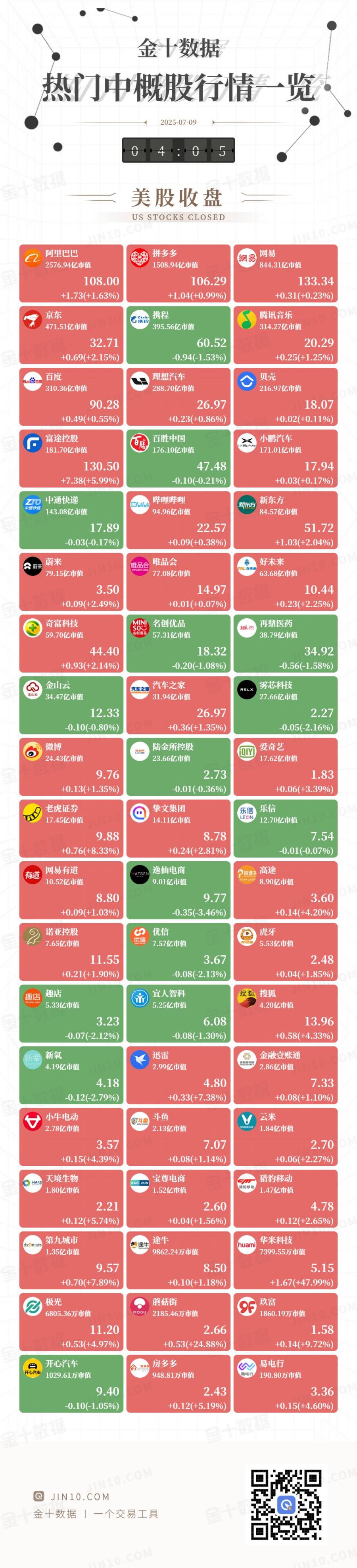
金十图示:2025年07月08日(周二)热门中概股行情一览(美股收盘)
news flash· 2025-07-08 20:07
Market Capitalization Overview - The market capitalizations of various companies are listed, with TAL Education Group at 14.308 billion, Vipshop at 9.496 billion, and others showing significant values [2]. - Notable market movements include a decrease of 0.03 (-0.17%) for TAL Education and an increase of 1.03 (+2.04%) for Vipshop [2]. Company Performance - Companies like Zai Lab and Qifu Technology show market capitalizations of 5.970 billion and 5.731 billion respectively, with Zai Lab experiencing a decrease of 0.20 (-1.08%) [2]. - The performance of other companies such as Huya and Sohu is also noted, with market capitalizations of 5.53 billion and 4.20 billion respectively [2]. Stock Price Changes - Stock price changes indicate a mixed performance, with some companies like Lexin increasing by 0.76 (+8.33%) while others like New Oxygen decreased by 0.07 (-2.12%) [3]. - The overall trend shows fluctuations in stock prices across various companies, reflecting market volatility [3].



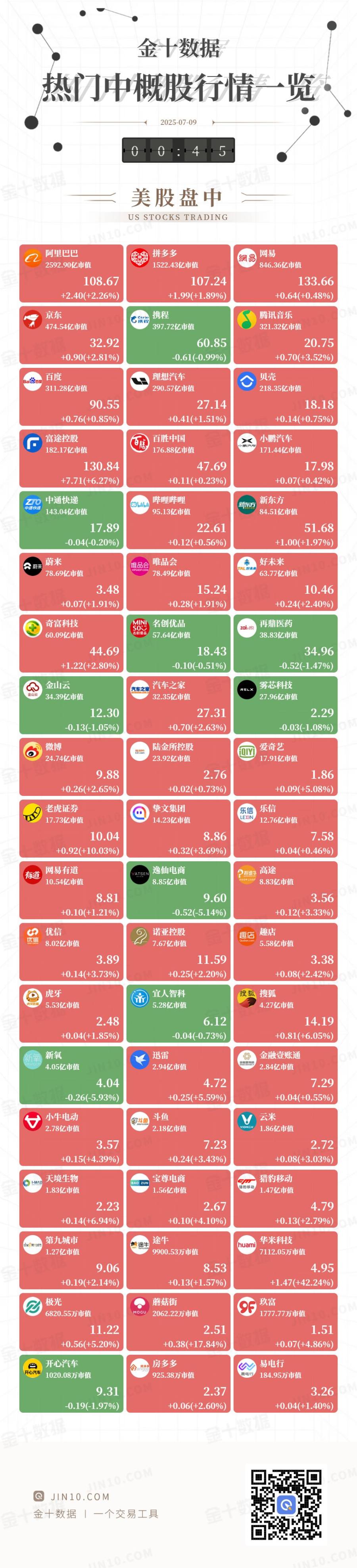
金十图示:2025年07月08日(周二)热门中概股行情一览(美股盘中)
news flash· 2025-07-08 16:46
Market Capitalization Summary - TAL Education Group has a market capitalization of 14.304 billion [2] - New Oriental Education has a market capitalization of 9.513 billion [2] - 51Talk has a market capitalization of 8.451 billion [2] - Zai Lab has a market capitalization of 7.849 billion [2] - BeiGene has a market capitalization of 6.377 billion [2] - 78.69 billion market capitalization for an unspecified company [2] Stock Performance - TAL Education Group's stock changed by -0.04 (-0.20%) [2] - New Oriental Education's stock increased by +0.12 (+0.56%) [2] - 51Talk's stock increased by +1.00 (+1.97%) [2] - Zai Lab's stock increased by +0.07 (+1.91%) [2] - BeiGene's stock increased by +0.28 (+1.91%) [2] - 78.69 billion market capitalization company increased by +0.24 (+2.40%) [2] Additional Companies and Market Data - JD Health has a market capitalization of 6.009 billion [2] - SOS Limited has a market capitalization of 3.883 billion [2] - Miniso Group has a market capitalization of 5.764 billion [2] - Lufax Holding has a market capitalization of 1.791 billion [2] - iQIYI has a market capitalization of 2.392 billion [2] - Weibo has a market capitalization of 1.791 billion [2] Performance Changes - JD Health's stock decreased by -0.10 (-0.51%) [2] - SOS Limited's stock increased by +1.22 (+2.80%) [2] - Miniso Group's stock decreased by -0.52 (-1.47%) [2] - Lufax Holding's stock increased by +0.26 (+2.65%) [2] - iQIYI's stock increased by +0.09 (+5.08%) [2]

TAL Education Group to Announce First Quarter of Fiscal Year 2026 Financial Results on July 31, 2025
Prnewswire· 2025-07-08 09:00
Core Viewpoint - TAL Education Group will release its unaudited financial results for the first quarter of fiscal year 2026 on July 31, 2025, before market opens [1] Group 1: Financial Results Announcement - The financial results will cover the period ended May 31, 2025 [1] - A conference call and live webcast will be held on July 31, 2025, at 8:00 a.m. U.S. Eastern Time [1] Group 2: Conference Call Registration - Participants need to pre-register for the conference call via a provided link [2] - Upon registration, participants will receive dial-in numbers and a unique passcode for access [2] Group 3: Company Overview - TAL Education Group is a smart learning solutions provider in China, aiming to enhance learning opportunities through quality teaching and technology [4] - The company offers diverse learning solutions for students of all ages, including enrichment programs and academic subjects [4]

金十图示:2025年07月08日(周二)中国科技互联网公司市值排名TOP 50一览


news flash· 2025-07-08 02:56
Core Viewpoint - The article presents the market capitalization rankings of the top 50 Chinese technology and internet companies as of July 8, 2025, highlighting significant players in the industry and their respective valuations [1]. Group 1: Top Companies by Market Capitalization - TSMC leads the list with a market capitalization of approximately $11,885.95 million [3]. - Tencent Holdings follows with a valuation of about $5,867.71 million [3]. - Alibaba ranks third with a market cap of $2,535.66 million [3]. - Xiaomi Group is positioned fourth with a market capitalization of $1,935.90 million [3]. Group 2: Additional Notable Companies - JD.com is ranked eighth with a market cap of $461.57 million [4]. - SMIC (Semiconductor Manufacturing International Corporation) is close behind at $456.82 million, ranking ninth [4]. - Kuaishou is in the tenth position with a valuation of $356.39 million [4]. - Tencent Music and Baidu are also notable, with market caps of $310.40 million and $308.67 million, respectively [4]. Group 3: Emerging Players - Li Auto and Beike are valued at $286.24 million and $216.73 million, respectively, indicating their growing presence in the market [4]. - Xpeng Motors and iFlytek have market caps of $170.73 million and $149.98 million, showcasing their potential in the automotive and AI sectors [4]. - Other companies like Zhongtong Express and Baoson Software are also making strides with valuations of $143.32 million and $94.87 million [4]. Group 4: Market Trends - The rankings reflect the competitive landscape of the Chinese technology sector, with significant fluctuations in market capitalizations among various companies [1]. - The data is calculated based on the daily market values, indicating the dynamic nature of the industry [6].

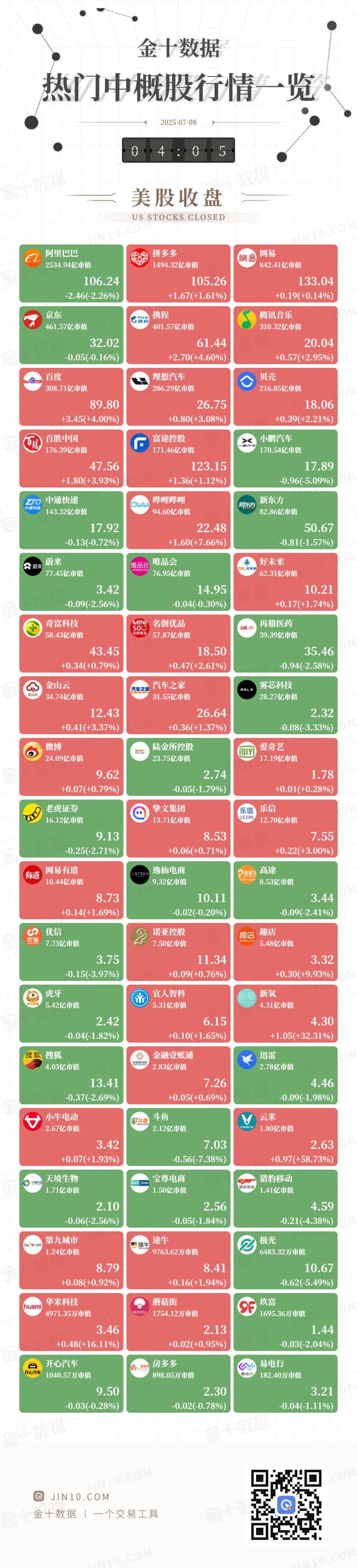
金十图示:2025年07月07日(周一)热门中概股行情一览(美股收盘)
news flash· 2025-07-07 20:06
Market Capitalization Overview - NIO has a market capitalization of 143.32 billion, while TAL Education has 94.60 billion [2] - Vipshop's market cap stands at 76.95 billion, with a stock price change of -0.04 (-0.30%) [2] - Zai Lab has a market cap of 58.43 billion, showing a price increase of +0.34 (+0.79%) [2] Stock Performance - NIO's stock price decreased by -0.13 (-0.72%), while TAL Education's increased by +1.60 (+7.66%) [2] - Vipshop's stock price decreased by -0.09 (-2.56%), whereas Zai Lab's increased by +0.47 (+2.61%) [2] - The stock price of iQIYI increased by +0.01 (+0.28%) with a market cap of 23.75 billion [2] Notable Changes - Sohu's market cap is 4.03 billion, with a stock price decrease of -0.37 (-2.69%) [4] - Tianjing Bio's stock price surged by +1.05 (+32.31%) despite a market cap of only 1.80 billion [4] - Huami's market cap is 4971.35 million, with a stock price increase of +0.48 (+16.11%) [4]
金十图示:2025年07月07日(周一)热门中概股行情一览(美股盘初)





news flash· 2025-07-07 13:40
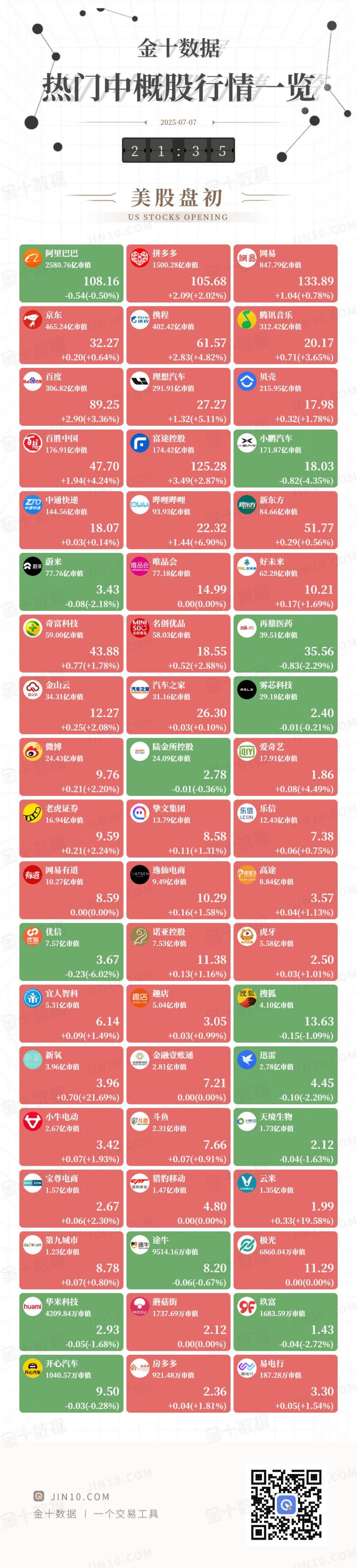
Market Capitalization Summary - NIO has a market capitalization of 14.456 billion [2] - TAL Education Group has a market capitalization of 9.393 billion [2] - Vipshop Holdings has a market capitalization of 8.466 billion [2] - Zai Lab has a market capitalization of 5.900 billion [2] - Huya has a market capitalization of 5.58 billion [2] Stock Performance - NIO's stock increased by 0.03 (+0.14%) [2] - TAL Education Group's stock increased by 1.44 (+6.90%) [2] - Vipshop Holdings' stock increased by 0.29 (+0.56%) [2] - Zai Lab's stock increased by 0.52 (+2.88%) [2] - Huya's stock decreased by 0.23 (-6.02%) [2] Additional Company Insights - New Oxygen has a market capitalization of 0.281 billion with a stock increase of 0.70 (+21.69%) [4] - Financial One Account has a market capitalization of 0.396 billion with no change in stock price [4] - Thunder has a market capitalization of 0.278 billion with a stock decrease of 0.10 (-2.20%) [4] - Xiaoniu Electric has a market capitalization of 0.231 billion with a stock increase of 0.07 (+1.93%) [4]
首发上海,学而思学习机开启本地学功能
Guo Ji Jin Rong Bao· 2025-07-07 10:51
Core Insights - The article discusses the acceleration of AI education adapting to local needs, with Xueersi Learning Machine leading the way in Shanghai [1][2] - The focus is on personalized learning solutions powered by AI technology, aiming to enhance educational experiences for students [1][2] Group 1: Product Features - Xueersi Learning Machine has launched three localized modules: Intelligent Local Practice System, Virtual Co-learning Community, and Local Educational Resource Recommendation Module [1] - The Intelligent Local Practice System utilizes the Nine Chapters model to analyze local exam trends, providing customized weekly practice and integrating local exam papers [1][2] - The Virtual Co-learning Community addresses the loneliness of online learning by allowing students to engage in group activities and interactions [1] Group 2: Market Trends - The education smart hardware market in China has grown from 52.5 billion yuan in 2020 to 67.7 billion yuan in 2023, with a compound annual growth rate of 8.85% [2] - The market is expected to expand further to 73.9 billion yuan by the end of 2024 [2] Group 3: Product Matrix - Xueersi has introduced a new product matrix covering entry-level, mid-range, and flagship models, catering to different market segments [3] - The P4 standard model is priced at 2,699 yuan, targeting budget-conscious families, while the S4 classic model is priced at 4,899 yuan, designed for comprehensive learning [3] - The flagship T4 series, priced at 7,299 yuan, integrates advanced AI capabilities to foster independent learning [3] Group 4: Technological Framework - All three product models utilize the DeepSeek and Nine Chapters dual-core model architecture, enhancing their educational functionalities [3] - The Nine Chapters model has developed capabilities in problem-solving and grading across all subjects, supporting features like "Precision Learning" [3]
金十图示:2025年07月07日(周一)中国科技互联网公司市值排名TOP 50一览
news flash· 2025-07-07 02:54
Core Insights - The article presents the market capitalization rankings of the top 50 Chinese technology and internet companies as of July 7, 2025, highlighting their respective valuations in billions of dollars [1]. Group 1: Market Capitalization Rankings - The top three companies by market capitalization are: 1. Alibaba: $1,000.00 billion 2. Tencent: $800.00 billion 3. Baidu: $500.00 billion [3] - Other notable companies in the top 10 include: - JD.com: $462.29 billion - SMIC: $449.86 billion - Kuaishou: $344.87 billion [3][4] Group 2: Additional Rankings - Companies ranked from 11 to 20 include: - Tencent Music: $301.42 billion - Li Auto: $277.73 billion - Beike: $212.17 billion [4][5] - The rankings continue with companies such as: - Xpeng Motors: $179.69 billion - iFlytek: $149.88 billion - ZTO Express: $144.36 billion [5]



金十图示:2025年07月04日(周五)中国科技互联网公司市值排名TOP 50一览


news flash· 2025-07-04 02:56
Group 1 - The article presents the market capitalization rankings of the top 50 Chinese technology and internet companies as of July 4, 2025 [1] - Alibaba leads the list with a market capitalization of approximately $259.36 billion [3] - Xiaomi and Pinduoduo follow, with market capitalizations of about $188.79 billion and $147.06 billion respectively [3] Group 2 - Meituan and NetEase rank sixth and seventh, with market capitalizations of $93.88 billion and $84.12 billion respectively [4] - Other notable companies include JD.com at $46.23 billion and Baidu at $29.68 billion [4] - The list includes a variety of companies from different sectors, such as Ideal Auto and Kuaishou, with market capitalizations of $27.77 billion and $32.88 billion respectively [4][5] Group 3 - The total market capitalization of the top 50 companies reflects the ongoing growth and competition within the Chinese technology sector [1] - The rankings are calculated based on the latest exchange rates, indicating the dynamic nature of the market [6] - Companies like NIO and Perfect World also feature in the rankings, showcasing the diversity of the industry [5][6]

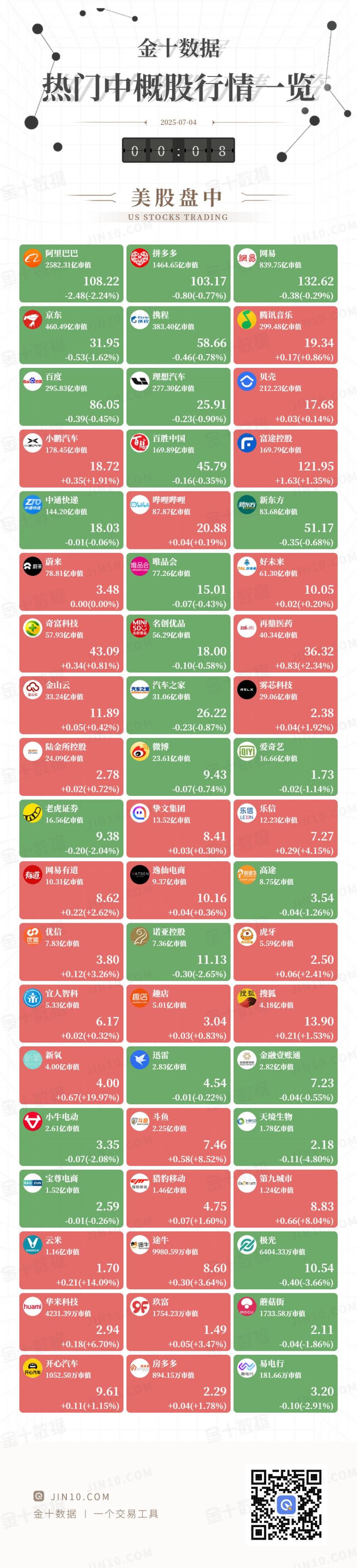
金十图示:2025年07月03日(周四)热门中概股行情一览(美股盘中)
news flash· 2025-07-03 16:12
Market Capitalization Overview - The market capitalizations of various companies are listed, with TAL Education Group at 14.42 billion, Vipshop at 8.78 billion, and others like 7.73 billion for Miniso and 5.33 billion for Yiren Digital [2]. - Notable changes in stock prices include a decrease of 0.01 (-0.06%) for TAL Education and an increase of 0.34 (+0.81%) for Miniso [2]. Company Performance - Companies such as New Oxygen and Thunder have market capitalizations of 2.83 million and 2.82 million respectively, with New Oxygen showing a significant increase of 0.67 (+19.97%) [3]. - Other companies like Baozun and Cheetah Mobile have market capitalizations of 1.52 million and 1.24 million respectively, with Baozun experiencing a slight decrease of 0.01 (-0.26%) [3]. Stock Price Movements - The stock price movements indicate a mix of increases and decreases across various companies, with notable gains for companies like New Oxygen and Miniso, while others like TAL Education and Yiren Digital show slight declines [2][3]. - The overall market sentiment appears to be varied, with some companies experiencing positive momentum while others face downward pressure [2][3].