
TAL(TAL)

Search documents
金十图示:2025年07月03日(周四)中国科技互联网公司市值排名TOP 50一览


news flash· 2025-07-03 02:52
Core Insights - The article presents the market capitalization rankings of the top 50 Chinese technology and internet companies as of July 3, 2025, highlighting significant players in the industry [1]. Group 1: Top Companies by Market Capitalization - Alibaba leads the list with a market capitalization of $2,641.6 billion [3]. - Xiaomi Group follows with a market cap of $1,925.84 billion [3]. - Pinduoduo ranks fourth with a valuation of $1,476.01 billion [3]. - Meituan and NetEase are also notable, with market caps of $963.67 billion and $842.15 billion, respectively [3][4]. Group 2: Additional Notable Companies - JD.com and SMIC (Semiconductor Manufacturing International Corporation) have market capitalizations of $468.06 billion and $449.86 billion, respectively [4]. - Kuaishou and Baidu are also included, with market caps of $329.93 billion and $297.16 billion [4]. - Other companies like Tencent Music, Li Auto, and Beike have market caps ranging from $211.93 billion to $296.92 billion [4][5]. Group 3: Companies with Lower Market Capitalization - Companies such as Vipshop, Kingdee International, and Ufine Network have market caps between $61.18 billion and $77.59 billion [5][6]. - The list continues with firms like Perfect World and Reading Group, which have market caps of $39.38 billion and $37.76 billion, respectively [6].


金十图示:2025年07月02日(周三)中国科技互联网公司市值排名TOP 50一览


news flash· 2025-07-02 02:52
Core Insights - The article presents the market capitalization rankings of the top 50 Chinese technology and internet companies as of July 2, 2025, highlighting significant players in the industry [1]. Group 1: Market Capitalization Rankings - Alibaba leads the list with a market capitalization of $2719.38 billion [3]. - Pinduoduo follows with a market cap of $1497.59 billion [3]. - Meituan ranks third with a market cap of $965.23 billion [4]. - NetEase is fourth with a market cap of $853.42 billion [4]. - Other notable companies include JD.com at $471.37 billion and Kuaishou at $337.84 billion [4]. Group 2: Additional Rankings - Tencent Music has a market cap of $298.01 billion, while Baidu stands at $295.78 billion [4]. - Li Auto and Beike are valued at $287.2 billion and $213.25 billion, respectively [4]. - Xpeng Motors and iFlytek have market caps of $174.04 billion and $152.06 billion [4]. - The list continues with companies like Zhongtong Express at $143.08 billion and New Oriental at $87.65 billion [5]. Group 3: Market Trends - The rankings reflect the competitive landscape of the Chinese tech industry, with significant fluctuations in market values among the top players [1]. - The data is based on the latest exchange rates, indicating the dynamic nature of the market [6].

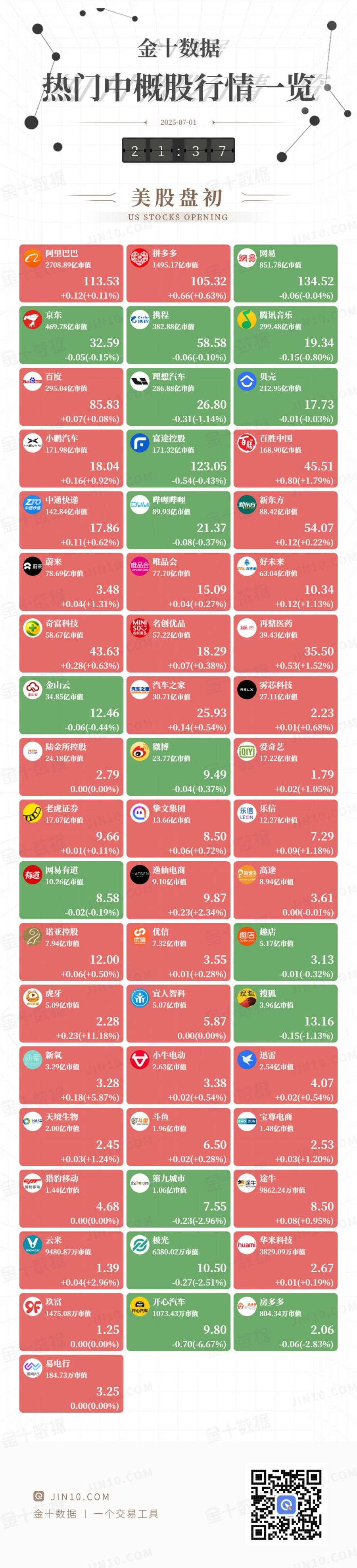
金十图示:2025年07月01日(周二)热门中概股行情一览(美股盘初)




news flash· 2025-07-01 13:39
Market Capitalization Summary - TAL Education Group has a market capitalization of 14.284 billion [2] - Vipshop Holdings has a market capitalization of 8.942 billion [2] - 51Talk has a market capitalization of 7.770 billion [2] - New Oriental Education has a market capitalization of 6.304 billion [2] - 58.com has a market capitalization of 5.867 billion [2] Stock Performance - TAL Education Group's stock increased by 0.11 (+0.62%) [2] - Vipshop Holdings' stock decreased by 0.08 (-0.37%) [2] - 51Talk's stock increased by 0.12 (+0.22%) [2] - New Oriental Education's stock increased by 0.04 (+1.31%) [2] - 58.com’s stock increased by 0.28 (+0.63%) [2] Additional Company Insights - New Oriental Education's stock price is 18.29 [2] - Vipshop Holdings' stock price is 15.09 [2] - TAL Education Group's stock price is 3.48 [2] - 51Talk's stock price is 10.34 [2] - 58.com’s stock price is 12.00 [2]
花旗:中国 K12 教育服务_看好教育集团(EDU),看淡思考乐教育(G TAL
花旗· 2025-07-01 00:40
Investment Ratings - Upgrade New Oriental Education (EDU) to Buy with target prices of US$77/HK$60, representing a potential upside of 54% [1][9] - Downgrade TAL Education Group (TAL) to Neutral with a target price of US$11.54, indicating a downside of 14% [1][18] Core Insights - The report highlights a pair trade strategy to capitalize on the diverging operational trajectories between EDU and TAL, with EDU expected to benefit from operating leverage in K12 education while TAL faces ongoing hardware losses [1][4] - EDU's revenue mix is shifting towards domestic segments, with K9 and Senior High expected to grow from 45% to 55% of revenue by FY26E, leading to significant margin expansion [2][12] - TAL's core Learning Services business provides a solid downside floor, but persistent losses in the Content Solutions segment limit near-term upside potential [3][18] Summary by Sections New Oriental Education (EDU) - The upgrade to Buy is based on a compelling domestic mix-shift story, with structural margin expansion expected as domestic segments grow significantly [2][54] - The report projects that each 1% revenue shift from overseas to domestic will add 8-10 basis points to consolidated margins, creating a multi-year earnings tailwind [2][13] - EDU's current valuation at ~17x NTM P/E does not reflect its intrinsic value, with a sum-of-parts analysis suggesting substantial upside potential [2][55] - Cost discipline measures, including rent cuts and controlled headcount growth, are expected to amplify operating leverage [2][14] - The anticipated dividend plan is viewed as a key near-term catalyst for re-rating [2][15] TAL Education Group (TAL) - The downgrade to Neutral reflects a balanced risk/reward profile, with limited near-term upside due to ongoing operational challenges [3][18] - TAL's core Learning Services business, combined with its net cash position, suggests a firm value floor at US$10.89 per share [3][31] - The Content Solutions segment is projected to continue incurring losses through FY27E, which significantly impacts overall profitability [3][18] - A proprietary lease-based analysis indicates that TAL's center maturity distribution is evolving, which is expected to drive margin expansion over time [20][24] - The report emphasizes the uncertainty surrounding the path to profitability for the Content Solutions segment, with execution risks persisting through FY28E [3][33]

摩根大通:中国消费,从商品到体验
摩根· 2025-06-25 13:03
Investment Rating - The report maintains a positive outlook on experience and learning-related services consumption names, recommending eight quality consumer services with an average forward P/E of 17x and 19% year-on-year sales growth [31]. Core Insights - Despite overall lackluster consumption trends in China post-reopening, selected "new consumption" stocks have significantly outperformed the MXCN index, with an average weighted index for Lunar New Year consumption rising by 21% compared to 10% for MXCN through June 12 [5][6]. - The ACGN sector has shown remarkable performance, with stocks like Pop Mart and Bloks rising by 155% and 94% respectively, while other sectors like Hainan travel/shopping and e-bikes lagged behind [5][6]. - The report highlights a structural shift in consumer behavior towards services over goods, with services consumption categories such as Transport & Communications and Education, Culture & Recreational Services growing at 15% and 18% year-on-year in 2023, compared to overall consumption growth of 9% [5][6]. - The report identifies nine experience and learning-related consumption names that are expected to benefit from favorable seasonal spending trends during the summer [5][31]. Summary by Sections New Consumption Trends - Two key trends identified are affordable treats, including ACGN goods and government-subsidized trade-ins, and experience-related consumption such as movies and travel [6][31]. - The report notes that leading affordable treats have outperformed year-to-date, indicating a shift in consumer preferences towards smaller pleasures rather than big-ticket items [5][6]. Valuation and Growth Potential - Valuation levels for top new consumption names are now comparable to established global brands, with significant upside potential for future growth [5][6]. - The report emphasizes that the ability to surprise on future growth is crucial for maintaining valuations in the new consumption space [5][6]. Recommendations - The report recommends focusing on experience and learning-related services, which are expected to benefit from seasonal trends and a structural shift towards services consumption in China [31]. - Specific companies highlighted include Tencent, NetEase, Trip.com, and Kuaishou, which are positioned well for growth in the digital entertainment and travel sectors [31].

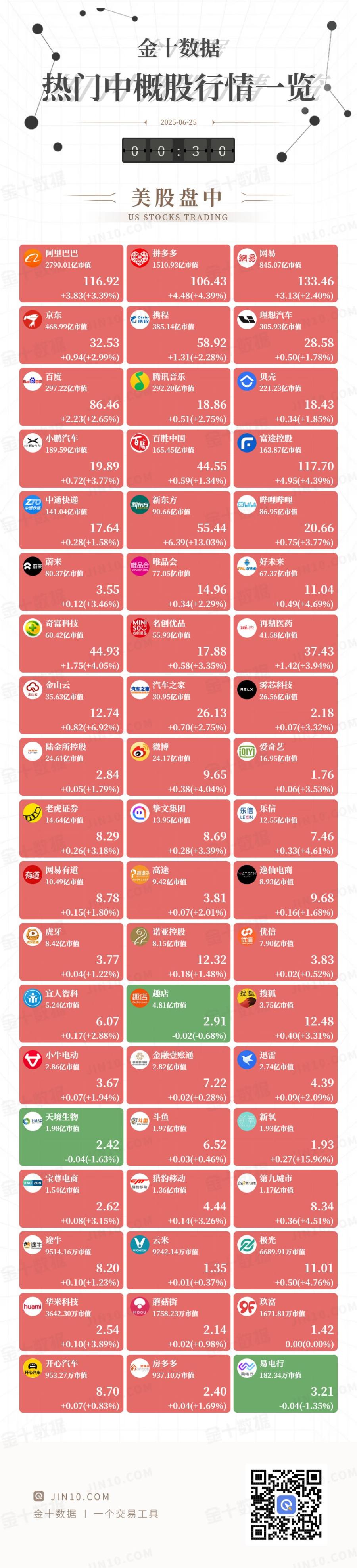
金十图示:2025年06月24日(周二)热门中概股行情一览(美股盘中)

news flash· 2025-06-24 16:35
Market Capitalization Summary - TAL Education Group has a market capitalization of 14.104 billion [2] - Vipshop Holdings has a market capitalization of 8.066 billion [2] - 7.705 billion market capitalization for SouFun Holdings [2] - 6.042 billion market capitalization for WuXi AppTec [2] - 2.461 billion market capitalization for Lufax Holding [2] Stock Performance - TAL Education Group's stock increased by 0.75 (+3.77%) [2] - Vipshop Holdings' stock rose by 0.34 (+2.29%) [2] - SouFun Holdings saw a stock increase of 1.75 (+4.05%) [2] - WuXi AppTec's stock increased by 0.70 (+2.75%) [2] - Lufax Holding's stock rose by 0.05 (+1.79%) [2] Additional Company Insights - The stock of iQIYI increased by 0.38 (+4.04%) with a market cap of 2.417 billion [2] - Xunlei's market capitalization is 2.74 billion with a stock increase of 0.09 (+2.09%) [4] - The market cap of Huami is 0.1758 billion with a stock increase of 0.02 (+0.98%) [4]
金十图示:2025年06月20日(周五)中国科技互联网公司市值排名TOP 50一览
news flash· 2025-06-20 02:56
Core Insights - The article presents the market capitalization rankings of the top 50 Chinese technology and internet companies as of June 20, 2025, highlighting their respective valuations in billions of dollars [1]. Group 1: Market Capitalization Rankings - The top three companies by market capitalization are: 1. Alibaba: $1,000.00 billion 2. Tencent: $900.00 billion 3. Baidu: $290.62 billion [3][4]. - Other notable companies in the top 10 include: - Kuaishou: $308.94 billion - Semiconductor Manufacturing International Corporation (SMIC): $403.59 billion - JD.com: $459.34 billion [3][4]. Group 2: Additional Rankings - Companies ranked from 11 to 20 include: - Ideal Automotive: $282.81 billion - Beike: $217.69 billion - Xpeng Motors: $177.13 billion [3][4]. - The rankings continue with companies like: - New Oriental: $76.78 billion - Vipshop: $75.79 billion - Kingsoft: $70.42 billion [4][5]. Group 3: Valuation Trends - The article indicates a competitive landscape among Chinese tech firms, with significant valuations reflecting their market positions and growth potential [1]. - The data is based on the latest exchange rates, converting values from Hong Kong dollars to US dollars [5].





AI 破解 2025 年教育「不可能三角」
3 6 Ke· 2025-06-19 02:28
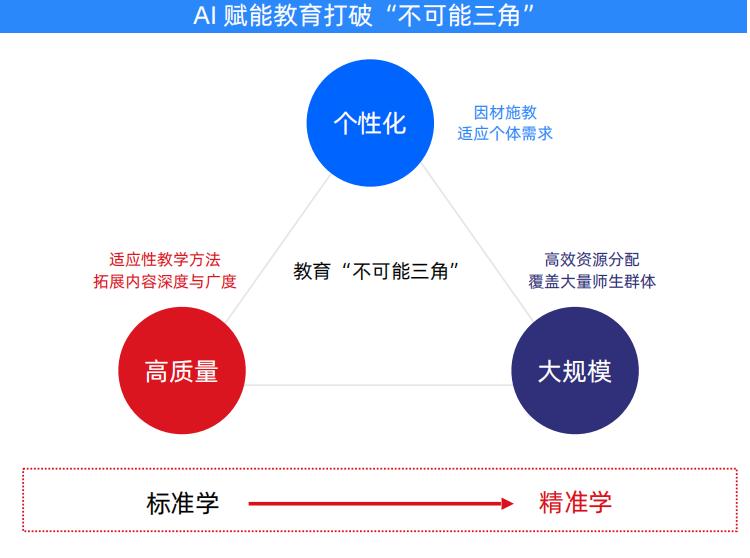
Core Insights - The AI wave in education is expected to transform the industry significantly by 2025, with the market size projected to exceed 70 billion yuan, creating a dual-loop of commercial and educational integration [1][26] - AI is seen as a key to resolving the challenges of personalized, high-quality, and large-scale education, with major educational technology companies integrating AI technologies into their products [2][13] Policy Support - The integration of AI in education is driven by favorable policies, with the government establishing a comprehensive framework for AI education since 2017, including recent guidelines released in May 2025 [4][5] - Policies emphasize the importance of personalized teaching systems, intelligent product development, and large-scale resource sharing to enhance educational efficiency [2][4] Technological Advancements - The evolution of AI technologies, particularly the rise of large models like DeepSeek, is reshaping the educational landscape, enabling significant improvements in language understanding and logical reasoning [9][13] - DeepSeek's open-source nature and low-cost advantages are attracting educational institutions, facilitating the spread of AI capabilities across various educational entities [14][26] Industry Structure - The AI+education industry is characterized by a clear division of roles along the supply chain, with upstream players focusing on core technology support and downstream players addressing diverse user needs [6][15] - The market is witnessing a growing number of participants, including traditional educational institutions and new AI technology companies, leading to a rich ecosystem of educational solutions [15][26] Commercial Models - The AI education market is developing differentiated commercial models across government (G), business (B), and consumer (C) segments, each targeting specific customer needs and offering tailored solutions [21][22] - The projected market size for AI+education is expected to reach nearly 300 billion yuan by 2030, with a compound annual growth rate of 47% [26] Global Expansion - Chinese companies are increasingly looking to international markets, leveraging their technological advancements and cost advantages to explore opportunities in diverse global education sectors [24][26]
AI代替真人、课程更新不足、价格混乱,好未来解不开硬件难题|电厂
Xin Lang Cai Jing· 2025-06-17 10:40
Core Insights - The article discusses the challenges faced by TAL Education Group, particularly its smart hardware segment, following the "double reduction" policy in 2021, which significantly impacted offline tutoring businesses [1] - TAL's smart hardware brand has launched several new learning machines, but the segment has not yet become a profitable pillar for the company, leading to a quarterly loss in Q4 of FY2025 [1][14] - Customer feedback indicates a mismatch between the advertised features of the learning machines and their actual performance, raising concerns about the effectiveness of AI interactions compared to human teachers [5][8] Product Development and Market Position - TAL has rapidly expanded its product lineup, introducing multiple series of learning machines aimed at different market segments, including entry-level and flagship models [11][13] - The pricing strategy for these products has been inconsistent, leading to dissatisfaction among early adopters who find their devices depreciating in value shortly after purchase [13] - The smart hardware segment is still in a loss-making phase, which has negatively impacted the overall profitability of TAL, despite a rise in revenue from learning content solutions [14][15] Customer Experience and Feedback - Parents have expressed frustration over the perceived lack of real-time interaction with teachers, as many features are based on pre-recorded content rather than live instruction [5][8] - There are concerns regarding the adequacy and timeliness of the educational resources provided, particularly in relation to local curriculum updates [9][10] - The transition from human teacher support to AI-based assistance has not met customer expectations, leading to calls for the reinstatement of live teacher services [8][19] Competitive Landscape - The learning machine market is becoming increasingly competitive, with various players, including traditional hardware brands and internet companies, entering the space [15][16] - TAL's market share is part of a fragmented landscape, with several brands collectively holding a significant portion of the market, indicating a need for continuous innovation and differentiation [16][18] - The company plans to focus on enhancing product features, expanding its content library, and improving marketing strategies to maintain and grow its market presence [19][20]

教育板块2025年中期投资策略:K12教育投资守正,职业教育与AI主题投资出奇
Guoxin Securities· 2025-06-17 07:46
Investment Rating - The report maintains an "Outperform" rating for the education sector [2] Core Insights - The education industry has two core functions: academic advancement and employment, leading to various sub-sectors. K12 education is characterized as a long-term growth sector with strong underlying demand and a long user lifecycle [3] - The K12 education market has previously reached valuations exceeding 1 trillion RMB, with leading companies like TAL Education, New Oriental, and Gaotu achieving peak market caps of 349.3 billion, 235 billion, and 217.8 billion RMB respectively [3] - The report highlights that the education sector is currently in a recovery phase post "Double Reduction" policy and pandemic, with structural investment opportunities still present [3] Summary by Sections Industry Trends - Favorable policies such as birth subsidies are expected to improve education consumption expectations, while K12 education is undergoing normalized regulation [6] - The population trend indicates a decline in the number of elementary school students starting in 2024 due to decreasing birth rates, although the demand for high school education remains strong [11][13] - There is a persistent strong desire for higher education, with the expansion of ordinary undergraduate degrees continuing [17][18] Market Performance - From January 1 to June 12, 2025, the education sector index rose by 5.04%, outperforming the broader market by 5.50 percentage points [24] - The report notes significant stock performance differentiation within the sector, with companies like China Oriental Education leading in vocational training due to a reassessment of blue-collar skill training value [30] Sub-sector Analysis - K12 Education: The report emphasizes the ongoing demand for K12 education despite regulatory challenges, with a focus on high-quality educational institutions benefiting from favorable demographic trends [30] - Vocational Education: The demand for vocational skills training is expected to grow, particularly as the labor market evolves [30] - AI in Education: The report highlights the rapid development and integration of AI in educational products, with traditional education companies accelerating their AI product offerings [22][24]
