TI(TXN)

Search documents
德州仪器取得经接收数据的数据转换跟踪专利
Jin Rong Jie· 2025-12-09 09:38
Group 1 - The core point of the article is that Texas Instruments has been granted a patent for a technology related to "data conversion tracking based on received data" [1] - The patent authorization announcement number is CN116171554B, and the application date was September 2021 [1]

14份料单更新!出售安世、ST、TI等芯片
芯世相· 2025-12-08 06:30
Core Insights - The article discusses the challenges of managing excess inventory in the semiconductor industry, highlighting the financial burden of storage and capital costs associated with unsold materials [1] - It emphasizes the services provided by Chip Superman, which has served 21,000 users and offers rapid inventory clearance solutions [8] Group 1: Inventory Management - A significant amount of obsolete materials is causing financial strain, with monthly storage and capital costs estimated at least 5,000, leading to a potential loss of 30,000 over six months [1] - The article suggests that companies struggling to sell their inventory can utilize Chip Superman's services for better pricing and faster transactions [1][9] Group 2: Chip Superman's Offerings - Chip Superman operates a 1,600 square meter smart warehouse with over 1,000 stock models and 50 million chips, valued at over 100 million [7] - The company has an independent laboratory in Shenzhen for quality control, ensuring that each item undergoes inspection [7] - The platform offers discounts for inventory clearance, with transactions completed in as little as half a day [8] Group 3: Demand for Specific Components - The article lists specific components that are in demand, indicating a market need for various semiconductor products [6] - It highlights the importance of understanding market trends and customer needs in the semiconductor sector [6]


汽车芯片,玩法变了
半导体行业观察· 2025-12-08 03:04
Core Viewpoint - The semiconductor supply chain for the automotive industry is undergoing a fundamental transformation, shifting from an efficiency-first approach to prioritizing safety and controllability in response to recent chip shortages [1][21]. Group 1: Impact of Ansys Semiconductor Crisis - Ansys Semiconductor, as the largest supplier of basic semiconductor devices, holds approximately 40% of the global automotive discrete device market share, and its supply fluctuations have led to production cuts or temporary shutdowns for major automakers like Honda, Ford, Volkswagen, and Nissan [1][3]. - The crisis highlights the structural risks within the automotive chip supply chain, emphasizing the industry's demand for safety and reliability, which complicates the rapid replacement of suppliers [3][4]. Group 2: Changes in Automotive Chip Supply Chain Logic - The automotive industry has experienced its second major chip shortage in five years, with the previous shortage during the pandemic primarily caused by supply-demand imbalances [3][5]. - The current crisis has revealed that the global automotive chip inventory turnover days are generally below 40 days, significantly lower than the 60-day safety level, indicating that the industry's focus on low inventory is unsustainable in the face of supply fluctuations [4][5]. Group 3: Localization Strategies of International Chip Manufacturers - Major international automotive chip manufacturers, including Infineon, STMicroelectronics, NXP, and Texas Instruments, are accelerating their localization strategies in China to enhance supply chain stability [7][11]. - Infineon has launched a "local for local" strategy, aiming for localized production of various products by 2027, while NXP has established a dedicated China division to adapt to local market needs [7][8][9]. Group 4: Opportunities and Challenges for Domestic Chip Manufacturers - The restructuring of the automotive supply chain presents unprecedented opportunities for domestic chip manufacturers, with the localization rate of automotive chips in China expected to rise from less than 5% in 2020 to 20% by the end of 2024 [16][17]. - Despite the opportunities, domestic manufacturers face challenges such as high certification barriers, longer certification cycles, and reliance on foreign EDA tools, which can hinder their competitiveness [17][19]. Group 5: Future Trends in the Automotive Chip Industry - The automotive chip industry is expected to evolve towards a more resilient and diversified supply chain, balancing global and regional strategies, with a focus on local production and multi-source backup [21]. - The trend of "local for local" is becoming a collective action among global semiconductor companies, reflecting a recognition of the importance of the Chinese market and the need for supply chain security [14][12].



中国模拟芯片:周期与竞争更新 -以企稳为主题-China Analog_ Cycle and competition update, _stabilization_ is the theme
2025-12-08 00:41
Summary of Conference Call on Global Semiconductors and China Analog Market Industry Overview - The focus of the call is on the **Global Semiconductors** industry, specifically the **China Analog** segment, highlighting the current demand cycle and competitive landscape [1][2][3] Key Insights Demand Dynamics - **China's Demand Growth**: Year-to-date (YTD) demand in China continues to grow faster than non-China demand, despite a higher base from the previous year [2][3] - **Crossover in Growth**: Recently, the rest of the world (RoW) analog market growth has exceeded that of China for the first time in this cycle, indicating a potential shift in market dynamics [2] - **Sector Performance**: The automotive and industrial sectors in China are leading the recovery, while consumer demand has entered a downturn after strong growth in late 2023 [2][3] Competitive Landscape - **Local Vendors' Market Share**: Local Chinese vendors have regained market share in 2Q25 after a weak 1Q25, stabilizing in 3Q25. They have leveraged strong product portfolios and competitive pricing to gain ground on international competitors [3][40] - **Tariff Impact**: Tariffs have disrupted momentum, with some customers pulling forward demand for Texas Instruments (TXN) products into 1Q25. However, local players are expected to continue gaining share [3][40] Inventory and Economic Indicators - **High Inventory Levels**: Inventory remains high across the industry, with an average of 154 days for Chinese analog companies in 3Q25, indicating a potential new norm [58][59] - **PMI Trends**: The Purchasing Managers' Index (PMI) remains low, suggesting weak end demand and a mild recovery in the analog up-cycle, particularly in specific applications [4][58] Future Outlook - **Mild Recovery Expected**: A mild recovery is anticipated for the global analog market in 2025-2026, with China’s analog market expected to grow by 13% in 2025, driven by automotive, computing, and consumer sectors [26][24] - **Localization Trend**: The localization ratio in China has steadily increased from 16% in 2018 to 34% in 2024, with expectations for rapid growth due to geopolitical risks [42][40] Company-Specific Insights Silergy Corp - **Market Positioning**: Silergy is recognized as China's largest analog chip supplier, with a market rating of Market-Perform and a target price of TWD 200. The company is expected to see long-term growth slow to 20-30% [6][96] Texas Instruments (TXN) - **Valuation Concerns**: TXN shares are considered fully valued in the current environment, with a market rating of Market-Perform and a target price of $160 [7][97] Analog Devices Inc (ADI) - **Growth Drivers**: ADI is experiencing strong growth in automotive and industrial sectors, with a market rating of Market-Perform and a target price of $270 [7][98] NXP Semiconductors (NXPI) - **Cyclical Recovery**: NXPI is rated Market-Perform with a target price of $220, with ongoing debates about the pace of recovery [8][99] Risks and Considerations - **Downside Risks**: Risks include worse-than-expected recovery, share losses, and further gross margin degradation for companies like Silergy, TXN, and ADI [100][102][103] - **Upside Risks**: Potential for faster-than-expected sales recovery and stronger localization trends could positively impact valuations [101][102] Conclusion - The conference call highlighted the evolving dynamics in the global semiconductor and China analog markets, emphasizing the importance of local players, inventory management, and the potential for a mild recovery in the coming years. The competitive landscape remains challenging, with significant implications for major players like TXN, ADI, and Silergy.

Texas Instruments Incorporated (TXN): A Bull Case Theory
Insider Monkey· 2025-12-05 23:08
Core Insights - Artificial intelligence (AI) is identified as the greatest investment opportunity of the current era, with a strong emphasis on the urgency to invest now [1][13] - The energy demands of AI technologies are highlighted, with data centers consuming as much energy as small cities, leading to concerns about power grid strain and rising electricity prices [2][3] Investment Opportunity - A specific company is presented as a significant investment opportunity, possessing critical energy infrastructure assets that are essential for supporting the anticipated surge in energy demand from AI data centers [3][6] - This company is characterized as a "toll booth" operator in the AI energy boom, benefiting from the increasing need for energy as AI technologies expand [4][5] Market Position - The company is noted for its ownership of nuclear energy infrastructure, positioning it strategically within America's energy strategy [7] - It is capable of executing large-scale engineering, procurement, and construction projects across various energy sectors, including oil, gas, and renewables [7][8] Financial Health - The company is described as being completely debt-free, with a cash reserve amounting to nearly one-third of its market capitalization, indicating strong financial health [8][10] - It is trading at less than 7 times earnings, suggesting it is undervalued compared to its potential [10] Growth Potential - The company holds a significant equity stake in another AI-related venture, providing investors with indirect exposure to multiple growth engines in the AI sector [9] - The ongoing influx of talent into the AI field is expected to drive continuous innovation and advancements, further enhancing the investment landscape [12] Strategic Trends - The investment narrative ties together themes of AI, energy, tariffs, and onshoring, suggesting a comprehensive approach to capitalizing on current market dynamics [6][14] - The anticipated surge in U.S. LNG exports under the current administration's energy policies is expected to create additional growth opportunities for the company [7][14]
Wall Street Analysts Tout Texas Instruments Incorporated (TXN) Growth Prospects amid Weak Guidance
Insider Monkey· 2025-12-05 03:10
Core Insights - Artificial intelligence (AI) is identified as the greatest investment opportunity of the current era, with a strong emphasis on the urgent need for energy to support its growth [1][2][3] Investment Opportunity - A specific company is highlighted as a potential investment opportunity, possessing critical energy infrastructure assets that are essential for meeting the increasing energy demands of AI data centers [3][7] - This company is not a chipmaker or cloud platform but is positioned to benefit significantly from the anticipated surge in electricity demand driven by AI technologies [3][6] Energy Demand and Infrastructure - AI technologies, particularly large language models like ChatGPT, are extremely energy-intensive, with data centers consuming as much energy as small cities [2] - The company is involved in the U.S. LNG exportation sector, which is expected to grow under the current administration's energy policies [7] Financial Position - The company is noted for being debt-free and having a substantial cash reserve, amounting to nearly one-third of its market capitalization, which positions it favorably compared to other energy firms burdened with debt [8] - It is trading at less than 7 times earnings, indicating a potentially undervalued investment opportunity [10] Market Trends - The company is strategically aligned with several market trends, including the AI infrastructure supercycle, the onshoring boom due to tariffs, and the surge in U.S. LNG exports [14] - There is a growing interest from hedge funds in this company, suggesting that it is gaining recognition among sophisticated investors [9] Future Outlook - The influx of talent into the AI sector is expected to drive continuous innovation and advancements, making investments in AI a strategic move for future growth [12] - The company is positioned to capitalize on the intersection of AI and energy, which is seen as a critical area for investment in the coming years [6][11]

The Zacks Analyst Blog Highlights Procter & Gamble, Lam Research, Texas Instruments, SandRidge Energy and Crown Crafts
ZACKS· 2025-12-04 10:27
Core Insights - The article highlights recent research reports on several major stocks, including Procter & Gamble, Lam Research, Texas Instruments, SandRidge Energy, and Crown Crafts, emphasizing their performance and outlook in the market [2][5][14]. Procter & Gamble (PG) - Procter & Gamble's shares have declined by 14.5% over the past year, slightly better than the Zacks Consumer Products - Staples industry's decline of 14.7% [5]. - The company expects all-in sales growth of 1-5% and flat to up 4% organic sales gains in fiscal 2026, supported by cost savings [6]. - Robust cash flow is anticipated to fund $15 billion in shareholder returns in fiscal 2026, including dividends and share buybacks [6][7]. Lam Research (LRCX) - Lam Research's shares have outperformed the Zacks Electronics - Semiconductors industry, increasing by 101% compared to the industry's 70.1% [8]. - The company is benefiting from strength in 3D DRAM and advanced packaging technologies, with a rebound in the System business due to improving memory spending [9]. - Total revenues are expected to grow at a CAGR of 8.5% from fiscal 2026 to 2028, although global spending on mature nodes may remain soft in the near term [10]. Texas Instruments (TXN) - Texas Instruments' shares have underperformed the Zacks Semiconductor - General industry, declining by 6.8% compared to the industry's 24.8% [11]. - The company is experiencing cautious spending from customers amid macroeconomic uncertainties, impacting overall growth [11]. - Revenue is projected to grow at a CAGR of 8.7% from 2025 to 2027, supported by solid data center demand and a focus on expanding its product portfolio [13]. SandRidge Energy (SD) - SandRidge Energy's shares have outperformed the Zacks Oil and Gas - Integrated - United States industry, increasing by 34.5% compared to the industry's decline of 9.3% [14]. - The company has a market capitalization of $527.34 million and is benefiting from strong early well results in the Cherokee shale [14]. - Cash generation supports a steady capital return program, with rising quarterly dividends and continued buybacks [15][16]. Crown Crafts (CRWS) - Crown Crafts' shares have underperformed the Zacks Textile - Home Furnishing industry, declining by 33.2% compared to the industry's decline of 11% [17]. - The company faces risks such as tariff-related margin pressure and high inventory, but the Baby Boom acquisition is expected to drive long-term growth [18]. - Cost synergies and internal consolidation are anticipated to streamline operations through fiscal 2027, enhancing overall performance [19].





Wall Street's Most Accurate Analysts Weigh In On 3 Tech Stocks With Over 3% Dividend Yields
Benzinga· 2025-12-03 11:43
Core Insights - Investors are increasingly turning to dividend-yielding stocks during market turbulence and uncertainty, as these companies typically have high free cash flows and offer substantial dividend payouts [1] Company Ratings and Analyst Insights - **Microchip Technology Inc (NASDAQ:MCHP)**: - Dividend Yield: 3.21% - Citigroup analyst Christopher Danely maintained a Buy rating but reduced the price target from $90 to $80 as of Nov. 7, 2025, with an accuracy rate of 80% [7] - Truist Securities analyst William Stein maintained a Hold rating and cut the price target from $64 to $60 on Nov. 7, 2025, with an accuracy rate of 86% [7] - Recent news indicates that Microchip Technology raised its FY26 guidance [7] - **Texas Instruments Inc (NASDAQ:TXN)**: - Dividend Yield: 3.24% - JP Morgan analyst Harlan Sur maintained an Overweight rating but reduced the price target from $225 to $210 on Oct. 22, 2025, with an accuracy rate of 80% [7] - Cantor Fitzgerald analyst Matthew Prisco maintained a Neutral rating and cut the price target from $200 to $170 on Oct. 22, 2025, with an accuracy rate of 85% [7] - Recent news shows Texas Instruments issued fourth-quarter EPS and sales guidance below analyst estimates [7] - **Xerox Holdings Corp (NASDAQ:XRX)**: - Dividend Yield: 3.73% - Citigroup analyst Asiya Merchant maintained a Neutral rating and reduced the price target from $4.5 to $3.5 on Nov. 10, 2025, with an accuracy rate of 88% [7] - Morgan Stanley analyst Erik Woodring maintained an Underweight rating and cut the price target from $10 to $8 on Oct. 30, 2025, with an accuracy rate of 77% [7] - Recent news highlights that Xerox named Chuck Butler as Chief Financial Officer [7]



Matter芯片,真的火了
3 6 Ke· 2025-12-03 03:33
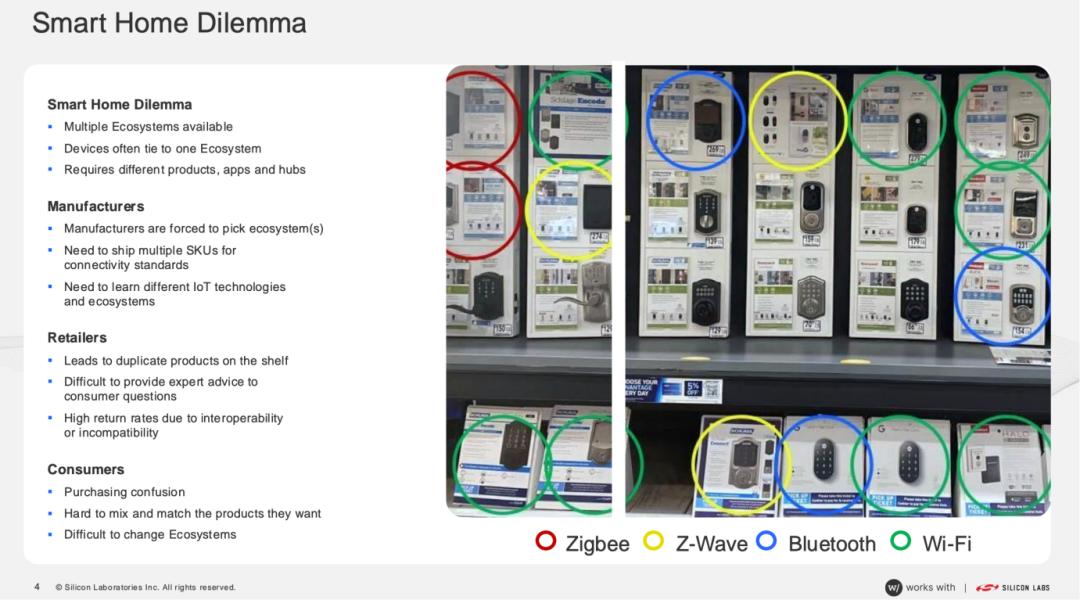
Core Insights - Matter has rapidly gained traction, with its version evolving to 1.5, receiving strong support from major terminal manufacturers like Amazon, Samsung, and Apple [1][6] - Despite the fragmented ecosystem in China, Matter remains a crucial standard for many overseas manufacturers [1] - The technology aims to eliminate fragmentation in the IoT space, enhancing interoperability among various smart devices [1][4] Development of Matter - Matter was initially proposed in December 2019 as CHIP and officially introduced as a new connectivity standard in May 2021 [6] - The first official version, Matter 1.0, was released in October 2022, followed by updates to versions 1.1 and 1.2 in May and October 2023, respectively [6] - The latest version, Matter 1.5, released in November 2023, includes native support for smart cameras and enhanced energy management capabilities [6][10] Features of Matter - Matter offers seamless interoperability, ease of use, strong security, and high acceptance within the ecosystem [7] - It effectively addresses the challenges of multi-protocol compatibility, allowing users to integrate new and existing devices without replacement [7] - The built-in security mechanisms of Matter reduce the burden on application layer security design, enabling developers to focus on user experience [7] Chip Technology and Manufacturers - Chip technology is crucial for the development of Matter, with two main configurations: System on Chip (SoC) and Co-processor [9] - STMicroelectronics launched the ST25DA-C, the first NFC chip compatible with Matter 1.5, allowing for easier device configuration [10][11] - Qorvo's multi-connection technology facilitates backward and forward compatibility for Matter, integrating various wireless standards [23][24] Product Offerings - Qorvo's QPG6200 series chips support multiple protocols with low power consumption, suitable for battery-operated applications [25][26] - Texas Instruments (TI) has been involved in Matter's development for over a decade, offering various compatible products [27][28][29] - NXP focuses on secure wireless connections and innovative solutions based on Matter, enhancing smart home and building automation applications [30][36][39] Industry Trends - Silicon Labs is among the first companies to support Matter compatibility certification, emphasizing the importance of flexible chip technology [40][41] - Nordic Semiconductor has expanded its product line to include high-memory wireless SoCs designed for low-power Bluetooth and Matter applications [44] - With increasing investments from chip manufacturers, the long-standing fragmentation issue in IoT is being addressed, making Matter a significant focus for companies looking to enter overseas markets [46]



全球市场早报|美股三大股指集体收涨,波音涨超10%
Sou Hu Cai Jing· 2025-12-02 23:30
Market Performance - The Dow Jones Industrial Average rose by 185.13 points, closing at 47,474.46, an increase of 0.39% [1] - The Nasdaq Composite gained 137.75 points, ending at 23,413.67, up by 0.59% [1] - The S&P 500 index increased by 16.74 points, closing at 6,829.37, a rise of 0.25% [1] Sector Performance - Major technology stocks mostly increased, with Apple up over 1%, Facebook nearly 1%, Nvidia up 0.86%, Microsoft up 0.67%, Google up 0.29%, Amazon up 0.223%, while Tesla fell by 0.21% [1] - Energy stocks declined across the board, with ExxonMobil down over 1%, Chevron down more than 1%, ConocoPhillips down over 1%, Schlumberger down 0.7%, and Western Oil down nearly 1% [1] - Airline stocks collectively rose, with Boeing up over 10%, American Airlines up more than 2%, Delta Airlines up over 1%, Southwest Airlines up nearly 2%, and United Airlines up over 3% [1] - Semiconductor stocks mostly increased, with the Philadelphia Semiconductor Index rising by 1.83%, Intel up over 8%, NXP Semiconductors up more than 7%, Microchip Technology up over 6%, and Texas Instruments up over 4% [1] Chinese Stocks - The Nasdaq Golden Dragon China Index fell by 0.65%, with individual stocks like Xpeng Motors down nearly 8%, and Artis Solar down nearly 6% [2] - Some Chinese stocks saw gains, such as Wanwu Xingsheng up over 6%, Atour up more than 5%, and Tiger Brokers up nearly 2% [2] Economic Indicators - Recent data indicates a gradual cooling of the economy, with policymakers urging caution on interest rate cuts and warning of potential inflationary pressures [2] - The probability of a 25 basis point rate cut by the Federal Reserve in December has surged to 89.2% according to the Chicago Mercantile Exchange [2] European Market Performance - European stock indices showed mixed results, with the FTSE 100 in London down 0.01%, the CAC 40 in Paris down 0.28%, and the DAX in Frankfurt up 0.51% [2] Commodity Prices - International oil prices fell, with light crude oil futures for January 2026 down by $0.68, closing at $58.64 per barrel, a decrease of 1.15% [3] - Brent crude oil futures for February fell by $0.72, closing at $62.45 per barrel, a decline of 1.14% [3] Currency Exchange Rates - The US dollar index decreased by 0.06%, closing at 99.357 [3] - The euro traded at 1.1622 against the dollar, the pound at 1.3211, and the yen at 155.88 [3]