Visa(V)

Search documents
With Financial Stocks Suddenly Tanking, Is Now the Time to Buy?
Yahoo Finance· 2026-01-17 12:05
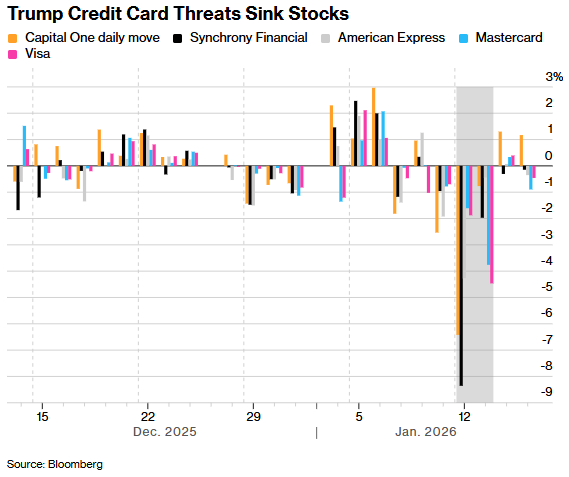
Core Viewpoint - The financial sector, particularly credit card issuers, is currently experiencing stock price declines despite potential long-term profitability due to proposed regulatory changes on interest rates [2][8]. Group 1: Impact of Proposed Interest Rate Cap - President Trump proposed a one-year, 10% cap on credit card interest rates, effective January 20, which has led to significant declines in stock prices of major credit card issuers [2][3]. - Major credit card issuers such as Bank of America, JPMorgan Chase, American Express, Capital One Financial, and Citigroup saw stock declines ranging from 4.5% to 9.9% following the announcement [9]. - Payment networks Visa and Mastercard also experienced stock drops of 8% and 6.9%, respectively, indicating a broader impact on the financial sector [4]. Group 2: Historical Context and Legislative Challenges - Previous attempts to cap credit card interest rates have failed, with a similar proposal by Senator Bernie Sanders stalling in Congress last year [5][6]. - The financial industry is expected to strongly oppose the current proposal, suggesting that it is unlikely to be enacted [6][7]. - Analysts predict that the banking industry will effectively counter this proposal before it gains traction [7].



Jim Cramer Discusses Trump Interest Rate Cap & Visa (V)
Yahoo Finance· 2026-01-16 18:21
Core Viewpoint - Visa Inc. (NYSE:V) is facing challenges due to President Trump's proposed 10% cap on credit card APR rates, impacting its stock performance and growth outlook [2]. Group 1: Stock Performance - Visa's shares have increased by 4% over the past year but have decreased by 5% year-to-date [2]. - The stock has struggled in the context of regulatory changes suggested by President Trump [2]. Group 2: Analyst Ratings and Price Targets - UBS has reiterated a Buy rating for Visa with a price target of $425, suggesting potential revenue growth acceleration in 2026 [2]. - Baird also maintained an Outperform rating and a $425 price target following Visa's announcement of a $500 million deposit in a litigation escrow account [2]. Group 3: Market Context - Visa is categorized as a payment processing company that does not engage in lending, which was highlighted in Jim Cramer's discussion regarding the implications of Trump's interest rate cap [2][3].
Why Visa Stock Is Attractive Despite Potential Regulation
Forbes· 2026-01-16 15:45
Core Viewpoint - Visa stock is currently considered an attractive investment due to its high margins, strong cash generation capabilities, and a significant discount in its valuation compared to the previous year [2][3]. Financial Performance - Visa's stock has declined by 6.5% this year, but it is 43% cheaper based on its Price-to-Sales (P/S) ratio compared to a year ago [3]. - In Q4 2025, Visa reported a 17% increase in data processing revenue and a 12% rise in higher-margin cross-border volume, driven by strong consumer spending [3]. - Processed transactions grew by 10%, indicating improved network utility [3]. - Revenue from value-added services increased by 25% due to new partnerships and technological investments [4]. - The company anticipates low double-digit net revenue growth for FY2026, supported by global events like the Olympics [4]. Competitive Position - Visa dominates the transition from cash to digital payments, operating in over 200 countries and benefiting from strong network effects [5]. - The asset-light business model allows Visa to maintain exceptional margins and strong free cash flow, facilitating consistent buybacks and dividends [5]. - Growth drivers such as cross-border travel, contactless payments, and B2B transactions remain robust [5]. Profitability Metrics - Visa's recent operating cash flow margin is approximately 57.6%, with an operating margin of 66.4% for the last twelve months [11]. - Long-term profitability metrics show an operating cash flow margin of roughly 58.9% and an operating margin of 66.8% over the last three years [11]. - Revenue growth for Visa was 11.3% for the last twelve months and 10.9% over the last three years [11]. Valuation - Visa's stock is currently available at a P/S multiple of 10.6, representing a 43% discount compared to one year ago [11].


特朗普利率突袭冲击金融股,华尔街高管财报季遭质询
智通财经网· 2026-01-16 12:48
Core Viewpoint - President Trump's unexpected request for credit card companies to set a cap on interest rates at 10% could significantly impact the profitability of the financial sector, leading to a decline in financial stocks and raising concerns among bank executives during earnings calls [1][4]. Financial Sector Impact - The proposed interest rate cap is half of the current average rate on outstanding balances, potentially erasing billions in profits for credit card issuers [1]. - Major banks such as Capital One (COF.US), JPMorgan Chase (JPM.US), and American Express (AXP.US) experienced significant stock declines following the announcement [1]. - Analysts from KBW indicated that if the policy is implemented, it would severely weaken the profitability of credit card issuers and could trigger economic repercussions [4]. Legislative Developments - Trump has called for Congressional support for the Credit Card Competition Act, which targets the nearly $200 billion in swipe fees charged by banks and payment companies, negatively affecting stocks of Visa (V.US) and Mastercard (MA.US) [4]. - Some analysts doubt the feasibility of the interest rate cap, suggesting that the probability of it being enacted is less than 20% due to the lack of legislative support [4]. Broader Economic Effects - Bank executives have warned that the interest rate cap could lead to a significant economic slowdown and push consumers towards unregulated lending sources [5]. - The proposed changes are expected to have ripple effects beyond the financial sector, impacting industries such as airlines and retail, which rely on partnerships with credit card companies for substantial revenue [7]. - Airlines like Delta (DAL.US) and United Airlines (UAL.US) saw stock declines, as did retailers like Macy's (M.US) and Kohl's (KSS.US), due to concerns over the potential impact of the proposed legislation [7].



Crypto Card Market Explodes 15x as Stablecoin Spending Soars 106% Annually: Report
Yahoo Finance· 2026-01-16 09:04
Group 1 - The crypto payments landscape has seen a significant transformation, with crypto card volumes increasing from approximately $100 million monthly in early 2023 to over $1.5 billion by late 2025, reflecting a 106% compound annual growth rate [1] - Crypto cards are becoming the primary bridge between digital assets and everyday commerce, with annualized volumes surpassing $18 billion, while traditional peer-to-peer transfers only grew by 5% to $19 billion during the same period [2] - Visa has established itself as the leading player in the crypto card infrastructure, capturing over 90% of on-chain card volume through strategic partnerships with emerging program managers and full-stack issuers [2] Group 2 - The strategy of Visa, which involves engaging infrastructure providers like Rain and Reap, has proven to be more scalable compared to Mastercard's direct exchange partnerships [3] - Full-stack issuers are reshaping card economics by integrating BIN sponsorship, lender-of-record status, and direct Visa network settlement into single platforms, thus eliminating traditional card issuance dependencies [4] - Visa's stablecoin-linked card spending reached a $3.5 billion annualized run rate in Q4 fiscal 2025, marking a 460% year-over-year growth, although it still accounts for about 19% of total crypto card settlement volume [5] Group 3 - Centralized exchanges are utilizing cards as user-acquisition tools, with platforms like Gemini incurring ongoing losses from credit card programs to enhance platform engagement [6] - DeFi protocols such as Ether.fi are offering higher cashback through token rewards, providing approximately 4.08% returns while boosting protocol total value locked (TVL) through collateralized borrowing features [6] Group 4 - Geographic opportunities for crypto card adoption are particularly pronounced in regions like India and Argentina, where USDC is nearing parity with USDT in market share [7] - India experienced $338 billion in crypto inflows over the 12 months ending June 2025, but stringent tax policies have driven most activity offshore, indicating a significant latent demand for compliant crypto products hindered by regulatory challenges [8]
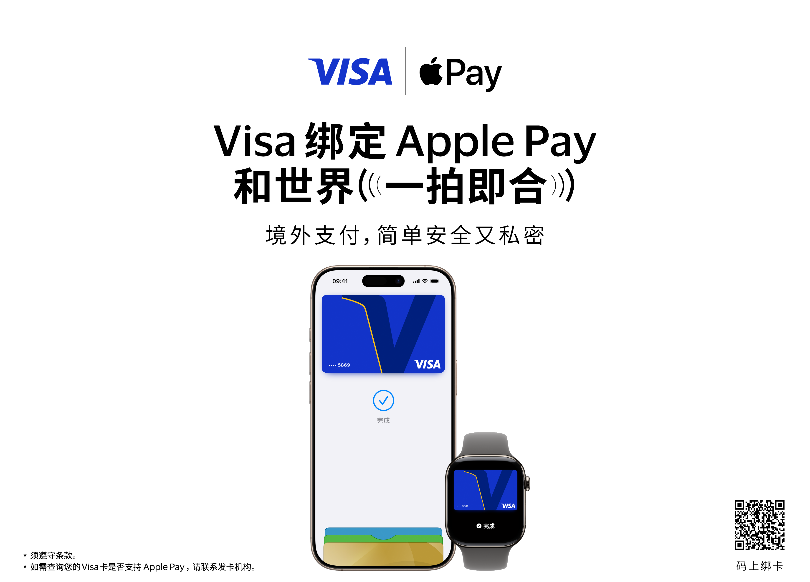
Visa Supports Chinese Cardholders to Add Cards to Apple Pay for a More Convenient and Secure Payment Experience
BusinessLine· 2026-01-16 08:30
Core Insights - Visa has announced support for Chinese Visa cardholders to use Apple Pay for payments at overseas merchants, enhancing mobile payment options for consumers [1][2] - The collaboration aims to provide a secure and seamless payment experience, with Visa increasing investments in data and payment security [2] - The initial group of participating banks includes major institutions such as Industrial and Commercial Bank of China and Bank of China, with plans to expand to more banks in the future [2][10] Group 1: Payment Features - Apple Pay allows users to make contactless payments by authenticating with Face ID, Touch ID, or a device passcode, ensuring transaction security [3] - Consumers can use Apple Pay for faster payments in overseas mobile apps and online without repeatedly entering personal information [4] - The system uses tokenization technology to enhance security, ensuring that actual card numbers are not stored on devices or servers [5] Group 2: User Experience and Benefits - Setting up Apple Pay is straightforward, allowing users to add Visa cards easily through the Wallet app [6] - Cardholders retain the same rewards and benefits as with physical cards, along with exclusive offers such as first-time binding bonuses [7] - Visa promotes its "V Select" WeChat Mini Program for users to access more information on benefits [7]


Visa首秀Apple Pay,八家银行开启“首刷”大战
Huan Qiu Wang· 2026-01-16 06:39
Core Insights - The credit card industry is undergoing a significant transformation as Visa announces support for Chinese-issued Visa cards to be linked to Apple Pay, breaking the long-standing dominance of UnionPay in China [1][2] Group 1: Industry Changes - Visa becomes the first international card organization to support Apple Pay in China, allowing Chinese cardholders to use their Visa cards for contactless payments abroad [1] - The collaboration marks an important step in the opening of the Chinese payment market and is a strategic move for banks and card organizations to capture the outbound financial consumption market [4] Group 2: Consumer Benefits - The upgrade enhances the convenience of cross-border payments, enabling users to link their Visa cards to their iPhone or Apple Watch for easy payments without needing to open an app [2] - Visa has launched a promotional campaign offering 100% cashback on the first transaction, up to $3, while other banks like China Merchants Bank are introducing innovative processes and cashback offers to attract users [2] Group 3: Security Measures - Payment security is a core focus of this collaboration, with Visa's technology removing sensitive card information and implementing constraints on transaction amounts and frequencies to reduce fraud risk [4] - When a Visa card is linked to Apple Pay, a unique device account is assigned and securely stored, ensuring safe transactions in various scenarios such as public transport and dining abroad [4] Group 4: Competitive Landscape - The partnership is expected to intensify competition in the cross-border mobile payment market, with banks eager to leverage digital solutions to enhance customer retention and differentiate their service offerings [4]

Trump’s Market Mayhem: A Daily Dose of Volatility, Served Fresh
Stock Market News· 2026-01-16 06:00
Financial Sector - The financial sector experienced a significant downturn following President Trump's announcement of a one-year cap of 10% on credit card interest rates, effective January 20, 2026, aimed at protecting consumers from high rates averaging around 20% [2][3] - Major financial institutions like JPMorgan Chase, Bank of America, Citigroup, and Wells Fargo saw their stock prices drop significantly, with JPMorgan's shares falling 4.2% to $310.90 despite better-than-expected earnings [3][4] - Consumer finance firms specializing in credit cards faced even steeper declines, with drops between 8% and 11% for companies like Synchrony Financial and Capital One, while Visa and Mastercard also saw declines of over 2% [4] Semiconductor Industry - A trade deal between the U.S. and Taiwan resulted in a reduction of tariffs on Taiwanese goods from 20% to 15%, in exchange for Taiwan's commitment to invest $250 billion in U.S. semiconductor and AI sectors [6][7] - Taiwan Semiconductor Manufacturing Co. reported a 35% year-over-year increase in fourth-quarter profit, leading to a 4.5% surge in its U.S.-listed shares, with trading volume increasing by 159% [7] - Despite a new 25% tariff on specific high-end AI chips, Nvidia's stock rebounded by around 3% due to positive earnings from TSMC and exemptions for companies investing in America [8][9] Healthcare Sector - President Trump introduced "The Great Healthcare Plan" aimed at lowering prescription drug prices and insurance premiums, but the lack of details and the need for Congressional approval left the market skeptical [10] - Some healthcare stocks like UnitedHealth Group and Cigna saw modest gains, but the overall market impact was minimal due to concerns over rising premium costs for millions of Americans [10] Geopolitical Developments - President Trump's announcement of a "Board of Peace" in Gaza and withdrawal from 66 global organizations had little immediate market impact, overshadowed by economic news [11] - Oil prices dropped approximately 5% following Trump's de-escalation of military threats against Iran, indicating a positive market reaction to reduced geopolitical tensions [11] Market Volatility - The week illustrated the unpredictable nature of the market under Trump's administration, characterized by sudden policy announcements and immediate market reactions, creating a challenging environment for investors [12]



中国金融开放的一次战术推进 Visa通过Apple Pay打通服务接口
Jing Ji Guan Cha Wang· 2026-01-16 02:45
Core Viewpoint - Visa has announced that Chinese cardholders can link their Visa cards to Apple Pay for use in overseas physical stores, mobile apps, or online websites, marking a significant enhancement in cross-border payment services [2][3]. Group 1: Partnership and Technical Implementation - The initial collaboration involves eight banks, including Industrial and Commercial Bank of China and Bank of China, with more banks expected to join in the future [2]. - Visa employs payment tokenization technology to ensure card number information is desensitized, enhancing security during the card linking process [2][3]. - This partnership reflects a pragmatic adjustment in the strategies of international financial institutions in the Chinese market, focusing on optimizing existing services rather than exploring new markets [3]. Group 2: Regulatory and Market Context - The collaboration showcases new characteristics in China's financial opening process, emphasizing technical openness at the service interface level rather than traditional market access [3][4]. - Visa's use of payment tokenization aligns with regulatory requirements for data localization and cross-border security transmission, demonstrating a deep understanding of the Chinese regulatory environment [3][4]. Group 3: User Experience and Industry Evolution - User adaptation to using Apple Pay for overseas payments will require time and strategic efforts, as Chinese users are more accustomed to domestic mobile payment ecosystems [4][5]. - The collaboration illustrates a new path for the evolution of financial infrastructure, where card organizations, commercial banks, and device manufacturers work together through standardized interfaces [4][5]. - This partnership is a significant attempt for Visa to deepen its service capabilities in the Chinese market, while also enhancing the application scenarios of Apple Pay and improving the competitive edge of participating banks in cross-border financial services [5]. Group 4: Future Implications - The standardization of payment service interfaces is expected to improve with ongoing technological advancements and regulatory enhancements, potentially extending collaborations beyond payment services to broader financial service scenarios [5]. - This partnership signals a key transition in China's financial opening, moving from market access to ecological integration, reflecting deeper institutional confidence and resilience in the financial system [5].

Visa 首开外卡 Apple Pay 通道,中国跨境支付“无感”升级
Jin Rong Shi Bao· 2026-01-16 02:15
Core Insights - Visa has partnered with Apple to allow Chinese cardholders to link their Visa cards to Apple Pay for seamless payments abroad, marking a significant advancement in cross-border payment solutions [1][3][12] Group 1: Payment Innovation - Visa is the first foreign card organization to enable this payment channel, facilitating a "frictionless" cross-border payment experience for Chinese consumers [3][12] - The collaboration with Apple allows users to bind their Visa cards to Apple Pay, enhancing payment convenience across various scenarios, including in-store, mobile apps, and online [1][4] - The initial launch supports eight major banks in China, with plans to expand to more banks in the future [3][4] Group 2: User Experience - Users can complete payments by simply tapping their iPhone or Apple Watch, utilizing Face ID or Touch ID for authentication, which streamlines the payment process [4][5] - The integration of Apple Pay with Visa allows users to enjoy the same rewards and benefits as with physical cards, including exclusive discounts and offers [5][6] Group 3: Security Measures - Visa's payment tokenization technology enhances security by replacing real card numbers with unique device account numbers, minimizing the risk of fraud [6][7] - The system ensures that real card numbers are not stored on devices or transmitted to merchants, providing an additional layer of protection for users [6][7] Group 4: Market Commitment - Visa's initiative reflects its nearly 40-year commitment to the Chinese market, evolving from a payment network provider to a key player in the modernization of China's payment industry [8][9] - The company has played a crucial role in the development of China's payment infrastructure, facilitating international payment solutions and enhancing cross-border commerce [9][10] Group 5: Future Developments - Visa plans to continue its innovation in payment solutions, including upgrades to dual-branded credit cards and the expansion of contactless payment methods in public transportation [10][11] - The company aims to achieve 100% payment tokenization in e-commerce transactions, further reducing fraud rates and enhancing user trust [7][11]