Netflix

Search documents
传媒互联网产业行业研究:恒生科技继续回调,“沪七条”企稳房市价格锚
SINOLINK SECURITIES· 2026-03-01 08:19
本周观点 风险提示 后续政策不及预期风险;中美关系变化风险;内容上线及表现不及预期风险;宏观经济运行不及预期风险;AI 技 术迭代和应用不及预期风险;政策监管风险。 敬请参阅最后一页特别声明 1 咖啡茶饮:1)咖啡:高景气维持;行业具备β性红利,各品牌依旧积极开店,整体咖啡行业价格竞争趋缓;阿 拉比卡咖啡期货价格持续下跌,后续有望带来成本改善。2)茶饮:略有承压;短期平台 AI 流量大战,奶茶成为 引流品,数据依旧具备韧性;但有关"糖税"征收相关研究讨论引发市场担忧。 电商:持续承压。受国内消费环境影响,整体国内电商基本面表现平淡。 流媒体平台:音乐流媒体平台为内需驱动的优质互联网资产,高性价比悦己消费,规模效应驱动盈利杠杆释放。 网易云音乐 2025 年收入略微不及预期,关注 2026 年音乐订阅业务有望量价齐升。 虚拟资产&资产交易平台:地缘冲突风险加剧,币价持续承压。香港 2026-2027 年度财政预算案确认香港年内将 提交法案,建立虚拟资产交易商及托管服务提供者的发牌制度,监管范围将进一步扩展至场外交易等数字资产买 卖业务。 汽车服务:IAM中,多家主机系汽服连锁蛰伏后市场,车后连锁品牌持续加码开店 ...



Why did Netflix back down from its deal to acquire Warner Bros.
TechCrunch· 2026-02-28 22:07
Core Viewpoint - Netflix has decided not to increase its bid for Warner Bros. Discovery, allowing Paramount Skydance to potentially acquire the studio, demonstrating financial discipline from Netflix's leadership [1]. Group 1: Financial Performance and Market Reaction - Netflix's share price has decreased by 30% since the announcement of the acquisition, indicating shareholder skepticism regarding the purchase of a Hollywood studio [2]. - Following the announcement that Netflix would not pursue the acquisition further, its stock price increased by nearly 14% [2]. Group 2: Competitive Landscape - Paramount Skydance has made an increased offer for Warner Bros. Discovery, suggesting a willingness to engage in a prolonged bidding war, which contributed to Netflix's decision to withdraw [2]. Group 3: Executive Decisions and External Influences - Netflix co-CEOs Ted Sarandos and Greg Peters expressed their commitment to financial discipline, with Sarandos reportedly taking advice from Trump administration officials regarding not overpaying for the studio [3]. - Concerns have arisen among Warner Bros. employees regarding potential layoffs and political pressures affecting CNN, reflecting the broader implications of the acquisition landscape [3].



Wall Street sets Netflix stock price target for next 12 months
Finbold· 2026-02-28 14:54
Core Viewpoint - Netflix's stock surged approximately 13.8% following the company's decision to withdraw from its acquisition bid for Warner Bros. Discovery, which investors interpreted as a disciplined capital allocation move [1][3][4]. Group 1: Acquisition Withdrawal - Netflix announced its exit from the bid for Warner Bros. Discovery's assets, including streaming and studio operations, after declining to match a superior offer from Paramount Skydance valued at around $110 billion [3][4]. - As part of the withdrawal, Netflix received a termination fee of $2.8 billion, which investors viewed positively as it allows the company to refocus on its core streaming business and original content production [4]. Group 2: Analyst Sentiment - Analysts on Wall Street maintain a 'Moderate Buy' rating for Netflix, with 28 out of 37 recent assessments recommending to buy the shares [5]. - The average 12-month price target set by analysts is $114.55, indicating a potential upside of 19.02%, with the highest target at $150 and the lowest at $92 [6]. - Jefferies analysts projected a 10% revenue growth and a 20% compound annual increase in earnings per share, emphasizing strong organic momentum despite concerns over declining hours per subscriber [7]. - Needham's analyst noted that exiting the deal removes regulatory uncertainty and distractions, preserving Netflix's identity as a disruptive force [8]. - Baird's analyst expects the withdrawal to trigger a recovery in Netflix shares by alleviating uncertainty surrounding the stock [9]. - KeyBanc Capital Markets highlighted the importance of continued investment in original programming and live events to sustain engagement and monetization [10].
Warner Bros Discovery Deal: Why Netflix May Have Still Won
The Motley Fool· 2026-02-28 13:05
Core Insights - Netflix may have benefited from losing the bidding for Warner Bros Discovery to Paramount Skydance, indicating a strategic advantage despite the loss [1] - The company faces larger issues that require attention beyond the bidding outcome [1] Company Analysis - Netflix's stock price increased by 14.03% as of February 27, 2026, reflecting positive market sentiment despite competitive challenges [1] - The competitive landscape is highlighted by Paramount Skydance's stock price increase of 20.93%, suggesting a strong market reaction to their acquisition [1] Industry Context - The bidding war for Warner Bros Discovery illustrates the intense competition within the media and entertainment industry [1] - The focus on strategic acquisitions and partnerships is critical for companies like Netflix to maintain market position and growth [1]

Billionaire Investor Ole Andreas Halvorsen Sold His Hedge Fund's Entire Stake in Nike, Netflix, and Meta and Bought 3 Insurance Stocks Instead
The Motley Fool· 2026-02-28 11:45
In the 1990s, a group of research analysts worked at a prominent hedge fund, Tiger Management, led by the legendary investor Julian Robertson. After Tiger closed down, many of these analysts went on to found their own funds, most of which heavily focused on the burgeoning tech sector. This group of investors that spun off from Tiger Management are known as the Tiger Cubs.One of, if not the most successful, in this group is the billionaire investor Ole Andreas Halvorsen, who hails from Norway and served as t ...

All the Ways Netflix Actually Won Even Though It Lost Warner
WSJ· 2026-02-28 10:30
Group 1 - The article highlights that the leading streaming company maintains its business model effectively, indicating stability in its operations [1] - In contrast, Paramount Skydance faces significant challenges due to a substantial post-merger debt load, which could impact its financial flexibility and operational strategies [1]

Netflix Backs Out of the Warner Bros. Deal. 5 Reasons It's a Smart Move
The Motley Fool· 2026-02-28 04:30
Core Insights - Netflix has withdrawn from the bidding for Warner Bros. Discovery, which was initially accepted but ultimately won by Paramount Skydance with a bid of $111 billion, including debt, or $31 per share for the entire company [1][2] Group 1: Strategic Rationale - Netflix does not require Warner Bros. as it already leads the streaming market, while Warner Bros. comprises struggling streaming and studio operations [4] - The management's interest in Warner Bros. brands does not justify the high price, as Netflix has successfully built its own content library without significant acquisitions [5] - Netflix's uncertainty regarding Warner Bros.' theatrical business conflicts with its strategy of limited theatrical releases [6] Group 2: Historical Context of Media Mergers - Media mergers often fail, with notable examples including the Time Warner and AOL merger, and AT&T's acquisition of Time Warner, which resulted in significant losses [7] - Disney's acquisition of Fox's assets is also viewed as unsuccessful, indicating that the Netflix-Warner Bros. merger lacked a solid strategic foundation [8] Group 3: Financial Considerations - Paramount's acquisition of Warner Bros. is seen as overpaying, given that Warner Bros. shares were trading below $13 prior to the sale discussions and had dropped to as low as $7.52 [9][10] - Warner Bros. carries a substantial debt of $33.5 billion, which would have limited Netflix's financial flexibility if the acquisition proceeded [10] Group 4: Competitive Landscape - The consolidation of Paramount and Warner Bros. may benefit Netflix by reducing competition for content and potentially leading to fewer streaming services in the market [11] - Given the financial struggles of both companies, Netflix might have the opportunity to acquire the combined entity in the future at a lower price [12] Group 5: Regulatory Challenges - The merger would have faced significant regulatory scrutiny, with potential antitrust issues raised by the Trump administration and opposition from Hollywood [13][15] - With the deal abandoned, Netflix will receive a $2.8 billion termination fee from Warner Bros. and Paramount, which is viewed as a favorable outcome for the company [16]

Netflix Leaders Reassure Staff At Town Hall After Ceding Warner Bros. To Paramount By Not Raising Bid
Deadline· 2026-02-28 03:54
Core Insights - Netflix has decided not to acquire Warner Bros. after evaluating the offer and determining it exceeded their acceptable price threshold [1][2][3] - Co-CEOs Ted Sarandos and Greg Peters expressed confidence in their decision, emphasizing that the acquisition was a "nice to have" rather than a necessity [3][5] - The company is optimistic about its future, projecting strong momentum through 2030 [3] Company Actions - Sarandos and Peters held a town hall meeting to communicate the decision to employees, which was moderated by Chief Communications Officer Dani Dudeck [1] - They thanked employees for their efforts during the integration process that ultimately did not occur [4] - The town hall was scheduled last minute following the announcement of Warner Bros. Discovery's higher bid from Paramount [6] Employee Reactions - Employee reactions to the news of the acquisition's cancellation were mixed, with many expressing surprise [6][7] - The atmosphere in the office was described as quiet following the announcement [7]

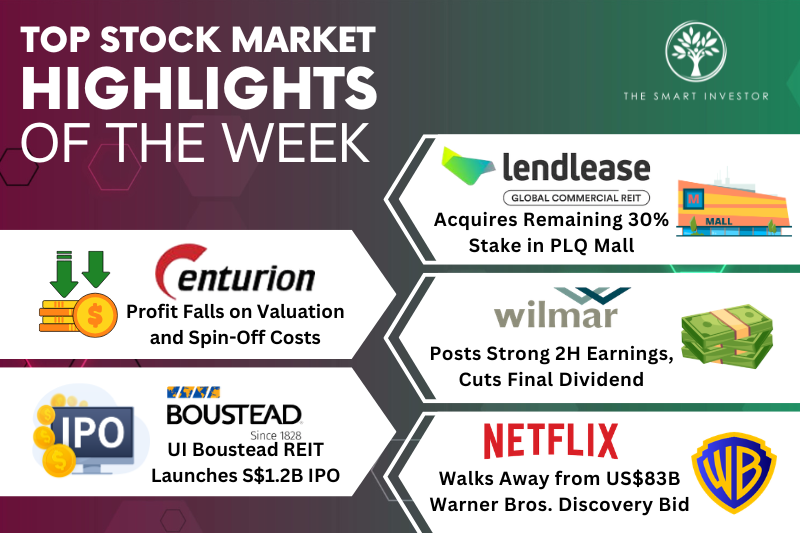
Top Stock Market Highlights: Lendlease REIT, Centurion, Wilmar, UI Boustead REIT, and Netflix
The Smart Investor· 2026-02-27 23:30
From strategic real estate power moves in Paya Lebar to a dramatic retreat in the streaming wars, this week’s market landscape is shifting rapidly. We dive into a billion-dollar REIT debut, dissect how valuation swings impacted a major accommodation provider, and analyze Wilmar’s resilient earnings despite a cautious dividend. Welcome to this week’s brief on the latest corporate shifts and investment opportunities.Lendlease Reit’s PLQ Mall AcquisitionLendlease Global Commercial REIT (SGX: JYEU), or LREIT is ...
Opinion | Why Netflix Lost Warner to Paramount
WSJ· 2026-02-27 22:41
Core Viewpoint - Antitrust laws are being utilized as a political tool, particularly against streaming services that are perceived to have a left-leaning bias [1] Group 1 - The article discusses how antitrust actions are increasingly influenced by political considerations rather than purely economic factors [1] - Streaming platforms are highlighted as targets of antitrust scrutiny due to their political affiliations and content [1] - The implications of these antitrust actions could reshape the competitive landscape of the streaming industry [1]