
Samsung Electronics

Search documents
全球经济 - 人工智能进口热潮下的宏微观视角-Global Economic Briefing-AI Imports in Overdrive, Macro and Micro Perspectives
2026-02-05 02:21
Summary of Key Points from the Conference Call Industry Overview - The focus of the conference call is on the **AI-linked imports** and their implications for the **US economy** and **investment landscape**. - AI-linked imports now represent approximately **17%** of total US imports, a significant increase from **6%** two years ago, with an annualized rate of about **$550 billion** as of Q4 2025 [7][11][15]. Core Insights and Arguments - **Investment Growth**: AI spending is expected to contribute approximately **3 percentage points (pp)** to nonresidential fixed investment by **2027** [7][48]. - **Import Dynamics**: The increase in AI-linked imports is attributed to the need for advanced hardware, including GPUs, servers, and other IT equipment, which are primarily sourced from Taiwan and Mexico [17][23][24]. - **Economic Impact**: The contribution of AI-related spending to GDP growth is nuanced; while it directly contributes to growth, the offset from imports limits its overall impact on GDP [41][48]. - **Productivity Gains**: AI investment is projected to add between **0.41% to 0.43%** to real GDP growth in **2026-2027**, with only about **10%** of firms currently utilizing AI technology regularly, indicating significant room for growth [49][50]. Geographical Concentration of AI Imports - **Taiwan** is the largest direct source of AI-linked imports, accounting for about **40%** of the total, primarily due to its leadership in chip fabrication [17][24]. - **Mexico** has emerged as a significant assembly hub, with **25%** of AI-linked imports, reflecting a shift in the supply chain dynamics [17][24]. - **ASEAN countries** collectively account for another **25%** of AI-linked imports, with Vietnam, Indonesia, and Thailand playing key roles [17]. Challenges and Considerations - The complexity of tracking AI-related capital expenditure (capex) is highlighted, as much of the investment is reflected in imports rather than domestic production [51][53]. - The **tariff environment** is favorable for AI-related imports, with low average applied rates, which has facilitated uninterrupted growth in import volumes [28]. - The **memory supply chain** is identified as a critical bottleneck for AI performance, with significant implications for future investment and productivity [58][61]. Future Outlook - The call emphasizes the expectation of continued acceleration in AI capabilities and adoption, necessitating further investment in data and systems integration [56]. - The **US policy agenda** is anticipated to support domestic manufacturing and supply chain resilience, which could influence future investment dynamics [67]. - Key debates for 2026 will revolve around the ROI of AI technology, productivity impacts, and the competitive landscape between US and Chinese AI solution providers [64]. Additional Insights - The **shift in supply chains** away from China has been ongoing since 2018, with increasing reliance on other Asian economies for technology products [33]. - The **memory market** is expected to experience a significant upcycle, driven by AI and hyperscale data center growth, with major players like **Samsung Electronics** and **SK hynix** positioned favorably [60][61]. This summary encapsulates the critical insights and projections discussed during the conference call, focusing on the implications of AI-linked imports for the US economy and investment landscape.
CNBC Daily Open: Alphabet capex plans spook investors, while AMD has a brutal day in markets
CNBC· 2026-02-05 01:13
Group 1: Alphabet's Financial Performance - Alphabet's fourth-quarter earnings and revenue exceeded Wall Street expectations, with its cloud unit achieving a nearly 48% increase in revenue year-over-year [1] - The company anticipates capital expenditure for 2026 to be between $175 billion and $185 billion, which would more than double from the previous year at the higher end [2] Group 2: Market Sentiment and Related Stocks - The sentiment around AI stocks has been negatively impacted, with Advanced Micro Devices shares dropping 17.3% due to a disappointing first-quarter forecast, affecting other AI-related companies like Broadcom and Oracle [3] - The tech-heavy Nasdaq Composite index fell by 1.51%, while the S&P 500 retreated by 0.51%, marking its fifth negative session in six [3] Group 3: Oil Market Developments - Oil prices decreased by approximately 1% following reports of upcoming talks between the U.S. and Iran in Oman [4] - Venezuela reassured China that its oil pricing will not be influenced by the U.S., while Russia stated that India has not indicated a halt in oil purchases from Moscow [5]



Samsung opens 'Samsung House' in Milan ahead of Milano Cortina Games
Reuters· 2026-02-04 23:14
Group 1 - Samsung Electronics opened its first "Samsung House" at Milan's historic Palazzo Serbelloni [1] - The initiative aims to raise the company's profile during the Milano Cortina Winter Olympics [1]


1月份89%QDII基金正收益 华泰柏瑞中韩半导体涨28%
Zhong Guo Jing Ji Wang· 2026-02-03 23:13
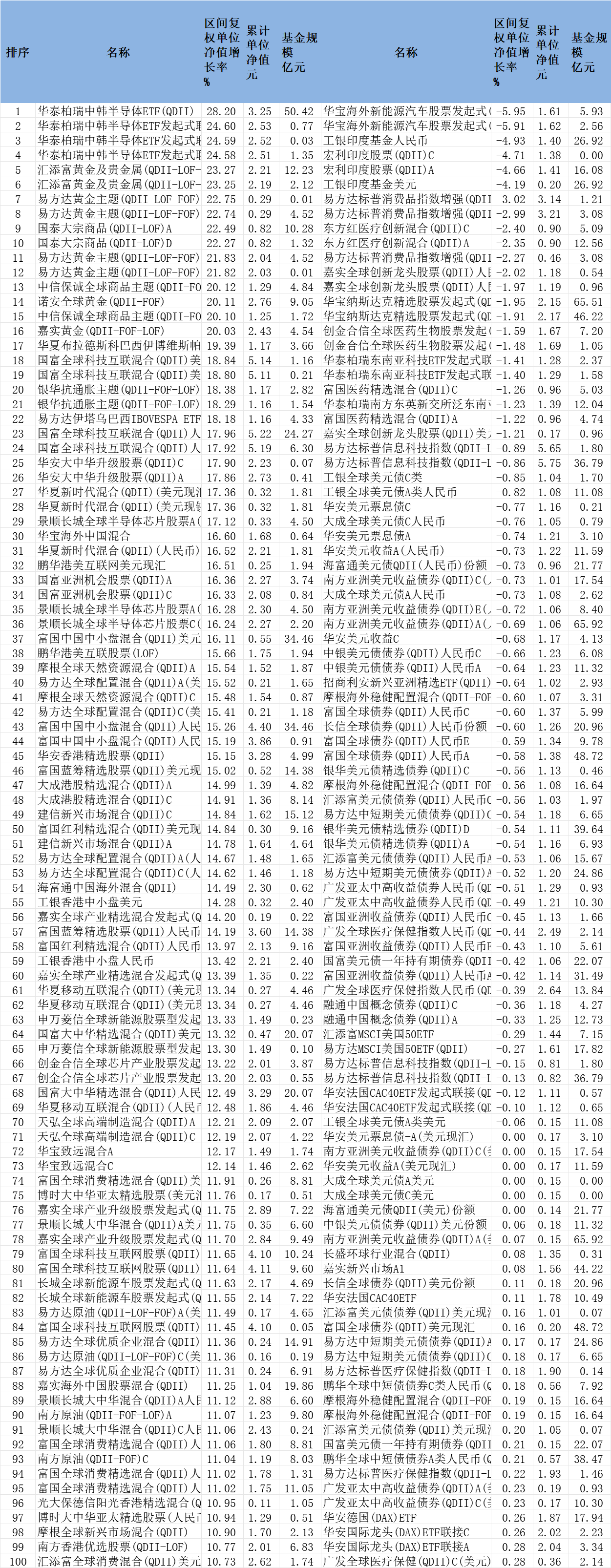
1月份共有16只QDII基金涨幅超过20%,大多数为被动权益类QDII基金。具体来看,华泰柏瑞中韩半导体ETF(QDII)夺冠,单月涨幅28.20%,华泰柏瑞 中韩半导体ETF发起式联接(QDII)A/I/C紧随其后,涨24.60%、24.59%、24.58%。其跟踪标的均为中证韩交所中韩半导体指数。 中国经济网北京2月4日讯(记者 何潇) 2026年1月份,全市场694只(各类份额分开计算,下同)有可比业绩的QDII基金中,有618只基金净值上涨, 占比约89%,有70只基金净值下跌,另外6只基金净值平收。 此外,宏利印度股票A/C也表现欠佳,其1月跌幅为4.66%、4.71%。该基金主投印度证券市场,去年四季度依旧保持个股集中,行业分散的投资策略, 整体组合保持行业均衡,继续注重组合整体的风险暴露和估值水平。 2026年1月份QDII基金涨跌幅前100名 | 排序 | 名称 | 区间复 | | 基金规 | | 区间复 权单位 | | --- | --- | --- | --- | --- | --- | --- | | | | | | 模 | 名称 浄值增 | | | | | % | 元 | 亿元 | 长 ...
Trump Cuts India Tariffs in Russian Oil Deal & Musk's SpaceX-xAI Combine | Daybreak Europe 2/3/2026
Bloomberg Television· 2026-02-03 09:03
JOUMANNA: GOOD MORNING, YOUR TOP STORIES. ASIAN STOCKS BOUNCE BACK FROM THEIR WORTH SELLOFF IN MORE THAN TWO MONTHS. A REBOUND IN GOLD AND SILVER HELPING TO CALM MARKETS. MUSK MEGAMERGER. SPACEX AND XAI ARE SET TO COMBINE IN A TRILLION DOLLAR DEAL AS THE WORLD'S RICHEST MAN FUELS HIS INCREASINGLY COSTLY AMBITIONS IN AI AND SPACE EXPLORATION. PLUS, A NIFTY DEAL. PRESIDENT TRUMP SLASHES U.S. TARIFFS FOLLOWING AN AGREEMENT BY PRIME MINISTER MODI TO STOP BUYING RUSSIAN OIL. YOU HEARD IT IN THE HEADLINES, WE ARE ...

Samsung, SK Hynix Shares Rebound Sharply, Leading Kospi Recovery
MarketWatch· 2026-02-03 08:14
Shares of Samsung Electronics and SK Hynix surged Tuesday as investors took the prior session's selloff as an opportunity to pile back in to the chip-making giants. ...

X @Bloomberg
Bloomberg· 2026-02-03 02:04
South Korea’s two most valuable companies are poised to eclipse a duo of Chinese internet giants by market cap for the first time, underscoring how an evolving global AI boom has reshaped the sector’s investment dynamics in Asia https://t.co/5Nh6ajF1nB ...
U.S. Markets Face Premarket Pressure Amid Fed Nominee Jitters and Tech Sell-Off
Stock Market News· 2026-02-02 11:07
Market Overview - U.S. stock futures are indicating a lower opening as investors react to global manufacturing concerns, uncertainty regarding the Federal Reserve's leadership, and a sell-off in precious metals and cryptocurrencies [1][2] - Major indexes are poised for declines following a weak close on Wall Street last Friday, with E-mini S&P 500 futures down approximately 0.7% and Nasdaq 100 futures falling roughly 1% [2] Current Performance of Major Market Indexes - The S&P 500 slipped 0.4% to 6,930.03, the Dow Jones Industrial Average fell 0.4% to 48,892.47, and the Nasdaq Composite dropped 0.9% to 23,461.82 [3] - The US500 index fell to 6,871 points, losing 0.99% from the previous session, while the Russell 2000 index declined 2.0% last week [3] Upcoming Market Events - Key economic data releases this week include the U.S. non-farm payrolls report, Manufacturing and Services PMI readings, ADP employment change, and weekly jobless claims [4] - The ISM manufacturing PMI has remained in contractionary territory since March 2025, heightening focus on these indicators [4] Corporate Earnings - Major tech companies reporting this week include Advanced Micro Devices, Amazon, Alphabet, Qualcomm, PayPal, and Super Micro Computer, with Palantir Technologies and The Walt Disney Company reporting today [5] - Analysts project moderate revenue growth for Disney, but there are risks of earnings per share slipping [12] Central Bank Decisions - The Reserve Bank of Australia, European Central Bank, and Bank of England are expected to set new policy rates, while the Federal Reserve recently left its benchmark interest rate unchanged at a range of 3.5% to 3.75% [6] Major Stock News - President Trump's nomination of Kevin Warsh as the next Federal Reserve Chair has introduced uncertainty into monetary policy expectations, impacting precious metals and strengthening the U.S. dollar [7] - Apple reported a record-breaking fiscal Q1 2026 with revenue of $143.8 billion, up 16% year-over-year, driven by iPhone sales and services growth [12] - Tesla shares fell 3.2% despite beating earnings estimates, facing pressure from competition and planning to double AI capital expenditures to $20 billion [12] - The healthcare insurance sector is under pressure due to a proposed minimal increase in Medicare payment rates for 2027, leading to significant declines in shares of UnitedHealth Group, Humana, and CVS Health Corporation [12] - Goldman Sachs saw a surprising 56% surge in 2025, benefiting from its trading desks and exiting consumer banking [12] - Nvidia slipped 2% in premarket trading amid broader tech sector pressure, with other tech companies like Samsung Electronics and SK Hynix also experiencing sell-offs [12]



US futures, world shares slip as worries over Trump's Fed chief pick and AI weigh on markets
BusinessLine· 2026-02-02 09:57
US futures and world shares skidded on Monday as worries over President Donald Trump's nominee to be the next Federal Reserve chair amplified jitters over a possible bubble in the artificial intelligence boom. South Korea's exchange, which is heavily influenced by tech-related developments, briefly suspended trading as its benchmark Kospi bounced, closing 5.3 per cent lower at 4,949.67. Samsung Electronics gave up 6.3 per cent, while chip maker SK Hynix sank 8.7 per cent. The Kospi has been forging records ...

Asian Shares Follow Wall Street Lower As Risk Aversion Mounts
RTTNews· 2026-02-02 08:46
Market Overview - Asian stocks declined, following Wall Street's downward trend, due to ongoing trade tensions, uncertainty over U.S. monetary policy, and heavy selling in precious metals [1] - Precious metals, including gold and silver, saw significant declines, with gold dropping over 5% and silver nearly 8% [2] - Oil prices fell nearly 5% amid reports of U.S. and Iran readiness to negotiate an agreement to ease tensions [2] Chinese Market - Chinese and Hong Kong markets experienced sharp declines, with China Vanke warning of an 11.8 billion net loss for 2025 and BYD reporting a 30.1% year-on-year drop in vehicle sales for January [3] - The Shanghai Composite index fell 2.48% to 4,015.75, while the Hang Seng index dropped 2.23% to 26,775.57 [3] - Both China Vanke and BYD shares fell more than 4% in Shanghai [3] Economic Data - China's official manufacturing purchasing managers' index (PMI) was reported at 49.3, below forecasts, indicating contraction, while the non-manufacturing PMI also fell into contraction [4] - A private gauge indicated that Chinese manufacturing activity continued to expand in January [4] Japanese Market - The Nikkei average decreased by 1.25% to 52,655.18, reversing early gains, while the broader Topix index settled 0.85% lower at 3,536.13 [5] - Major companies like SoftBank Group, Advantest, Disco Corp, and Lasertec saw declines ranging from 3.8% to 14% [5] - Investors overlooked a private-sector survey indicating Japan's manufacturing activity grew at the fastest pace in about three and a half years [6] South Korean Market - The Kospi average plunged 5.26% to 4,949.67, ending a four-session winning streak, with major companies like Hyundai Motor and Samsung Electronics falling between 4% and 9% [7] - The Korea Exchange issued a sell-side circuit breaker for 5 minutes during the trading session [7] Australian and New Zealand Markets - Australian markets closed lower, with the S&P/ASX 200 falling 1.02% to 8,778.60, driven down by financials and materials amid rate hike concerns [7] - New Zealand's S&P/NZX-50 index finished marginally lower at 13,412.44 [8] U.S. Market Influence - U.S. stocks ended lower, with the dollar index climbing and Treasury yields surging after President Trump nominated Kevin Warsh for Fed Chair, leading to a hawkish shift in U.S. monetary policy [8][9] - Warsh is perceived as skeptical of loose monetary policy and has previously criticized the Fed for underestimating inflation risks [9]


