Wayfair

Search documents
Wayfair: Valuation Outruns Fundamentals (NYSE:W)
Seeking Alpha· 2025-10-10 10:04
Core Insights - The article discusses the current market trends and potential investment opportunities within specific sectors, highlighting the importance of thorough analysis before making investment decisions [2]. Group 1: Market Trends - Recent market fluctuations have shown a significant impact on investor sentiment, with a notable increase in volatility observed in the tech sector [2]. - Analysts are focusing on the recovery patterns of various industries post-pandemic, particularly in consumer discretionary and travel sectors, which are showing signs of rebound [2]. Group 2: Investment Opportunities - There are emerging opportunities in renewable energy companies, driven by increasing government incentives and consumer demand for sustainable solutions [2]. - The healthcare sector is also highlighted as a potential area for growth, especially companies involved in biotechnology and telehealth services, which have gained traction during the pandemic [2]. Group 3: Risks and Considerations - Investors are advised to remain cautious of potential regulatory changes that could impact certain industries, particularly in technology and finance [2]. - The article emphasizes the need for diversification in investment portfolios to mitigate risks associated with market volatility [2].


3 Bargain AI Stocks to Invest $1,000 Right Now
Yahoo Finance· 2025-10-09 11:15
Group 1: AI Market Dynamics - Artificial intelligence (AI) stocks are driving market gains, with companies like Nvidia and Palantir Technologies outperforming the S&P 500 [1] - There are still opportunities to find bargain stocks involved in the AI revolution, including Alphabet, Amazon, and Taiwan Semiconductor [1] Group 2: Alphabet Overview - Alphabet is the parent company of Google, the largest search engine globally, and is advancing AI with its Gemini large-language model (LLM) [2] - The company provides AI solutions for advertising clients, enhancing their success and increasing Alphabet's revenue [2] - Alphabet's diverse revenue streams include devices, subscription services, and self-driving cars, with a 14% year-over-year revenue increase in Q2 2025 [4] - Operating income rose 14% year-over-year with a 32.4% margin, while the stock trades at a bargain price of 26 times trailing-12-month earnings [5] Group 3: Amazon Overview - Amazon leads in both e-commerce and cloud computing, leveraging AI to enhance fulfillment and improve operations in both sectors [6][7] - E-commerce accounts for less than 20% of total retail spending in the U.S., with Amazon capturing around 40% of that market [8] - The company is enhancing its value proposition through the Prime program, which fosters customer loyalty and increases sales volume [8] - Fulfillment times are improving, with a 30% year-over-year increase in same or next-day deliveries in Q2 [8] Group 4: Taiwan Semiconductor's Role - Taiwan Semiconductor is supporting AI growth through its manufacturing facilities and is shifting more operations to the U.S. [7]


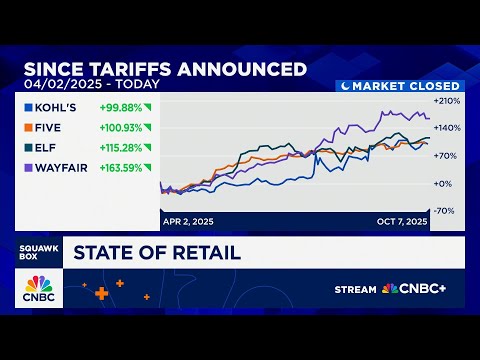
Many larger retailers have been able to mitigate the tariff cost
CNBC Television· 2025-10-07 13:12
Courtney Reagan joins us with a look at the choices retailers need to make and the prices that we all might pay for this holidays. Hopefully they're going to be lower. Court >> see kind of depends on what you get.I mean since April 2nd trade deals of course you know been negotiated with lower rates for some countries though India tariffs are higher than initially announced. China remains in flux and then other types of tariffs like on upholstered furniture for example those have also been levied. So, while ...
Trump’s Market Mayhem: Where the Tweets Meet the Tickers
Stock Market News· 2025-10-05 18:00
Group 1: Tariffs and Market Reactions - Trump announced a 100% tariff on foreign films and new duties on lumber and furniture, aiming to protect domestic industries, which led to negative market reactions from major streaming and production companies [2][3] - Shares of Netflix and Amazon fell by 1.5%, while Warner Bros Discovery and Paramount dropped by 1.1% and 1% respectively, indicating immediate market concerns over the enforceability of these tariffs [3] - The furniture and lumber industries are facing significant tariffs, with 10% on imported timber and 25% on kitchen cabinets and upholstered furniture, set to increase by 2026, causing stock declines for companies reliant on imports like Wayfair and Restoration Hardware [4][5] Group 2: Domestic Manufacturing Gains - Domestic manufacturers such as La-Z-Boy and Ethan Allen saw stock gains, with Ethan Allen up 5% year-to-date, benefiting from the tariffs imposed on foreign competitors [5] - The U.S. Lumber Coalition supported the new tariffs, while Canadian lumber producers face high total tariff rates of 45%, leading to reduced shipment targets and weaker earnings [5] Group 3: Government Shutdown and Market Indices - The U.S. government experienced a partial shutdown, yet major market indices like the Dow Jones and S&P 500 rose, indicating resilience in the face of political turmoil [9][10] - Historically, markets have shown the ability to weather government shutdowns, often viewing them as minor disruptions rather than significant economic threats [10] Group 4: Agricultural Aid and Market Impact - Trump announced a substantial aid package for U.S. soybean farmers, estimated between $10 billion and $14 billion, which positively affected soybean futures [11] - The aid is seen as a response to the trade tensions with China, where soybean purchases have been halted, highlighting a circular economic model where tariff revenue is used to mitigate damage from tariffs [11] Group 5: Geopolitical Factors and Market Behavior - Trump's foreign policy announcements, including a "zero-enrichment policy" for Iran and a ceasefire agreement in Gaza, have historically led to predictable market reactions, such as falling stocks and rising oil prices [7][8] - Despite initial market jitters, these geopolitical events often result in short-lived impacts, with markets quickly recovering as investors compartmentalize global crises [8]


Aerospike Database 8.0 Wins 2025 SiliconANGLE TechForward Awards
Markets.Businessinsider.Com· 2025-09-30 09:00
Core Insights - Aerospike Database 8 has won the 2025 TechForward Award for Data Platform Tech — Database Systems, recognizing its innovation in real-time data management [1][5]. Company Overview - Aerospike Database is designed for enterprises deploying intelligent systems that require real-time data processing, integrating seamlessly with machine learning and streaming frameworks [2][9]. - The database supports high-throughput, ACID-compliant transactions with strong serializability, eliminating trade-offs between speed, consistency, and cost that are common in legacy and NoSQL systems [3][9]. Industry Recognition - The TechForward Awards highlight technologies that drive business innovation, with Aerospike selected from a competitive pool by industry experts [5][6]. - Aerospike has also been recognized in other awards, including making the Inc. 5000 list for four consecutive years and winning "Solution of the Year" in the Data Breakthrough Awards [4]. Customer Engagement - Aerospike is actively engaging with customers and partners through a worldwide tour in the Asia-Pacific region, focusing on real-time data challenges and machine learning solutions [7]. Market Position - Aerospike is recognized as a leading real-time database for mission-critical applications, powering millions of transactions per second with low latency, and is trusted by global leaders across various industries [9].

Wayfair Stock Is Back From the Dead and Up 339%. Can It Keep Soaring?
The Motley Fool· 2025-09-30 07:34
Core Insights - Wayfair's business and stock have shown a significant recovery after being heavily impacted by the post-pandemic shift, with the stock price increasing by 339% since its low in April [5][6]. Company Performance - During the pandemic, Wayfair experienced a surge in e-commerce sales due to increased demand for home furnishings as consumers shifted to online shopping [2]. - After the pandemic, Wayfair faced challenges due to overinvestment and a decline in demand, resulting in revenue remaining flat and well below pandemic peaks [3]. - The company reported flat revenue of $2.7 billion in the first quarter, but adjusted earnings per share improved to $0.10 from a loss of $0.32 year-over-year [7]. - In the second quarter, Wayfair achieved a 6% revenue increase to $3.3 billion, surpassing estimates, with adjusted earnings per share rising from $0.47 to $0.87 [8]. Market Strategy - Wayfair is gaining market share and expanding into brick-and-mortar retail by opening large-scale stores, with plans for additional locations [9][10]. - The company opened a new store in the Chicago suburbs and has three more planned, including a significant 140,000 square foot store in Denver [10]. Industry Context - The home furnishings sector has faced challenges due to a sluggish housing market, which typically affects furniture purchases [12]. - Investors are optimistic that potential interest rate cuts from the Federal Reserve could stimulate a recovery in the housing market and benefit companies like Wayfair [12]. Valuation and Future Outlook - Despite recent momentum, Wayfair still has a long way to go to regain pre-pandemic growth rates, facing competition from major players like Amazon and IKEA [11]. - The stock is currently trading at a forward P/E above 40, raising concerns about its valuation without faster revenue growth [13]. - The potential for stronger growth exists if the housing market improves, but the current rally may have limitations [13].
President Trump reignites trade tensions with new tariffs
Youtube· 2025-09-28 15:01
Group 1: Tariff Implications - A new set of tariffs will take effect on October 1st, including a 100% tariff on some imported drugs, 50% on kitchen cabinets, 30% on upholstered furniture, and 25% on big trucks [1] - The pharmaceutical industry may benefit from a loophole allowing companies that invest in U.S. manufacturing to avoid the tariffs [6][10] - The impact of the tariffs on the furniture industry is significant, particularly for companies relying on foreign imports, while U.S.-based manufacturers may see stock gains [11][20] Group 2: Market Reactions - Stock reactions have been mixed across affected industries, with pharmaceutical companies like Eli Lilly and Johnson & Johnson seeing stock increases due to U.S. manufacturing investments [10] - Companies like Restoration Hardware and Wayfair are under pressure due to their reliance on foreign sourcing, while U.S.-based Ethan Allen is experiencing stock gains [11][12] - Overall, stock futures are up, indicating a different market reaction compared to past tariff announcements [13] Group 3: Economic Context - The tariffs are part of President Trump's broader strategy to bring manufacturing back to the U.S., which is politically significant, especially in key states like North Carolina [8][21] - The effectiveness of tariffs as a policy tool is debated, with concerns about labor shortages in manufacturing complicating the return of jobs to the U.S. [22][23] - The pharmaceutical tariffs specifically target branded drugs, which account for a smaller market share compared to generic drugs, potentially limiting their overall impact [16][17]
President Trump reignites trade tensions with new tariffs
Yahoo Finance· 2025-09-28 15:01
The tariff war isn't over just yet. October 1st, a slew of new tariffs will take effect, including a 100% tariff on some imported drugs, 50% on kitchen cabinets, 30% on upholstered furniture, and 25% on big trucks. On top of that, the Wall Street Journal reporting that President Trump plans to mandate a onetoone policy for chip makers to manufacture as many chips in the US as they do overseas or face hefty tariffs.Here to break it all down, Sam Stovall, CFR research chief investment strategist and Yahoo Fin ...

首届数贸领潮大会在杭举办 绘就科技引领消费新蓝图
Sou Hu Cai Jing· 2025-09-28 05:58
Core Insights - The first Digital Trade Leadership Conference was held in Hangzhou, focusing on the integration of "digital intelligence + consumption" to explore growth paths for the consumer goods industry under technological leadership [2][3] - The conference aims to build a value co-creation platform and empower high-quality development in the consumption industry, with significant participation from government, industry experts, and corporate leaders [2][3] Group 1: Conference Overview - The conference was inaugurated with a speech by Zhu Jun, highlighting Zhejiang's commitment to digital trade, which has seen double-digit growth for six consecutive years [3] - The event is positioned as a national-level digital trade platform, with the goal of becoming a hub for resource connection and industry consensus [3][4] - Key figures from various sectors, including academia and corporate leadership, participated in discussions about global digital trade opportunities and industry challenges [2][3] Group 2: Key Presentations - Wang Xiaoyi from Zhejiang University discussed the transformation of consumption logic driven by new productive forces, emphasizing the shift from scale-driven to innovation-driven economic growth [6] - Pan Songting, CEO of Hejun Consulting, analyzed growth opportunities for consumer goods companies, focusing on the integration of "consumption + technology" and "industry + capital" [6] - Chen Yan, CEO of Fanruan Software, shared practical insights on using data to drive operational decisions, advocating for a strategic framework of "look ten years ahead, plan three years, and act in one year" [6][7] Group 3: Roundtable Discussion - A roundtable discussion led by Pan Songting explored the core of consumer innovation and breakthroughs, emphasizing the importance of data in reconstructing business logic and leveraging AI to enhance consumer experiences [8] - Participants highlighted the need for collaboration across the industry to meet consumer demands for better and more precise products [8] - The conference concluded with a vision for ongoing collaboration to integrate data elements with the consumption industry, aiming to position Zhejiang as a national leader in digital consumption innovation [8]


Why Is RH Stock Falling Friday? - RH (NYSE:RH)
Benzinga· 2025-09-26 16:29
Core Viewpoint - RH's stock declined due to new tariff announcements and updated manufacturing and spending plans, impacting the home furnishings sector [1][2]. Company Summary - RH anticipates producing approximately 52% of its upholstered furniture in the U.S. next year, with this percentage expected to increase through 2026 [3]. - The company has incorporated about $30 million in additional tariff costs for the second half of the year, net of mitigation, and expects around $40 million in revenue to shift from Q3 to Q4 and Q1 of 2026 [3]. - Projected adjusted capital expenditures are between $200 million to $250 million in 2026 and $150 million to $200 million in 2027 and beyond, aimed at enhancing supply-chain resilience and addressing policy-driven cost pressures [4]. Industry Summary - The new tariffs, including a 30% duty on upholstered furniture, have been met with resistance from U.S. businesses, complicating operating conditions for companies like Ikea [5]. - Competitors such as Williams-Sonoma, Inc. and Wayfair Inc. experienced stock declines following the tariff announcements [5]. - A higher U.S. production mix may help RH mitigate import-related volatility, although near-term tariff costs and revenue timing shifts present execution risks [6].