消费品制造

Search documents
2026年1-2月工业企业利润数据点评:工业企业“补库存”
Ping An Securities· 2026-03-28 23:31
Group 1: Profit Growth - In January-February 2026, profits of large-scale industrial enterprises reached 10,245.6 billion yuan, a year-on-year increase of 15.2%[1] - The profit growth rate improved significantly from 5.3% in December 2025, an increase of 9.9 percentage points[2] - The cumulative revenue profit margin reached 4.92%, up 0.39 percentage points from the same period last year, contributing to profit growth[2] Group 2: Sector Performance - Mining and raw materials sectors saw a profit increase of 9.9% and 88.3% respectively, with the latter accelerating by 71.1 percentage points compared to the previous year[2] - Equipment manufacturing profits grew by 23.5%, while high-tech manufacturing profits surged by 58.7%, contributing 7.9 percentage points to overall industrial profit growth[2] - The computer and communication equipment sector experienced a staggering profit growth of 203.5%, significantly boosting overall industrial profit growth by 8.6 percentage points[2] Group 3: Inventory and Receivables - By the end of February, industrial enterprises' assets and liabilities grew by 5.5% and 5.8% respectively, with liabilities expanding faster than assets[2] - Finished goods inventory increased by 6.6%, marking the fastest growth since April 2023, while revenue grew by 5.3%[2] - Accounts receivable increased by 7.1%, with an average collection period of 76.4 days, up 1.5 days from the previous year[2] Group 4: Risks - Risks include the potential ineffectiveness of growth stabilization policies, overseas economic downturns, and escalating geopolitical conflicts[7]
——1-2月经济数据点评:\供强需弱\问题有所改善
Huachuang Securities· 2026-03-17 05:53
Supply and Demand Improvement - The supply-demand imbalance is improving, with industrial output growth at 6.3% in January-February, while demand growth (investment, retail sales, and exports) is at 6.6%[3] - In 2025, industrial output growth is projected at 5.9%, while combined growth for investment, retail sales, and exports is expected to be only 1.3%, indicating a significant demand-supply divergence[3] Structural Analysis - The supply-demand contradiction in the midstream manufacturing sector is easing, with a rolling annual demand growth of 9.6% in January-February, up from 8.4% previously[3] - Investment in the midstream sector (excluding instruments) shows a rolling annual decline of -1.8%, worsening from -1.5%[3] Production and Sales Rates - The production-sales rate for industrial enterprises is projected to be -0.1% for 2023, worsening to -0.5% in 2024, and slightly improving to -0.4% in 2025[3] - In January-February 2026, the production-sales rate dropped to -0.1%[3] Price Trends - The Producer Price Index (PPI) decline is narrowing, with a month-on-month increase of 0.42% in January and 0.39% in February, indicating strong performance beyond just bulk commodities[4] Economic Data Overview - In January-February, industrial value-added growth was 6.3%, while retail sales growth was 2.8%, up from 0.9% in December[6] - Export growth reached 21.8% in January-February, compared to 6.6% in December[6] Real Estate Market - Real estate sales area decreased by 13.5% year-on-year in January-February, an improvement from a 15.6% decline in December[6] - Real estate investment growth was -11.1% in January-February, significantly better than the -35.8% in December[6] Investment Trends - Fixed asset investment growth was 1.8% in January-February, with infrastructure investment growing at 11.4%[6] - Large project investments (over 100 million yuan) increased by 5.0%, contributing to a 2.7% overall investment growth[6]
涨价链:谁受益?谁承压?
Huachuang Securities· 2026-03-15 09:22
Group 1: Oil Price Impact - Recent geopolitical conflicts have led to a significant increase in oil prices, with a 10% rise in oil prices potentially increasing PPI by approximately 0.3-0.4 percentage points[3] - The utility sector is most affected by rising oil prices, with a high dependence on upstream materials and limited ability to pass on costs due to regulatory price controls[3][6] - The gas industry experiences the most significant profit impact, with a 10% increase in oil prices corresponding to a 114% decrease in total profits for 2025[3] Group 2: Industry Comparisons - Historical inflation cycles show that upstream sectors benefit the most, with gross margins expanding by 5-10 percentage points, while manufacturing and consumer sectors face pressure[4][5] - The chemical industry is significantly impacted by rising oil prices, with rubber and plastic products facing a profit decline of 14%[3] - The equipment manufacturing sector experiences indirect pressure from metal prices, with automotive and machinery sectors facing a 10% profit impact due to rising costs[3] Group 3: Cost Dependency Analysis - The utility sector has a complete consumption coefficient of 59% for gas, indicating high reliance on oil and gas extraction[6][9] - The chemical sector has a complete consumption coefficient of around 15% for oil, with downstream products like plastics and rubber having coefficients exceeding 50%[6][9] - Metal products, particularly in equipment manufacturing, show a complete consumption coefficient of 38% for electrical machinery, indicating significant cost transmission from upstream[6][9]
AI创造性破坏下的产业重构
Huachuang Securities· 2026-03-12 09:10
Group 1 - The AI revolution is expected to trigger "creative destruction," replacing existing jobs while generating new supply and driving systemic changes in the economic system [2][8][12] - The impact of AI on industries can be assessed through two dimensions: the evolution stage of AI technology and the essence of industry business models [3][31][34] - The current stage shows that the US stock market is more directly affected by AI due to its industry structure, while the A-share market experiences relatively indirect impacts [6][8][19] Group 2 - In production industries, the impact of AI is low to moderate, with future differentiation around automation rates [3][31] - Service industries face medium to high impacts, with human replacement and value upgrades occurring simultaneously [4][34] - Technology industries are experiencing medium to high impacts, with significant restructuring in research and creative fields [4][35] Group 3 - The financial sector is also facing medium to high impacts, characterized by process automation and service stratification [4][35] - The performance gap between leading AI model providers in China and the US has significantly narrowed, indicating a "catch-up" phase [5][8] - China has established a unique competitive advantage through its global leadership in optical modules and resilient software applications [5][8] Group 4 - The pricing logic of AI in the US stock market has evolved from "concept-driven" to "value verification," with a focus on infrastructure investments in the near term [16][22] - The market is transitioning from narrative-driven to performance-driven evaluations, with significant differentiation among sectors [16][19] - A-share market dynamics are expected to align with the US market's evolution, focusing on actual performance contributions rather than just infrastructure narratives [22][23]
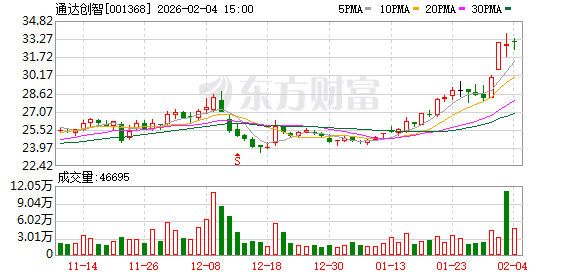
通达创智股价连续5天下跌累计跌幅15.81%,诺安基金旗下1只基金持56.79万股,浮亏损失295.86万元
Xin Lang Cai Jing· 2026-02-11 07:15
Group 1 - The core viewpoint of the news is that Tongda Chuangzhi has experienced a significant decline in stock price, dropping 1.35% to 27.82 CNY per share, with a total market value of 3.167 billion CNY and a cumulative decline of 15.81% over the past five days [1] - Tongda Chuangzhi, established on February 2, 2016, is located in Xiamen, Fujian Province, and was listed on March 13, 2023. The company focuses on product design, precision mold design, and smart manufacturing, primarily in the consumer goods sector, including home living (54.36%), sports and outdoor (39.09%), health care (4.23%), and other products (1.07%) [1] - The trading volume for Tongda Chuangzhi was 141 million CNY, with a turnover rate of 15.59% [1] Group 2 - Among the top ten circulating shareholders of Tongda Chuangzhi, the Noan Multi-Strategy Mixed A Fund (320016) has recently entered the list, holding 567,900 shares, which accounts for 1.77% of the circulating shares [2] - The Noan Multi-Strategy Mixed A Fund has reported a year-to-date return of 13.21% and a one-year return of 78.24%, ranking 720 out of 8,884 and 346 out of 8,127 in its category, respectively [2] - The fund manager, Kong Xianzheng, has been in position for 5 years and 78 days, with the fund's total asset size at 6.675 billion CNY and a best return of 110.79% during his tenure [2]
“宁工品推”供需对接与暖心市集活动成功举办 助力本土企业高质量发展
Zheng Quan Ri Bao Wang· 2026-02-06 07:34
Core Insights - The event "Ning Gong Pin Tui" serves as a platform for local industrial upgrades, optimizing the business environment and supporting the real economy [1][2] - The initiative effectively connects local manufacturing with union procurement, enhancing the flow of quality products and creating a beneficial cycle for both businesses and consumers [2] Group 1: Event Overview - The "Ning Gong Pin Tui" event was co-hosted by the Nanjing Municipal Bureau of Industry and Information Technology and the Nanjing Federation of Trade Unions, featuring 30 local consumer goods manufacturers and 30 union representatives [1] - The event aimed to build a communication bridge among government, enterprises, and labor unions, facilitating efficient resource linkage and precise supply-demand matching [1] Group 2: Key Activities and Outcomes - The event included a presentation on the "Ning Gong Pin Tui" brand's initiatives to help local consumer goods companies expand their market presence and increase orders [1] - A live streaming platform was promoted to support businesses in broadening sales channels and enhancing brand influence [1] - The event atmosphere was described as lively and efficient, with union representatives providing clear market signals and procurement directions to consumer goods companies [1][2] Group 3: Impact on Local Economy - The successful execution of the event is expected to stimulate consumer potential and local industrial vitality, creating a two-way empowerment effect [2] - The initiative aims to reduce marketing costs for local consumer goods companies while enhancing their market competitiveness, contributing to high-quality development of the local economy [2] - Future activities will focus on deepening collaboration among government, enterprises, and labor unions, improving supply-demand connection channels for sustained industrial upgrades and improved livelihoods [2]
通达创智:公司主要产品涵盖体育户外、家居生活、健康护理等领域消费品
Zheng Quan Ri Bao· 2026-02-04 11:44
Industry Overview - The global consumer goods industry has matured over years of development, characterized by a high degree of market participation and competition [2] - The domestic market shows a decentralized structure among consumer goods manufacturers, with significant differentiation in product focus, application areas, and business models [2] - No single company has achieved full category coverage, and there remains a large number of small and medium-sized enterprises in the market [2] Company Positioning - The company, Tongda Chuangzhi, offers a comprehensive product range in sports and outdoor, home living, and health care consumer goods, with core clients including international brands like Decathlon, IKEA, Wagner, and YETI [2] - Currently, there are no domestic companies with a product and client structure fully aligned with that of Tongda Chuangzhi, although some competitors offer similar product categories [2] Market Dynamics - Leading quality enterprises are increasing investments in technology research and development and smart manufacturing to enhance supply capabilities and service levels [2] - The market is expected to gradually eliminate low-end capacities and small enterprises with weak R&D capabilities and substandard product quality, leading to a concentration of resources among high-quality companies [2] - The company’s customized product attributes, diverse categories, and broad downstream application scenarios contribute to its competitive edge, with no authoritative market statistics currently available [2] Future Outlook - As the company's core competitive advantages continue to strengthen and operational performance steadily grows, its industry position is expected to be further consolidated and enhanced, leading to a gradual increase in market share [2]

1月PMI数据点评:制造业PMI超季节性回落,价格指数抬升
Western Securities· 2026-02-01 13:06
1. Report's Investment Rating for the Industry - No information provided regarding the industry investment rating in the report. 2. Core Viewpoints of the Report - In January 2026, the manufacturing PMI declined more than seasonally with supply - demand converging and enterprise - scale differentiation intensifying, while price indices rose. The service industry PMI slightly dropped and the construction industry's prosperity significantly declined, thus more efforts are needed to promote economic - stabilizing policies [1][10][34]. - In January, the shock of sentiment was gradually digested, and the bond market recovered after adjustment. However, there were still some constraints for a smooth short - term decline. The 10Y Treasury bond yield may return to the central part of the oscillation range in February. Two structural investment opportunities are recommended: the allocation opportunities of 5Y government - financial bonds and 3 - 5Y general - credit bonds, and the spread - compression opportunities such as 10Y CDB - 10Y Treasury bonds [4][34][35]. 3. Summary According to the Directory 3.1 1 - month PMI Data Overview - Manufacturing PMI declined by 0.8 percentage points to 49.3% in January, returning to the contraction range and being weaker than the seasonal average. The production index expansion slowed, demand was under pressure, price indices rose, and enterprises replenished inventory passively with a decline in purchasing willingness [10]. - In the non - manufacturing sector, the service industry PMI slightly decreased by 0.2 percentage points to 49.5%, and the construction industry's business activity index dropped by 4.0 percentage points to 48.8%, both showing different degrees of deviation from seasonal performance [11][14]. 3.2 Manufacturing: Demand - side Operation Under Pressure, Both Price Indices Rising - **Production**: The manufacturing PMI production index was 50.6% in January, down 1.1 percentage points month - on - month, weaker than the seasonal level. The slowdown was due to factors like cold weather and approaching Spring Festival, especially the over 4 - percentage - point decline in the consumer goods manufacturing production index [17]. - **Demand**: The new order index and new export order index of manufacturing PMI decreased by 1.6 and 1.2 percentage points respectively. The "new order - new export order" index dropped to 1.4%. Seasonal factors and external policy changes affected demand, but the proportion of manufacturing enterprises reporting insufficient market demand decreased [19]. - **Enterprise Scale and New Kinetic Energy**: The PMI of large, medium, and small enterprises decreased by 0.5, 1.1, and 1.2 percentage points respectively. New kinetic energy industries continued to lead, while traditional industries' prosperity declined [20]. - **Price**: Affected by multiple factors, the main raw material purchase price index and ex - factory price index were 56.1% and 50.6% respectively, up 3.0 and 1.7 percentage points month - on - month. The index difference reached 5.5 percentage points, compressing the profit space of mid - and downstream enterprises [23]. - **Inventory**: The raw material inventory index decreased by 0.4 percentage points, and the finished - product inventory increased by 0.4 percentage points. The economic kinetic energy index decreased by 2.0 percentage points, and the purchasing volume index dropped to 48.7%. The start of the replenishment cycle depends on the recovery of market demand [24]. 3.3 Non - manufacturing: Slight Decline in Service Industry PMI, Significant Decline in Construction Industry - **Service Industry**: In January, the service industry PMI slightly declined. The strong support from the financial industry, the stable development of new kinetic energy, and the good performance of some consumption - related service industries maintained its stability. However, the real - estate industry's business activity index fell below 40.0%, and Spring Festival consumption may boost the consumption - related service industries [29]. - **Construction Industry**: Due to cold weather and the approaching Spring Festival, the construction industry's business activity index decreased by 4.0 percentage points to 48.8% in January. Both housing construction and civil engineering construction activities slowed down, and the off - season characteristics may continue in February [32]. 3.4 Impact on the Bond Market - In January, after the shock of sentiment was digested, the bond market recovered. The 10Y Treasury bond yield dropped to the lower limit of the 1.8% - 1.9% oscillation range. With insufficient broad - money expectations and increased local - bond supply in February, the 10Y Treasury bond yield may return to the central part of the oscillation range. Two parts of structural investment opportunities are recommended [4][34][35].
1月制造业PMI点评:关注价的积极信号
Huachuang Securities· 2026-01-31 14:45
1. Report Industry Investment Rating No information about the industry investment rating is provided in the report. 2. Core Viewpoints - In January 2026, China's official manufacturing PMI was 49.3%, a month - on - month decrease of 0.8pct; the official non - manufacturing PMI was 49.4%, also a month - on - month decrease of 0.8pct; the composite PMI output index was 49.8%, a decrease of 0.9pct from the previous month. The PMI returned below the boom - bust line due to factors such as demand overdraft at the end of the previous year, early holiday closures around the Spring Festival, and the impact of cold snaps on construction demand [5][8]. - Positive signals include the simultaneous recovery of price indices and a continued decline in the proportion of enterprises reporting insufficient demand in January, indicating that the direction of demand stabilization remains unchanged [5][11]. - For the bond market, the decline in PMI is affected by short - term factors. The price increase expectations brought by the transformation of new and old driving forces and "anti - involution" are difficult to disprove for the time being. The PMI may continue to weaken in February during the Spring Festival, but the "Golden March" may see a strong recovery, and attention should be paid to the potential impact of fundamental data on bond market expectations [5][12]. 3. Summary by Directory 3.1 Manufacturing PMI: Short - term factors lead to a return to the contraction range 3.1.1 Supply and Demand: Orders decline more deeply while production remains in expansion - New orders dropped to 49.2% in January, returning to the contraction range, reflecting the demand overdraft effect from the previous month. The month - on - month decline in new orders was 1.6pct, lower than most previous periods but better than January 2025. Domestic demand orders slowed down more significantly than new export orders [15]. - Production slowed down but remained in the expansion range. In January, production decreased by 1.1pct month - on - month to 50.6%. The decline in production was due to pressure on the demand side, and the production index of the consumer goods manufacturing industry dropped below the boom - bust line, while the production of new - driving - force industries remained highly prosperous, increasing the differentiation [16]. 3.1.2 Foreign Trade: Strong imports and weakening export orders - New export orders decreased by 1.2pct month - on - month to 47.8%, with the contraction intensifying. Factors such as new US tariffs on some high - tech manufacturing products, trade tariff frictions between the US and Europe, and the approaching Spring Festival led to a slowdown in the growth of new export orders. However, imports increased by 0.3pct month - on - month to 47.3%, showing a stable improvement for three consecutive months [20]. 3.1.3 Price: Both purchase and ex - factory prices rise, but profits may still be squeezed - In January, the raw material purchase price and ex - factory price increased by 3.0pct and 1.7pct month - on - month to 56.1% and 50.6% respectively. The ex - factory price returned above the boom - bust line for the first time since May 2024. However, the increase in the ex - factory price was less than that of raw materials, indicating limited downstream demand to absorb price increases and potential pressure on corporate profits [24]. 3.1.4 Inventory: Slower destocking of finished products - Raw material inventory decreased by 0.4pct month - on - month to 47.4%, indicating that production remained prosperous and procurement slowed down, with a relatively faster digestion of raw materials. Finished product inventory increased by 0.4pct month - on - month to 48.6%, with the destocking pressure rising for three consecutive months [28]. 3.2 Non - manufacturing PMI: Seasonal factors affect construction, leading to a significant slowdown in construction activities - In January, the non - manufacturing PMI was 49.4%, a month - on - month decrease of 0.8pct. The service industry PMI decreased by 0.2pct month - on - month to 49.5%, and the construction industry PMI decreased by 4.0pct month - on - month to 48.8%, shifting from expansion to contraction [29]. - The slowdown in construction activities was due to cold weather and the approaching Spring Festival. Construction projects entered the off - season, and investment demand is expected to be further released after the Spring Festival in February [29]. - The service industry showed potential demand and industry differentiation. In January, the financial industry in the service sector was highly prosperous, while industries such as the Internet and railway transportation declined, and the retail and catering industries remained in the contraction range. The Spring Festival holiday may boost the consumer service industry in February [32].
【高端制造】2025年新兴市场出口占比进一步提升,北美占比下滑最为显著——行业海关总署出口月报(2025年12月)(黄帅斌/庄晓波/陈奇凡)
光大证券研究· 2026-01-26 23:03
Group 1: Consumer Goods - The overall performance of consumer goods, including electric tools, hand tools, and lawn mowers, shows mixed results with export growth rates for 2025 projected at -2%, -6%, and +32% respectively, with December showing month-on-month changes of -5pcts, -4pcts, and +7pcts [4] - Exports to North America for electric tools, hand tools, and lawn mowers are expected to decline significantly in 2025, with cumulative amounts showing year-on-year decreases of -25%, -10%, and -17% respectively, indicating a slow recovery in end-demand [5] - The European market shows resilience, particularly for lawn mowers, with a projected export growth of +52% in 2025, contributing to a 72% share of total exports to Europe, reflecting strong demand [5] Group 2: Capital Goods - Forklift exports are projected to grow by +1% in 2025, with significant increases in emerging markets such as Africa (+35%), Asia (+16%), and Latin America (+13%), while North America and Europe are expected to see declines of -17% and -14% respectively [6] - Machine tool exports are expected to increase by +12% in 2025, driven primarily by growth in Asia (+22%), with Asia accounting for 50% of total exports [6] - Mining machinery exports are projected to have a cumulative share of 42% to Asia, 25% to Africa, and 17% to Europe, with growth rates of +25%, +36%, and +15% respectively [7]