华数传媒

Search documents
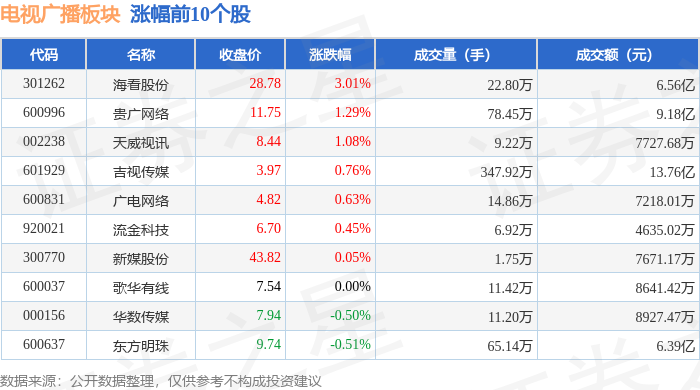
电视广播板块11月26日跌0.19%,无线传媒领跌,主力资金净流入1111.08万元
Zheng Xing Xing Ye Ri Bao· 2025-11-26 09:12
Market Overview - The television broadcasting sector experienced a decline of 0.19% compared to the previous trading day, with wireless media leading the losses [1] - The Shanghai Composite Index closed at 3864.18, down 0.15%, while the Shenzhen Component Index closed at 12907.83, up 1.02% [1] Stock Performance - Notable stock performances in the television broadcasting sector include: - Haisheng Co. (301262) closed at 28.78, up 3.01% with a trading volume of 228,000 shares and a turnover of 656 million yuan [1] - Guoguang Network (600996) closed at 11.75, up 1.29% with a trading volume of 784,500 shares and a turnover of 918 million yuan [1] - Tianwei Video (002238) closed at 8.44, up 1.08% with a trading volume of 92,200 shares and a turnover of 77.27 million yuan [1] - Huashu Media (000156) closed at 7.94, down 0.50% with a trading volume of 112,000 shares and a turnover of 89.27 million yuan [1] Capital Flow - The television broadcasting sector saw a net inflow of 11.11 million yuan from institutional investors, while retail investors experienced a net outflow of 83.33 million yuan [2] - The overall capital flow indicates that while institutional and speculative funds were net buyers, retail investors were net sellers [2] Individual Stock Capital Flow - Guoguang Network (600996) had a net inflow of 53.74 million yuan from institutional investors, while retail investors had a net outflow of 49.05 million yuan [3] - Jiushi Media (601929) saw a net inflow of 14.29 million yuan from institutional investors, with retail investors experiencing a net outflow of 2.26 million yuan [3] - Broadcasting Network (600831) had a net inflow of 9.21 million yuan from institutional investors, while retail investors had a net outflow of 480.33 million yuan [3]

浪尖调研|以文兴业的杭州文化产业
Xin Lang Cai Jing· 2025-11-24 01:21
Core Insights - Hangzhou has a rich cultural history and has evolved from a single-core culture centered around West Lake to a multi-dimensional cultural landscape, establishing itself as a national cultural and creative industry center [1][2][5] - The city has 1,828 large-scale cultural enterprises, generating a total revenue of 1,083 billion yuan, with digital cultural enterprises accounting for over 80% of this revenue [1][11] - The "Waves: Trillion City 2030" research group conducted extensive studies on Hangzhou's cultural industry, aiming to clarify the relationships between government, universities, and enterprises, and to provide recommendations for future development [1][2] Cultural Industry Development - Hangzhou's cultural industry was officially recognized as a pillar industry in 2007, with a focus on creating a "big cultural industry" that encompasses various sectors including technology services, education, and entertainment [2][3] - The city has a diverse cultural resource base, including various cultural heritages such as the West Lake culture, Liangzhu culture, and Grand Canal culture, which contribute to its cultural richness [2][3][5] - The administrative adjustments from 1996 to 2017 have significantly expanded Hangzhou's cultural space, allowing for a more integrated and diverse cultural industry landscape [5][6] Government and Policy Support - The Hangzhou government has adopted a "city management" philosophy, viewing the city as a platform for cultural exchange and life experiences, which has positively influenced the urban environment [7][8] - The city has implemented stable industrial policies, including financial support and talent incentives, to foster the growth of the cultural industry [10][11] - Hangzhou's government has also focused on creating a favorable business environment, attracting talent and enterprises through various initiatives [8][9] Role of Universities - Zhejiang University and China Academy of Art play a crucial role in nurturing Hangzhou's cultural landscape through research, talent cultivation, and participation in urban development [12][13] - These institutions have been involved in various cultural projects and initiatives, contributing to the city's cultural infrastructure and industry ecosystem [12][13] Corporate Innovation and Collaboration - Companies in Hangzhou, such as Zhejiang Cultural Technology, have embraced innovation and collaboration, leveraging partnerships with major tech firms like Alibaba and NetEase to enhance their digital cultural offerings [14][15] - The integration of cultural and technological resources has led to the establishment of a robust digital cultural industry in Hangzhou, positioning it as a national leader in this sector [4][11] Future Directions - Experts suggest further exploration of Hangzhou's cultural resources and the integration of technology to enhance cultural offerings, such as the development of cultural parks and historical sites [20][21] - The emphasis on digital culture and new media is seen as a key driver for future growth, with recommendations to combine online and offline experiences to meet evolving consumer demands [19][20][22]



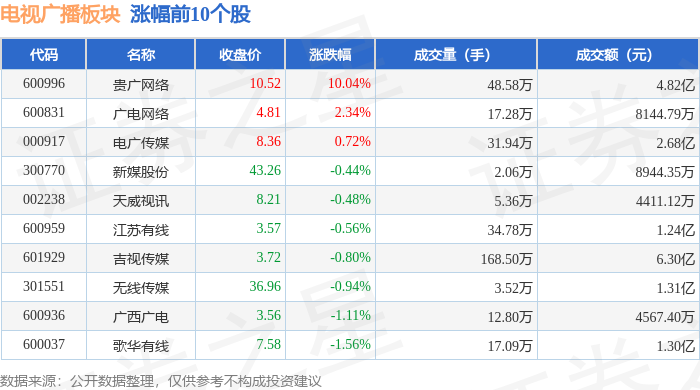
电视广播板块11月20日跌0.34%,流金科技领跌,主力资金净流出1.86亿元
Zheng Xing Xing Ye Ri Bao· 2025-11-20 09:16
Market Overview - The television broadcasting sector experienced a decline of 0.34% compared to the previous trading day, with Liujin Technology leading the losses [1] - The Shanghai Composite Index closed at 3931.05, down 0.4%, while the Shenzhen Component Index closed at 12980.82, down 0.76% [1] Stock Performance - Key stocks in the television broadcasting sector showed varied performance, with Gai Guang Network rising by 10.04% to a closing price of 10.52, while Liujin Technology fell by 2.99% to 6.50 [2][1] - Other notable performers included Guo Dian Network, which increased by 2.34%, and Dian Guang Media, which saw a slight increase of 0.72% [1] Trading Volume and Capital Flow - The television broadcasting sector saw a net outflow of 186 million yuan from institutional investors, while retail investors contributed a net inflow of 236 million yuan [2][3] - The trading volume for Gai Guang Network reached 485,800 shares, with a transaction value of 482 million yuan, indicating strong interest despite the overall sector decline [1] Individual Stock Capital Flow - Gai Guang Network had a net inflow of 126 million yuan from institutional investors, representing 26.04% of its trading volume, while retail investors showed a net outflow of 1 million yuan [3] - Liujin Technology experienced a net outflow of 482,290 yuan from institutional investors, indicating weaker institutional support [3]




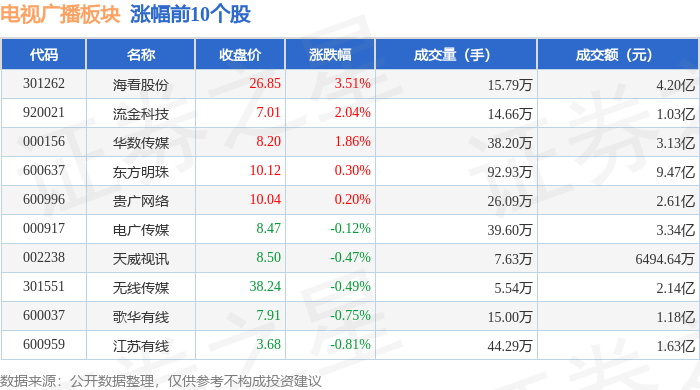
电视广播板块11月18日跌0.78%,湖北广电领跌,主力资金净流出1.51亿元
Zheng Xing Xing Ye Ri Bao· 2025-11-18 08:11
Core Insights - The television broadcasting sector experienced a decline of 0.78% on the previous trading day, with Hubei Broadcasting leading the losses [1] - The Shanghai Composite Index closed at 3939.81, down 0.81%, while the Shenzhen Component Index closed at 13080.49, down 0.92% [1] Stock Performance - Hubei Broadcasting (code: 000665) saw a significant drop of 6.10%, closing at 6.77, with a trading volume of 1,498,900 shares and a transaction value of 1.017 billion [2] - Other notable declines included Jishi Media (code: 601929) down 4.35% to 3.96, and Guangxi Broadcasting (code: 600936) down 1.32% to 3.73 [2] - Conversely, Hai Zhuo Co. (code: 301262) increased by 3.51% to 26.85, with a trading volume of 157,900 shares and a transaction value of 420 million [1] Capital Flow - The television broadcasting sector experienced a net outflow of 151 million from institutional investors, while retail investors saw a net inflow of 83.13 million [2] - The capital flow for individual stocks showed that Hai Zhuo Co. had a net inflow of 33.02 million from institutional investors, while Hubei Broadcasting had a net outflow of 11.35 million [3]

华数传媒涨2.11%,成交额1.16亿元,主力资金净流入1155.95万元
Xin Lang Zheng Quan· 2025-11-18 03:02
Core Viewpoint - 华数传媒's stock price has shown a year-to-date increase of 17.09%, with recent trading activity indicating a mixed performance in the short term [1][2]. Group 1: Stock Performance - On November 18, 华数传媒's stock rose by 2.11%, reaching a price of 8.22 CNY per share, with a trading volume of 1.16 billion CNY and a turnover rate of 0.84% [1]. - The stock has experienced a 2.11% increase over the last five trading days and a 3.66% increase over the last 20 days, while it has decreased by 0.84% over the last 60 days [1]. - The company has appeared on the龙虎榜 twice this year, with the most recent appearance on February 13, where it recorded a net buy of -35.23 million CNY [1]. Group 2: Financial Performance - For the period from January to September 2025, 华数传媒 reported a revenue of 6.407 billion CNY, reflecting a year-on-year growth of 0.92%, while the net profit attributable to shareholders was 349 million CNY, a decrease of 0.77% year-on-year [2]. - The company's revenue composition includes: 30.25% from integrated projects for group clients, 19.46% from internet TV, 15.57% from broadband and data communication, and other segments contributing smaller percentages [2]. Group 3: Shareholder Information - As of September 30, 2025, 华数传媒 had 42,700 shareholders, a decrease of 9.37% from the previous period, with an average of 39,811 circulating shares per shareholder, an increase of 10.34% [2]. - The company has distributed a total of 3.603 billion CNY in dividends since its A-share listing, with 1.149 billion CNY distributed over the last three years [3].
电视广播板块11月17日涨0.91%,湖北广电领涨,主力资金净流入1.27亿元
Zheng Xing Xing Ye Ri Bao· 2025-11-17 09:00
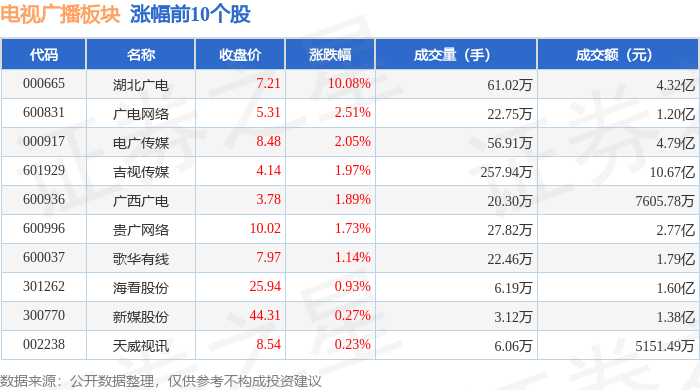
Market Overview - The television broadcasting sector increased by 0.91% compared to the previous trading day, with Hubei Broadcasting leading the gains [1] - The Shanghai Composite Index closed at 3972.03, down by 0.46%, while the Shenzhen Component Index closed at 13202.0, down by 0.11% [1] Stock Performance - Hubei Broadcasting (000665) closed at 7.21, up by 10.08% with a trading volume of 610,200 shares and a transaction value of 432 million yuan [1] - Other notable performers include: - Guangdian Network (600831) at 5.31, up by 2.51% [1] - Dianguang Media (000917) at 8.48, up by 2.05% [1] - Jishi Media (601929) at 4.14, up by 1.97% [1] - Guangxi Broadcasting (600936) at 3.78, up by 1.89% [1] Capital Flow - The television broadcasting sector saw a net inflow of 127 million yuan from institutional investors, while retail investors experienced a net outflow of 88.43 million yuan [2] - The capital flow for key stocks includes: - Hubei Broadcasting with a net inflow of 150 million yuan from institutional investors [3] - Jishi Media with a net inflow of 34.84 million yuan [3] - Dianguang Media with a net inflow of 33.32 million yuan [3] Investor Behavior - Institutional investors showed a strong interest in Hubei Broadcasting, while retail investors were net sellers across several stocks [3] - The net outflow from retail investors was particularly significant for Hubei Broadcasting, with a total outflow of 75.75 million yuan [3]


【干货】传媒产业链全景梳理及区域热力地图
Qian Zhan Wang· 2025-11-15 06:09
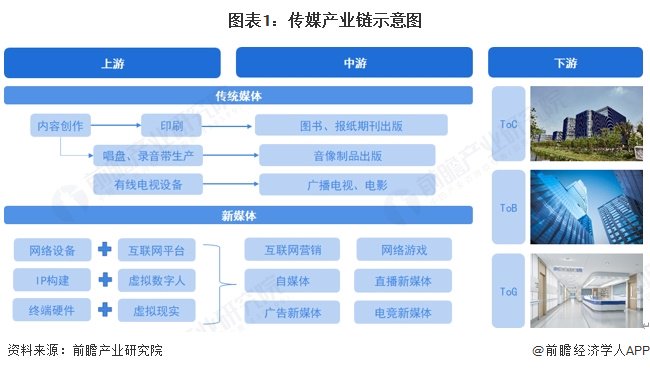
Core Insights - The article provides a comprehensive overview of the Chinese media industry, highlighting its vast and complex supply chain, which includes upstream, midstream, and downstream sectors [1][2][5]. Industry Overview - The Chinese media industry consists of various sectors, including publishing, film, exhibitions, broadcasting, internet marketing, and gaming, with numerous companies participating in each area [2][10]. - The industry is characterized by a large number of enterprises, with significant representation from companies such as BlueFocus (蓝色光标), Leo Group (利欧股份), and 37 Interactive Entertainment (三七互娱), all of which reported revenues exceeding 17 billion yuan in 2024 [10]. Regional Distribution - The majority of media companies in China are concentrated in Beijing, with over 121,000 registered media enterprises as of October 20, 2025. Guangdong follows with approximately 92,000 registered companies [5][7]. - Major representative companies are also distributed in Shanghai, Zhejiang, and Guangdong, indicating a concentration in the southeastern region of China [7]. Investment Trends - Recent investment activities in the media sector include acquisitions and capital increases in subsidiaries to expand business operations. Notable investments involve various companies across different funding rounds, including strategic investments and angel rounds [11][12].





电视广播板块11月14日跌0.36%,广电网络领跌,主力资金净流出1.27亿元
Zheng Xing Xing Ye Ri Bao· 2025-11-14 08:58
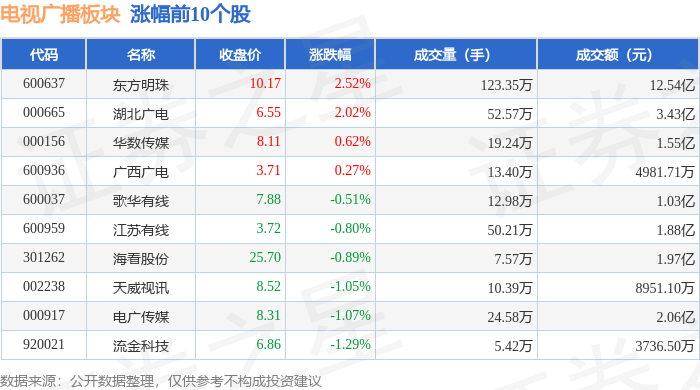
Core Viewpoint - The television broadcasting sector experienced a decline of 0.36% on the previous trading day, with significant losses from Guangdian Network, while the overall market indices also fell, with the Shanghai Composite Index closing at 3990.49, down 0.97%, and the Shenzhen Component Index at 13216.03, down 1.93% [1]. Group 1: Market Performance - The television broadcasting sector's stocks showed mixed performance, with notable gainers including Oriental Pearl, which rose by 2.52% to close at 10.17, and Hubei Broadcasting, which increased by 2.02% to 6.55 [1]. - Conversely, Guangdian Network led the decline with a drop of 4.60% to 5.18, followed by New Media Co., which fell by 3.64% to 44.19 [2]. Group 2: Trading Volume and Capital Flow - The television broadcasting sector saw a net outflow of 127 million yuan from institutional investors, while retail investors contributed a net inflow of 4.77 million yuan [2]. - The trading volume for Oriental Pearl reached 1.23 million shares, with a total transaction value of 1.25 billion yuan, indicating strong interest despite the overall market decline [1]. Group 3: Individual Stock Analysis - Oriental Pearl had a net inflow of 1.10 billion yuan from institutional investors, representing 8.81% of its trading volume, while retail investors showed a net outflow of 1.49 billion yuan [3]. - Hubei Broadcasting experienced a net outflow of 658.45 million yuan from institutional investors, indicating a negative sentiment towards the stock [3].
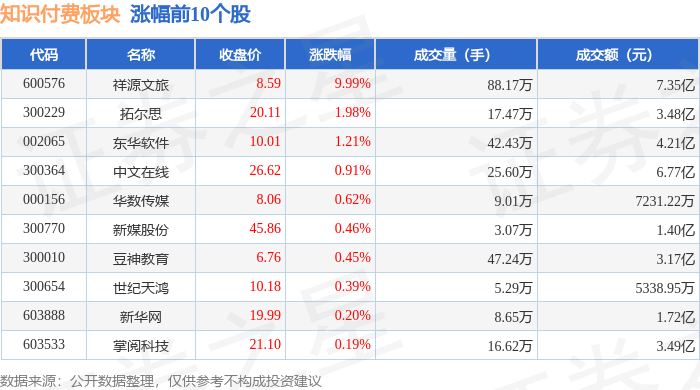
知识付费板块11月13日涨0.35%,祥源文旅领涨,主力资金净流出2263.89万元


Sou Hu Cai Jing· 2025-11-13 10:47
Market Overview - The knowledge payment sector increased by 0.35% on November 13, with Xiangyuan Cultural Tourism leading the gains [1] - The Shanghai Composite Index closed at 4029.5, up 0.73%, while the Shenzhen Component Index closed at 13476.52, up 1.78% [1] Stock Performance - Xiangyuan Cultural Tourism (600576) closed at 8.59, with a rise of 9.99% and a trading volume of 881,700 shares, totaling a transaction value of 735 million [1] - Other notable stocks included: - Tuorisi (300229) at 20.11, up 1.98%, with a transaction value of 348 million [1] - Donghua Software (002065) at 10.01, up 1.21%, with a transaction value of 421 million [1] - Zhongwen Online (300364) at 26.62, up 0.91%, with a transaction value of 677 million [1] Fund Flow Analysis - The knowledge payment sector experienced a net outflow of 22.64 million from institutional investors, while retail investors saw a net inflow of 16.86 million [2] - The main stocks with significant fund flows included: - Xiangyuan Cultural Tourism with a net inflow of 209 million from institutional investors [3] - Zhiyue Technology (603533) with a net inflow of 28.83 million from institutional investors [3] - China Publishing (601949) with a net inflow of 6.01 million from institutional investors [3]
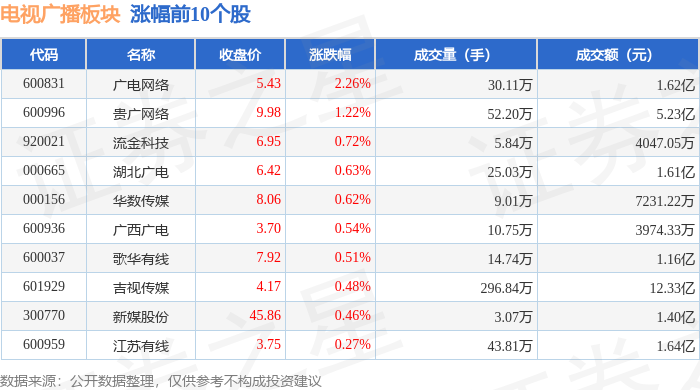
电视广播板块11月13日涨0.38%,广电网络领涨,主力资金净流出1.52亿元
Zheng Xing Xing Ye Ri Bao· 2025-11-13 08:51
Market Overview - The television broadcasting sector increased by 0.38% compared to the previous trading day, with Guangdian Network leading the gains [1] - The Shanghai Composite Index closed at 4029.5, up 0.73%, while the Shenzhen Component Index closed at 13476.52, up 1.78% [1] Stock Performance - Guangdian Network (600831) closed at 5.43, with a rise of 2.26% and a trading volume of 301,100 shares, amounting to a transaction value of 162 million yuan [1] - Other notable stocks include: - Gai Guang Network (600996) at 9.98, up 1.22% [1] - Liujin Technology (920021) at 6.95, up 0.72% [1] - Hubei Broadcasting (000665) at 6.42, up 0.63% [1] - Huashu Media (000156) at 8.06, up 0.62% [1] Capital Flow - The television broadcasting sector experienced a net outflow of 152 million yuan from institutional investors, while retail investors saw a net inflow of 159 million yuan [2] - The capital flow for specific stocks shows: - Guangdian Network had a net outflow of 13.25 million yuan from institutional investors [3] - Jishi Media (601929) had a net inflow of 7.87 million yuan from institutional investors [3] - Huashu Media (000156) had a net inflow of 92,700 yuan from institutional investors [3]