
Xiaomi

Search documents
The Wrap-Up for Tuesday November 25
CNBC Television· 2025-11-25 12:11
Government & Technology - US government launches "Genesis mission" to boost tech innovation using AI, involving a public-private partnership with the Department of Energy, Nvidia, Dell, HPE, and AMD [1][2] Cryptocurrency & Legal Issues - Binance founder Changpang Zhao faces accusations of facilitating millions of dollars in payments to Hamas after the October 2023 attack on Israel [2] - Victims and families of the Israel attack filed a complaint alleging Zhao and Binance laundered money for the terror group [3] - Peter Coker Senior and Peter Coker Junior failed to pay over 55 million USD in restitution for their roles in a 100 million USD pump and dump stock scheme [4] Company Performance & Stock Activity - Xiaomi founder increased his stake in the company by purchasing an additional 13 million shares [4] - Xiaomi's stock has fallen more than 30% from its July peak [5] - Chinese EV maker NIO reported a smaller than expected Q3 loss, with revenue rising by 17% through October [5] - NIO's vehicle sales reached approximately 270,000, a 60% year-over-year increase [5]



X @Bloomberg
Bloomberg· 2025-11-25 05:58
Xiaomi founder Lei Jun’s purchase of about $12.9 million worth of company stock may help bolster sentiment in the smartphone maker after shares tumbled more than 30% from its July peak https://t.co/H01lS89Yqy ...
Here's what's behind Tesla's 3-year sales low in China
CNBC· 2025-11-24 14:22
Core Insights - Tesla's sales in China fell to a three-year low in October, raising concerns about a potential full-year sales decline in the country [1] - The company's market share in the Chinese EV sector decreased significantly from 8.7% in September to 3.2% in October [1] Competitive Landscape - Tesla faces intense competition from local rivals such as NIO and Li Auto, which are also reporting strong sales [1] - Xiaomi has emerged as a new competitor in the upper segment of the Chinese EV market, achieving record sales for its YU7 SUV and SU7 sedan despite safety concerns [2] - Leapmotor, a newer player founded in 2015, has begun to outperform local competitors in sales and stock price, with its C10 SUV priced significantly lower than Tesla's Model Y [4] - Geely's Geome Xingyuan leads EV sales in China this year, targeting budget-conscious consumers with a price tag under $10,000, indicating a shift in consumer preferences [5][6] Tesla's Position and Future Outlook - Despite the competition, Tesla's Model Y remains competitive, ranking 6th in the overall market [7] - Analysts suggest that Tesla needs to refresh its vehicle models to keep pace with local competitors like Xiaomi, BYD, and XPeng [8] - Tesla's third-quarter revenue increased by 12% year-over-year to $28.10 billion, but the company continues to experience a sales slump in Europe due to competition from brands like Volkswagen and BYD [8][9]


Tesla's China sales hit 3-year low: Here's why
CNBC Television· 2025-11-24 13:14
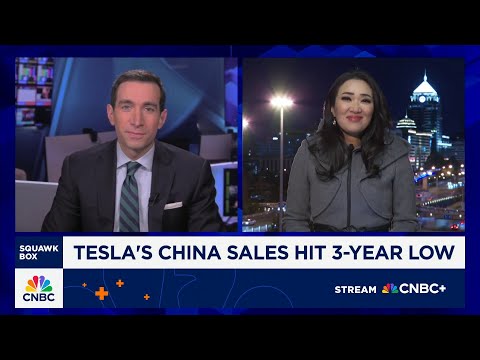
Tesla's China sales dropping to a three-year low last month. Ununice Yun joins us this morning from Beijing with a look at the competition. Ununice.>> Thanks, Andrew. Well, Tesla's share of the Chinese EV market shrank from 8.7% in September to 3.2% last month. So, I took a look at some of the latest competition.Tesla's newest direct competitor in the upper echelon of the Chinese EV market is China's Xiaomi. The smartphone makers U7 SUV and Sue7 sedan posted record sales in October despite accidents that ra ...
Xiaomi raises its 2025 BEV sales target
Yahoo Finance· 2025-11-24 10:23
Core Insights - Xiaomi Automobile Company has increased its full-year sales target for battery electric vehicles (BEVs) from 350,000 to 400,000 units, driven by higher production of its SU7 sedan and YU7 SUV models [1][4] - The revised sales target represents a threefold increase compared to the 135,000 vehicles delivered last year, positioning Xiaomi as one of the fastest-growing automakers in China [2][4] - The company achieved a significant milestone by producing its 500,000th BEV, having commenced vehicle production in December 2023 [2] Financial Performance - In Q3 2025, Xiaomi's BEV operations reported a profit of CNY 700 million (approximately US$ 98 million), a turnaround from a loss of CNY 300 million in the previous quarter [4] - Sales surged by 175% year-on-year, with 108,796 cars sold in Q3 2025 [4] - For the first ten months of 2025, the company delivered a total of 315,376 BEVs in China [4] Strategic Positioning - Xiaomi emphasizes that quality and safety are top priorities, stating that safety is foundational to their production efforts [3] - The company is viewed as a significant competitor to Tesla in China, alongside other BEV startups like Leapmotor and Li Auto [3] - Recently, Xiaomi opened an R&D center in Germany, indicating plans to establish a sales network in the region [3]
固定收益部市场日报-20251124
Zhao Yin Guo Ji· 2025-11-24 03:33
Report Summary 1. Report Industry Investment Rating - Not provided in the report. 2. Core Views - The Chinese government is considering a stimulus package to revive the property market, which led to some recovery in Chinese property bonds [2]. - SJM's acquisition of the L'Arc Hotel and termination of the Ponte 16 acquisition could delay its de - leverage trajectory and may lead to negative rating action [7][8]. - Xiaomi's solid credit profiles and strong performance in the Smart EV segment support a buy recommendation on its 30 - 31s bonds [13]. 3. Summary by Relevant Sections Trading Desk Comments - Yesterday, new BBLTB 35s widened 1bp, new BBLTB 30s tightened 1bp, new SMBCAC 35s tightened 2 - 3bps, and there were better selling flows on existing SMBCAC 28s/34s [2]. - Asia IG space had some recoveries (1 - 2bps tighter) in TW lifers and KR/TH/SG T2s, but better selling on JP corps and some bank papers [2]. - JP AT1s and insurance subs struggled, while SOFTBK 31 - 65s were up 0.9 - 1.4pts, Yankee AT1s bounced back 0.3 - 0.5pt, and NWDEVL complex rose 0.2 - 1.0pt [2]. - In Chinese properties, VNKRLE 27 - 29 recovered 0.5 - 0.8pt, LNGFOR 27 - 32 increased 0.2 - 0.3pt, and in SEA, VLLPM 27 - 29 dropped 0.8 - 2.4pts [2]. - In AU, INFRAB 14.5 28 lost 0.5pt, and in LGFV space, HFs bought higher - yielding issues and RMs sourced AAA - guaranteed papers [2]. Analyst Comments - SJMHOL: SJM is acquiring the L'Arc Hotel for HKD1.75bn and terminating the Ponte 16 acquisition. The pro - forma net debt/LTM EBITDA may increase to 7.3x from 6.8x as of Sep'25 [7][8]. - XIAOMI: In 3Q25, Xiaomi's revenue increased 22% yoy to RMB113.1bn, mainly driven by the Smart EV segment. Smartphones revenue declined 3.1% yoy, while Smart EV segment revenue rose 199% yoy and achieved a quarterly operating profit of RMB0.7bn [13][14][15]. Macro News Recap - On Thursday, S&P was down 1.56%, Dow was down 0.84%, and Nasdaq was down 2.15%. US initial jobless claims were +220k, lower than expected, and Sep'25 non - farm payroll was +119k, higher than expected [6]. - The US Sep'25 unemployment rate was 4.4%, higher than expected, and UST yields were lower on Thursday [6]. Offshore Asia New Issues - Priced: Agricultural Bank of China Limited, Singapore Branch issued USD300mn 3 - year bonds at SOFR + 43 with an issue rating of A1/-/- [21]. - Pipeline: First Abu Dhabi Bank is planning a PerpNC6 issuance with a coupon of 6.375 - 6.5% and an issue rating of Baa3/-/- [22]. Onshore Primary Issuances - Yesterday, 153 credit bonds were issued with an amount of RMB137bn. Month - to - date, 1,456 credit bonds were issued with a total amount of RMB1,561bn, a 34.3% yoy increase [25]. - There were also various corporate news such as China Great Wall's asset - backed special plan, IDASAL's possible investment, and others [25].
亚洲科技- 历史经验对存储芯片价格影响智能手机行业的启示-Asia Tech_ What history tells about memory pricing impact on smartphone sector_
2025-11-24 01:46
Summary of Key Points from the Conference Call Industry Overview - The conference call focuses on the **smartphone sector**, particularly the impact of rising **memory prices** on **smartphone OEMs** (Original Equipment Manufacturers) such as **Xiaomi** and **Transsion**, as well as **camera component suppliers** [1][15]. Core Insights and Arguments - **Memory Price Trends**: - A strong demand from AI has led to a significant memory price increase, with mobile DRAM contract prices expected to rise by **30-40% QoQ** in **4QCY25** and potentially continue into **1HCY26** [2]. - NAND pricing is also expected to increase, albeit at a milder rate [2]. - **Impact on Smartphone OEMs**: - Rising memory prices affect low-to-mid-end smartphones more than flagship models. For example, memory accounts for **4%** of an iPhone's ASP, **7%** for a Xiaomi flagship, and over **10%** for a Redmi model [3][16]. - A **40% increase** in memory prices could reduce Xiaomi's smartphone gross margins by **2-3 percentage points**. Xiaomi may pass some costs to consumers, which could affect sales volume [3]. - **Xiaomi's Premiumization Strategy**: - Xiaomi's shift towards premium models is helping to offset some of the pressures from rising memory costs. The **Xiaomi 17 series** saw a **30% increase** in shipments compared to the previous generation, with **80%** of the mix being premium models [3]. - **Camera Component Suppliers**: - The correlation between memory pricing and camera lens margins is historically weak, with a delayed impact on camera modules. The camera lens market is more consolidated, leading to less margin impact from rising memory prices [3][42]. - The current memory upcycle is expected to negatively impact camera budgets for low-to-mid-end Android models, but high-end Android and Apple supply chains are less affected [44]. Additional Important Insights - **Sunny Optical's Outlook**: - Concerns regarding Sunny Optical's performance due to rising memory prices are considered overstated. The bear case suggests a **6%** revenue growth and **1%** EPS growth for 2026, which is below consensus estimates [4][66]. - The price target for Sunny Optical in the bear case is set at **HKD 82**, indicating a potential upside of **~25%** [4]. - **Market Dynamics**: - The smartphone market has been saturated since the late 2010s, with annual shipments fluctuating due to various factors, including the Huawei ban and COVID-19 [17][31]. - The transition from **memory downcycle** to **upcycle** is expected to stabilize the market, with both Xiaomi and Transsion gaining market share and improving ASPs [17]. - **Investment Ratings**: - Sunny Optical is rated **Outperform** with a price target of **HKD 110** [7]. - Xiaomi is also rated **Outperform** with a price target of **HKD 57** [9]. Conclusion - The rising memory prices present challenges for smartphone OEMs, particularly in the low-to-mid-end segments, while high-end models and Apple suppliers remain relatively insulated. The premiumization strategy of companies like Xiaomi may help mitigate some of these pressures. The outlook for camera component suppliers is mixed, with expectations of budget constraints for lower-end models but stability in high-end segments.
小米-买入评级,逆风已可控
2025-11-24 01:46
Xiaomi (1810 HK) Equity Research Summary Industry Overview - **Industry**: Electronic Equipment & Instruments - **Company**: Xiaomi Corporation Key Financial Highlights - **3Q25 Non-IFRS Net Profit**: RMB 11.3 billion, up 81% year-on-year, exceeding consensus by 13% due to higher than expected EV average selling price (ASP) which increased by 9% year-on-year and 2.5% quarter-on-quarter [3][29] - **EV Business**: Achieved its first quarterly operating profit of RMB 0.7 billion in 3Q25, with vehicle deliveries increasing by 34% quarter-on-quarter [3][11] - **Total Revenue**: RMB 113.1 billion in 3Q25, a 22.3% increase year-on-year [29] Segment Performance Smartphone Segment - **Revenue**: RMB 45.97 billion, a decrease of 3.1% year-on-year [29] - **ASP Decline**: From RMB 1,073 in 2Q25 to RMB 1,063 in 3Q25, with gross margin dropping from 11.5% to 11.1% [3][29] - **Profitability Pressure**: Expected due to rising memory costs; prioritizing ASP improvement over shipment growth [4][11] IoT and Lifestyle Products - **Revenue Growth**: Slowed to 5.7% year-on-year, impacted by reduced shipments of smart large home appliances due to subsidy cuts and increased competition [3][4] - **Gross Margin Recovery**: Increased by 1.4 percentage points sequentially [3] EV Segment - **Revenue**: RMB 29.01 billion, a significant increase of 199.2% year-on-year [29] - **Delivery Goal**: On track to meet 2025 vehicle delivery target of 350,000 units, with monthly deliveries expected to rise from approximately 30,000 in July to over 40,000 by October 2025 [4][11] Strategic Insights - **Premiumisation Strategy**: Aimed at alleviating cost pressures in the smartphone segment [4][11] - **Product Mix Optimization**: To mitigate the impact of subsidy reductions in the IoT segment [4] Valuation and Estimates - **Target Price**: Decreased to HKD 62.80 from HKD 65.40, implying a 54% upside from the current share price of HKD 40.78 [5][11] - **Net Profit Estimates**: Lowered by 3%, 6%, and 3% for 2025-2027, respectively, due to reduced revenue estimates [5][30] - **Valuation Method**: Sum-of-the-parts (SOTP) approach; applying a 25x target PE for legacy businesses and DCF for the EV business [5][32] Risks and Challenges - **Component Shortages**: Potential revenue caps due to shortages in key semiconductor components [40] - **Competition**: Increased competition in IoT and internet services from established players like Huawei and Lenovo [40] - **FX Volatility**: Risks associated with foreign exchange fluctuations as Xiaomi expands in overseas markets [40] Conclusion - Xiaomi is positioned for growth in its EV segment while facing challenges in its smartphone and IoT businesses. The company’s strategic focus on premiumisation and product mix optimization is crucial for navigating current market pressures. The revised target price reflects a cautious outlook amid anticipated cost pressures and competitive dynamics.
X @Bloomberg
Bloomberg· 2025-11-21 13:38
Xiaomi wanted to one-up Tesla’s Model Y. “When you do a comparison, they bested it in almost every way.” https://t.co/JnkuXEcrIb ...
XIAOMI(1810.HK):3Q25ABOVE; NOT IMMUNE TO MEMORY COST HIKE AND EV PURCHASE TAX SUBSIDIES IN THE NEAR TERM
Ge Long Hui· 2025-11-21 03:44
Core Viewpoint - Xiaomi's 3Q revenue and adjusted net profit growth of 22% and 81% YoY, respectively, were slightly above expectations, driven by the fast-growing smart EV business, resilient internet segment, and improved operating efficiency, despite weaker smartphone sales [1][2] Financial Performance - 3Q25 revenue growth of 22% YoY was in line with expectations, supported by smart EV and internet services growth [2] - Smartphone revenue declined by 3% YoY due to flat shipments and a decrease in average selling price (ASP) [2] - Smart EV revenue surged by 198%, achieving operating income breakeven for the first time, attributed to strong EV deliveries and ASP increases [2] - IoT revenue increased by 6% YoY, driven by overseas markets, although this was partially offset by weaker sales in large home appliances in China [2] - Internet revenue grew by 11% YoY, supported by solid advertising growth [2] Outlook - Management is conservative regarding margin headwinds in the near term due to memory cost hikes and EV tax subsidies, but strategic objectives for smartphone and EV market share gains, new retail networks, and overseas expansion remain on track [3] - GPM pressure for smartphones is expected to persist into 4Q25 and 2026, despite securing supply agreements with memory suppliers [3] - For smart EVs, a decline in GPM is anticipated in 2026 due to competition and EV purchase tax subsidies [3] - IoT is expected to benefit from rapid overseas expansion and the development of Xiaomi's OS and local LLM as a foundation for an edge AI ecosystem [3] Strategic Positioning - Xiaomi's strong ecosystem and market expansion strategies are expected to help navigate headwinds, leading to a maintained BUY rating [4] - FY26-27E adjusted EPS has been trimmed by 9% each to reflect 3Q results, rising memory costs, and competition [4] - The new SOTP-based target price of HK$ 55.31 implies a 26.3x FY26E P/E ratio [4] - Upcoming catalysts include product launches, updates on memory pricing, and ramp-up of EV capacity [4]