海兰信

Search documents
航海装备板块1月15日涨0.15%,亚星锚链领涨,主力资金净流出2.39亿元
Zheng Xing Xing Ye Ri Bao· 2026-01-15 08:59
Group 1 - The marine equipment sector increased by 0.15% on January 15, with Yaxing Anchor Chain leading the gains [1] - The Shanghai Composite Index closed at 4112.6, down 0.33%, while the Shenzhen Component Index closed at 14306.73, up 0.41% [1] - The trading volume and turnover for key stocks in the marine equipment sector showed varied performance, with China Shipbuilding achieving a turnover of 2.749 billion yuan [1] Group 2 - The net outflow of main funds in the marine equipment sector was 239 million yuan, while retail investors saw a net inflow of 402 million yuan [1] - Specific stock performances indicated that China Shipbuilding had a net inflow of 20.5 million yuan from main funds, while Yaxing Anchor Chain experienced a net inflow of 9.364 million yuan [2] - The overall sentiment in the sector was mixed, with significant outflows from stocks like Jianglong Shipbuilding and Tianhai Defense, while retail investors showed interest in several stocks [2]






预见2025:《2025年中国深海科技行业全景图谱》(附市场现状、竞争格局和发展趋势等)
Qian Zhan Wang· 2026-01-15 02:13
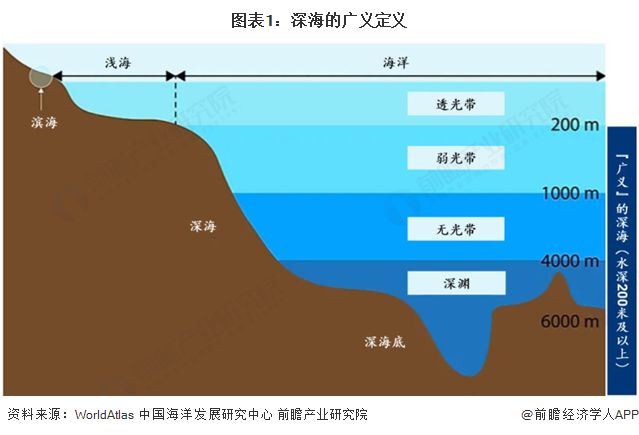
Industry Overview - Deep-sea technology refers to a series of scientific technologies and equipment systems used for exploration, research, and development in deep-sea areas (typically below 200 meters) [1] - The industry encompasses deep-sea detection, resource development, environmental monitoring, and biological research, including technologies like manned submersibles, unmanned underwater vehicles, and autonomous underwater robots [1] Industry Chain Analysis - The deep-sea technology industry chain includes three main areas: deep-sea material research, deep-sea equipment manufacturing and system integration, and deep-sea resource and application development [3] - Upstream material research focuses on providing high-strength, high-pressure resistant, and corrosion-resistant materials essential for deep-sea equipment [3] - Midstream involves the manufacturing of deep-sea equipment, including manned submersibles and underwater robots, which are critical for deep-sea research and resource exploration [3] - Downstream development focuses on the commercial extraction of deep-sea oil, gas, and minerals, as well as the technological commercialization of underwater security and deep-sea data centers [4] Industry Development History - The development of China's deep-sea technology has gone through four stages, from initial exploration in the late 1980s to the current phase of comprehensive layout and frontier exploration since 2021 [7][10] Policy Background - National policies for the deep-sea technology industry are characterized by systematic and precise features, aiming to promote high-quality development through top-level design and industry guidance [12] - Key policies include support for deep-sea equipment development, critical technology breakthroughs, and financial backing for long-term financing of deep-sea enterprises [12][13] Current Industry Status - The marine economy market in China has exceeded 10 trillion yuan, with deep-sea technology becoming a core driver of new industries [15] - The deep-sea technology market size has grown from 1.90 trillion yuan in 2020 to 2.53 trillion yuan in 2024, with an average annual growth rate of approximately 7.4% [16] - Investment in deep-sea equipment has increased significantly, from less than 100 million yuan in 2020 to 745 million yuan in 2024, reflecting a compound annual growth rate of 72% [18] Regional and Competitive Landscape - Guangdong and Hainan account for nearly 30% of the industry enterprise distribution, with Guangdong at 18% and Hainan at 14% [26] - The competitive landscape shows differentiation, with state-owned enterprises like China Shipbuilding and CNOOC leading in deep-sea equipment manufacturing, while companies like Baotai and Hailanxin excel in specialized materials and underwater communication systems [27] Future Industry Trends - The deep-sea technology market is projected to reach 3.8 trillion yuan by 2030, driven by ongoing investments in traditional oil and gas exploration and the commercialization of new applications [31] - Key trends include the intelligent and autonomous development of equipment, accelerated green energy development, expansion of new application scenarios, and deepening industry chain collaboration [32][34]
国产航母概念下跌0.74%,主力资金净流出28股
Zheng Quan Shi Bao Wang· 2026-01-14 09:21
Group 1 - The domestic aircraft carrier concept index declined by 0.74%, ranking among the top declines in the concept sector, with notable declines in stocks such as Beidou Star, Sichuan Electronics, and Yinbang Shares [1] - Among the domestic aircraft carrier concept stocks, 10 stocks saw price increases, with Haige Communication, China First Heavy Industries, and AVIC Heavy Machinery leading the gains at 10.00%, 10.00%, and 5.85% respectively [1][2] - The domestic aircraft carrier concept experienced a net outflow of 2.947 billion yuan in main funds today, with 28 stocks seeing net outflows, and 7 stocks experiencing outflows exceeding 100 million yuan [2] Group 2 - The top net outflow stock in the domestic aircraft carrier concept was Haige Communication, with a net outflow of 1.434 billion yuan, followed by China Satellite, Yinbang Shares, and Hailanxin with net outflows of 612.8 million yuan, 442.9 million yuan, and 319.8 million yuan respectively [2][3] - The stocks with the highest net inflow in the domestic aircraft carrier concept included China First Heavy Industries, AVIC Heavy Machinery, and China Shipbuilding, with net inflows of 573.0 million yuan, 408.0 million yuan, and 6.1 million yuan respectively [2][3] - The stock performance of Haige Communication showed a significant increase of 10.00% despite the overall sector decline, indicating potential investor interest [3]


2025年1-11月中国民用钢质船舶产量为4858.7万载重吨 累计增长19.8%
Chan Ye Xin Xi Wang· 2026-01-14 03:35
Group 1 - The core viewpoint of the article highlights the growth in China's metal shipbuilding industry, with significant increases in production and market outlook for the coming years [1] Group 2 - In November 2025, China's production of civil steel ships reached 4.82 million deadweight tons, representing a year-on-year increase of 18.4% [1] - From January to November 2025, the cumulative production of civil steel ships in China was 48.587 million deadweight tons, showing a cumulative growth of 19.8% [1] - The article references a report by Zhiyan Consulting that outlines the competitive landscape and market prospects for the Chinese metal shipbuilding industry from 2026 to 2032 [1]


订单落地与资本布局并进 深海科技开年“迎新”
Shang Hai Zheng Quan Bao· 2026-01-13 18:34
Core Insights - The deep-sea technology sector in China is expected to see significant advancements and growth by 2026, driven by policy guidance and market demand, focusing on "technological iteration" and "industrialization" [5][11] Group 1: Industry Developments - Shandong Future Robotics has secured two contracts for underwater robots capable of operating at depths of 3,500 meters, indicating strong demand for high-end equipment in the sector [6] - Shenzhen Qianxing Innovation plans to significantly increase the production of underwater robots, with expected revenue surpassing 300 million yuan in 2026, reflecting a doubling of industry-level product shipments [6][7] - The underwater robotics market is seeing a shift towards commercial applications, with nearly 70% of products being exported overseas, and companies are focusing on various application scenarios in energy and underwater infrastructure [7] Group 2: Investment Trends - The deep-sea technology sector is attracting diverse capital sources, with ongoing C+ round financing efforts and total financing exceeding 300 million yuan for some companies [8] - The "Marine Equipment" sector has seen a 7.95% increase in stock prices since the beginning of the year, with notable gains in companies like Jili Sogou and Hailanxin [8] - Experts predict that the deep-sea technology sector will continue to attract investment, particularly in high-pressure materials and resource development equipment, which are expected to yield stable returns [9][10] Group 3: Regional Development Strategies - Various provinces in China are outlining differentiated development paths for deep-sea technology, with regions like Zhejiang and Hainan focusing on marine electronics and high-end equipment clusters [10] - The emphasis is on expanding resource development from land to ocean and from nearshore to deep-sea areas, with specific plans laid out by provinces such as Guangdong and Fujian [10] - 2026 is anticipated to be a pivotal year for the deep-sea technology industry, transitioning from isolated breakthroughs to collaborative development, forming a "deep-sea economic corridor" [11]

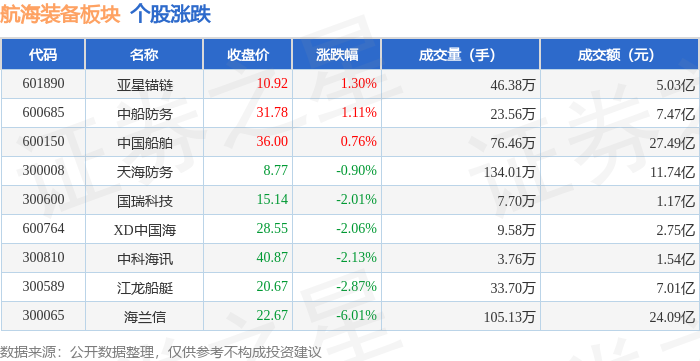
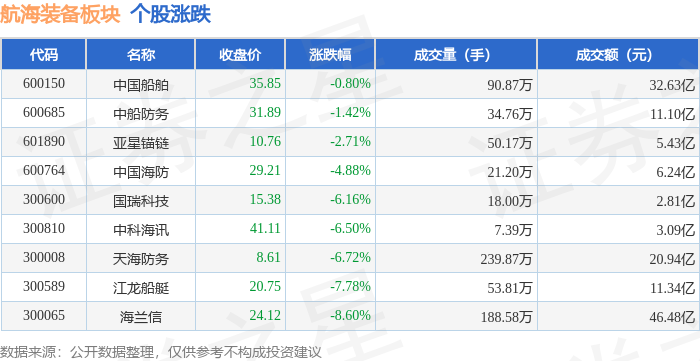
航海装备板块1月13日跌1.97%,海兰信领跌,主力资金净流出11.09亿元
Zheng Xing Xing Ye Ri Bao· 2026-01-13 09:06
Core Viewpoint - The maritime equipment sector experienced a decline of 1.97% on January 13, with Hailanxin leading the drop, while the Shanghai Composite Index fell by 0.64% and the Shenzhen Component Index decreased by 1.37% [1] Group 1: Market Performance - The closing price of China Shipbuilding was 35.85, down by 0.80% with a trading volume of 908,700 shares and a transaction value of 3.263 billion [1] - China Shipbuilding Defense closed at 31.89, down by 1.42% with a trading volume of 347,600 shares and a transaction value of 1.11 billion [1] - Yaxing Anchor Chain closed at 10.76, down by 2.71% with a trading volume of 501,700 shares and a transaction value of 543 million [1] - China Marine Defense closed at 29.21, down by 4.88% with a trading volume of 212,000 shares and a transaction value of 624 million [1] - Yuanrui Technology closed at 15.38, down by 6.16% with a trading volume of 180,000 shares and a transaction value of 281 million [1] - Kangkang Society closed at 41.11, down by 6.50% with a trading volume of 73,900 shares and a transaction value of 309 million [1] - Tianhai Defense closed at 8.61, down by 6.72% with a trading volume of 2,398,700 shares and a transaction value of 20.947 million [1] - Jianglong Shipbuilding closed at 20.75, down by 7.78% with a trading volume of 538,100 shares and a transaction value of 1.134 billion [1] - Hailanxin closed at 24.12, down by 8.60% with a trading volume of 1,885,800 shares and a transaction value of 4.648 billion [1] Group 2: Capital Flow - The maritime equipment sector saw a net outflow of 1.109 billion from main funds, while retail investors had a net inflow of 1.061 billion [1] - The main fund net inflow for China Shipbuilding was 11.3247 million, with a net outflow from retail investors of 6.9356 million [2] - China Marine Defense experienced a significant main fund net outflow of 75.2825 million, while retail investors had a net inflow of 59.8658 million [2] - Hailanxin had a main fund net outflow of 479 million, with a retail net inflow of 427 million [2]

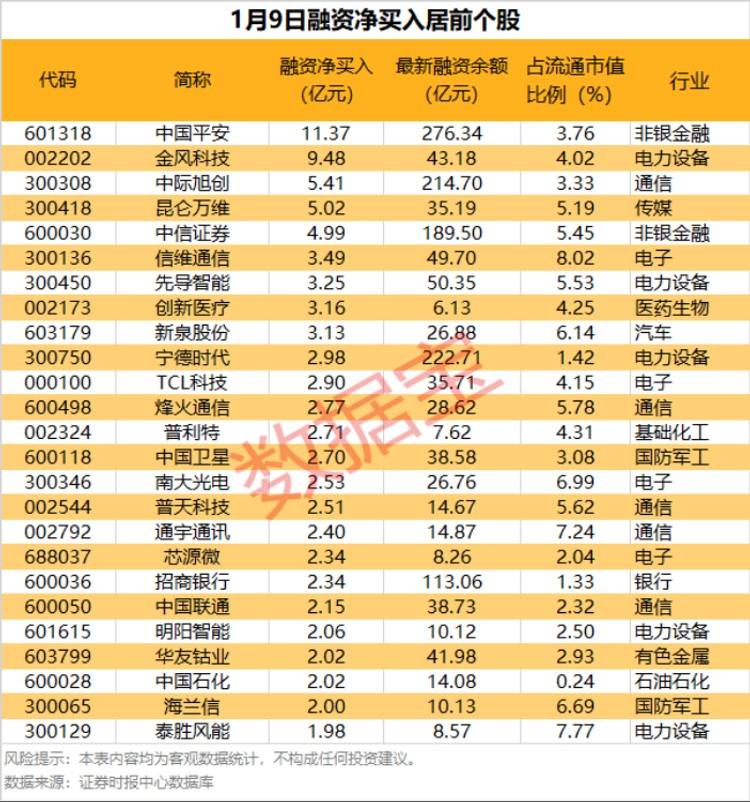
融资连增背后,别被走势骗了
Sou Hu Cai Jing· 2026-01-12 14:07
Core Viewpoint - The recent increase in financing funds, reaching approximately 2.6 trillion yuan, indicates a positive market sentiment, but surface price movements may not reflect true trading intentions [1] Group 1: Market Behavior - Many investors are misled by superficial price fluctuations, often reacting emotionally to market movements, which can lead to poor decision-making [3][9] - There are two types of market behaviors: one where prices rise but experience multiple pullbacks, leading investors to sell out of fear; and another where prices appear to rebound, misleading investors into thinking new funds are entering the market [5][8] Group 2: Quantitative Data Analysis - Utilizing quantitative data can help reveal the true trading intentions behind market movements, as traditional observations may not capture the underlying dynamics [7][8] - The "institutional inventory" data reflects the activity level of large institutional funds, providing insights into whether institutions are actively participating in trades [6][8] Group 3: Investment Strategy - A continuous increase in financing funds suggests a generally positive market attitude, but it is crucial to analyze individual stocks beyond their price movements, focusing on the underlying trading behaviors [8] - If a stock shows price fluctuations but maintains active "institutional inventory," it indicates significant institutional involvement; conversely, if a stock rebounds without such activity, it may be a false signal [8][9]
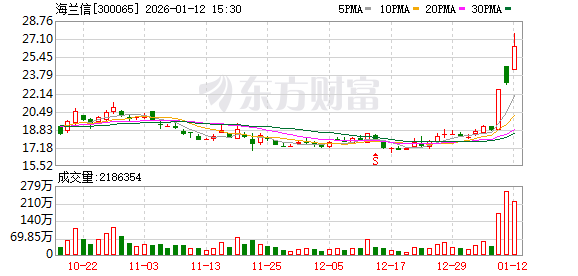
海兰信:关于股价异动的公告
Zheng Quan Ri Bao· 2026-01-12 13:43
(文章来源:证券日报) 证券日报网讯 1月12日,海兰信发布公告称,公司2026年1月8日至12日连续3个交易日收盘价格涨幅偏 离值累计超30%,属异常波动;经自查,前期披露无需更正,经营环境未变,除已披露重大资产重组外 无应披未披事项,控股股东及5%以上股东期间未买卖股票。 ...
海兰信(300065) - 关于股价异动的公告
2026-01-12 09:40
证券代码:300065 证券简称:海兰信 公告编号:2026-001 北京海兰信数据科技股份有限公司 2.公司未发现近期公共传媒报道了可能或者已经对公司股票交易价格产生 较大影响的未公开重大信息。 3.近期公司经营状况及内外部经营环境未发生重大变化。 4.除已经披露的公司正在进行的重大资产重组信息外,公司、控股股东和 实际控制人不存在应披露而未披露的重大事项,或处于筹划阶段的重大事项。 关于股价异动的公告 本公司及其董事会全体成员保证公告内容真实、准确、完整,公告不存在 虚假记载、误导性陈述或重大遗漏。 一、股票交易异常波动情况 北京海兰信数据科技股份有限公司(以下简称"公司")2026年1月8日、2026 年1月9日和2026年1月12日连续三个交易日收盘价格涨幅偏离值累计超过30%, 根据《深圳证券交易所创业板股票上市规则》的有关规定,属于股票交易异常波 动的情况。 二、公司关注并核实情况说明 针对公司股价异常波动,公司对相关事项进行了核实,核实情况如下: 1.公司前期披露的信息不存在需要更正、补充之处。 特此公告。 北京海兰信数据科技股份有限公司董事会 二〇二六年一月十二日 5.股票异常波动期间控股股东 ...
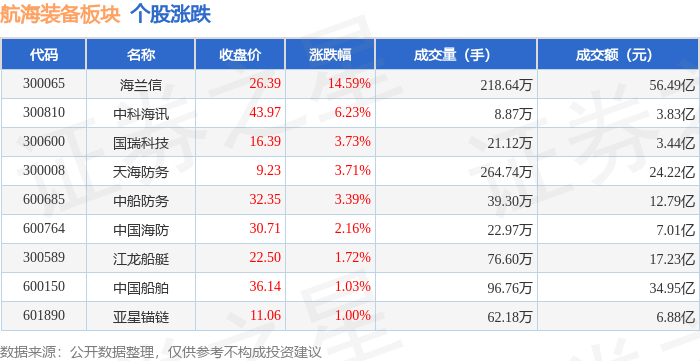
航海装备板块1月12日涨2.03%,海兰信领涨,主力资金净流入2.21亿元
Zheng Xing Xing Ye Ri Bao· 2026-01-12 09:10
Core Insights - The maritime equipment sector experienced a 2.03% increase on January 12, with Hailanxin leading the gains [1] - The Shanghai Composite Index closed at 4165.29, up 1.09%, while the Shenzhen Component Index closed at 14366.91, up 1.75% [1] Sector Performance - Hailanxin (300065) saw a closing price of 26.39, with a significant increase of 14.59% and a trading volume of 2.1864 million shares, amounting to a transaction value of 564.9 million [1] - Other notable performers included: - Zhongmofan (300810) with a closing price of 43.97, up 6.23% [1] - Yuanrui Technology (300600) at 16.39, up 3.73% [1] - Tianhai Defense (300008) at 9.23, up 3.71% [1] - China Shipbuilding (600150) at 36.14, up 1.03% [1] Capital Flow - The maritime equipment sector saw a net inflow of 221 million yuan from institutional investors, while retail investors experienced a net outflow of 30.41 million yuan [1] - Detailed capital flow for key stocks includes: - China Shipbuilding (600150) with a net inflow of 220 million yuan from institutional investors [2] - Tianhai Defense (300008) with a net inflow of 57.1 million yuan from institutional investors [2] - Hailanxin (300065) with a net inflow of 12.64 million yuan from institutional investors [2]