
Reliance Industries

Search documents
科技巨头南亚AI竞赛升级:继微软175亿后,亚马逊宣布在印投资350亿美元
Hua Er Jie Jian Wen· 2025-12-10 06:49
Group 1 - The core point of the article highlights the intensifying AI arms race among global tech giants in the South Asian market, with Amazon committing to invest over $35 billion in India's cloud and AI sectors by 2030 [1][2] - Amazon's investment aligns with India's national priorities, focusing on expanding AI capabilities, enhancing logistics infrastructure, supporting small businesses, and creating job opportunities [1][2] - The investment is expected to create 1 million additional jobs, quadruple export value to $80 billion, and benefit 15 million small businesses through AI technology [1][2] Group 2 - Amazon's new investment builds on nearly $40 billion previously invested in India, including a $26 billion plan announced in 2023, aimed at developing fulfillment centers, data centers, and payment infrastructure [2] - The company aims to significantly increase the cumulative export value of Indian sellers from over $20 billion in the past decade to $80 billion by 2030, with the new jobs encompassing direct, indirect, and seasonal employment [2] - The competition in the Indian market is fierce, with Amazon facing challenges from local players like Flipkart and Reliance Industries, as well as global competitors like Microsoft and Google [3]

TV broadcasters on a sticky wicket: Global cricket economy heads towards major correction on weaker profits, smaller budgets
The Economic Times· 2025-12-10 00:00
Core Insights - The broadcasting industry is facing a significant correction due to shrinking advertising budgets, weaker TV profitability, and ongoing streaming losses, leading to a reassessment of payment capabilities [1][14] - Industry consolidation, particularly the merger of Star India and Viacom18 into JioStar, has reduced competition for major cricket properties, impacting rights pricing [1][12] Broadcasting and Rights Pricing - The previous model where broadcasters absorbed losses while rights owners profited is no longer sustainable, contrasting sharply with the $10 billion committed to cricket in the 2022-23 cycle [2][14] - Rights prices are expected to correct due to consolidation and regulatory changes, with predictions of a 40-50% drop in ICC and BCCI rights and up to a 20% correction in IPL rights [6][15] ICC and Financial Implications - The ICC is in a precarious position, struggling to secure firm bids for its 2026-29 cycle, with no interest shown for its $2.4 billion valuation [8][15] - A decline in India rights income would significantly impact ICC member boards, particularly the BCCI, which contributes nearly 80% of ICC revenue [10][11] Market Dynamics and Future Outlook - The merger of Star India and Viacom18 has led to a substantial reduction in competitive intensity, with both companies previously spending nearly $10 billion on cricket rights [12][15] - Global streaming platforms like Netflix and Amazon Prime Video remain cautious due to misalignment with the advertising economics of live sports, limiting their interest in large cricket packages [13][15]



Reliance-Disney's JioHotstar to invest $444 million in south Indian content, executive says
Reuters· 2025-12-09 13:31
Core Insights - JioHotstar plans to invest $444 million over the next five years to acquire and produce content specifically from South India [1] Company Strategy - The investment is aimed at enhancing JioHotstar's content library and catering to the regional audience in South India [1] - This move is part of a broader strategy by the company to strengthen its position in the competitive streaming market [1] Industry Context - The investment reflects the growing importance of regional content in the Indian streaming industry, as companies seek to attract diverse audiences [1] - The collaboration between Walt Disney and Reliance Industries in this venture highlights the trend of major players investing in localized content to drive subscriber growth [1]


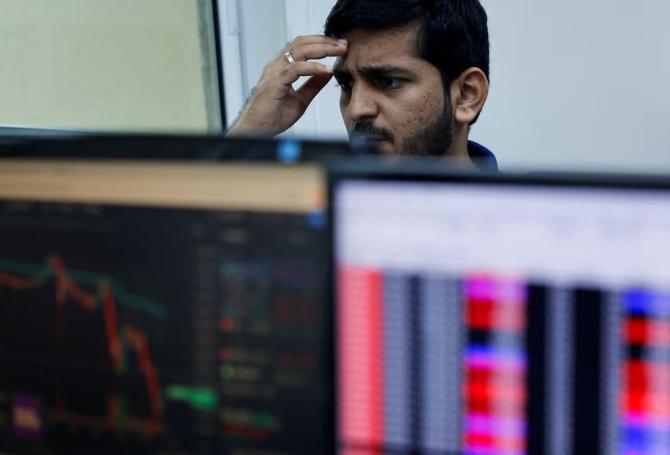
Sensex tanks 610 pts; Nifty slips below 26K
Rediff· 2025-12-08 12:35
Market Overview - Equity benchmark indices Sensex and Nifty experienced significant declines after two days of gains, driven by profit-taking among investors and continued selling by foreign investors [1][4] - The BSE Sensex fell by 609.68 points (0.71%) to close at 85,102.69, while the NSE Nifty dropped by 225.90 points (0.86%) to settle at 25,960.55 [4] Investor Sentiment - Analysts noted that investors adopted a defensive stance ahead of the US Federal Reserve's policy decision, which negatively impacted market sentiment [3][6] - Despite strong domestic growth figures and a recent rate cut by the Reserve Bank of India (RBI), short-term sentiment is clouded by global monetary policy concerns, persistent foreign institutional investor (FII) outflows, and currency depreciation [8] Sector Performance - Among the Sensex constituents, several companies such as Bharat Electronics Ltd, Tata Steel, and Bajaj Finance were among the laggards, while Tech Mahindra and HDFC Bank were the only gainers [5] - The market saw a broad-based decline, with the Nifty slipping below the 26,000 mark as caution prevailed among investors [6] Foreign Investment Activity - Foreign institutional investors offloaded equities worth ₹438.90 crore, while domestic institutional investors purchased stocks worth ₹4,189.17 crore [9] Global Market Context - Other Asian markets showed mixed performance, with South Korea's KOSPI rising by 1.34% and Hong Kong's Hang Seng index falling by 1.23% [9] - The surge in Japanese bond yields to multi-year highs raised concerns about potential unwinding of the yen carry trade, contributing to market volatility [8] Commodity Prices - Brent crude oil prices decreased by 0.61% to $63.37 per barrel, reflecting broader market trends [10]
ICC on a sticky wicket as JioStar seeks to exit deal
The Economic Times· 2025-12-07 18:27
Core Insights - The ICC is initiating a new sale process for India media rights for 2026-29, seeking approximately $2.4 billion, following a previous cycle valued at $3 billion for 2024-27 [1][24] - JioStar has indicated it cannot fulfill its media rights obligations due to significant financial losses, leading the ICC to approach other platforms like Sony, Netflix, and Amazon Prime Video, but interest has been limited due to pricing concerns [1][24] - The Indian market accounts for nearly 80% of ICC revenue, highlighting its critical importance to the sport's financial ecosystem [9][24] Financial Performance - JioStar has more than doubled its provisions for expected losses on sports contracts to ₹25,760 crore for 2024-25, up from ₹12,319 crore the previous year, reflecting the financial strain from long-term sports rights [5][24] - Star India reported a standalone net loss of ₹12,548 crore for the year ending March 31, 2024, primarily due to provisions related to its ICC media rights deal [6][24] - Despite JioStar's losses, the ICC reported a surplus of $474 million in 2024, indicating strong economic fundamentals for cricket [7][24] Market Dynamics - The asking price for ICC media rights remains high, deterring established players like SPNI, which has adopted a conservative approach to cricket rights [10][24] - The ban on real-money gaming has created a significant revenue gap of approximately $840 million (₹7,000 crore) for cricket advertising, further complicating the financial landscape [11][24] - The merger of Star India and Viacom18 into JioStar has resulted in a duopoly in sports broadcasting, limiting options for rights holders like the ICC [17][24] Valuation Concerns - Initial valuations for ICC rights have been viewed as disconnected from market benchmarks, with SPNI bidding around $1.4 billion and Viacom18 approximately $1 billion for combined rights [19][24] - JioStar's financial burden has increased to about $3.3 billion due to rising dollar rates and rupee depreciation, as ICC payments are dollar-denominated [21][25] - Global spending on sports rights is projected to exceed $78 billion by 2030, with Asian spending expected to rise significantly, driven in part by Indian cricket [22][25]
Market recap: Five of top-10 most-valued firms add Rs 72,285 cr in mcap; TCS, Infosys emerge as biggest gainers
The Times Of India· 2025-12-07 09:21
Group 1 - The BSE benchmark closed with a narrow rise of 5.7 points, while the NSE Nifty slipped 16.5 points, indicating a muted market mood [2][3] - Tata Consultancy Services (TCS) saw the largest increase in market capitalization, adding Rs 35,909.52 crore to reach Rs 11,71,862.37 crore [2][3] - Infosys experienced the second-largest growth, increasing its valuation by Rs 23,404.55 crore to end at Rs 6,71,366.53 crore [2][3] Group 2 - Other companies that gained include Bajaj Finance, which advanced by Rs 6,720.28 crore to Rs 6,52,396.39 crore; Bharti Airtel, up by Rs 3,791.9 crore to Rs 12,01,832.74 crore; and ICICI Bank, which gained Rs 2,458.49 crore to reach Rs 9,95,184.46 crore [2][3] - In contrast, Reliance Industries faced the steepest decline, losing Rs 35,116.76 crore to settle at Rs 20,85,218.71 crore [2][3] - LIC also saw a significant drop of Rs 15,559.49 crore, bringing its valuation down to Rs 5,50,021.80 crore [2][3] - State Bank of India fell by Rs 7,522.96 crore to Rs 8,96,662.19 crore, HDFC Bank declined by Rs 5,724.03 crore to Rs 15,43,019.64 crore, and Larsen & Toubro decreased by Rs 4,185.39 crore to Rs 5,55,459.56 crore [2][3]
Mcap of five of top-10 most-valued firms surges ₹72,285 cr; TCS, Infosys biggest winners
BusinessLine· 2025-12-07 06:11
Core Insights - The combined market valuation of five of the top-10 most valued firms increased by ₹72,284.74 crore last week, with Tata Consultancy Services (TCS) and Infosys being the primary beneficiaries [1] Group 1: Gainers - TCS's market capitalization rose by ₹35,909.52 crore, reaching ₹11,71,862.37 crore [2] - Infosys's market capitalization increased by ₹23,404.55 crore to ₹6,71,366.53 crore [2] - Bajaj Finance's valuation climbed by ₹6,720.28 crore to ₹6,52,396.39 crore [2] - Bharti Airtel's market capitalization edged higher by ₹3,791.9 crore to ₹12,01,832.74 crore [2] - ICICI Bank's market capitalization went up by ₹2,458.49 crore to ₹9,95,184.46 crore [2] Group 2: Losers - Reliance Industries' market valuation fell by ₹35,116.76 crore to ₹20,85,218.71 crore [3] - LIC's market capitalization dropped by ₹15,559.49 crore to ₹5,50,021.80 crore [3] - State Bank of India's valuation declined by ₹7,522.96 crore to ₹8,96,662.19 crore [3] - HDFC Bank's market capitalization slid by ₹5,724.03 crore to ₹15,43,019.64 crore [3] - Larsen & Toubro's market capitalization dipped by ₹4,185.39 crore to ₹5,55,459.56 crore [3] Group 3: Market Position - Reliance Industries remains the most-valued domestic firm, followed by HDFC Bank, Bharti Airtel, TCS, ICICI Bank, State Bank of India, Infosys, Bajaj Finance, Larsen & Toubro, and LIC [4]

4 India ETFs Under the Spotlight as RBI Cuts Interest Rate
ZACKS· 2025-12-05 15:51
Core Insights - The Reserve Bank of India's Monetary Policy Committee cut the key repo rate by 25 basis points to 5.25%, marking the fourth rate cut in 2025 and a cumulative reduction of 125 basis points for the year [1][7] Market Reaction - The announcement led to a rally in India's equity markets, with the Sensex gaining around 300 points and the Nifty rising 100 points shortly after the market opened [1] - Rate-sensitive sectors such as real estate, banking, and automobiles experienced pronounced gains, with the Nifty Realty index increasing by 1.5%, Nifty Bank by 0.65%, and Nifty Auto by 0.4% [2] Economic Context - The rate cut was influenced by low inflation and strong economic growth, with the FY26 GDP forecast revised upward to 7.3% from 6.8% [5][6] - The consumer price index (CPI) headline retail inflation fell to approximately 0.25% in October, contributing to the favorable policy environment [6] Impact on Corporate Valuations - Lower borrowing costs from the rate cut are expected to boost corporate profitability and demand for major purchases, benefiting sectors like banking, real estate, and automobiles [8] - The reduction in interest rates will also enhance corporate valuations by decreasing the discount factor used in financial models, justifying higher equity valuations [9] Investment Opportunities - Exchange-Traded Funds (ETFs) are highlighted as a means for investors to gain broad exposure to high-growth sectors in the current market environment [11] - ETFs typically have lower expense ratios compared to actively managed funds, providing liquidity and transparency, making them suitable for both tactical and long-term investment strategies [12] Recommended ETFs - **iShares MSCI India ETF (INDA)**: Net assets of $9.51 billion, exposure to 164 companies, year-to-date gain of 2.1%, fees of 62 basis points [13] - **WisdomTree India Earnings Fund (EPI)**: Total assets of $2.79 million, exposure to 544 companies, year-to-date gain of 0.9%, fees of 84 basis points [14] - **iShares India 50 ETF (INDY)**: Total assets of $685.6 million, exposure to 50 large stocks, year-to-date gain of 4.1%, fees of 65 basis points [15] - **Franklin FTSE India ETF (FLIN)**: Total assets of $2.64 billion, exposure to 273 companies, year-to-date gain of 1.8%, fees of 19 basis points [16]

X @Bloomberg
Bloomberg· 2025-12-04 12:14
In today’s India Edition, Saritha Rai writes what Microsoft CEO Nadella’s visit and billionaire Mukesh Ambani’s empire mean for India’s AI future.. https://t.co/1WU438aXxd ...
X @Bloomberg
Bloomberg· 2025-12-04 09:07
Reliance Industries has started work on an initial draft prospectus for a listing of Jio Platforms in what is expected to be India’s biggest-ever initial public offering https://t.co/Lrz7MrQhRh ...