瑞声科技

Search documents
浪涌潮退
Zhao Yin Guo Ji· 2025-12-18 11:06
Macro Economic Outlook - In 2026, the U.S. midterm elections, Japan and Europe’s defense spending demands, and China's growth stabilization will lead to continued policy easing in the first half of the year. However, the actual space for macro policy is limited due to high inflation, rising government debt, and previous policy overreach [7] - The AI boom is expected to enhance efficiency and market valuations but may also exacerbate job losses and economic K-shaped divergence. Global liquidity easing and a weaker dollar may lead to rising inflation in the second half of the year, potentially causing volatility in high-valuation assets [7] Chinese Internet Software Sector - 2026 is seen as a critical year for capturing user mindshare in the AI era, focusing on lowering usage barriers and enhancing decision-making efficiency. Companies with stable cash flows supporting AI investments and strong operational capabilities are expected to have higher long-term investment value [8] - Recommended stocks include Tencent, Alibaba, and Kuaishou for AI-driven growth, and NetEase and Trip.com for stable earnings growth [8] Overseas Internet Software Sector - The competition in the large model industry is expected to intensify, with AI application monetization continuing to grow. Companies like Microsoft, Google, Amazon, and Palantir are recommended for their potential in AI revenue generation [9] Chinese Semiconductor Sector - The sector is expected to focus on AI-driven structural growth, self-sufficiency trends, high-yield defensive allocations, and industry consolidation. The global semiconductor market is projected to grow by 26% to $975 billion in 2026, with AI-related segments leading the growth [10] Chinese Technology Sector - The global tech industry will experience demand differentiation and accelerated AI innovation. The expansion of computing power and the introduction of AI products are expected to drive growth, with a focus on AI infrastructure and end-user AI products [11] Chinese Essential Consumer Sector - The core constraint on consumer spending in 2026 is expected to be asset shrinkage and slow income recovery. Investment themes include the deepening of consumer stratification and a focus on essential survival needs [12] Chinese Discretionary Consumer Sector - The overall retail sales growth is projected to slow to about 3.5% in 2026. Investment strategies should focus on survival-type consumption, compensatory consumption, and defensive stocks [13] Chinese Automotive Sector - Despite pressures from subsidy reductions, the automotive industry is expected to show resilience, with retail sales of passenger vehicles projected to remain stable. Key trends include intensified competition and the growth of plug-in hybrid vehicles [14] Chinese Pharmaceutical Sector - The innovative drug sector has seen significant growth driven by overseas licensing deals. Future catalysts are expected to shift from upfront payments to milestone payments as clinical progress is made [15] Chinese Equipment Manufacturing Sector - The mining machinery sector is anticipated to be a major growth area, driven by high capital expenditures from global mining companies. Companies like Zoomlion and Sany Heavy Industry are expected to benefit [16] Natural Uranium Sector - The global supply of natural uranium is expected to remain tight, supporting a rising price trend. Demand may exceed expectations due to the recovery of U.S. nuclear power plants [17] Chinese Insurance Sector - The life insurance sector is undergoing a transformation towards dividend insurance, with expectations of improved profitability and valuation recovery. Companies like Ping An and China Life are recommended for their strong growth potential [18] Chinese Real Estate and Property Management Sector - The real estate market is expected to face continued sales declines, with a focus on stock market-related opportunities and resilient property management companies. Recommendations include China Resources and Beike [19]






瑞声科技(02018)12月18日斥资565.28万港元回购15万股
智通财经网· 2025-12-18 09:47
智通财经APP讯,瑞声科技(02018)发布公告,于2025年12月18日,该公司斥资565.28万港元回购15万股 股份,每股回购价37.46-37.92港元。 ...
瑞声科技12月18日斥资565.28万港元回购15万股
Zhi Tong Cai Jing· 2025-12-18 09:45
瑞声科技(02018)发布公告,于2025年12月18日,该公司斥资565.28万港元回购15万股股份,每股回购价 37.46-37.92港元。 ...
瑞声科技(02018.HK)12月18日耗资565.28万港元回购15万股
Ge Long Hui· 2025-12-18 09:42
格隆汇12月18日丨瑞声科技(02018.HK)发布公告,2025年12月18日耗资565.28万港元回购15万股,回购 价格每股37.46-37.92港元。 ...
瑞声科技(02018) - 翌日披露报表
2025-12-18 09:37
表格類別: 股票 狀態: 新提交 公司名稱: 瑞聲科技控股有限公司(於開曼群島註冊成立之有限公司) 呈交日期: 2025年12月18日 如上市發行人的已發行股份或庫存股份出現變動而須根據《香港聯合交易所有限公司(「香港聯交所」)證券上市規則》(「《主板上市規則》」)第13.25A條 / 《香港聯合交易所有限公司GEM證券 上市規則》(「《GEM上市規則》」)第17.27A條作出披露,必須填妥第一章節 。 FF305 翌日披露報表 (股份發行人 ── 已發行股份或庫存股份變動、股份購回及/或在場内出售庫存股份) | 第一章節 | | | | | | | | | --- | --- | --- | --- | --- | --- | --- | --- | | 1. 股份分類 | 普通股 | 股份類別 | 不適用 | | 於香港聯交所上市 | 是 | | | 證券代號 (如上市) | 02018 | 說明 | | | | | | | A. 已發行股份或庫存股份變動 | | | | | | | | | | | | 已發行股份(不包括庫存股份)變動 | | 庫存股份變動 | | | | | 事件 | 已發行股份(不包 ...
瑞声科技(02018.HK)12月17日回购15.00万股,耗资570.18万港元
Zheng Quan Shi Bao Wang· 2025-12-17 13:19
瑞声科技回购明细 自12月15日以来公司已连续3日进行回购,合计回购36.45万股,累计回购金额1393.75万港元。 其间该 股累计下跌2.26%。 | 2025.02.25 | 29.15 | 48.350 | 46.350 | 1386.02 | | --- | --- | --- | --- | --- | | 2025.02.24 | 36.15 | 49.600 | 46.850 | 1722.86 | | 2025.02.21 | 1.00 | 50.050 | 49.450 | 49.83 | | 2025.02.20 | 1.00 | 49.750 | 48.850 | 49.38 | | 2025.02.19 | 1.15 | 48.950 | 46.600 | 55.32 | | 2025.02.18 | 16.85 | 47.650 | 46.700 | 793.36 | | 2025.02.17 | 60.10 | 46.900 | 45.500 | 2768.47 | | 2025.02.14 | 1.00 | 48.750 | 47.300 | 48.10 | | 2025.02 ...
领益智造赴港IPO:大客户依赖下增收不增利 多元化布局成效寥寥 此次递表恰逢“果链”估值回调期
Xin Lang Cai Jing· 2025-12-17 09:51
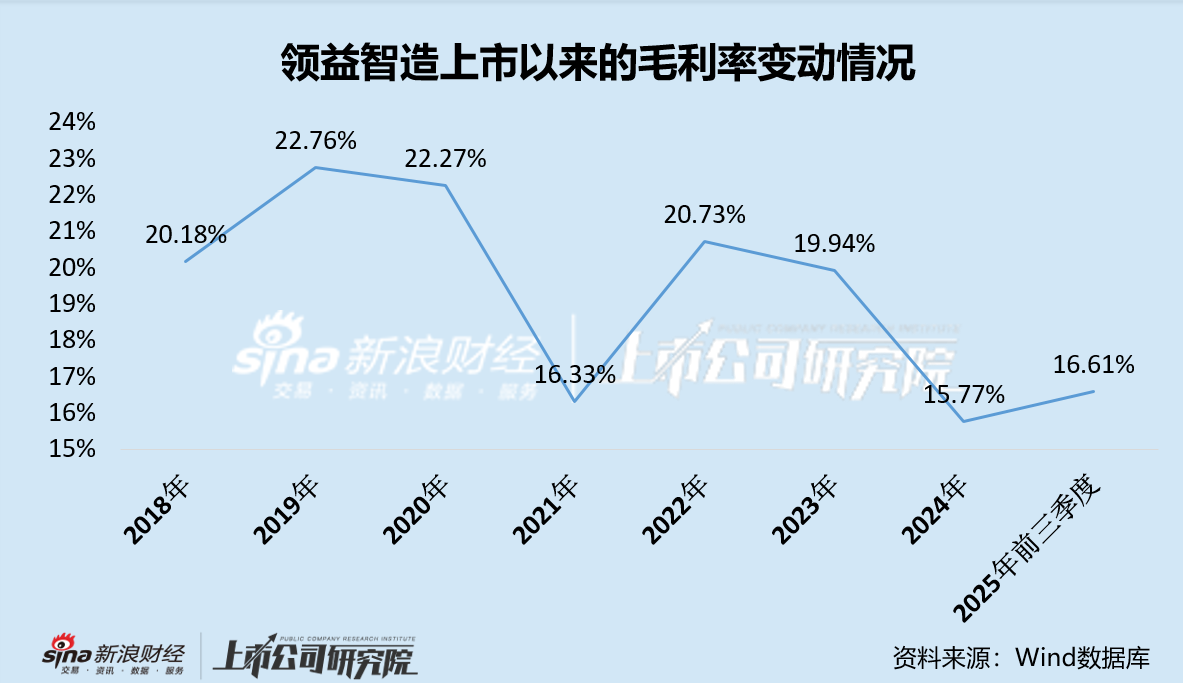
Core Viewpoint - Lingyi Technology is seeking a dual listing on the Hong Kong Stock Exchange, positioning itself as a global core AI hardware precision manufacturing platform, despite its business structure remaining largely unchanged [1]. Group 1: Company Overview - Lingyi Technology was established in 2006 and initially entered the consumer electronics market through die-cutting technology, later becoming part of Apple's supply chain in 2008 [2]. - The company achieved a significant revenue increase from 22.5 billion yuan in 2018 to 44.2 billion yuan in 2024, effectively doubling its revenue [2]. - The reliance on major clients has increased, with revenue from the top five clients rising from 44.26% in 2020 to 56.04% in the first three quarters of 2025 [2]. Group 2: Financial Performance - Despite doubling revenue, the net profit attributable to shareholders has fluctuated, decreasing from 1.894 billion yuan in 2019 to 1.753 billion yuan in 2024, with a peak of no more than 2.3 billion yuan [3]. - The gross margin has declined from over 22% in 2019-2020 to around 15% in recent years, with 2024's gross margin at 15.77% and the first three quarters of 2025 at 16.61% [3]. Group 3: Market Challenges - The company has faced significant impacts from shifts in downstream customer procurement needs, particularly in 2021 and 2024, leading to a drop in overall gross margin [5]. - The performance and stock price of Lingyi Technology are heavily influenced by its major clients, a common issue among "fruit chain" companies [6]. Group 4: Diversification Efforts - To mitigate reliance on Apple, Lingyi Technology is pursuing diversification through acquisitions and investments, targeting automotive and intelligent robotics sectors [12]. - Recent acquisitions include a 95% stake in Zhejiang Jintai for 38 million yuan and stakes in Jiangsu Keda and Zhejiang Xianglong for 3.32 billion yuan and 2.404 billion yuan, respectively [13]. - The automotive business, while growing rapidly, accounted for only 5% of total revenue in the first half of 2025, indicating a slow diversification process [15]. Group 5: Business Structure and Revenue Breakdown - In 2024, the revenue from AI terminal products reached 40.731 billion yuan, while automotive and low-altitude economy segments generated 2.117 billion yuan [14]. - The automotive sector's gross margin is significantly lower than traditional business lines, with 2024's gross margin at only 1.71% [15].


瑞声科技(02018.HK)12月17日耗资570.18万港元回购15万股
Ge Long Hui· 2025-12-17 09:23
格隆汇12月17日丨瑞声科技(02018.HK)发布公告,2025年12月17日耗资570.18万港元回购15万股,回购 价格每股37.56-38.36港元。 ...
瑞声科技(02018) - 翌日披露报表
2025-12-17 09:20
FF305 翌日披露報表 (股份發行人 ── 已發行股份或庫存股份變動、股份購回及/或在場内出售庫存股份) 表格類別: 股票 狀態: 新提交 公司名稱: 瑞聲科技控股有限公司(於開曼群島註冊成立之有限公司) 呈交日期: 2025年12月17日 若股份曾以超過一個每股價格發行/出售/購回/贖回,則須提供每股成交量加權平均價格。 若購回/贖回股份將於期終結存日期之後購回/贖回結算完成之時予以註銷,則該等購回/贖回股份仍屬A部所述期終結存當日的已發行股份的一部分。該等購回/贖回股份的詳情應在B部作 出披露。 如上市發行人的已發行股份或庫存股份出現變動而須根據《香港聯合交易所有限公司(「香港聯交所」)證券上市規則》(「《主板上市規則》」)第13.25A條 / 《香港聯合交易所有限公司GEM證券 上市規則》(「《GEM上市規則》」)第17.27A條作出披露,必須填妥第一章節 。 | 第一章節 | | | | | | | | --- | --- | --- | --- | --- | --- | --- | | 1. 股份分類 | 普通股 | 股份類別 不適用 | | 於香港聯交所上市 | 是 | | | 證券代號 (如 ...
瑞声科技于12月16日斥资437.3万港元回购11.45万股
Xin Lang Cai Jing· 2025-12-17 01:17
瑞声科技(02018)发布公告,于2025年12月16日,该公司斥资437.3万港元回购11.45万股股份,每股回 购价格为37.8-38.5港元。 热点栏目 自选股 数据中心 行情中心 资金流向 模拟交易 客户端 瑞声科技(02018)发布公告,于2025年12月16日,该公司斥资437.3万港元回购11.45万股股份,每股回 购价格为37.8-38.5港元。 责任编辑:卢昱君 责任编辑:卢昱君 热点栏目 自选股 数据中心 行情中心 资金流向 模拟交易 客户端 ...