
Illumina

Search documents
2024年国内测序仪收入同比增11.37%,基因测序仪龙头华大智造稳拿国内市占率第一
Ge Long Hui· 2025-04-29 15:03
值得一提的是,2024年公司实现了对"激发光""自发光""不发光"三种技术路径基因测序产品的全方位战 略布局,成为全球首个同时拥有大规模商业量产级短读长与长读长测序产品的企业,构建了以"全读 长"(SEQ ALL)为目标的全流程工具矩阵。 4月29日晚间,华大智造发布年报显示,2024年基因测序仪业务收入23.48亿元,其中国内测序仪新增装 机市占率63.8%,连续三年登顶。在2024年多家A股医械行业龙头企业业绩下滑、国际同业巨头裁员亏 损的寒冬中,公司以28.2%的全球测序仪新增装机份额逆势突围,较上年提升9.5个百分点,创历史同期 新高。 国产替代进程因政策东风加速,灼识咨询数据显示,中国基因测序仪及耗材市场规模从2017年约30亿元 人民币增至2024年约43亿元人民币,并预计于2032年达到约100亿元人民币。2024年,华大智造国内区 域基因测序仪业务相关收入实现16.07亿元,同比增11.37%,国内新增测序仪销售装机超1000台。公司 测序设备在国内市场新增装机的市场份额连续三年位居国内第一,并在国内疾控、海关、环境、食品安 全及农业等新兴应用领域实现了新增测序仪市场占有率第一。 随着美国基因 ...

专家访谈:医疗+AI落地成熟度分析
雪球· 2025-03-30 06:22
长按即可参与 3、AI医疗产业端落地成熟度,影像→体外诊断→医疗机器人→制药→慢病管理→医疗信息化。 4、AI+诊断领域: 1)体外诊断公司:主业有业绩压力,但需给予AI属性估值溢价。关注与大厂绑定深、落地成熟的 公司。 2)影像公司:如联影,在设备市场铺设、市占率、数据授权上有优势。 3)业绩变好公司:对主业业绩有包容度,关注可能迎来拐点的公司。 风险提示:本文所提到的观点仅代表个人的意见,所涉及标的不作推荐,据此买卖,风险自负。 作者: 巴菲特读书会 来源:雪球 1、AI医疗产业整体前景大,能够赋能医疗产业端公司的传统业务,提升其盈利能力,并在客户绑 定、新客户开拓上提供帮助。 2、在患者端,AI医疗可以提高了医疗资源的可及性,使得偏远地区的人能够触达到高等级的医疗 资源(医疗资源平权);还可以减少漏诊和误诊,提高诊断的准确性(诊断准确性);以及AI制 药如果成功,患者将受益(制药)。 4)细分领域数据公司:如华大智造,除数据、AI逻辑外,还受Illumina被禁入中国市场影响。 5、AI+医院/医生:AI能提高医生和医院的诊断治疗能力;对医院和医生的运营效率有帮助。 6、AI+慢病管理:看好AI慢病管理 ...


Molecular Breeding Market Insights, Competitive Intelligence and Growth Forecast 2025-2030 - CRISPR and Genomic Advances are Driving Crop Innovation
Globenewswire· 2025-03-11 11:46
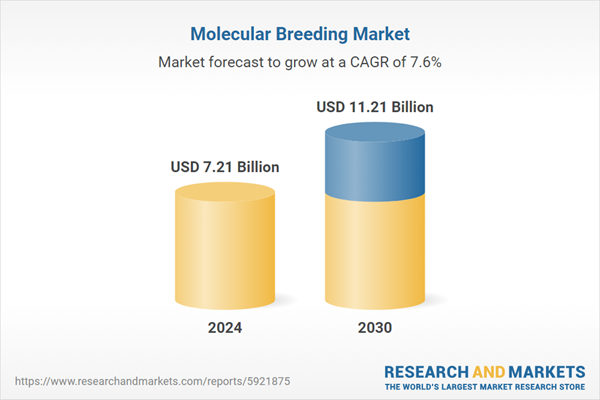
Core Insights - The Molecular Breeding Market was valued at USD 7.21 Billion in 2024 and is projected to reach USD 11.21 Billion by 2030, with a compound annual growth rate (CAGR) of 7.63% [2][16] - The market is driven by the need for increased agricultural productivity to meet the demands of a growing global population amidst environmental challenges [4][5] Market Drivers - Technological advancements in molecular biology, genomics, and bioinformatics are key drivers of growth, enabling precision in crop improvement and reducing the time required for developing new crop varieties [6][10] - The integration of advanced genomic technologies, such as next-generation sequencing and CRISPR-Cas9, allows for rapid analysis and precise modification of crop genomes, enhancing yield and resistance to diseases [10][11][13] Market Challenges - High initial investments in infrastructure, technology, and skilled personnel create financial barriers for entry into the molecular breeding market, particularly for smaller players [7][8][9] - The challenge lies in democratizing access to advanced molecular breeding technologies to ensure equitable opportunities for all stakeholders [8][9] Market Trends - The market is witnessing increased investments in research and development to leverage genomic advancements, promising a future where crops are tailored to meet evolving consumer preferences and climate challenges [12][13] - Collaborative efforts and innovative funding models are emerging as strategies to overcome financial hurdles and unlock the potential of molecular breeding [9]
医药生物周报(25年第10周):Illumina被禁止向中国出口测序仪,国产替代有望加速-2025-03-11
Guoxin Securities· 2025-03-11 09:44
Investment Rating - The report maintains an "Outperform" rating for the pharmaceutical and biotechnology sector [5][4]. Core Insights - The ban on Illumina's export of sequencing instruments to China is expected to accelerate domestic alternatives, with companies like BGI Genomics likely to capture significant market share [2][14]. - The overall performance of the pharmaceutical sector has been weaker than the broader market, with a TTM P/E ratio of 31.19x, which is at the 54.01 percentile of the past five years [1][51]. Market Overview - The A-share market rose by 1.90% overall, with the healthcare services sector leading at 2.63%, while the biotechnology sector increased by 1.06% [1][44]. - The market for global sequencing instruments and consumables is projected to grow from approximately $2.8 billion in 2017 to about $20.2 billion by 2032, with a CAGR of 16.8% [19]. Company Performance and Recommendations - Illumina holds a 26.5% share of the new sequencing instrument market in China, with an expected revenue of $310 million in 2024 [2][14]. - BGI Genomics is positioned to gain the largest share of the newly available market due to its established solutions and market foundation [2][14]. - Other domestic companies such as Aihua Long, Shengxiang Biology, Antu Biology, and Zhenmai Biology are also expected to benefit from this market shift [2][14]. Valuation and Investment Strategy - The report suggests focusing on high-quality domestic manufacturers of sequencing instruments, such as BGI Genomics, Aihua Long, Shengxiang Biology, and Antu Biology [2][14]. - The report continues to recommend innovative pharmaceuticals and AI healthcare as key investment themes, highlighting companies like Kangfang Biologics, Keren Biotechnology, and Sanofi [3][4]. Key Company Forecasts - Major companies in the sector, including Mindray Medical and WuXi AppTec, are rated as "Outperform" with projected net profits increasing from 115.8 billion yuan in 2023 to 176.4 billion yuan by 2026 [4][7]. - The report emphasizes the importance of innovation in driving growth within the pharmaceutical industry, particularly in the context of digital transformation and AI integration [3][4].
嘉必优拟高溢价并购欧易生物
IPO日报· 2025-03-10 10:37
星标 ★ IPO日报 精彩文章第一时间推送 近期,嘉必优生物技术(武汉)股份有限公司(下称"嘉必优")公告称,拟以发行股份及支付现金的方式向王树伟、董栋等13名交易对方购买欧易 生物63.2134%的股权,并募集配套资金,交易价格8.31亿元。 嘉必优在2024年营收和净利润双增长,但其在2021年—2023年净利润波动剧烈。2023年净利润虽有所回升,但风险仍存。此次,公司以8.31亿元的溢价收 购欧易生物,未来业绩兑现存不确定性,机遇与挑战并存。 制图:佘诗婕 01 净利润不稳定 嘉必优成立于2004年,2019年12月在科创板上市。公司是国内较早从事微生物合成法生产多不饱和脂肪酸及脂溶性营养素的企业之一。主要产品为多不饱 和脂肪酸ARA(花生四烯酸)、藻油DHA(二十二碳六烯酸)等。这些产品广泛应用于婴幼儿配方食品、膳食营养补充剂、健康食品、特殊医学用途配 方食品以及动物营养、个护美妆等领域。客户方面,其与雀巢、达能、嘉吉、飞鹤、伊利、君乐宝等国内外知名企业建立了长期的合作关系。 2024年,嘉必优实现了营收和净利润的双增长。其营收为5.55亿元,同比增长25.06%;归母净利润为1.24亿元,同比增长 ...

AI如何赋能基因测序行业
2025-03-09 13:19
Summary of Key Points from the Conference Call on the Gene Sequencing Industry Industry Overview - The domestic gene sequencing industry in China has developed rapidly, with early entrants like BGI and the establishment of companies like GeneMind in 2012, which adopted different technological approaches [2][7] - The industry has seen significant advancements in non-invasive prenatal testing (NIPT) and cancer drug guidance applications, especially during the COVID-19 pandemic [2][3] Core Insights and Arguments - **Technological and Regulatory Barriers**: The gene sequencing industry has high technological and regulatory barriers due to its interdisciplinary nature, requiring expertise in optics, fluid mechanics, and software development [4] - **Market Dominance of Second-Generation Sequencing**: Second-generation sequencing (NGS) will continue to dominate the market in the next five years, while third-generation sequencing is still exploring its application scenarios [6][8] - **Impact of U.S. Sanctions**: Chinese gene sequencing companies have been placed on a sanctions list, but domestic platforms are capable of replacing foreign products, particularly in clinical applications [7][8] - **Data Security Concerns**: The ban on U.S. testing instruments is linked to economic security and data leakage risks, prompting a shift towards domestic testing solutions [9][10] - **AI Integration**: AI plays a crucial role in processing gene sequencing data, particularly in primary and secondary analyses, helping to reduce costs [22][23] Additional Important Content - **Clinical and Research Applications**: The clinical use of gene sequencing is expected to become more widespread, with early cancer detection technologies being a key focus area [25][26] - **Emerging Competitors**: New competitors may emerge in the gene sequencing market as existing patents expire, leading to innovation and new applications [15] - **Market Adaptation**: Chinese companies need to diversify their product offerings and improve usability to meet market demands [21] - **Future of Gene Sequencing**: The industry is expected to significantly reduce genetic defects and transform cancer into a manageable chronic disease through advancements in early detection technologies [39] Conclusion The gene sequencing industry in China is poised for growth, driven by technological advancements, regulatory adaptations, and the integration of AI. The shift towards domestic solutions in response to international sanctions presents both challenges and opportunities for local companies. The focus on early detection and personalized medicine will likely shape the future landscape of healthcare.
Grail, Inc.(GRAL) - 2024 Q4 - Earnings Call Transcript
2025-02-21 03:09
Financial Data and Key Metrics Changes - In Q4 2024, the company reported revenue of $38.3 million, an increase of $7.9 million or 26% compared to Q4 2023 [17] - Full-year revenue for 2024 was $125.6 million, up 35% from 2023, with screening revenue of $108.6 million, reflecting a 45% increase year-over-year [18] - The net loss for Q4 2024 was $97.1 million, an improvement of 48% compared to Q4 2023, while the full-year net loss was $2 billion, an increase of $561 million or 38% from 2023 [19][20] - Non-GAAP adjusted gross profit for Q4 2024 was $17.9 million, up 17% from Q4 2023, and for the full year, it was $57.8 million, an increase of 44% from 2023 [21][22] - The company ended the year with a cash position of $766.8 million and expects cash burn for 2025 to be no more than $320 million, a projected decrease of over 40% from 2024 [23][24] Business Line Data and Key Metrics Changes - U.S. Galleri revenue grew by 45% year-over-year, with over 137,000 tests sold throughout 2024, including more than 40,000 tests in Q4 [9][19] - Development services revenue for Q4 2024 was $6.7 million, a decrease of 13% compared to Q4 2023, while full-year development service revenue was $17 million, down 6% from 2023 [18][19] Market Data and Key Metrics Changes - The U.S. Military's TRICARE health insurance program has added the Galleri test to its list of covered benefits for patients aged 50 and older with an elevated risk of cancer [13][14] Company Strategy and Development Direction - The company aims to drive multi-cancer early detection as a new standard of care and is focused on scalability and cost efficiency following the launch of an updated version of the Galleri test [25][26] - The company is in the final stages of data collection for its registrational studies and anticipates completion of its modular PMA submission with the FDA in the first half of 2026 [26] Management's Comments on Operating Environment and Future Outlook - Management expressed confidence in the company's financial position and momentum, highlighting strong growth for Galleri and improved cost efficiency [25][26] - The company has built in flexibility to cover potential delays in FDA submission timelines, with a cash runway extending into 2028 [66][68] Other Important Information - The company has implemented a significant restructure to extend its capital runway and is focused on reducing its spending profile [9][23] Q&A Session Summary Question: Details on the new Galleri test and pricing flexibility - Management indicated that the new version of the test allows for a reduction in COGS and potential pricing flexibility, but elasticity testing has not yet been conducted [30][38] Question: Current events regarding MCED legislation - Management remains encouraged by the reintroduction of the MCED bill and its bipartisan support, with no significant changes in the level of support [31][40] Question: Collaboration with Quest Diagnostics and TRICARE - Management confirmed that the collaboration with Quest and the TRICARE news were considered in the 2025 guidance, with no changes to the guidance at this time [44][48] Question: Success metrics for the PATHFINDER 2 study - The main endpoints for the PATHFINDER 2 study include traditional measures of test performance and safety, with results expected to be part of the final modular submission to the FDA [57][60] Question: Impact of cash preservation initiatives on payer coverage - Management stated that there have been no changes to cash preservation initiatives and that the restructuring provides a cash runway into 2028 [61][62] Question: Impact of FDA submission timelines on cash burn - Management believes they have built in flexibility to cover any potential delays in FDA submission timelines, maintaining confidence in the current timeline [66][68] Question: Impact of recent AI developments on Q1 results - Management indicated that while AI presents long-term opportunities, there has been no immediate impact on Q1 results [70]

Illumina(ILMN) - 2024 Q4 - Annual Report
2025-02-12 21:21
Revenue Performance - Revenue decreased by 3% in 2024 to $4.4 billion compared to $4.5 billion in 2023, primarily due to a decrease in sequencing instruments revenue[170]. - Total revenue for the year ended December 29, 2024, was $4,372 million, a decrease of 2.9% from $4,504 million in 2023[258]. - Product revenue decreased to $3,656 million in 2024 from $3,787 million in 2023, representing a decline of 3.5%[258]. - Core Illumina consumables revenue increased by 2% to $3.169 billion in 2024, primarily due to an increase in NovaSeq X consumables[173]. - Core Illumina instruments revenue decreased by 29% to $501 million in 2024, driven by fewer shipments of high-throughput instruments[173]. - Revenue from product sales is recognized upon delivery to the end customer, with invoicing typically occurring upon shipment and payment due within 30 days[294]. - Revenue from Greater China was $308 million in 2024, down from $384 million in 2023, a decline of 19.8%[353]. - Americas revenue was $2,441 million in 2024, down from $2,521 million in 2023, a decline of 3.2%[353]. Financial Performance - Gross margin increased to 65.4% in 2024 from 60.9% in 2023, driven by operational excellence initiatives and a favorable revenue mix[170]. - Loss from operations improved to $0.8 billion in 2024 from $1.1 billion in 2023, due to a decrease in operating expenses and an increase in gross profit[171]. - The net loss for 2024 was $1,223 million, compared to a net loss of $1,161 million in 2023, reflecting a $62 million increase[187]. - The company reported a net loss of $1,223 million for the year ended December 29, 2024, compared to a net loss of $1,161 million in 2023[258]. - The company incurred a goodwill and intangible asset impairment of $1,889 million in 2024, compared to $827 million in 2023, reflecting a significant increase[268]. - The company recorded a net unrealized loss of $310 million on marketable equity securities in 2024[360]. Cash Flow and Investments - Cash, cash equivalents, and short-term investments totaled $1.220 billion at the end of 2024, with approximately $439 million held by foreign subsidiaries[171]. - Net cash provided by operating activities in 2024 was $837 million, a significant increase from $478 million in 2023[202]. - Net cash used in investing activities was $178 million in 2024, including $128 million in capital expenditures and $81 million for an acquisition[205]. - The company issued $500 million in 2026 Term Notes in September 2024, with net proceeds of $497 million used to repay part of the outstanding debt[193]. - The company anticipates that current cash, cash equivalents, and short-term investments are sufficient to fund near-term capital and operating needs for at least the next 12 months[201]. Operational Efficiency - Core Illumina's R&D expense decreased by $42 million, or 4%, in 2024, primarily due to reductions in headcount and employee compensation costs[180]. - Core Illumina's SG&A expense decreased by $348 million, or 28%, in 2024, mainly due to gains on GRAIL contingent consideration liability and reduced restructuring charges[181]. - Total consolidated operating expense decreased by $119 million, or 3%, from $3,813 million in 2023 to $3,694 million in 2024[180]. Strategic Initiatives - Strategic goals for 2025 include a focus on returning to revenue growth and further progress in operational excellence initiatives[169]. - The company plans to continue advancing research and development efforts and may pursue strategic acquisitions to enhance product offerings[202]. GRAIL Spin-Off - The Spin-Off of GRAIL on June 24, 2024, resulted in Illumina retaining approximately 14.5% of GRAIL common stock[165]. - The company completed the Spin-Off of GRAIL on June 24, 2024, distributing approximately 85.5% of GRAIL's outstanding common stock to Illumina stockholders[272]. - The cash contribution to GRAIL for 2.5 years of operations was determined to be $974 million, net of cash and cash equivalents held by GRAIL[346]. Impairment and Valuation - GRAIL's goodwill and intangible impairment in 2024 was $1,886 million, significantly higher than the $821 million in 2023[183]. - The impairment assessment of GRAIL IPR&D involved significant estimation uncertainty, particularly regarding forecasted revenues and discount rates[251]. - The company recorded an impairment loss of $420 million related to GRAIL in-process research and development (IPR&D), with a carrying value of $140 million post-assessment[250]. Tax and Interest - The effective tax rate was (3.8)% in 2024, impacted by non-deductible goodwill impairment and the reversal of a fine related to the GRAIL acquisition[171]. - Interest income decreased by $12 million, or 21%, to $46 million in 2024, while interest expense increased by $23 million, or 30%, to $100 million[185]. Market and Currency - The total notional amounts of outstanding forward contracts for foreign currency purchases was $621 million as of December 29, 2024, used to hedge portions of foreign currency exposure associated with forecasted revenue transactions[237]. - The company had foreign exchange forward contracts in place to hedge exposures in multiple currencies, including euro and Japanese yen, as of December 29, 2024[327].

Illumina(ILMN) - 2024 Q4 - Earnings Call Transcript
2025-02-07 02:33
Financial Data and Key Metrics Changes - In Q4 2024, Illumina reported revenue of $1.1 billion, reflecting approximately 1% growth year-over-year, driven primarily by consumables [15][34] - Non-GAAP gross margins for Q4 were 67.4%, an increase of 270 basis points year-over-year, attributed to operational excellence initiatives and growth in consumables [37] - Non-GAAP EPS for Q4 was $0.95, exceeding expectations due to higher revenue and a lower tax rate [39] Business Line Data and Key Metrics Changes - Sequencing consumables revenue was $698 million, growing approximately 2% year-over-year, driven by the transition to NovaSeq X [35] - Sequencing instruments revenue declined 3% year-over-year to $155 million, primarily due to a decrease in mid-throughput shipments [36] - Total sequencing GB output grew over 30% year-over-year, indicating robust growth from both clinical and research customers [36] Market Data and Key Metrics Changes - Revenue from the Americas, which constitutes more than half of Illumina's business, increased by 3% year-over-year [17] - EMEA revenue decreased by 10%, while Greater China revenue increased by 1% [17] Company Strategy and Development Direction - Illumina aims to return to revenue growth in 2025 and achieve high single-digit growth by 2027, focusing on customer collaboration, continuous innovation, and operational excellence [13][18] - The company is transitioning to the NovaSeq X series, with expectations that over 75% of high-throughput gigabases will be shipped on this platform by mid-2025 [44] - Illumina is enhancing partnerships, such as with NVIDIA, to leverage AI tools for better data analysis and interpretation [19][144] Management's Comments on Operating Environment and Future Outlook - Management is closely monitoring the evolving political and macroeconomic environment, particularly regarding research funding and the recent announcements from China [27][42] - For 2025, Illumina expects low single-digit revenue growth and a non-GAAP operating margin of approximately 23%, reflecting a 170 basis points improvement from 2024 [28][46] - The company remains committed to supporting global customers and advancing scientific discovery through genomics [28] Other Important Information - Illumina achieved over $100 million in cost savings in 2024 through improved manufacturing and logistics efficiencies [26] - The company ended Q4 with approximately $1.22 billion in cash and short-term investments, indicating a strong cash generation profile [41] Q&A Session Summary Question: Update on China revenue mix and guidance implications - Management acknowledged that China represents about 7% of total revenue and is assessing the situation, but did not provide detailed financials [57][58] Question: Insights on Q1 revenue cadence - Management indicated that top-line growth is expected to be stronger in the second half of the year, driven by the NovaSeq X transition [60] Question: Volume growth and pricing dynamics - Management noted that volume growth is expected to remain strong, with mid-20% growth anticipated in the longer term [69] Question: Clarification on clinical transition and gigabyte shipments - Management stated that approximately 50% of clinical volume has transitioned to the NovaSeq X series, with expectations for further growth [77] Question: Margin protection strategies amid China uncertainties - Management is exploring all opportunities for margin expansion and operational leverage, aiming for 170 basis points of margin improvement year-over-year [91] Question: R&D investment strategy - Management confirmed that R&D spending will remain below $1 billion per year, focusing on optimizing costs and driving innovation [149]
Illumina(ILMN) - 2025 Q4 - Annual Results
2025-02-06 21:11
Revenue Performance - Q4 2024 revenue of approximately $1.10 billion, up 1% from Q4 2023[4] - Full-year 2024 revenue of approximately $4.33 billion, down 2% from 2023[4] - Fiscal year 2025 guidance: constant currency revenue growth in the low single digits, with reported revenue expected between $4.28 billion and $4.4 billion[4] Operating Margin - GAAP operating margin of 16.7% for Q4 2024 and 34.2% for full-year 2024[4] - Non-GAAP operating margin of 19.7% for Q4 2024 and 21.3% for full-year 2024[4] - Non-GAAP operating margin expected to be approximately 23% for fiscal year 2025[4] Earnings Per Share (EPS) - GAAP diluted EPS of $0.77 - $0.79 for Q4 2024 and $5.65 - $5.67 for full-year 2024[4] - Non-GAAP diluted EPS of $0.91 - $0.93 for Q4 2024 and $4.12 - $4.14 for full-year 2024[4] - Non-GAAP diluted EPS growth expected to be approximately 10% for fiscal year 2025[4] Cash Flow - Free cash flow of approximately $1.07 billion for 2024[4]