创新药械

Search documents
破解“最后一公里”!商业健康险助力创新药,如何布局?
券商中国· 2026-03-21 01:45
Core Viewpoint - The article emphasizes the significant role of commercial health insurance in promoting the development of innovative drugs and medical devices, highlighting its potential to alleviate patients' financial burdens and enhance the accessibility of high-value medical services [1][3][4]. Group 1: Development of Commercial Health Insurance - The government report during the Two Sessions called for accelerating the development of commercial health insurance to better meet diverse medical needs [1][2]. - The insurance industry sees the government's focus on commercial health insurance as an opportunity to stimulate market participants to enhance its development and facilitate medical innovation [2][3]. - Commercial health insurance is viewed as a crucial component of a multi-tiered medical security system, effectively addressing the economic pressures faced by patients [2][3]. Group 2: Challenges in Implementation - Despite the establishment of the commercial health insurance innovative drug directory, challenges remain in the practical application of innovative drugs, particularly in hospitals [6][7]. - Issues such as the "last mile" problem, where innovative drugs face difficulties in hospital access and prescription availability, hinder their effective use [6][7]. - The lack of clinical guidelines and the limited willingness of hospitals to adopt these drugs contribute to the low utilization rates of the commercial health insurance directory drugs [6][7]. Group 3: Financial Implications and Market Dynamics - In 2024, the total compensation amount for innovative drugs under commercial health insurance is projected to be approximately 12.4 billion yuan, with a significant portion coming from government-led initiatives [4]. - The introduction of the commercial health insurance innovative drug directory allows for a dual-track payment system, where commercial insurance complements basic medical insurance by covering high-value innovative drugs [5][6]. - The insurance industry faces challenges in pricing and risk management due to a lack of comprehensive data on innovative drugs, which complicates the development of related insurance products [8][9]. Group 4: Recommendations for Improvement - Suggestions include accelerating the inclusion of public hospitals in the commercial health insurance innovative drug directory and establishing a dynamic adjustment mechanism for the directory [9][10]. - Enhancing the payment levels of commercial health insurance for innovative drugs is crucial, with recommendations for reforming funding models and improving efficiency [10][11]. - The establishment of a collaborative governance model involving insurance companies in the development of clinical guidelines for high-value innovative drugs is proposed to improve accessibility and affordability [9][10].


重视涨价逻辑演绎,“十五五”规划明确产业方向,看好创新药械与AI+机遇
ZHONGTAI SECURITIES· 2026-03-15 14:05
Investment Rating - The report maintains an "Overweight" rating for the industry [5] Core Insights - The pharmaceutical sector is experiencing a divergence in performance, with price increase logic and structural opportunities during the earnings window being noteworthy [7][11] - The report highlights the strong performance of the medical device sector, particularly in brain-computer interface policies and price increases for gloves, which are catalyzing market activity [11] - The "14th Five-Year Plan" has been released, clarifying the direction for the medical industry and system construction, emphasizing innovation in biomedicine and the integration of AI technologies [11][12] Summary by Sections Industry Overview - The pharmaceutical industry comprises 504 listed companies with a total market value of 69,254.89 billion [2] - The circulating market value stands at 63,426.67 billion [2] Market Dynamics - The Shanghai Composite Index rose by 0.19%, while the pharmaceutical sector fell by 0.22%, ranking 13th among 31 sub-industries [11] - The report notes a mixed performance across various segments, with medical devices and biological products showing positive trends [11] Key Recommendations - The report recommends focusing on sectors likely to see price increases, such as gloves and raw materials, as well as innovative drugs and AI applications [11] - Specific companies to watch include Innovent Biologics, Mindray Medical, and others in the innovative drug and medical device sectors [8][12] Policy and Regulatory Developments - The report discusses the approval of the first invasive brain-computer interface medical device, marking a significant milestone in the industry [16] - The "14th Five-Year Plan" outlines key technological advancements and legislative support for emerging industries, including biomedicine and AI [11][13]



——医药生物行业周报:关注癌症早筛领域未满足临床需求-20260315
Guohai Securities· 2026-03-15 08:34
Investment Rating - The report maintains an investment rating of "Recommended" for the pharmaceutical and biotechnology industry [1]. Core Insights - The report emphasizes the unmet clinical needs in the cancer early screening field, highlighting the potential for investment opportunities in this area [1]. - The report notes that despite a recent decline in the pharmaceutical sector, the logic behind innovative drugs and devices remains unchanged, with domestic companies gradually enhancing their innovation capabilities [35]. Summary by Sections 1. Industry Performance - The pharmaceutical sector has underperformed compared to the CSI 300 index, with a year-to-date return of -0.13% against the CSI 300's 0.85% [22]. - For the week ending March 13, 2026, the CSI 300 rose by 0.19%, while the pharmaceutical sector fell by 0.22%, ranking 13th among 31 primary sub-industries [10][22]. 2. Market Dynamics - The report indicates that the pharmaceutical sector's valuation is currently at 33.5 times PE based on 2026 profit forecasts, which is a 27% premium over the overall A-share market (excluding financials) [23]. - The TTM valuation is 30.3 times PE, which is below the historical average of 34.9 times PE, indicating a 9.9% premium over the overall A-share market [23]. 3. Key Company Focus - The report highlights MIRXES (觅瑞), a leading company in cancer screening, which focuses on RNA technology and multi-cancer early screening. It is the only listed cancer screening company in Asia and has a strong patent portfolio [12][14]. - MIRXES is expected to deepen its market presence in Asia-Pacific and accelerate global expansion, with significant projects in gastric cancer screening planned for 2026 [14]. 4. Individual Stock Performance - The report identifies several stocks to watch, including Aidi Pharmaceutical, Fuhong Hanlin, and others, suggesting potential investment opportunities in these companies [34][36].
医药生物行业周报:多家医药公司3月纳入港股通,交易流动性有望提升-20260309
Guohai Securities· 2026-03-09 07:04
Investment Rating - The report maintains a "Recommended" rating for the pharmaceutical and biotechnology industry [1]. Core Insights - The pharmaceutical sector has underperformed compared to the broader market, with a decline of 2.78% over the past week, while the Shanghai Composite Index fell by 1.07% [10]. - The report highlights that 42 companies will be included in the Hong Kong Stock Connect on March 9, 2026, with 13 from the biopharmaceutical and healthcare sectors, which is expected to enhance trading liquidity and shareholder structure [4][11]. - The current valuation of the pharmaceutical sector is 33.3 times PE based on 2026 earnings forecasts, representing a 26% premium over the overall A-share market (excluding financials) [4][11]. Summary by Sections 1. Industry Performance - The pharmaceutical sector ranks 17th among 31 primary sub-industries, with specific sub-sectors like medical services and biological products experiencing significant declines [10]. - Year-to-date, the pharmaceutical sector has yielded a return of 0.10%, lagging behind the Shanghai Composite Index's return of 0.66% [4][10]. 2. Market Dynamics - The report notes that the pharmaceutical sector's performance has been affected by various factors, including recent policy adjustments and market sentiment [4][10]. - The report emphasizes the ongoing innovation in domestic pharmaceutical companies, which is expected to drive future growth [4]. 3. Valuation Metrics - The TTM (Trailing Twelve Months) PE ratio for the pharmaceutical sector is currently at 30.5, which is below the historical average of 34.9 [4][11]. - The report indicates that the pharmaceutical sector's valuation is relatively attractive compared to the overall market, suggesting potential investment opportunities [4][11]. 4. Key Companies to Watch - The report identifies several companies to focus on, including Aidi Pharmaceutical, WuXi Biologics, and others, which are expected to benefit from the current market dynamics [4][5].
医疗服务行业周报3.2-3.6:明确生物医药为新支柱产业,发展目标转向高质量-20260308
Xiangcai Securities· 2026-03-08 09:16
Investment Rating - The report maintains a "Buy" rating for the medical services industry [6][10] Core Insights - The medical and biological sector experienced a decline of 2.78%, ranking 17th among 31 primary industries [2] - The government has elevated the strategic importance of the biopharmaceutical industry, designating it as a "new pillar industry" [5][6] - The focus for 2026 has shifted towards "high-quality" development in innovative pharmaceuticals and medical devices [6] Summary by Sections Industry Performance - The medical services sector's PE (ttm) is 32.48X, with a recent decline of 1.63X, while the PB (lf) is 3.29X, down by 0.16X [4] - The medical services sector index closed at 6863.51 points, down 4.71% for the week, but up 33.71% year-to-date [25] Government Initiatives - The government aims to enhance the medical service system, optimize medical insurance and procurement, and expand long-term care insurance coverage to 300 million people [5] - Key tasks for 2026 include improving emergency services, optimizing medical layouts, and promoting collaboration between traditional and Western medicine [6] Company Performance - Notable performers in the medical services sector include International Medicine (+4.2%), Nuotai Biological (+3.9%), and Heyuan Biological (+3.1%) [3] - Underperformers include Haoyuan Pharmaceutical (-12.3%) and Nossger (-10.3%) [3] Investment Recommendations - Focus on high-growth areas such as ADC CDMO and peptide CDMO in the pharmaceutical outsourcing sector, with companies like WuXi AppTec and Haoyuan Pharmaceutical highlighted [10] - Consider companies in the third-party testing laboratories and consumer healthcare sectors, such as Aier Eye Hospital and Dean Diagnostics, which are expected to see a recovery in profitability [10]

AH医疗回血!绩优股提振,最大医疗ETF收复年线!药明系CXO强力助攻,港股通医疗ETF(159137)探底回升
Xin Lang Cai Jing· 2026-02-27 11:45
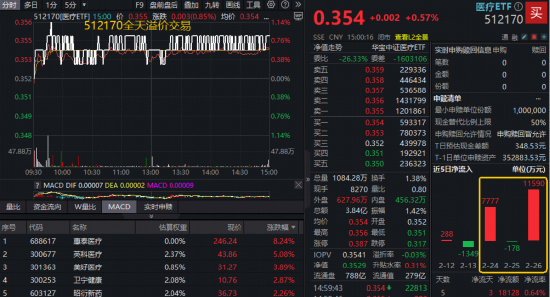
Group 1 - The A-share medical sector showed positive performance on February 27, with the largest medical ETF (512170) rising by 1.14% and successfully recovering the annual line, with a transaction volume of 384 million CNY [1][9] - The ETF experienced continuous premium trading, indicating a positive buying sentiment, with over 190 million CNY net subscriptions in the previous three days [1][9] - The leading stock, Huatai Medical, surged by 8.24%, with its performance report indicating over 20% year-on-year growth in revenue and net profit for 2025 [1][11] Group 2 - The Hong Kong medical sector rebounded after several days of decline, with the Hong Kong medical ETF (159137) recovering from a historical low, ending a six-day losing streak [3][11] - CXO companies, particularly those under WuXi AppTec, showed strong performance, with shares rising by 8.23% for WuXi AppTec, 5% for WuXi Biologics, and 3.21% for WuXi AppTec [3][11] - Citic Securities remains optimistic about the growth potential and space for the CXO sector due to increasing overseas orders and a gradual recovery in domestic demand [4][12] Group 3 - In the medical device industry, Citic Securities believes that policy impacts will eventually clear, and companies will gradually recover after strategic adjustments, suggesting an allocation increase in 2026 [6][14] - Investment opportunities are expected to arise from performance recovery, international expansion, brain-computer interfaces, and AI medical applications [6][14] - The medical ETF fund size reached 27.7 billion CNY, making it the largest in the medical sector, covering various themes including brain-computer interfaces and innovative medical devices [7][14]


礼来新药在华获批,医疗创新ETF(516820)备受关注
Xin Lang Cai Jing· 2026-02-13 02:33
Group 1 - The core viewpoint of the news highlights the performance of the China Securities Pharmaceutical and Medical Device Innovation Index, with Zhejiang Medicine leading the gains at 1.43% and Xinhecheng experiencing the largest decline [1] - The Medical Innovation ETF (516820) has a latest price of 0.36 yuan, with a turnover rate of 0.28% and a transaction volume of 5.138 million yuan during the trading session [1] - Over the past month, the average daily transaction volume of the Medical Innovation ETF reached 62.8359 million yuan, indicating strong market interest [1] Group 2 - Recently, Eli Lilly's drug, Migalastat, received approval from the National Medical Products Administration of China for two formulations to treat moderate to severe active Crohn's disease and ulcerative colitis, marking a significant advancement in targeted therapies for autoimmune diseases in the digestive system [1] - According to CMB International, the pharmaceutical industry is experiencing structural differentiation due to medical insurance cost control and normalized centralized procurement, with resources increasingly concentrating on innovative pharmaceutical and medical device companies with technological barriers [1] - Since Q4 2025, both domestic and foreign institutions have been increasing their positions in the innovative pharmaceutical and medical device supply chain, reflecting a clearer market logic for allocating innovative assets with clinical value and overseas potential [1] Group 3 - The China Securities Pharmaceutical and Medical Device Innovation Index (931484) selects 30 publicly listed companies with good profitability, growth potential, and research innovation capabilities to reflect the overall performance of the pharmaceutical and medical device sector [2] - As of January 30, 2026, the top ten weighted stocks in the index include WuXi AppTec, Mindray Medical, Heng Rui Medicine, Aier Eye Hospital, and others, accounting for a total of 63.9% of the index [2]

20cm速递|创业板医药ETF国泰(159377)盘中涨超0.5%,行业政策与创新主线受关注
Mei Ri Jing Ji Xin Wen· 2026-01-29 06:58
Core Viewpoint - The article highlights the positive performance of the ChiNext Medical ETF (国泰, 159377) amid supportive policies and a focus on innovation within the pharmaceutical and medical device sectors [1]. Group 1: Industry Policies and Innovations - Recent supportive policies are continuously emerging, leading to a recommendation for innovative drugs and medical devices along with their supply chains [1]. - The high demand for innovative drugs is noted, with a recommendation for Pharma companies that are expected to see a revaluation, as well as Biopharma/Biotech firms whose performance is entering a growth phase [1]. Group 2: Investment Opportunities - The report suggests investment in CXO and upstream pharmaceutical companies that benefit from innovation and a recovery in market conditions [1]. - In the medical device sector, companies that excel in engineering and have successful overseas expansions are recommended for investment [1]. Group 3: Future Catalysts - The report mentions that from 2026 onwards, there will be frequent catalysts in the medical device sector, with a focus on investment opportunities in overseas markets, brain-computer interfaces, and AI in healthcare [1]. Group 4: ETF Performance - The ChiNext Medical ETF (国泰, 159377) tracks the Innovation Medicine Index (创医药指数, 399275), which has a daily price fluctuation limit of 20% and includes listed companies involved in the research, production, and related services of innovative drugs [1].

创新药行业再迎政策支持,医疗创新ETF(516820)连续8天净流入
Xin Lang Cai Jing· 2026-01-28 02:25
Group 1 - The China Securities Pharmaceutical and Medical Device Innovation Index (931484) decreased by 0.45% as of January 28, 2026, with mixed performance among constituent stocks, led by Pien Tze Huang with a 1.57% increase [1] - The Medical Innovation ETF (516820) has seen continuous net inflows over the past 8 days, with a maximum single-day net inflow of 41.8265 million yuan, totaling 156 million yuan, averaging 19.475 million yuan per day [1] - The newly revised Implementation Regulations of the Drug Administration Law of the People's Republic of China were officially released on January 27, marking the first comprehensive revision in 23 years, aimed at enhancing the drug regulatory system and supporting high-quality development of the pharmaceutical industry [1] Group 2 - The Medical Innovation ETF closely tracks the China Securities Pharmaceutical and Medical Device Innovation Index, which selects 30 profitable and growth-oriented listed companies in the pharmaceutical and medical device sectors [2] - As of December 31, 2025, the top ten weighted stocks in the index include WuXi AppTec, Hengrui Medicine, Mindray, Aier Eye Hospital, Pien Tze Huang, New Horizon, East China Pharmaceutical, CRISPR Therapeutics, Ailisi, and Gan Li Pharmaceutical, collectively accounting for 63.75% of the index [2] Group 3 - The current adjustment in the pharmaceutical sector does not change the logic of innovative drugs and devices, maintaining a "neutral" rating for the industry [1] - Aidi Kang Holdings, a pioneer in the independent medical laboratory (ICL) industry in China, acquired 100% of the shares of Crown Bio, a global CRO focused on oncology and immuno-oncology, for 204 million USD in November 2025, enhancing its testing service capabilities in core disease areas [1]
【转|太平洋医药-26年度策略】聚焦创新,共赴新程
远峰电子· 2026-01-25 11:53
Market Overview - The pharmaceutical sector is experiencing a structural bull market in 2025, with the CITIC Pharmaceutical Index rising nearly 30% in the first three quarters, driven by the global recognition of the value of innovative drugs and devices [2][3] - The industry is expected to enter a critical phase of innovation realization and global expansion in 2026, shifting investment logic from expectation-driven to closely tracking clinical data, commercialization progress, and international achievements [2][3] Valuation Insights - The pharmaceutical sector's valuation remains at historical lows, with significant investment opportunities still available. As of December 31, 2025, various sub-sectors are trading at relatively low valuations, such as biopharmaceuticals at 35.16X and medical devices at 33.07X [7][9] - The medical services, chemical raw materials, and chemical preparations sectors have shown impressive growth, with increases of 29.22%, 22.03%, and 20.44% respectively [7] Revenue and Profit Trends - From January to November 2025, China's pharmaceutical manufacturing industry reported total revenue of 220.65 billion yuan, a year-on-year decline of 2.51%, while total profit decreased by 1.79% [9] - The performance of the biopharmaceutical, medical services, and pharmaceutical distribution sectors has improved, with biopharmaceuticals benefiting from rapid drug volume growth post-collection [9] Fund Management and Investment Opportunities - As of the end of Q3 2025, public funds' holdings in the pharmaceutical sector were at 11.22%, below the ten-year average of 8.15%, indicating potential for excess returns as the sector approaches a performance inflection point [11] - The low allocation of public funds and the sector's historical low valuations present significant opportunities for investment in high-potential sub-sectors and individual stocks [11] Innovation and Policy Support - The Chinese biopharmaceutical industry is entering a new phase of high-quality development, with significant improvements in innovation capabilities among the top 100 pharmaceutical companies [14][21] - The government has implemented comprehensive policies to support the development of innovative drugs and medical devices, transitioning from single-item support to a full-chain, regional, and financial support system [15][28] Global Market Position - China has become the second-largest market for innovative drug launches globally, contributing approximately 30% of the world's innovative pipelines as of Q3 2025 [50][66] - The country is increasingly recognized for its efficiency and cost-effectiveness in drug development, with a significant number of clinical trials initiated in China, particularly in oncology [53][66] Licensing and Commercialization Trends - The number of license-out transactions for Chinese innovative drugs has surged, with 103 deals recorded in the first three quarters of 2025, totaling $92.03 billion, marking a 77% increase year-on-year [43][63] - The successful inclusion of innovative drugs in the new commercial insurance directory is expected to enhance their commercialization prospects [30] Future Growth Areas - Next-generation therapies, including ADCs, bispecific antibodies, and cell and gene therapies, are becoming focal points for research and investment, with China leading in these areas [76][87] - The oncology drug market is projected to reach $441 billion, with new therapies expected to account for about 20% of treatment expenditures by 2029 [82]