科力远

Search documents
科力远跌2.06%,成交额4.93亿元,主力资金净流出5541.90万元
Xin Lang Cai Jing· 2025-11-10 06:19
Core Viewpoint - The stock of Kolyuan experienced a decline of 2.06% on November 10, with a trading volume of 4.93 billion yuan and a market capitalization of 12.691 billion yuan, despite a significant year-to-date increase of 84.50% [1] Company Overview - Kolyuan New Energy Co., Ltd. is located in Hunan Province and was established on January 24, 1998, with its stock listed on September 18, 2003. The company focuses on battery and material businesses, particularly in the nickel-hydride battery sector, and is expanding into lithium battery upstream supply chains [2] - The revenue composition of Kolyuan includes: 30.14% from power batteries and pole pieces, 29.76% from consumer batteries, 13.66% from nickel products, 9.26% from trade income, 7.00% from lithium materials, 6.31% from energy storage products, and 3.87% from other sources [2] Financial Performance - For the period from January to September 2025, Kolyuan achieved a revenue of 3.086 billion yuan, representing a year-on-year growth of 25.25%. The net profit attributable to shareholders reached 132 million yuan, marking a substantial increase of 539.97% [2] Shareholder Information - As of September 30, 2025, Kolyuan had 85,700 shareholders, a decrease of 17.04% from the previous period. The average number of circulating shares per shareholder increased by 20.54% to 19,427 shares [2] - The company has distributed a total of 89.324 million yuan in dividends since its A-share listing, with 24.983 million yuan distributed over the past three years [3] - Notable institutional shareholders include Hong Kong Central Clearing Limited and Harvest CSI Rare Earth Industry ETF, both of which are new entrants among the top ten circulating shareholders [3]
【明日主题前瞻】小鹏计划2026年底规模量产高阶人形机器人
Xin Lang Cai Jing· 2025-11-06 14:16
Group 1: Humanoid Robots and AI - Xiaopeng plans to achieve mass production of advanced humanoid robots by the end of 2026, with a supply chain preparation timeline set for April 2026 [1] - Xiaopeng will open the SDK of its robot IRON to global developers to build an application ecosystem, with Baosteel as a partner exploring industrial applications [1] - Huaxin Securities believes Xiaopeng's fifth-generation humanoid robot shares high technical commonality with its automotive technology, indicating potential benefits for related stocks [1] Group 2: Data Center Energy Demand - The AI wave is expected to significantly increase global data center electricity demand, potentially doubling it to approximately 945 TWh by 2030 [2] - SOFC (Solid Oxide Fuel Cell) technology is highlighted as having substantial growth potential due to its higher energy conversion efficiency compared to gas and steam turbines [3] - Companies like Yishitong are in the mid-test phase of SOC projects, with a demonstration project expected to be operational by the end of 2025 [3] Group 3: Energy Storage Capacity - As of September, China's new energy storage capacity has surpassed 100 million kW, making it the largest globally, with a growth of over 30 times compared to the end of the 13th Five-Year Plan [4] - Dongwu Securities anticipates a 40-50% growth in energy storage demand next year, driven by new policies and market dynamics [4] - Companies like Shenghui Technology are developing portable energy storage products, while Shuneng Electric has maintained a top position in domestic storage inverter shipments for four consecutive years [4] Group 4: Lithium Battery Industry - In October, China's lithium carbonate production increased by 6% month-on-month and 55% year-on-year, driven by strong demand in the new energy vehicle and energy storage markets [5] - The production of lithium iron phosphate materials rose by approximately 10.5% month-on-month and 51% year-on-year, with an industry operating rate of about 74.4% [5] - Companies like Xingyuan Material are expanding overseas production capacity, while Shida Shenghua has achieved significant growth in electrolyte production [6] Group 5: Space Tourism and Commercial Aerospace - The China Space Tourism project will be globally launched at the 27th High-Tech Fair, reflecting the growing commercial aerospace industry, which is expected to reach a market size of $1.1 trillion by 2030 [7] - Companies like Aerospace Intelligence are providing services in satellite and rocket manufacturing, with a focus on high-precision components and testing services [7] Group 6: Consumer Electronics - Huawei has launched the Mate70 Air, with features including a 7-inch OLED display and various color options, indicating a strong push in the domestic consumer electronics market [8] - IDC reports a slight increase in global smartphone shipments, with a focus on the rising influence of domestic brands and the potential for growth in the Apple supply chain [9] - Companies like Furi Electronics and Desai Battery are key suppliers for Huawei, indicating strong partnerships within the consumer electronics sector [9]


破解用电荒!SOFC成为缓解北美发电紧张新选择
财联社· 2025-11-06 14:14
Core Viewpoint - The article discusses the significant opportunity presented by Solid Oxide Fuel Cells (SOFC) in addressing the challenges faced by data centers in the U.S., particularly regarding power supply and grid access delays [3][7]. Group 1: SOFC Technology and Market Potential - SOFC technology can potentially resolve two major bottlenecks: "grid access delays" and "gas turbine shortages" [6]. - SOFC offers a high power generation efficiency of 55% to 65%, with some advanced technologies reaching up to 70%, which is nearly double that of gas turbines (30% to 40%) and diesel generators (35%) [9]. - The domestic SOFC industry chain has begun to take shape, covering key areas from materials to system integration [6][12]. Group 2: Economic Viability and Competitive Advantage - Bloom Energy's SOFC systems have a cost of approximately $3,400 to $3,500 per kW, with a levelized cost of electricity (LCOE) around $90/MWh after tax credits, making it competitive with diesel engines ($244/MWh) and comparable to modified gas turbines ($91/MWh) [13]. - The rapid deployment capability of Bloom Energy, with delivery times of 55 to 90 days, positions SOFC as a favorable option for data centers facing immediate power needs [10][11]. Group 3: Industry Players and Collaborations - Major clients of Bloom Energy include Oracle, which received SOFC systems for its AI data center, and AEP, which has a procurement agreement for up to 1 GW of SOFC systems [11]. - The collaboration between Bloom Energy and Brookfield, valued at $5 billion, focuses on AI infrastructure, highlighting the growing demand for SOFC solutions in the data center market [11]. Group 4: Domestic Development and Policy Support - The domestic SOFC sector is driven by policy support, with SOFC recognized as a strategic emerging industry under China's "14th Five-Year Plan" for energy technology innovation [12]. - Local governments, such as Shenzhen, are providing financial support for SOFC projects, with individual project funding reaching up to 15 million yuan [12].


科力远涨2.03%,成交额6.25亿元,主力资金净流出5828.78万元
Xin Lang Zheng Quan· 2025-11-06 03:06
Core Viewpoint - The stock price of Kolyuan has increased significantly this year, with a notable rise in recent trading days, indicating strong market interest and performance in the battery and materials sector [2][3]. Group 1: Stock Performance - Kolyuan's stock price has risen by 94.43% year-to-date, with an 8.51% increase in the last five trading days, a 21.30% increase over the last 20 days, and a 40.38% increase over the last 60 days [2]. - As of November 6, the stock was trading at 8.03 CNY per share, with a market capitalization of 13.374 billion CNY [1]. Group 2: Financial Performance - For the period from January to September 2025, Kolyuan reported a revenue of 3.086 billion CNY, reflecting a year-on-year growth of 25.25%. The net profit attributable to shareholders was 132 million CNY, showing a remarkable increase of 539.97% [3]. - Cumulative cash dividends since the company's A-share listing amount to 89.324 million CNY, with 24.983 million CNY distributed over the last three years [4]. Group 3: Business Overview - Kolyuan, established in 1998 and listed in 2003, operates in the battery and materials sector, focusing on nickel-hydride batteries and expanding into lithium battery supply chains [2]. - The company's revenue composition includes 30.14% from power batteries, 29.76% from consumer batteries, 13.66% from nickel products, and 7.00% from lithium materials, among others [2]. - Kolyuan is categorized under the electric equipment and battery industry, with involvement in various concepts such as supercapacitors, energy storage, solid-state batteries, hydrogen energy, and battery recycling [2]. Group 4: Shareholder Information - As of September 30, 2025, Kolyuan had 85,700 shareholders, a decrease of 17.04% from the previous period, with an average of 19,427 circulating shares per shareholder, an increase of 20.54% [3]. - Notable new institutional shareholders include Hong Kong Central Clearing Limited and the Harvest CSI Rare Earth Industry ETF, holding 18.7572 million shares and 14.3275 million shares, respectively [4].
科力远11月5日现1笔大宗交易 总成交金额1408.83万元 溢价率为-13.09%
Xin Lang Cai Jing· 2025-11-05 10:05
Group 1 - The stock of Kolyuan increased by 3.69% on November 5, closing at 7.87 yuan, with a significant block trade of 2.0597 million shares totaling 14.0883 million yuan [1] - The first transaction occurred at a price of 6.84 yuan for 2.0597 million shares, resulting in a premium rate of -13.09%, with the buyer being Guojin Securities and the seller being Shenwan Hongyuan Securities [1] - Over the past three months, Kolyuan has recorded three block trades with a total transaction value of 25.5912 million yuan, and in the last five trading days, the stock has risen by 10.38% despite a net outflow of 152 million yuan from main funds [1]
海外机构调研股名单出炉 16股业绩翻倍


Zheng Quan Shi Bao Wang· 2025-11-05 00:04
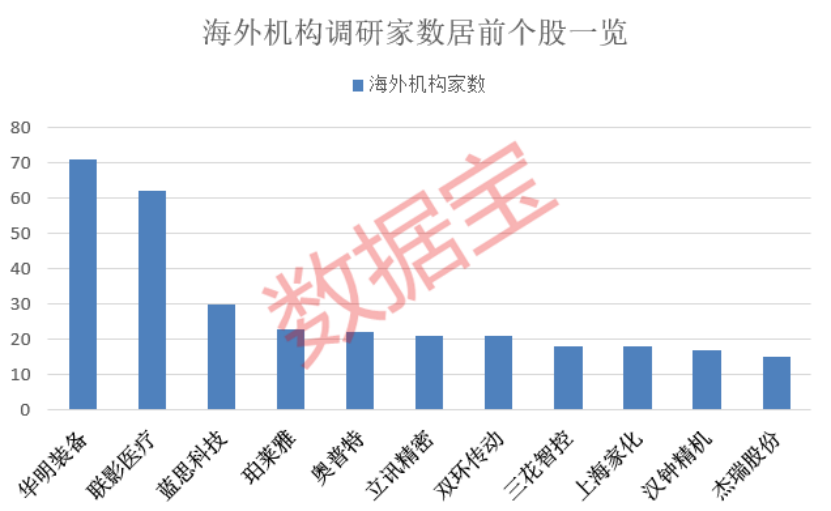
Core Insights - In the past 10 days (from October 22 to November 4), 747 companies were investigated by institutions, with securities companies conducting the most research at 710 firms, followed by fund companies at 635 firms [1] - Overseas institutions conducted research on 293 listed companies, with 11 companies receiving more than 15 investigations each [1] - Among the companies investigated by overseas institutions, Luxshare Precision had the largest net profit, followed by China General Nuclear Power, SF Holding, China National Nuclear Power, and Mindray Medical [1] - Eleven companies, including Boteng Co., Ltd., Chutian Technology, and SIRUI, reported a turnaround in performance [1] - Sixteen companies, such as Chuangjiang New Material and Sanyou Medical, saw their net profit increase by over 100% year-on-year [1] Company Performance - Chuangjiang New Material reported a net profit of 3.55 billion yuan, with a year-on-year increase of 2089.49% [3] - Sanyou Medical had a net profit of 0.62 billion yuan, reflecting a year-on-year increase of 623.19% [3] - Keli Yuan achieved a net profit of 1.32 billion yuan, with a year-on-year increase of 539.97% [3] - Diya Co., Ltd. reported a net profit of 1.03 billion yuan, with a year-on-year increase of 407.97% [3] - Duofluoride reported a net profit of 0.78 billion yuan, with a year-on-year increase of 407.74% [3] - Shenghong Technology had a net profit of 32.45 billion yuan, with a year-on-year increase of 324.38% [3] - New Yiqi reported a net profit of 63.27 million yuan, with a year-on-year increase of 284.38% [3] - Weicai Technology achieved a net profit of 2.02 billion yuan, with a year-on-year increase of 226.41% [3] - Chengdu Xian Dao reported a net profit of 0.93 billion yuan, with a year-on-year increase of 208.34% [3] - Narui Radar had a net profit of 0.73 billion yuan, with a year-on-year increase of 181.28% [3] - Runfeng Co., Ltd. reported a net profit of 8.90 million yuan, with a year-on-year increase of 160.49% [3] - Shanghai Jahwa reported a net profit of 4.05 billion yuan, with a year-on-year increase of 149.12% [3] - Dazhu CNC reported a net profit of 4.92 billion yuan, with a year-on-year increase of 142.19% [3] - Jizhi Co., Ltd. had a net profit of 0.32 billion yuan, with a year-on-year increase of 133.25% [3] - Tailin Micro reported a net profit of 1.40 billion yuan, with a year-on-year increase of 117.35% [3] - Yiyuan Communication had a net profit of 7.33 million yuan, with a year-on-year increase of 105.65% [3]
共享经济板块11月4日跌1.13%,博实结领跌,主力资金净流出15.06亿元
Sou Hu Cai Jing· 2025-11-04 08:57
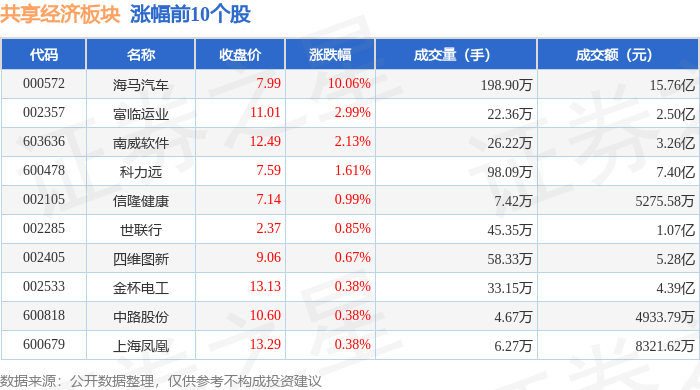
Market Overview - The shared economy sector experienced a decline of 1.13% on November 4, with BoShijie leading the drop [1] - The Shanghai Composite Index closed at 3960.19, down 0.41%, while the Shenzhen Component Index closed at 13175.22, down 1.71% [1] Stock Performance - Notable gainers in the shared economy sector included: - Publishing TianShi (000572) with a closing price of 7.99, up 10.06% on a trading volume of 1.989 million shares and a turnover of 1.576 billion [1] - FuLinYuanV (002357) closed at 11.01, up 2.99% with a trading volume of 223,600 shares and a turnover of 250 million [1] - Nanwei Software (603636) closed at 12.49, up 2.13% with a trading volume of 262,200 shares and a turnover of 326 million [1] - Major decliners included: - BoShijie (301608) closed at 88.06, down 2.70% with a trading volume of 10,300 shares and a turnover of 91.444 million [2] - Qianli Technology (601777) closed at 11.43, down 1.97% with a trading volume of 282,800 shares and a turnover of 324 million [2] - BYD (002594) closed at 97.80, down 1.81% with a trading volume of 435,000 shares and a turnover of 4.274 billion [2] Capital Flow - The shared economy sector saw a net outflow of 1.506 billion from institutional investors, while retail investors contributed a net inflow of 1.136 billion [2][3] - The capital flow for specific stocks showed: - Haima Automobile (000572) had a net inflow of 73.226 million from institutional investors [3] - Siwei Tuxin (002405) had a net inflow of 31.064 million from institutional investors [3] - BoShijie (301608) had a net inflow of 9.602 million from institutional investors [3]
科力远涨2.01%,成交额2.62亿元,主力资金净流出809.13万元
Xin Lang Zheng Quan· 2025-11-04 02:28
Core Viewpoint - Kolyuan's stock price has increased by 84.50% this year, with significant recent gains, indicating strong market performance and investor interest [2]. Company Overview - Kolyuan, established on January 24, 1998, and listed on September 18, 2003, is located in Hunan Province and specializes in battery and material businesses, focusing on nickel-hydride batteries and expanding into lithium battery supply chains [2]. - The company's revenue composition includes: 30.14% from power batteries and electrode sheets, 29.76% from consumer batteries, 13.66% from nickel products, 9.26% from trade income, 7.00% from lithium materials, 6.31% from energy storage products, and 3.87% from other sources [2]. Stock Performance - As of November 4, Kolyuan's stock price was 7.62 CNY per share, with a market capitalization of 12.691 billion CNY [1]. - The stock has seen a 17.59% increase over the last five and twenty trading days, and a 35.11% increase over the last sixty days [2]. Financial Performance - For the period from January to September 2025, Kolyuan reported a revenue of 3.086 billion CNY, reflecting a year-on-year growth of 25.25%, and a net profit attributable to shareholders of 132 million CNY, marking a significant increase of 539.97% [3]. - Cumulatively, Kolyuan has distributed 89.324 million CNY in dividends since its A-share listing, with 24.983 million CNY distributed over the last three years [4]. Shareholder Information - As of September 30, 2025, Kolyuan had 85,700 shareholders, a decrease of 17.04% from the previous period, with an average of 19,427 circulating shares per shareholder, an increase of 20.54% [3]. - Notable new institutional shareholders include Hong Kong Central Clearing Limited and Harvest CSI Rare Earth Industry ETF, holding 18.7572 million shares and 14.3275 million shares, respectively [4].
储能需求大增 社保基金持仓11只概念股
Zheng Quan Shi Bao· 2025-11-03 17:44
Group 1: Industry Developments - Multiple energy storage companies have secured significant orders, including a 520 million yuan contract signed by Shanghai Hope Smart New Energy Development Co., a subsidiary of Hope Co., and an agreement between Nari Technology and Pacific Green Group [1] - According to data from the National Energy Administration and third-party organizations, global lithium battery energy storage installations are expected to exceed 170 GWh in the first three quarters of 2025, representing a year-on-year growth of 68% [1] - Huatai Securities notes that a recent policy document from the Central Committee emphasizes carbon reduction goals and the development of new energy systems, which is expected to benefit energy storage, wind power, and grid companies [1] Group 2: Market Trends - CITIC Securities believes the energy storage market is recovering, with a projected increase in domestic new installations to 300 GWh next year, driven by marketization of new energy and capacity pricing [1] - The demand for energy storage is anticipated to grow significantly due to data centers, with leading companies already receiving substantial orders [1] Group 3: Company Performance - In the first three quarters, major companies like CATL, BYD, and Sungrow reported strong financial performance, with CATL achieving a revenue of 283.072 billion yuan and a net profit of 49.034 billion yuan, marking a year-on-year increase of 36.2% [3] - Companies such as Sungen and Gotion High-Tech saw their net profits double year-on-year, with Sungen's revenue reaching 14.809 billion yuan, a year-on-year increase of 11.48%, and a staggering net profit growth of 1121.72% [3] - As of the end of the third quarter, 11 energy storage concept stocks were held by social security funds, with companies like Haopeng Technology and Shenghong Shares having significant holdings [3] Group 4: Stock Performance - The average increase in energy storage concept stocks this year is 62.87%, with companies like Haibo Technology and Sungrow seeing their stock prices double, and Haibo Technology achieving the highest increase of 352.95% [2] - In October, 17 concept stocks underwent institutional research, with Jinpan Technology receiving attention from 254 institutions, indicating strong market interest [2]




磷酸铁锂电池头部企业产能利用率普遍维持高位
Zheng Quan Ri Bao· 2025-11-02 16:40
Core Insights - The energy storage battery materials market is experiencing a significant supply-demand gap, driven by explosive domestic demand and accelerated overseas market expansion, particularly for lithium iron phosphate (LFP) materials [1][2] Group 1: Market Demand and Growth - Domestic energy storage demand has surged since 2024, leading to saturated orders for leading companies and full-capacity utilization [1] - As of mid-2025, the new energy storage installation capacity in China reached 94.91 million kilowatts, a 29% increase compared to the end of 2024 [2] - The shipment volume of energy storage batteries in China for the first half of 2025 was 265 GWh, representing a 128% year-on-year growth, with LFP batteries becoming the mainstream route for electrochemical storage [2] Group 2: Technological Innovations - Companies are focusing on technological innovations to enhance LFP materials, with leading firms like Hunan Youneng and Jiangxi Shenghua pioneering new product lines and production techniques [3] - The breakthrough in high-pressure LFP technology has opened up vast market opportunities for chemical energy storage applications [3] Group 3: Production Capacity and Expansion - Major companies are experiencing high production capacity utilization rates, with some reporting over 80% for ternary lithium and 70% for LFP [4] - Companies are accelerating their expansion plans, with significant increases in shipments and ongoing construction of overseas production bases [5] - The current tight supply-demand balance in the energy storage market is expected to persist until the second half of 2026 [5]