Samsung

Search documents
2024 年,“印度制造”智能手机出货量同比增长 6% ,出口创历史新高
Counterpoint Research· 2025-03-27 03:49
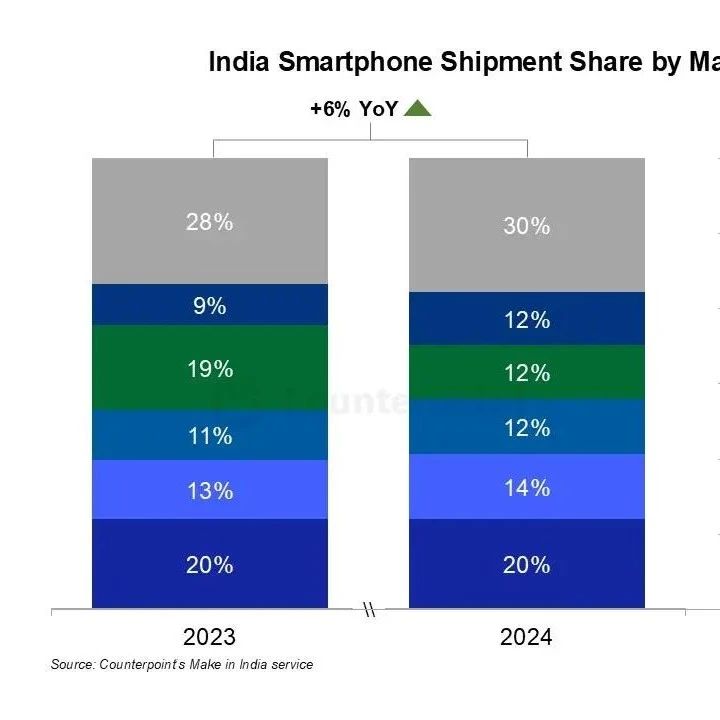
Core Viewpoint - The "Make in India" initiative is driving a 6% year-on-year growth in smartphone shipments in 2024, primarily fueled by the export growth of Apple and Samsung, which together account for approximately 94% of India's smartphone exports [1][4]. Group 1: Market Dynamics - Samsung maintains its leading position in India's smartphone manufacturing with a 7% year-on-year growth in shipments, supported by a 13% increase in exports [4][7]. - Foxconn Hon Hai's shipments in India grew by 19% year-on-year, driven by the strong performance of iPhone 14, iPhone 15, and iPhone 13 models [4][7]. - Tata Electronics emerged as the fastest-growing smartphone manufacturer in India in 2024, with a remarkable 107% year-on-year growth, largely attributed to the iPhone 15 and iPhone 16 [4][7]. Group 2: Future Projections - The Indian smartphone manufacturing sector is expected to achieve double-digit growth in 2025, bolstered by government initiatives and the diversification of global supply chains [5][6]. - The local value addition in smartphone manufacturing is anticipated to increase continuously, making India an attractive manufacturing hub due to its large domestic market and low labor costs [5][6]. Group 3: Competitive Landscape - Vivo ranks second in the market with a 14% year-on-year growth, benefiting from the expansion of offline retail channels and a strengthened distribution network [7]. - OPPO faced challenges in 2024, with a 34% decline in shipments due to intense market competition and increased reliance on contract manufacturing [7]. - Dixon became the largest manufacturer in the overall mobile device market, driven by partnerships with Transsion and Motorola, achieving a 39% year-on-year growth in smartphone shipments [8].


全球智能手机 AP-SoC 市场份额:按季度分析(2023 年 Q2 - 2024 年 Q4)
Counterpoint Research· 2025-03-27 03:49
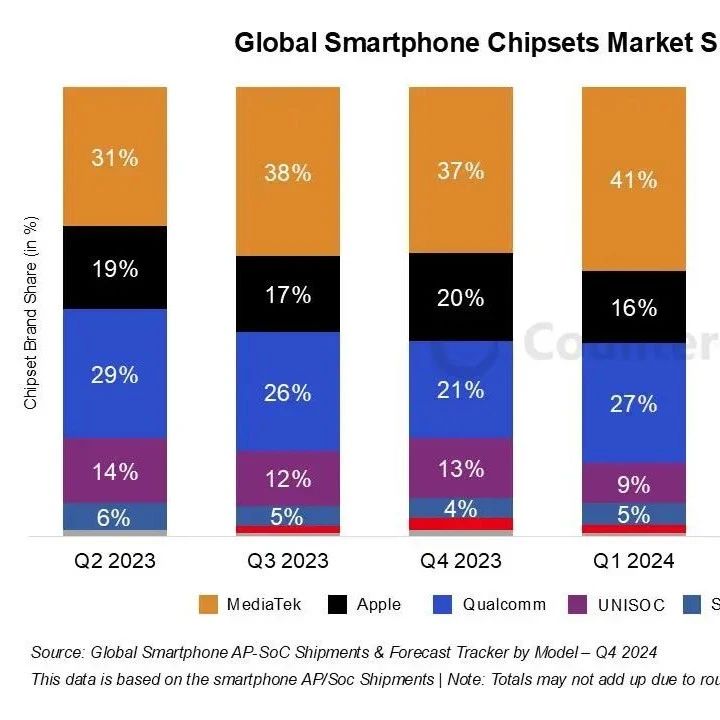
Core Insights - The global smartphone chip market is experiencing shifts in market share among key players, with MediaTek leading in Q2 2023 and projected to maintain a strong position through Q4 2024 [4][5] - Apple is expected to see an increase in chip shipments in Q4 2024 due to the launch of the A18 series [6] - Qualcomm's chip shipments are projected to decline slightly in Q4 2024, but revenue growth is anticipated due to strong demand in the high-end market [6] Market Share Overview - MediaTek's market share is projected to fluctuate from 31% in Q2 2023 to 34% in Q2 2024, with a peak of 41% in Q1 2024 [4] - Apple's market share is expected to decrease from 19% in Q2 2023 to 13% in Q2 2024, with a rebound to 23% in Q4 2024 [4] - Qualcomm's share is forecasted to drop from 29% in Q2 2023 to 30% in Q2 2024, but will decline to 21% by Q4 2024 [4] - UNISOC is projected to increase its share from 14% in Q2 2023 to 15% in Q2 2024, maintaining a steady presence [4] - Samsung's market share is expected to remain low, fluctuating between 4% and 6% throughout the forecast period [4] Company-Specific Developments - MediaTek is set to increase overall shipments in Q4 2024, driven by the launch of new high-end chips and stable LTE chip shipments [6] - Qualcomm anticipates a slight decline in shipments but expects revenue growth from the Snapdragon 8 Elite, which is in demand among multiple smartphone brands [6] - Samsung's Exynos chip shipments are expected to remain stable, with growth in specific models like Exynos 2400 and Exynos 1480 due to new product launches [6] - UNISOC is expanding its presence in the low-end market, benefiting from the adoption of its LTE chips by leading manufacturers [6]
Zepp Health(ZEPP) - 2024 Q4 - Earnings Call Transcript
2025-03-27 00:02
Financial Data and Key Metrics Changes - Overall sales in Q4 2024 rose by more than 40% quarter over quarter, aligning with guidance despite macroeconomic headwinds and supply bottlenecks [3][21] - Gross margin for 2024 reached 39%, compared to 26.2% for the full year 2023, indicating significant margin expansion [4][23] - Cash on hand at the end of 2024 was $112 million, providing ample runway for market investments [4][30] - Adjusted operating loss for Q4 2024 was $7.4 million, the narrowest in the past four quarters, demonstrating sequential improvement [27][28] - GAAP net loss for Q4 2024 was $36.9 million, including various impairments and deferred tax asset valuation allowances [28] Business Line Data and Key Metrics Changes - The successful launch of the T Rex3 smartwatch significantly boosted sales, establishing a strong market demand [4][21] - The Amazfit Active2 and BIP6 series are expected to expand reach in the entry-level segment, enhancing sales growth in Q2 2025 [7][11] - The T Rex series has outperformed competitors, achieving higher profitability and steady growth [11][12] Market Data and Key Metrics Changes - Global smartwatch sales fell by 7% in 2024, primarily due to a decline in Apple Watch shipments, which fell by 19% [18][19] - Sales in China grew from 19% to 25% of the market, marking a significant shift in market dynamics [19] - The Indian market saw a decline from 30% to 23%, attributed to quality issues with ultra-cheap devices [19] Company Strategy and Development Direction - The company is transitioning towards a brand-empowered, high-margin business model for Amazfit products, focusing on technological innovation and global marketing [3][4] - The strategy includes diversifying the product portfolio beyond smartwatches to include health solutions and lifestyle products [8][12] - Partnerships with athletes and emerging sports organizations are aimed at enhancing brand visibility and market positioning [9][10] Management's Comments on Operating Environment and Future Outlook - Management expressed confidence in the long-term growth trajectory of ZEP Health, emphasizing the importance of a robust product pipeline and strategic partnerships [15][14] - The company anticipates a recovery in the global smartwatch market in 2025, driven by AI features and health data emphasis [20] - Management highlighted the importance of maintaining cost management while investing in R&D and marketing for long-term competitive advantage [25][26] Other Important Information - The company plans to continue its share repurchase program in 2025, reflecting confidence in long-term value [15][31] - Inventory levels were reported at $57 million in Q4, the lowest since 2018, indicating effective inventory management [30] Q&A Session Summary Question: Impact of new tariffs on Chinese smartwatch imports - Management indicated minimal impact on U.S. consumer pricing or gross margin due to proactive supply chain management, with 20% to 25% of overall manufacturing coming from non-China regions [17][35][36] Question: Details on impairment losses and tax increases - The impairment losses were due to investments in upstream and downstream technology companies that did not perform as expected, leading to a $13 million impairment [38][40] Question: Market demand shift towards lower-priced players - Management noted that while the overall market declined, segments like outdoor and sports smartwatches, particularly the T Rex series, gained market share [43][44] Question: Long-term strategy and vision for a global health ecosystem - The company is diversifying its product portfolio and exploring B2B opportunities, aiming to create a comprehensive health ecosystem [52][54] Question: Relationship with Xiaomi and its impact - Management emphasized a strong relationship with Xiaomi while focusing on transforming into a self-branded company to improve profitability [56][58] Question: Stock liquidity and market valuation - Management acknowledged the stock's illiquidity and outlined plans for a stock buyback program, expressing confidence in the company's growth trajectory [62][64]

Zepp Health(ZEPP) - 2024 Q4 - Earnings Call Transcript
2025-03-26 23:00
Financial Data and Key Metrics Changes - Overall sales in Q4 2024 rose by more than 40% quarter over quarter, aligning with guidance despite macroeconomic headwinds and supply bottlenecks [3][21] - Gross margin for 2024 reached 39%, up from 26.2% in 2023, indicating significant margin expansion [4][23] - Cash on hand at the end of 2024 was $112 million, providing ample runway for market investments [4][30] - Adjusted operating loss for Q4 2024 was $7.4 million, the narrowest in the past four quarters, demonstrating sequential improvement [27][28] - GAAP net loss for Q4 2024 was $36.9 million, including various impairments and deferred tax asset valuation allowances [28] Business Line Data and Key Metrics Changes - The successful launch of the T Rex3 smartwatch significantly boosted sales and market demand, establishing a strong position in the outdoor and sports smartwatch segment [5][21] - The Amazfit Active2 and BIP6 series are expected to drive further sales growth in the entry-level segment [7][11] - The T Rex series has outperformed competitors, achieving higher profitability and steady growth [11][12] Market Data and Key Metrics Changes - Global smartwatch sales fell by 7% in 2024, primarily due to a decline in Apple Watch shipments, which dropped by 19% [18][19] - Sales in China grew from 19% to 25% of the market, marking a significant shift in market dynamics [19] - The Indian market saw a decline from 30% to 23% due to issues with ultra-cheap devices [19] Company Strategy and Development Direction - The company is transitioning towards a brand-empowered, high-margin business model, focusing on technological innovation and global marketing [3][4] - A comprehensive smart wearable ecosystem is being built, integrating advanced AI-driven health solutions and performance tracking [14][15] - The strategy includes launching one to two new products every quarter in 2025, aiming for a different demand pattern compared to 2024 [22][61] Management's Comments on Operating Environment and Future Outlook - Management remains optimistic about growth in 2025, driven by new product launches and a focus on AI features [20][45] - The company is confident in its long-term growth trajectory, supported by a robust product pipeline and strategic partnerships [15][30] - Despite challenges in 2024, the company effectively managed costs and is positioned for sustained growth [32] Other Important Information - The company is committed to maintaining a lean operating structure while investing in R&D and marketing [25][27] - A share repurchase program will continue in 2025, reflecting confidence in the company's long-term value [15][31] Q&A Session Summary Question: Impact of new tariffs on Chinese smartwatch imports - Management indicated minimal impact due to proactive supply chain management and dual sourcing strategies [17][35] Question: Details on impairment losses and tax increases - Impairment losses were due to investments in upstream and downstream technology companies that underperformed [38][41] Question: Shift in demand towards lower-priced players - Management noted that while the market declined, segments like outdoor and sports smartwatches, particularly the T Rex series, are performing well [43][45] Question: Long-term strategy and vision for a global health ecosystem - The company is diversifying its product portfolio and exploring B2B opportunities while focusing on consumer health solutions [49][52] Question: Relationship with Xiaomi and its impact - The relationship remains strong, but the company is focusing on self-branded products to achieve profitability before expanding revenue with Xiaomi [55][59] Question: Stock liquidity and market valuation - Management acknowledged the stock's illiquidity and emphasized ongoing buyback programs and strategic growth initiatives to enhance market perception [63][65] Question: New product roadmap for 2025 - The company plans to launch multiple new products across different price segments, which is expected to drive significant growth in 2025 [70][73]
ADT Strengthens Executive Leadership Team with Appointments of Fawad Ahmad as Chief Operating and Customer Officer and Omar Khan as Chief Business Officer
Newsfilter· 2025-03-25 20:00
Core Insights - ADT Inc. has announced the appointment of Fawad Ahmad as Executive Vice President and Chief Operating and Customer Officer, and Omar Khan as Executive Vice President and Chief Business Officer, aiming to enhance leadership and operational capabilities [1][2][3] Leadership Changes - Fawad Ahmad will oversee operations, customer experience, and digital transformation initiatives, while Omar Khan will lead product development, innovation, business development, and engineering teams [2][4] - Ahmad brings over 20 years of experience in global product development and digital transformations, previously serving as Chief Strategy & Transformation Officer at State Farm [3] - Khan joins from Boston Consulting Group, with a background in strategic planning and emerging technologies, having held leadership roles at Magic Leap, Samsung, and Motorola [4] Strategic Vision - The leadership changes are expected to accelerate growth, drive innovation, and enhance customer experience across all channels [3] - Ahmad expressed enthusiasm about enhancing operations and digital capabilities to elevate customer experience [4] - Khan emphasized the opportunity to redefine home security and smart living, aiming to deliver innovative solutions [4] Company Overview - ADT provides safe, smart, and sustainable solutions for homes and small businesses, focusing on innovative offerings and premium customer experience [5]

The Market Is Wrong: 3 Reasons Micron's Stock Should Be Up, Not Down After Earnings
The Motley Fool· 2025-03-25 11:00
Core Viewpoint - Micron's stock fell over 8% after its earnings release, but the market may be misjudging the company's long-term potential, particularly in the AI sector, while focusing too much on short-term challenges in legacy businesses [1][2]. Financial Performance - In fiscal Q2 2025, Micron reported a revenue increase of 38% year-over-year to $8.05 billion, with adjusted EPS growing 271% to $1.56, both exceeding expectations [3]. - Despite the strong earnings, shares dropped due to cautious guidance on gross margins, projecting a decline to 36.5%, down 1.5 percentage points, while operating expenses are expected to rise by approximately $100 million [4]. Market Dynamics - Concerns about near-term margin trends are seen as exaggerated, with management attributing margin pressure to increased sales of lower-margin consumer electronics memory, which is expected to recover [5]. - The NAND flash market remains weak, with prices dropping by a high-teens percentage last quarter, but NAND only accounted for 26% of revenues, indicating that the more critical enterprise data center business is growing due to AI [6]. Positive Trends - **Positive Trend 1: HBM for AI Growth** The high-bandwidth memory (HBM) market is projected to grow from $16 billion in 2024 to $35 billion in 2025, and over $100 billion by 2030, significantly surpassing the pre-HBM DRAM industry [7][8]. Micron has improved its HBM manufacturing yields and has secured a third large customer, with quarterly HBM revenue exceeding $1 billion, representing 12.5% of total revenue [9][10]. - **Positive Trend 2: New Low-Power DRAM** Micron has developed a new low-power data center DRAM called SOCAMM, which offers up to two-thirds power savings compared to standard D5 DRAM, specifically designed for AI data centers [11][12]. This innovation positions Micron as a leader in this segment, potentially generating significant revenue alongside HBM [13]. - **Positive Trend 3: Shift to SSDs in Data Centers** Micron is gaining market share in high-end data center SSDs, and there is a potential shift from HDDs to SSDs in AI data centers due to latency and power consumption issues [14][15]. If this transition occurs, it could enhance demand for NAND products, improving margins and profits significantly by 2026 or 2027 [16].

Apple's Product Roadmap Reportedly Includes Camera-Equipped Watch
PYMNTS.com· 2025-03-23 20:20
Group 1: Apple Watch Developments - Apple is reportedly developing a new version of its Watch that will include a camera, aimed at enhancing user interaction with the outside world through AI [1] - The camera setup will differ between the Series and Ultra models, with the Series having an internal display camera and the Ultra featuring a side-mounted lens [2] - The Ultra model will allow users to scan objects by pointing their wrist, while Series users will need to flip their wrists [3] Group 2: AI and Siri Challenges - Apple is facing challenges in catching up with competitors in AI, with rivals like Amazon, Google, and Samsung ahead in integrating advanced AI features [3] - Upgrades to Apple's Siri AI assistant have been delayed, with the company acknowledging missteps and a demotion of the executive in charge of Siri operations [4] - The removal of AI head John Giannandrea and the appointment of Mike Rockwell reflects a shift in strategy, as concerns about perfectionism are seen as hindering faster improvements to Siri [5][6]

英伟达_GTC 大会第三天亮点 - 首席执行官和首席财务官问答环节及人工智能工厂
2025-03-23 15:39
Summary of NVIDIA Corp Conference Call Company Overview - **Company**: NVIDIA Corp - **Date**: March 20, 2025 Key Industry Insights - **Data Center Revenue Growth**: NVIDIA anticipates its data center revenue could grow more than 2x from approximately $215 billion in 2025 to around $430 billion by 2028, suggesting an EPS of about $12/share during this period [2][2][2] - **Compute Intensity**: The company argues that advancements in reasoning models are increasing compute intensity, as machines need to "think for themselves" to resolve issues, necessitating faster inference [2][2][2] - **Infrastructure Focus**: NVIDIA emphasizes its role in the infrastructure sector, asserting that it is the only reliable option for customers planning large-scale deployments [2][2][2] Financial Highlights - **Revenue Projections**: - 2025: $130.5 billion - 2026E: $232.1 billion - 2027E: $263.7 billion - 2028E: $264.6 billion - 2029E: $299.2 billion - 2030E: $273.9 billion [4][4][4] - **EPS Growth**: - 2025: $3.00 - 2026E: $5.27 - 2027E: $6.22 - 2028E: $6.35 - 2029E: $7.21 - 2030E: $6.50 [4][4][4] - **Market Capitalization**: Approximately $2,880 billion as of March 19, 2025 [5][5][5] Technological Developments - **AI Memory Market**: Samsung projects AI memory revenues to exceed $826 billion by 2030, focusing on memory solutions for AI applications [10][10][10] - **Liquid Cooling Solutions**: Supermicro highlighted the advantages of liquid cooling over air cooling, including up to 89% reduction in electricity costs for cooling infrastructure and up to 80% space savings in data centers [16][16][16] Robotics and AI Innovations - **GR00T Model**: NVIDIA's new model for humanoid robotics, designed to run on accessible hardware, is trained on diverse datasets, including human videos and synthetic data [12][12][12] - **Closing the Sim-to-Real Gap**: Advances in accelerated computing are improving the ability to replicate real-world simulations, allowing robots to learn from experience rather than just programming [12][12][12] AI Agents in Enterprise - **Workflow Transformation**: AI agents enable dynamic software workflows, enhancing efficiency and automation in enterprise settings, with potential automation levels increasing from ~20% to ~70% [14][14][14] - **Challenges**: Adoption hurdles include the need for education on AI concepts, reimagining workflows, and ensuring safety and transparency [14][14][14] Inventory and Production Insights - **Inventory Build**: NVIDIA's inventory increased by 15-20% due to AI server components, with a focus on building full racks rather than holding GPUs in inventory [17][17][17] - **Production Capacity**: Hon Hai confirmed its ability to scale production in the US, with expectations to ship 30-50k racks over the next 12 months [17][17][17] Conclusion NVIDIA Corp is positioned for significant growth in the data center and AI sectors, with robust revenue projections and advancements in technology that support its infrastructure and robotics initiatives. The company is also addressing challenges in the enterprise sector through the adoption of AI agents, while maintaining a focus on efficient production and inventory management.

With the Nasdaq in Correction Territory, I've Got My Eye on These 2 Stocks
The Motley Fool· 2025-03-22 08:00
Group 1: Market Overview - The Nasdaq Composite has entered a correction phase, defined as a pullback of at least 10%, due to concerns over trade wars, weakening consumer confidence, and high valuations [1] - Investor sentiment has shifted rapidly, with fears of a looming recession affecting market dynamics [1] Group 2: Axon Enterprise - Axon Enterprise was a top performer in the S&P 500 last year, achieving a 130% gain, and has shown significant growth over the past decade [3] - The company specializes in law enforcement technology, producing Taser weapons, body cameras, and cloud software for managing records and evidence [4] - Axon is investing in AI technology with a new tool called Draft One, which generates police report drafts from body cam footage, receiving positive feedback from law enforcement [4] - Despite a recent 25% decline from its all-time high, Axon management remains optimistic about potential new agreements with Flock Safety and reported better-than-expected fourth-quarter results [5][6] - Axon's primary clients are local and state law enforcement agencies, which may be more insulated from economic downturns, and the company's offerings provide strong competitive advantages [7][8] - Revenue is expected to grow by 25% this year, reaching between $2.55 billion and $2.65 billion [8] Group 3: Taiwan Semiconductor Manufacturing Company (TSMC) - TSMC is the world's largest third-party semiconductor manufacturer and is closely tied to the tech sector, particularly chip stocks [9] - The company experienced a 39% revenue increase in the fourth quarter, reaching $26.9 billion, with a high operating margin of 49% [11] - TSMC's shares have declined 24% from their peak in January, despite strong growth and profitability, and currently have a price-to-earnings ratio of 25, indicating good value [12] - The ongoing AI boom is expected to support TSMC's growth, and the company is investing heavily in new factories in the U.S. and elsewhere [13] - TSMC's revenue increased by 43% year over year in February, presenting a rare opportunity to invest in a high-growth company at a reasonable valuation [14]



Is ASML Stock Still Worth Holding Despite Plunging 25% in a Year?
ZACKS· 2025-03-21 17:45
Core Viewpoint - ASML Holding N.V. has experienced a significant stock price decline of 25.1% over the past year, underperforming the broader market and major semiconductor companies, despite its strong market position and financial performance [1][3]. Company Performance - ASML's stock underperformance is attributed to macroeconomic pressures and company-specific challenges, including a broader tech sector sell-off and weakening semiconductor demand [4][5]. - The Dutch government's export restrictions on ASML's advanced lithography tools to China have hampered growth prospects, as China accounted for 41% of ASML's lithography shipments in 2024 [6]. - ASML's forward P/E ratio stands at 27.92, which is higher than the Zacks Computer and Technology sector average of 23.92, raising valuation concerns among investors [7]. Technological Leadership - ASML maintains a near-monopoly on extreme ultraviolet (EUV) lithography, essential for producing advanced chips at 3nm and below, positioning it as a key enabler in semiconductor manufacturing [9][11]. - The company's High-NA EUV technology, designed for sub-2nm nodes, represents significant long-term potential, despite slower-than-expected adoption [10]. Financial Performance - ASML reported €9.26 billion in net sales for Q4 2024, a 24% year-over-year increase, with net income rising 30% to €2.69 billion and EPS growing 30% to €6.85 [12]. - The gross margin expanded by 90 basis points year-over-year to 51.7%, reflecting strong cost management and productivity improvements [13]. - For 2025, ASML expects a 15% revenue growth, driven by rising demand for EUV and DUV lithography systems, along with anticipated margin expansions [14]. Order Backlog and Revenue Visibility - ASML has a record-high order backlog of €36 billion, providing strong revenue visibility, with €7.1 billion in new orders booked in Q4 2024 [15][16]. - The demand for ASML's lithography tools is driven by the AI boom and the need for next-generation chip production [17][18]. Conclusion - Despite facing near-term challenges, ASML's technological leadership, robust financials, and substantial order backlog indicate strong long-term growth potential, making it a compelling hold for investors [19][20].