Vanguard

Search documents
Should You Invest in the Invesco S&P 500 Equal Weight Consumer Staples ETF (RSPS)?
ZACKS· 2025-07-23 11:20
Core Insights - The Invesco S&P 500 Equal Weight Consumer Staples ETF (RSPS) is designed to provide broad exposure to the Consumer Staples sector, launched on November 1, 2006 [1] - The ETF has accumulated over $257.18 million in assets, positioning it as an average-sized ETF in its category [3] - The fund has an annual operating expense ratio of 0.40% and a 12-month trailing dividend yield of 0.74% [4] Fund Details - RSPS aims to match the performance of the S&P 500 Equal Weight Consumer Staples Index, which equally weights stocks in the consumer staples sector [3] - The ETF is fully allocated to the Consumer Staples sector, minimizing single stock risk [5] Holdings - Estee Lauder Cos Inc (EL) constitutes approximately 3.28% of total assets, with the top 10 holdings accounting for about 28.11% of total assets under management [6] Performance Metrics - As of July 23, 2025, RSPS has gained about 2.14% year-to-date but is down approximately -0.44% over the past year [7] - The ETF has traded between $28.68 and $32.71 in the last 52 weeks, with a beta of 0.52 and a standard deviation of 12.95% over the trailing three-year period [7] Alternatives - RSPS holds a Zacks ETF Rank of 3 (Hold), indicating a moderate investment outlook based on various factors [8] - Other options in the Consumer Staples ETF space include the Vanguard Consumer Staples ETF (VDC) and the Consumer Staples Select Sector SPDR ETF (XLP), with VDC having $7.64 billion in assets and XLP $15.91 billion [10]


Should Direxion NASDAQ-100 Equal Weighted Index Shares (QQQE) Be on Your Investing Radar?
ZACKS· 2025-07-23 11:20
Core Insights - The Direxion NASDAQ-100 Equal Weighted Index Shares (QQQE) is a passively managed ETF launched on March 21, 2012, designed to provide broad exposure to the Large Cap Growth segment of the US equity market, with assets exceeding $1.26 billion [1] - Large cap companies typically have market capitalizations above $10 billion, characterized by stability and predictable cash flows, making them less volatile compared to mid and small cap companies [2] - Growth stocks, which QQQE primarily invests in, exhibit higher sales and earnings growth rates but also come with higher valuations and volatility [3] Costs - The annual operating expenses for QQQE are 0.35%, which is competitive within its peer group, and it has a 12-month trailing dividend yield of 0.60% [4] Sector Exposure and Top Holdings - QQQE has a significant allocation of approximately 40.10% to the Information Technology sector, followed by Consumer Discretionary and Telecom [5] - The top 10 holdings represent about 10.69% of total assets, with Datadog Inc - Class A (DDOG) accounting for around 1.16% of total assets [6] Performance and Risk - QQQE aims to match the performance of the NASDAQ-100 Equal Weighted Index, which includes 100 of the largest non-financial securities listed on NASDAQ [7] - The ETF has returned approximately 11.52% year-to-date and 12.01% over the past year, with a trading range between $76.98 and $99.91 in the last 52 weeks [8] - With a beta of 1.07 and a standard deviation of 19.85% over the trailing three-year period, QQQE is considered a medium risk investment [8] Alternatives - Other ETFs in the same space include the Vanguard Growth ETF (VUG) and Invesco QQQ (QQQ), with VUG having $179.21 billion in assets and an expense ratio of 0.04%, while QQQ has $358.16 billion in assets and charges 0.20% [11] Bottom-Line - Passively managed ETFs like QQQE are gaining popularity among both institutional and retail investors due to their low cost, transparency, flexibility, and tax efficiency, making them suitable for long-term investment strategies [12]

2 Vanguard ETFs That Can Turn $400 per Month Into Over $1.7 Million
The Motley Fool· 2025-07-23 08:32
Core Viewpoint - Exchange-traded funds (ETFs) can be a lucrative investment option for long-term investors, providing passive exposure to the stock market without the need for expert stock picking [1][2]. Group 1: Vanguard S&P 500 ETF - The Vanguard S&P 500 ETF (VOO) offers passive exposure to the S&P 500 index, allowing for high diversification and reduced downside risk [3][4]. - Since its inception in 2010, VOO has generated a total return of 647%, equating to an annual return of 14.5% [6]. - A consistent investment of $200 monthly could grow to significant amounts over time, reaching approximately $1,232,848 after 30 years [7]. Group 2: Vanguard Dividend Appreciation ETF - The Vanguard Dividend Appreciation ETF (VIG) consists of companies that have increased their dividend payments for over 10 years, ensuring financial stability and growth potential [8]. - VIG serves as a complement to VOO, providing a mix of growth and value stocks, with an annual return since inception around 10% [9]. - A $200 monthly contribution to VIG could grow to roughly $450,000 over 30 years, assuming consistent returns [9]. Group 3: Expense Ratios and Investment Strategy - The expense ratios for VOO and VIG are low, at 0.03% and 0.05% respectively, making them cost-effective options for investors [11]. - Consistent contributions to these ETFs are crucial for building wealth over time, emphasizing the importance of discipline and patience in investment strategies [12].

Warren Buffett Says to Buy This Kind of ETF. One Could Turn $1,000 Per Month Into $252,000 in 10 Years.
The Motley Fool· 2025-07-22 17:28
Core Insights - Warren Buffett is recognized as one of the greatest investors due to his successful capital allocation at Berkshire Hathaway, achieving nearly 20% annualized returns over six decades [1] - Buffett advises average investors to consider investing in an S&P 500 index fund, highlighting that even small investments can grow significantly with patience and discipline [2] Investment Strategy - Investors are encouraged to consider the Vanguard S&P 500 ETF, which could potentially grow a monthly investment of $1,000 into $252,000 over 10 years [3][7] - The S&P 500 index has delivered a total return of 255% over the past decade, translating to an annualized return of 13.5%, exceeding its long-term average of 10% [5] ETF Characteristics - The Vanguard S&P 500 ETF tracks the performance of S&P 500 stocks and is managed by a reputable firm with trillions in assets, providing investor confidence [6] - The ETF has a low expense ratio of 0.03%, aligning with Buffett's preference for low-cost investment options [8] Future Performance Considerations - While past performance does not guarantee future results, if the next decade mirrors the last, a consistent investment strategy could yield substantial returns [7] - Current high valuations, indicated by a CAPE ratio of 37.8, suggest that future returns may be lower than historical averages [10] - Factors such as rising government spending and liquidity could potentially support asset prices, leading to returns that match or exceed the previous decade [12]

澳上市公司高管富豪排行榜揭晓榜首身价134亿 石墨板块走强 中国汽车品牌或占澳新车销量半壁江山 特斯拉全球首家超级充电站餐厅落地
Sou Hu Cai Jing· 2025-07-22 17:24
Group 1: Graphite Sector Developments - The Australian graphite sector has seen a significant rise in stock prices, particularly for NOVONIX (ASX: NVX) and Syrah Resources Ltd (ASX: SYR), following the announcement of a proposed 93.5% anti-dumping tax on graphite anode active materials (AAM) imported from China [1][2] - NOVONIX is expanding its graphite production capacity in Chattanooga, with an expected annual output of 20,000 tons from its Riverside facility and an additional facility named "Enterprise South," aiming for a total capacity exceeding 50,000 tons per year [1] - The stock price of NOVONIX has rebounded from a low of 0.32 AUD in April 2023, experiencing a 15.96% increase on one Friday and a further 10.09% rise the following Monday [1][2] Group 2: Market Trends and Predictions - Despite recent stock price recoveries, the overall trend for many graphite companies has been a mid-term adjustment, with a significant decline in stock prices over the past few years [2][3] - The majority of Australian graphite companies are still in the early exploration stages, and while recent price increases may continue, future performance will depend on the fundamental changes within each company [3] Group 3: Electric Vehicle Market Insights - Chinese automotive brands are rapidly gaining market share in Australia, with predictions indicating that by 2035, 43% of imported vehicles will come from China, up from 17% currently [9][10] - Leading Chinese manufacturers like BYD have surpassed Tesla to become the best-selling electric vehicle brand in Australia, with a 368% year-on-year sales increase in June [9]

Should Vanguard S&P Mid-Cap 400 Value ETF (IVOV) Be on Your Investing Radar?
ZACKS· 2025-07-22 11:21
Core Viewpoint - The Vanguard S&P Mid-Cap 400 Value ETF (IVOV) is a passively managed fund designed to provide broad exposure to the Mid Cap Value segment of the US equity market, with assets exceeding $952.66 million, making it an average-sized ETF in this category [1]. Group 1: Mid Cap Value Characteristics - Mid cap companies have market capitalizations between $2 billion and $10 billion, typically offering higher growth prospects than large cap companies while being less volatile than small cap companies [2]. - Value stocks are characterized by lower price-to-earnings and price-to-book ratios, but they also exhibit lower sales and earnings growth rates compared to growth stocks [3]. Group 2: Costs and Performance - The ETF has an annual operating expense ratio of 0.10%, positioning it as one of the least expensive options in the market, with a 12-month trailing dividend yield of 1.71% [4]. - IVOV aims to match the performance of the S&P MidCap 400 Value Index, having gained approximately 2% year-to-date and about 9.06% over the past year, with a trading range of $79.85 to $104.98 in the last 52 weeks [7]. Group 3: Sector Exposure and Holdings - The ETF has a significant allocation to the Financials sector, comprising about 21.10% of the portfolio, followed by Industrials and Consumer Discretionary [5]. - Flex Ltd accounts for approximately 1.38% of total assets, with the top 10 holdings representing about 7.85% of total assets under management [6]. Group 4: Risk and Alternatives - IVOV has a beta of 1.05 and a standard deviation of 19.52% over the trailing three-year period, indicating a medium risk profile with effective diversification across 301 holdings [8]. - The ETF holds a Zacks ETF Rank of 2 (Buy), making it a strong option for investors seeking exposure to the Mid Cap Value segment, alongside alternatives like the iShares Russell Mid-Cap Value ETF (IWS) and the Vanguard Mid-Cap Value ETF (VOE) [9][10]. Group 5: Market Trends - There is a growing trend among retail and institutional investors towards passively managed ETFs due to their low costs, transparency, flexibility, and tax efficiency, making them suitable for long-term investment strategies [11].

Should You Invest in the Fidelity MSCI Utilities Index ETF (FUTY)?
ZACKS· 2025-07-22 11:21
Core Insights - The Fidelity MSCI Utilities Index ETF (FUTY) is a passively managed ETF launched on 10/21/2013, designed to provide broad exposure to the Utilities - Broad segment of the equity market [1] - The ETF has gained popularity among institutional and retail investors due to its low cost, transparency, flexibility, and tax efficiency [1] Index Details - Sponsored by Fidelity, FUTY has over $1.90 billion in assets, making it one of the larger ETFs in the Utilities - Broad segment [3] - The ETF aims to match the performance of the MSCI USA IMI Utilities Index, which reflects the utilities sector's performance in the U.S. equity market [3] Costs - FUTY has an annual operating expense ratio of 0.08%, making it the least expensive product in its category [4] - The ETF offers a 12-month trailing dividend yield of 2.69% [4] Sector Exposure and Top Holdings - The ETF is heavily allocated in the Utilities sector, with approximately 99.90% of its portfolio [5] - Nextera Energy Inc (NEE) constitutes about 10.92% of total assets, with the top 10 holdings accounting for approximately 53.49% of total assets under management [6] Performance and Risk - As of 07/22/2025, FUTY has returned roughly 12.50% year-to-date and 22.41% over the past year [7] - The fund has traded between $45.51 and $54.12 in the past 52 weeks, with a beta of 0.58 and a standard deviation of 17.72% over the trailing three-year period, indicating medium risk [7] Alternatives - FUTY holds a Zacks ETF Rank of 2 (Buy), indicating strong expected performance based on asset class return, expense ratio, and momentum [8] - Other ETFs in the utilities space include Vanguard Utilities ETF (VPU) and Utilities Select Sector SPDR ETF (XLU), with VPU having $7.22 billion in assets and XLU $20.31 billion [9]
Should You Invest in the Fidelity MSCI Energy Index ETF (FENY)?
ZACKS· 2025-07-22 11:21
Core Insights - The Fidelity MSCI Energy Index ETF (FENY) is a passively managed ETF launched on 10/21/2013, designed to provide broad exposure to the Energy sector of the equity market [1] - FENY has amassed over $1.35 billion in assets, making it one of the largest ETFs in the Energy sector [3] - The ETF has an annual operating expense ratio of 0.08%, making it the least expensive product in its category, with a 12-month trailing dividend yield of 3.31% [4] Index and Performance - FENY seeks to match the performance of the MSCI USA IMI Energy Index, which represents the U.S. energy sector [3] - The ETF has returned approximately 0.07% year-to-date and is down about -4.96% over the past year, with a trading range between $20.83 and $26.91 in the last 52 weeks [7] - The fund has a beta of 0.77 and a standard deviation of 24.77% over the trailing three-year period, indicating a high-risk profile [7] Holdings and Sector Exposure - FENY has a heavy allocation in the Energy sector, with about 99.90% of its portfolio dedicated to this sector [5] - The top three holdings include Exxon Mobil Corp (22.92%), Chevron Corp, and Conocophillips, with the top 10 holdings accounting for approximately 64.27% of total assets [6] Alternatives and Market Position - FENY carries a Zacks ETF Rank of 3 (Hold), indicating it is a reasonable option for investors seeking exposure to Energy ETFs [8] - Other alternatives in the market include the Vanguard Energy ETF (VDE) with $7 billion in assets and the Energy Select Sector SPDR ETF (XLE) with $26.99 billion in assets, both of which have competitive expense ratios [9]



Should You Invest in the Invesco S&P 500 Equal Weight Financials ETF (RSPF)?
ZACKS· 2025-07-22 11:21
Core Viewpoint - The Invesco S&P 500 Equal Weight Financials ETF (RSPF) offers a low-cost, transparent, and diversified investment option for exposure to the financial sector, appealing to both institutional and retail investors [1][2]. Fund Overview - RSPF was launched on November 1, 2006, and has accumulated over $320.11 million in assets, positioning it as an average-sized ETF in the financial sector [3]. - The ETF aims to replicate the performance of the S&P 500 Equal Weight Financials Index, which equally weights stocks in the financial sector of the S&P 500 [3]. Cost Structure - The annual operating expense ratio for RSPF is 0.40%, which is competitive within its peer group [4]. - The ETF has a 12-month trailing dividend yield of 1.20% [4]. Sector Exposure and Holdings - RSPF is fully allocated to the financial sector, with approximately 100% of its portfolio dedicated to this area [5]. - Coinbase Global Inc (COIN) represents about 1.84% of total assets, with the top 10 holdings accounting for approximately 15.19% of total assets under management [6]. Performance Metrics - The ETF has returned roughly 6.85% and is up approximately 20.74% year-to-date as of July 22, 2025 [7]. - RSPF has traded between $61.80 and $78.05 over the past 52 weeks, with a beta of 0.95 and a standard deviation of 17.28% for the trailing three-year period [7]. Alternatives - RSPF carries a Zacks ETF Rank of 3 (Hold), indicating a reasonable option for investors seeking exposure to financial ETFs [8]. - Other alternatives include the Vanguard Financials ETF (VFH) and the Financial Select Sector SPDR ETF (XLF), with VFH having $12.59 billion in assets and XLF having $51.50 billion [9].

澳洲ASX300高管富豪排行榜揭晓 榜首身价134亿澳元 日元或因选举结果承压 澳元兑多种货币面临回调风险
Sou Hu Cai Jing· 2025-07-21 14:36
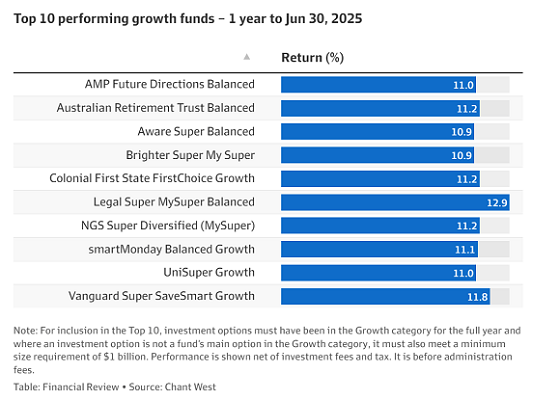
Group 1: Executive Wealth Rankings - The 2025 fiscal year Australian executive wealth rankings reveal Richard White, founder and executive chairman of WiseTech Global, at the top with a net worth of approximately AUD 13.4 billion [1] - Mario Verrocchi, co-founder of Chemist Warehouse, ranks second with a wealth of about AUD 7.64 billion, while Sam Hupert, co-founder of Pro Medicus, is third with nearly AUD 6.9 billion [1] - The top 50 executives hold a combined wealth of nearly AUD 61 billion, with AUD 52 billion coming from the top 10 and AUD 57 billion from the top 20 [1] Group 2: Growth Superannuation Funds - Legal Super leads the 2025 fiscal year growth superannuation fund rankings with a return rate of 12.9%, followed by Vanguard at 11.8% and Colonial First State and Australian Retirement Trust both at 11.2% [1][2] - The median annual return for Australian growth superannuation funds in 2025 is 10.5%, an increase from 9.1% in the previous fiscal year [2] Group 3: M&A Activity in Australia - Australian M&A transaction value reached USD 63 billion (AUD 91.6 billion) in the first half of the year, marking a 97% year-on-year increase, significantly higher than the global average increase of 23% [15] - The increase is largely attributed to a single acquisition by Santos valued at AUD 36.4 billion, which accounts for 38% of the total M&A value [15] Group 4: Currency and Economic Outlook - The Australian dollar faces potential depreciation risks against multiple currencies due to global economic uncertainties and trade tensions, with specific attention to the AUD/JPY and AUD/CNY exchange rates [6] - The Australian dollar was reported at 96.581 JPY and 4.6675 CNY as of Monday morning [6] Group 5: Block's Inclusion in S&P 500 - Block, the parent company of Afterpay, is set to be included in the S&P 500 index, leading to a significant stock price increase of over 11% on the day of the announcement [8] - The stock price reached AUD 122.07, marking a year-to-date increase of 19.41% [8] Group 6: Real Estate Market Trends - The clearance rate for property auctions in Australian capital cities has risen for the fourth consecutive week, with Melbourne showing a notable recovery in property transactions [10] - The preliminary clearance rate for 1,574 property auctions across Australia was 74.4%, the second highest this year, with Melbourne achieving a clearance rate of 76.6% [10] Group 7: NOVONIX and Graphite Market - NOVONIX Limited is positioned to benefit from the U.S. Department of Commerce's preliminary ruling to impose a 93.5% anti-dumping duty on graphite imports from China, leading to a total effective tax rate of 160% [17] - NOVONIX is expanding its production capacity in Chattanooga, aiming to meet the growing demand for high-performance graphite in various sectors [18]