
Commonwealth Fusion Systems

Search documents
马斯克一句“愚蠢至极”,又得罪了整个硅谷
3 6 Ke· 2025-12-17 04:17
Core Viewpoint - Elon Musk criticized the investment in small nuclear fusion reactors, arguing that the sun serves as a free and efficient nuclear fusion reactor, making such investments "super dumb" [1][2]. Group 1: Investment Landscape in Nuclear Fusion - Significant investments in nuclear fusion have been made by prominent figures in Silicon Valley, including Bill Gates, Jeff Bezos, and Sam Altman, with nearly $10 billion in private capital expected to flow into the sector by July 2025 [5][6]. - The fusion industry is viewed as a long-term infrastructure investment rather than a typical "hot trend," with a focus on developing a "civilization-level infrastructure" that could reshape human technological capabilities [5][6]. - Commonwealth Fusion Systems (CFS) has raised nearly $3 billion, focusing on high-temperature superconducting tokamak technology, which is seen as a promising path toward practical fusion energy [6][7]. Group 2: Diverging Perspectives on Nuclear Fusion - Musk's skepticism towards nuclear fusion highlights the engineering challenges and economic impracticalities associated with terrestrial fusion reactors, which he believes cannot compete with solar energy [15][17]. - The narrative surrounding nuclear fusion as a source of "unlimited energy" continues to attract investment, despite repeated delays in its commercialization [13][14]. - Musk argues that the costs and complexities of developing nuclear fusion reactors are not justified when solar energy has become significantly cheaper and more efficient [16][18]. Group 3: Alternative Energy Strategies - Musk advocates for solar energy and energy storage technologies as the most viable and economically sound solutions for future energy needs, proposing a comprehensive approach that includes both terrestrial and space-based solar energy systems [18][19]. - The concept of deploying solar AI satellites in near-Earth orbit aims to leverage the advantages of space for energy collection, providing continuous power without the limitations faced by ground-based solar systems [19][20]. - The ongoing debate between nuclear fusion and solar energy reflects broader themes in energy transition, emphasizing the need for a balanced approach to risk and return in energy investments [21].

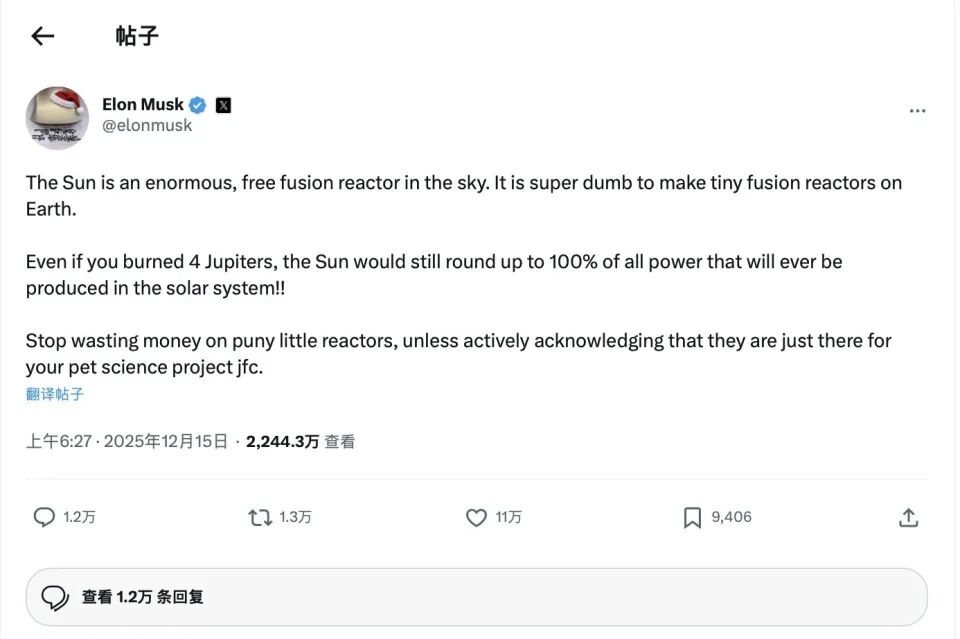
Elon Musk Says Sun Is 'Free' Fusion Reactor, Slams Companies 'Wasting Money' On Nuclear Energy: 'It Is Super Dumb…' - Tesla (NASDAQ:TSLA)
Benzinga· 2025-12-15 08:43
Group 1: Solar Power Advocacy - Elon Musk emphasizes the Sun as an "enormous, free fusion reactor" capable of meeting global energy needs, criticizing the development of small fusion reactors on Earth as inefficient [2][3] - Musk asserts that the Sun will account for 100% of the Solar System's power production potential, even if resources equivalent to four Jupiters were consumed [3] Group 2: Nuclear Energy Developments - Major Silicon Valley tech companies are increasingly supporting nuclear fusion, with Commonwealth Fusion Systems recently securing $863 million in funding, including investment from Nvidia Corp [4] - The Trump administration's Energy Secretary claims that energy prices will decrease, attributing recent electricity price increases, which have risen 13% on average since 2022, to the previous administration's policies [5] Group 3: Tesla's Energy Storage Performance - Tesla reports a 44% revenue growth in its energy storage business, generating over $3.4 billion in Q3, which now represents 12% of the company's total sales, up from 9% year-over-year [6]


2025年全球核聚变行业报告
Sou Hu Cai Jing· 2025-11-11 10:14
Industry Overview - The global fusion industry is transitioning from scientific exploration to commercialization, with significant advancements in funding, technology, and collaboration [1][2] - As of 2025, total funding in the fusion sector has exceeded $9.7 billion, with over $2.6 billion raised in the past year alone, marking a five-fold increase since 2021 [9][23] - The number of companies in the industry has grown from 23 in 2021 to 53 in 2025, employing over 4,600 direct employees and supporting at least 9,300 supply chain jobs [10][23] Funding and Investment - Cumulative financing in the fusion industry has surpassed $97 billion, with a notable increase of over $2.6 billion in the last year [1][23] - Public funding has increased by 84%, reaching nearly $800 million, indicating strong government support for the industry's growth [17] - The median additional funding required for companies to bring their first pilot plants online is reported to be $700 million, with total capital needed for commercialization estimated at over $77 billion [11][12] Technological Advancements - Companies are utilizing diverse technological pathways, including magnetic confinement and inertial confinement, with several achieving key breakthroughs [2][10] - 35 companies plan to operate commercially viable pilot plants capable of generating net energy between 2030 and 2035, with expectations for the first fusion plant to deliver electricity to the grid between 2031 and 2040 [13][14] Collaboration and Ecosystem - Public-private partnerships are expanding, with governments engaging in cost-sharing initiatives to accelerate commercialization [17][20] - Collaborations between companies and academic institutions are fostering innovation in related technologies, benefiting sectors such as wind energy and transportation [2][18] Challenges and Future Outlook - The industry faces challenges in achieving sufficient fusion power gain, developing resilient materials, and navigating regulatory frameworks [15][16] - Despite these challenges, the fusion industry is poised for a defining decade, with strong investor confidence and a clear trajectory towards commercialization [3][14]

X @Bloomberg
Bloomberg· 2025-11-08 16:16
Commonwealth Fusion Systems is trying to solve one of the industry’s biggest challenges: getting people to drop using the words “nuclear” and "reactors." https://t.co/5PEI1vWXWo ...
Materion (MTRN) - 2025 Q3 - Earnings Call Transcript
2025-10-29 15:00
Financial Data and Key Metrics Changes - The company achieved all-time high EBITDA margins of 27% in electronic materials, reflecting improved cost structure and operational performance [4] - Sales increased approximately 1% year-over-year, with adjusted earnings per share at $1.41, flat compared to the prior year and up 3% sequentially [12][18] - Adjusted EBITDA was $55.5 million, down 2% year-over-year, primarily due to lower volume from equipment downtime in Performance Materials [12][13] Business Line Data and Key Metrics Changes - Performance Materials saw value-added sales of $157.1 million, down 4% year-over-year, impacted by equipment downtime [12][14] - Electronic materials reported value-added sales of $79.7 million, up 2% from the prior year and up 7% organically, with EBITDA margins reaching a record 27.1% [15][16] - Precision Optics experienced value-added sales of $27.1 million, up 21% year-over-year, returning to double-digit EBITDA margins [16][17] Market Data and Key Metrics Changes - Semiconductor sales, excluding China, increased 7% year-to-date, with high-performance memory applications up over 30% [6] - The defense market saw record bookings up approximately 40% year-to-date, with $150 million in requests for quotes (RFQs) [10][43] - The space market has grown fivefold in three years, with significant opportunities expected to continue [11] Company Strategy and Development Direction - The company is focusing on high-growth markets such as semiconductor, defense, space, and energy, with order rates up more than 10% sequentially [5][11] - Strategic partnerships, such as with Commonwealth Fusion Systems and Kairos Power, are aimed at expanding into new energy solutions [9][25] - The company aims to achieve midterm target margins of 23% and is committed to improving operational reliability and cost structure [13][57] Management's Comments on Operating Environment and Future Outlook - Management expressed optimism about a strong Q4, driven by defense orders and improving operational performance [24] - There is uncertainty regarding the China market, which has seen a 20% year-over-year decline, impacting overall sales [74][92] - The company anticipates continued growth in high-demand sectors despite challenges in the automotive market [60][62] Other Important Information - The company ended the quarter with a net debt position of approximately $441 million and $214 million of available capacity on its credit facility [17] - A new $50 million stock repurchase program was authorized, although organic growth remains the top priority for capital allocation [17][65] Q&A Session Summary Question: Why was the full year outlook range not narrowed? - Management cited uncertainty around China and potential impacts from the government shutdown as reasons for maintaining the range [24] Question: What financial impact is expected from the new agreement with Commonwealth Fusion Systems? - Initial shipments are expected to contribute a few million this year, with a more significant annualized run rate anticipated next year [25][27] Question: What is the nature of the equipment downtime in Performance Materials? - The downtime was primarily due to issues in the largest plant, but operations have resumed, and sales are expected to catch up in Q4 [36][37] Question: What are the expectations for 2026 growth? - Management is optimistic about growth in key markets, with a focus on offsetting challenges in China with high-growth opportunities [42][45] Question: How is the company addressing operational reliability? - The company is focused on capital improvements and maintenance to minimize equipment downtime in the future [40][41] Question: What is the expected impact of tariffs on financial results? - The China business is down about 20% year-over-year, with some tariff impacts being manageable through pricing strategies [74][75] Question: Will beryllium be stockpiled due to increased defense spending? - Management indicated that increased U.S. defense spending could lead to higher demand for beryllium-based applications [102][103]
Materion Corporation Reports Strong Third Quarter 2025 Financial Results and Affirms Full Year Outlook
Businesswire· 2025-10-29 10:47
Core Insights - Materion Corporation reported strong financial results for the third quarter of 2025, with net sales of $444.8 million, an increase from $436.7 million in the prior year period, and affirmed its full-year outlook [1][4][11] - The company highlighted significant improvements in its Electronic Materials and Precision Optics segments, with record margin performance and a return to double-digit EBITDA margins in Precision Optics [3][4] Financial Summary - Net sales for Q3 2025 were $444.8 million, up 1% from $436.7 million in Q3 2024 [4][11] - Value-added sales were $263.9 million, reflecting a 1% organic growth driven by non-China semiconductor and space markets [4][11] - Operating profit increased to $34.9 million from $31.3 million year-over-year, while net income rose to $25.4 million, or $1.22 per diluted share, compared to $22.3 million, or $1.07 per share, in the prior year [5][11] - Adjusted EBITDA was $55.5 million, representing 21.0% of value-added sales, slightly down from 21.5% in the prior year [6][11] Business Highlights - The Electronic Materials segment achieved record EBITDA margins of 27.1%, up 700 basis points year-on-year, while Precision Optics saw a significant sales increase and approximately 1000 basis points of margin expansion [11][11] - Order rates increased double-digit sequentially across all business segments, driven by strong macroeconomic trends in semiconductor, energy, space, and defense markets [4][11] - Materion announced a supply agreement with Commonwealth Fusion Systems to provide materials for fusion technologies, indicating a strategic move into emerging energy markets [11] Outlook - The company expects a strong fourth quarter and has reaffirmed its guidance for adjusted earnings per share for the full year to be between $5.30 and $5.70 [8][11]

Materion Signs Supply Agreement with Commonwealth Fusion Systems to Provide Beryllium Fluoride for Fusion Energy Technology
Businesswire· 2025-10-28 10:47
Core Insights - Materion Corporation has entered into an agreement with Commonwealth Fusion Systems to supply beryllium fluoride for fusion power plants [1] Company Summary - Materion Corporation is recognized as a global leader in advanced materials solutions [1] - The agreement involves the provision of beryllium fluoride for the production of FLiBE molten salt [1] Industry Summary - Commonwealth Fusion Systems is identified as the leading and largest commercial fusion energy company [1] - The beryllium fluoride supplied will be utilized in CFS' ARC power plants [1]
可控核聚变火了,上百家投资机构抢份额
投中网· 2025-10-27 06:47
Core Viewpoint - The article discusses the increasing interest and investment in controlled nuclear fusion, often referred to as the "artificial sun," highlighting its potential as a future energy source and the shift in investor sentiment towards this sector [3][4][19]. Investment Trends - The controlled nuclear fusion sector is experiencing a surge in attention from investors, with significant funding rounds being completed, such as the nearly 100 million yuan first round financing for Andong Fusion [3][14]. - There are at least two other startups in the controlled nuclear fusion space expected to complete new rounds of financing by 2025, indicating a growing trend in investment [14]. Historical Context - The concept of nuclear fusion has a long history, dating back to the 1940s, with significant milestones such as the first hydrogen bomb explosion marking humanity's initial achievement in nuclear fusion [6]. - The development of controlled nuclear fusion has faced challenges, with the International Thermonuclear Experimental Reactor (ITER) project experiencing delays and budget overruns [7]. Technological Advances - Recent technological advancements, including breakthroughs in materials and structures, have made the realization of controlled nuclear fusion more feasible [7][8]. - The article notes that various technical approaches, such as magnetic confinement and inertial confinement, are being explored, with magnetic confinement currently being the mainstream method [7]. Market Dynamics - The demand for clean energy is driving increased investment in controlled nuclear fusion, with the global fusion industry seeing a dramatic rise in investment from 1.9 billion USD in 2021 to 9.7 billion USD in recent years [18]. - The number of nuclear fusion companies has increased by 143% since 2021, reflecting a growing interest in this sector [18]. Policy Support - Government policies in countries like China and the U.S. are increasingly supporting the development of nuclear fusion, with the recent inclusion of "fusion" in Chinese law signaling significant opportunities for the sector [17]. - Cities such as Shanghai and Hefei are actively promoting policies to accelerate the development of controlled nuclear fusion, attracting both national teams and startups [17]. Future Outlook - The consensus among commercial fusion companies is that grid-connected power generation could be achieved before 2040, with many expecting to reach this milestone between 2030 and 2035 [20]. - The article suggests that the combination of entrepreneurial enthusiasm and investment momentum is significantly accelerating the commercialization of controlled nuclear fusion [20].

X @Demis Hassabis
Demis Hassabis· 2025-10-16 16:39
Collaboration & Technology - Google DeepMind is collaborating with Commonwealth Fusion Systems (CFS) to accelerate fusion development using AI [1] - The collaboration aims to speed up the development of clean, safe, and limitless fusion power with AI [1] Industry Focus - The collaboration focuses on nuclear fusion, aiming for a sustainable future with limitless clean energy [1]
北美替代能源:核能、太阳能与人工智能-North America Alternative Energy _Nuclear, Solar & AI_ Windham
2025-10-13 01:00
Summary of Key Points from the Conference Call Industry Overview - The conference call discusses the North American alternative energy sector, focusing on nuclear, solar, and AI technologies, emphasizing the urgent need for clean electricity generation in the U.S. market [2][3][70]. Core Insights and Arguments 1. **Clean Electricity Demand**: The U.S. market is significantly short of clean electricity generation, with fossil fuels and aging nuclear accounting for approximately 80% of current electricity generation. A multi-decade build cycle is necessary to meet the demand for clean electricity, which includes solar, wind, storage, nuclear, and natural gas [2][4][70]. 2. **Nuclear and Solar Relationship**: The increased interest in nuclear energy is not detrimental to solar energy; rather, it highlights the need for a diverse energy mix to meet future electricity demands. The nuclear build timelines extend into the 2030s and 2040s, necessitating a long-term view on energy generation [2][3][101]. 3. **Solar and Storage Growth**: In the second quarter of 2025, U.S. electricity generation grew by 2.3% year-over-year, with solar contributing 78% of the incremental demand. Solar and storage accounted for about two-thirds of the approved capacity additions in the U.S. [4][41]. 4. **Investor Sentiment**: Following the resolution of U.S. solar policy uncertainties in mid-2025, investor interest in solar stocks is expected to increase, particularly for companies like First Solar (FSLR) and Nextracker (NXT) [5][7][11]. 5. **Corporate Renewable Demand**: Corporate Power Purchase Agreements (C-PPA) signed in 2024 grew by 60% year-over-year, with solar comprising 78% of total capacity. Major technology companies dominate this market, accounting for 80% of total capacity signed in 2025 year-to-date [41][55]. Additional Important Insights 1. **Tax Credits and Manufacturing**: The 45X advanced manufacturing tax credits are expected to benefit incumbent U.S. manufacturers like FSLR and NXT significantly, as they are positioned to capture a large share of the domestic manufacturing market [35][37][36]. 2. **Long-term Energy Transition**: The U.S. electricity generation carbon emissions have declined by approximately 35% since 2007, indicating ongoing progress in the energy transition. However, the transition is expected to continue for decades, with a need for diverse generation technologies [74][92]. 3. **Future Projections**: By 2050, the U.S. may require substantial new nuclear capacity to meet electricity demand, with projections suggesting a need for around 100GW of new nuclear capacity, alongside significant solar and wind installations [96][100]. 4. **Technological Disruption**: The potential for nuclear fusion to disrupt the energy generation landscape is acknowledged, with partnerships being formed to develop fusion power plants [117][120]. Conclusion The conference call highlights the critical need for a diversified energy strategy in the U.S. to meet future electricity demands, emphasizing the roles of solar, nuclear, and emerging technologies. The resolution of policy uncertainties and the growing corporate demand for renewable energy are expected to drive investment and growth in the sector.


