UBTech

Search documents
5000美元级别机器人!大摩:中国发展速度远超西方认知
Hua Er Jie Jian Wen· 2025-08-27 04:14
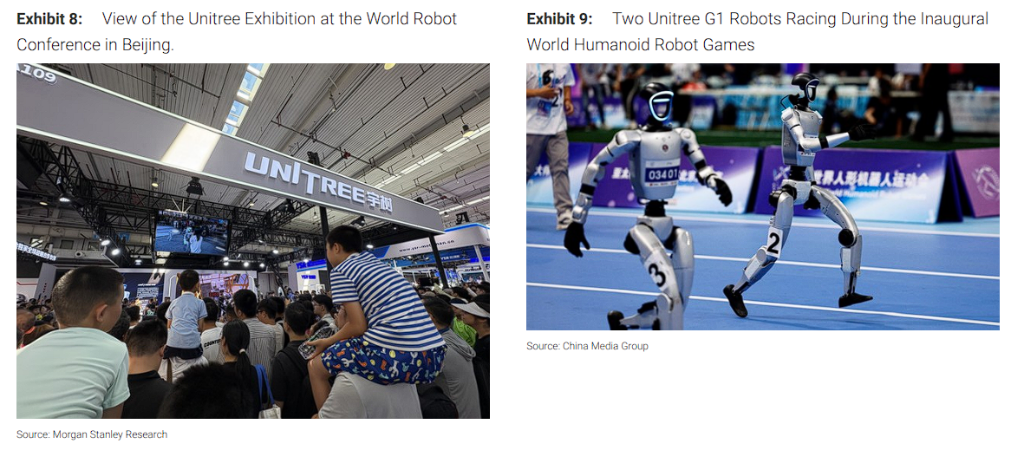
Core Insights - The humanoid robot industry in China is rapidly advancing, with significant progress in commercialization and cost reduction, as evidenced by the introduction of humanoid robots priced around $5,000 [1][8][9] - Morgan Stanley estimates that the global humanoid robot market could reach nearly $5 trillion in annual revenue by 2050, indicating a growth trajectory similar to that of autonomous vehicles in the late 2010s [2][22] - The recent World Robot Conference and the inaugural World Humanoid Robot Games in Beijing highlight China's strategic prioritization of humanoid robots, showcasing technological advancements and industry commitment [3][4][5] Industry Development - The World Robot Conference attracted over 200 global robotics companies, demonstrating the scale and interest in the humanoid robotics sector [3] - The participation of 280 teams and over 500 humanoid robots in the World Humanoid Robot Games reflects the growing engagement and competitive spirit within the industry [4] - Chinese startups like Yushu Technology and EngineAI have launched humanoid robots at competitive prices, significantly lower than market expectations, indicating advancements in cost control and mass production [1][9] Consumer Sentiment - A consumer sentiment survey revealed that Chinese consumers are significantly more optimistic about humanoid robots compared to their American counterparts, with 67% of Chinese respondents believing in the potential applications of humanoid robots [10][14] - The perception of humanoid robots having a positive societal impact is held by 61% of Chinese respondents, contrasting sharply with only 5% in the U.S. [10][14] Government Support - The Chinese government has established a comprehensive policy framework to support the humanoid robot industry, including various action plans and funding initiatives aimed at fostering innovation and collaboration [15][16][17] - By 2025, multiple significant policies are expected to be implemented, with goals to exceed 50 billion RMB in industry scale by 2027 [16] - The total scale of government funds supporting the humanoid robot sector is approximately 187 billion RMB, indicating strong financial backing for industry growth [17] Market Outlook - Morgan Stanley's analysis suggests that by 2050, approximately 1 billion humanoid robots could be adopted globally, with significant market penetration expected in the coming decades [22] - The "Humanoid Robot 100 Index" has outperformed major indices since its inception, reflecting investor confidence in the sector's growth potential [19][22]


中国实地观察 -2025关键词:多元化与差异化On the ground of China - July 2025
2025-08-18 02:52
Summary of Key Points from the Conference Call Industry Overview - The report focuses on the **Chinese manufacturing and consumer sectors**, highlighting trends in **capital goods**, **technology**, **leisure**, and **beauty** industries [2][3][5]. Core Insights and Arguments 1. **Global Diversification Strategy**: Amid deflation and tariff uncertainties, mid-stream corporates are diversifying capacity globally as a key strategy [3][5]. 2. **Consumer Trends**: Leisure and beauty firms are experiencing solid growth through product differentiation aimed at self-rewarding consumers [3][5]. 3. **Sector Performance**: In July, **capital goods**, **software**, and **real estate** sectors gained the most wallet share, while **technology hardware** saw a significant decline in investor interest [5][10][16]. 4. **Investor Interest Shifts**: The top sectors for investor meetings in July were **technology**, **consumer**, and **financials**, contrasting with previous quarters [3][5]. 5. **Company Visits**: Notable companies visited include **BYD**, **Transsion**, **OmniVision**, and **Mindray**, indicating strong investor interest in these firms [3][5]. Additional Important Insights 1. **Sales Growth in SMID/Materials**: Companies like **Sunresin** and **Shengquan** reported robust sales growth, particularly in overseas markets, with significant projects in the pipeline [8][26][27]. 2. **Leisure and Beauty Sector Dynamics**: Companies such as **Yiwu CCC** and **Chicmax** are focusing on online sales channels and product launches to drive growth [32][37]. 3. **Transport Sector Recovery**: Express shipping prices are recovering, particularly in key regions like Guangdong, indicating a positive trend in logistics [8][32]. 4. **Technology Sector Challenges**: The **China Wafer Level CSP Company** is expanding overseas but faces flat demand in domestic smartphone markets [25]. 5. **Automotive Insights**: Visits to car dealers revealed a shift in consumer sentiment, with a positive outlook for brands like **BYD** amid changing market dynamics [40]. Conclusion The conference call provided a comprehensive overview of the current state of various sectors in China, emphasizing the importance of diversification, consumer trends, and shifts in investor interest. The insights gathered from company visits and sector performance highlight potential investment opportunities and risks in the evolving market landscape.
'Tesla Has The Robot And The Customer': Dave Mazza's HUMN ETF Makes A Calculated Bet On Optimus
Benzinga· 2025-06-30 17:40
Core Insights - The humanoid robotics market is transitioning from a futuristic concept to a viable investment opportunity, with estimates suggesting it could reach a $5 trillion market by 2050 [1][2][3] Market Dynamics - The market is experiencing a turning point due to three converging trends: record labor shortages, significant reductions in AI costs (down approximately 85% since 2023), and competitive pricing for Robots-as-a-Service (RaaS) at around $30 per hour [2][3][4] - Over 450,000 warehouse roles in the U.S. remain unfilled, highlighting the labor shortage [3] Investment Vehicles - Roundhill's HUMN ETF is one of the first actively managed ETFs focused on humanoid robotics, allowing for more agile trading compared to index-based ETFs like KraneShares' KOID [4][5] - HUMN's portfolio is reviewed monthly to capitalize on emerging opportunities, contrasting with KOID's static approach [5][6] Tesla's Role - Tesla's humanoid robot, Optimus, is already operational within its factories, and the company is a significant holding in the HUMN ETF, capped at approximately 13% to mitigate risk from volatility [7][8] - Tesla's unique advantages include an in-house AI stack and large-scale manufacturing capabilities, positioning it favorably in the humanoid robotics space [8][9] Future Projections - Adoption of humanoid robotics is expected to follow a linear growth pattern through the late 2020s, with a significant inflection point in the mid-2030s as fleets scale [10] - Investors are encouraged to view HUMN as a long-term holding with potential for strong returns in shorter time frames [10] Global Exposure - HUMN ETF provides exposure to sophisticated humanoid robotics through ownership stakes in companies like Hyundai (owner of Boston Dynamics' Atlas) and Xiaomi, which are part of its portfolio [11][12] - The ETF adopts a value-chain approach, incorporating U.S. silicon producers, Chinese humanoid builders, and Japanese precision gear manufacturers to ensure comprehensive market exposure [12] Conclusion - As the humanoid robotics sector evolves, Roundhill's HUMN ETF offers a potential first-mover advantage for investors looking to capitalize on the growing demand for robotic solutions in various industries [13][14]