Zynga

Search documents
Videogame maker EA in advanced talks to go private at roughly $50 billion valuation
Yahoo Finance· 2025-09-26 18:46
Group 1 - Electronic Arts (EA) is in advanced talks to go private at a valuation of approximately $50 billion [1][2] - A consortium of investors, including Silver Lake, Saudi Arabia's Public Investment Fund, and Affinity Partners, may announce a deal soon, potentially marking the largest leveraged buyout in history [2][4] - The take-private offer comes at a critical time for EA, which is focusing on its sports portfolio and action shooter titles to navigate a challenging video game market [3] Group 2 - EA's future success heavily relies on the upcoming releases of "Battlefield 6" and "FC 26," which are expected to perform well in sales [3][4] - The deal would contribute to further consolidation in the video game industry, following acquisitions of other major companies like Activision Blizzard and Zynga [4] - Analysts note that EA is an attractive acquisition target due to its consistent cash flows and predictable revenue from annualized titles [4][5] Group 3 - The current environment for large-cap mergers and acquisitions is improving, with increased boardroom confidence and favorable conditions for pursuing strategic mergers [5] - The anticipated Fed rate cuts are expected to ease capital costs, facilitating mergers over organic growth strategies [5] - Affinity Partners, founded by Jared Kushner, has backing from funds in Saudi Arabia, Qatar, and the UAE, while Silver Lake is recognized for significant technology buyouts [6]

+30%收入,切支付,大厂们都是怎么做的?
3 6 Ke· 2025-09-15 00:23
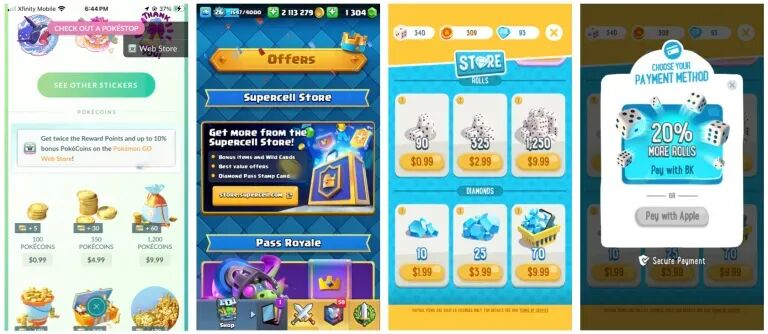
Core Insights - The article discusses how mobile game developers are increasingly directing players to external payment options to avoid Apple's 30% commission, referred to as the "Apple tax" [1][3][12] - A study by Liquid & Grit analyzed over 30 cases of leading mobile game companies like Supercell and Niantic, focusing on their strategies to sell in-app purchases (IAP) directly to players outside of the App Store [1][3] Group 1: Strategies for Redirecting Players - Liquid & Grit categorized the new store designs into four main types: offering web store discounts in the native IAP store, pop-ups, buttons on the main game interface, and using in-game news and email systems for guidance [1][3] - "Social Casino" games are the most proactive in redirecting players to web stores, utilizing all four methods, while other game categories show varied adoption [3][5] - Specific games like "Dragon City" and "PUBG Mobile" employ different strategies, such as banners and pop-ups, to encourage players to use web stores for purchases [5][7] Group 2: Incentives and Challenges - To enhance conversion rates, developers must reduce payment friction and increase player motivation to choose external payment options over Apple’s [11][12] - Companies like Epic Games offer incentives, such as a 20% cash back, to encourage players to opt for web payments [11] - The report suggests that the most effective design so far is the "purchase pop-up," which allows players to complete transactions without leaving the game, thus maintaining a seamless experience [11][12] Group 3: Alternative Payment Solutions - Companies with in-house resources are encouraged to build their own web stores and utilize payment processors like Stripe or Adyen to handle transactions [12] - For developers who prefer not to create their own stores, managed web store service providers like Xsolla and Stash are available, offering a quicker setup at a cost lower than Apple's commission [12]


在欧盟服软、美国硬气,苹果面对的问题并不相同
3 6 Ke· 2025-08-08 11:53
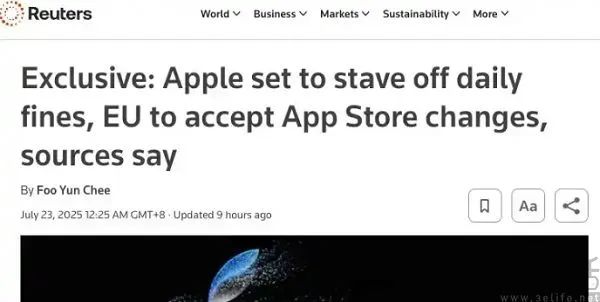
Core Viewpoint - Apple is facing significant challenges in both the US and European markets regarding its App Store policies, particularly the so-called "Apple tax" on in-app purchases, leading to different strategic responses in each region [1][3][10]. Group 1: Legal Challenges and Responses - Two months ago, Apple lost a lawsuit against Epic Games, resulting in a forced adjustment of its App Store policies in the US, including a 27% commission on external purchases and restrictions on developers directing users to alternative payment methods [1][3]. - Apple is now targeting the court that issued the ruling, arguing that the decision overstepped its jurisdiction by affecting all US developers, not just those involved in the case [1][3]. - In contrast, Apple has accepted the European antitrust ruling and is making significant adjustments to its App Store rules in the EU to avoid potential fines of up to €50 million per day for violating the Digital Markets Act (DMA) [1][3]. Group 2: Market Dynamics and Strategic Differences - The EU's determination to assert digital sovereignty has led to a more stringent regulatory environment, compelling Apple to comply with new rules, while the US market remains more lucrative for Apple, prompting a more defensive stance [5][7][8]. - Apple's market share in Europe is 26%, compared to 12% in China, but the revenue generated from the App Store in Europe is significantly lower, at $148 billion, compared to $539 billion in China and $406 billion in the US [5][7]. - The difference in revenue potential between the US and Europe is stark, with the US being the largest consumer market, which influences Apple's reluctance to concede on its "Apple tax" in the US [8][10]. Group 3: Financial Implications - If the US court's injunction is not overturned, Apple's App Store revenue could face catastrophic declines, as the company currently earns approximately $12.18 billion from the US App Store's commission structure [10]. - The disparity in penalties between the US and EU is notable; while Apple retains a 15% commission for external purchases in Europe, it would receive no revenue if developers bypass the in-app purchase system in the US [10][12]. - Major game developers, such as King and Zynga, have strong incentives to direct users to external payment methods, potentially increasing their profit margins by 5-8%, which could lead to significant revenue growth for US mobile game companies [12].
法院裁决打破苹果(AAPL.US)“佣金墙”,移动游戏商未来将夺回195亿美元收入
智通财经网· 2025-05-30 00:47
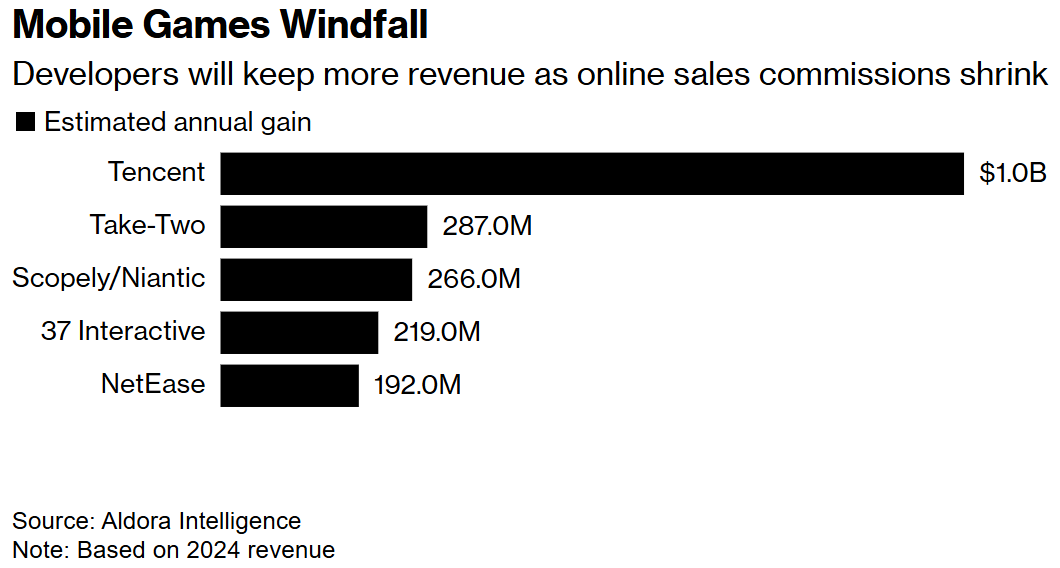
Core Insights - Mobile game developers are expected to gain billions in additional revenue due to a court ruling that allows them to bypass Apple's App Store rules [1][4] - Aldora Intelligence estimates that $4.1 billion will be transferred from Apple to developers annually, increasing the funds available for game creators [1] - Wedbush Securities predicts that developers could see up to $19.5 billion in additional revenue over the next few years, which was previously collected by the App Store [4] Group 1: Impact of Court Ruling - The ruling mandates that Apple must allow developers to sell products outside of the App Store, which typically charges a commission of 15% to 30% on transactions [4] - Developers are already incentivizing players to make purchases outside of Apple's ecosystem, as seen with Epic Games' actions leading to the removal of Fortnite from the App Store [4][5] - Aldora's report suggests that the commission rate paid by mobile game developers to app stores will decrease by one-third to around 20% [4][6] Group 2: Developer Responses and Market Trends - Major mobile game publishers like Take-Two Interactive and others have refrained from commenting on the commission impact, although Take-Two has created a direct-to-consumer web store [5] - The CEO of Take-Two noted that their direct-to-consumer store has become a significant part of their business, reflecting a trend towards a more open app distribution ecosystem [5] - Payment management companies like Xsolla and Stash are facilitating the creation of direct-to-consumer web stores for mobile game companies, charging significantly lower commissions than the App Store [6]