Scale AI

Search documents
他,37岁华裔,靠AI成为福布斯400最年轻亿万富翁,身价180亿美金
3 6 Ke· 2025-09-22 09:35
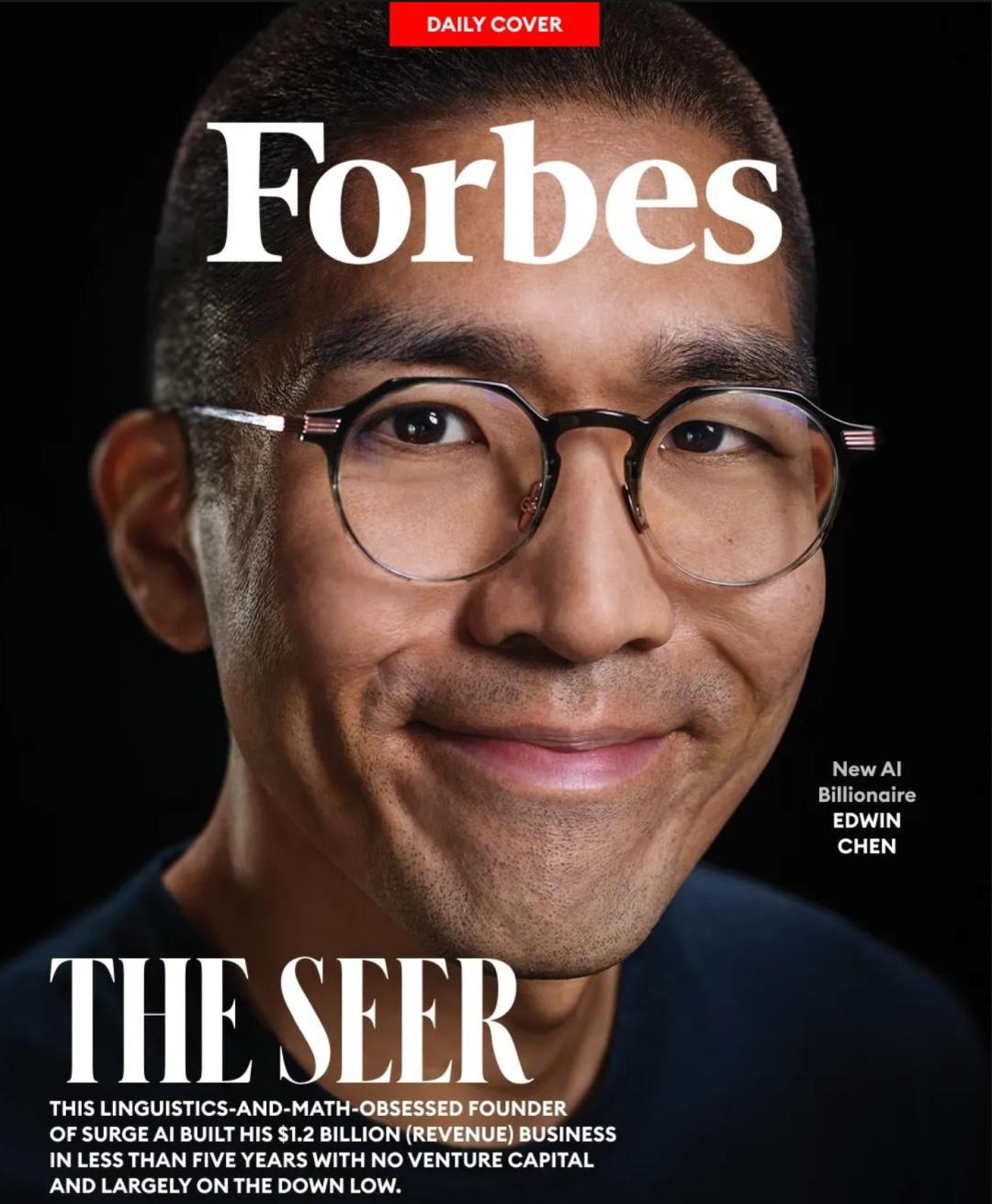
Core Insights - Edwin Chen, a former Google employee, founded Surge, an AI data annotation company, achieving over $1.2 billion in revenue and a valuation of $30 billion within five years [1][27][29] - He is the youngest member of the Forbes 400 list, with a net worth of $18 billion at the age of 37 [1][3][29] - Chen's approach to AI training emphasizes human complexity and understanding, employing professors from top universities and over a million gig workers globally [2][19][27] Company Overview - Surge was founded in 2020 and has quickly become a leader in the AI data annotation industry, with a unique model that contrasts with traditional low-cost labor practices [30][34] - The company has secured contracts with major clients, including Google, Meta, and Microsoft, and has been profitable since its inception [27][29][50] - Surge's workforce is significantly smaller than competitors like Scale AI, yet it generates higher revenue, indicating a focus on quality over quantity [26][34] Business Model and Strategy - Edwin Chen self-funded Surge, avoiding venture capital to maintain control and avoid the pitfalls of rapid scaling typical in Silicon Valley [22][23] - The company employs a unique data annotation process that involves professional annotators interacting with AI, rather than relying on low-paid workers [30][33] - Surge's pricing is notably higher than competitors, reflecting its commitment to quality and expertise in data annotation [45] Industry Context - The AI data annotation market is rapidly evolving, with competitors like Scale AI and Turing emerging, but Surge claims to be the largest by revenue [34] - There is a growing concern in the industry regarding the future role of human annotators as AI technology advances, with some models beginning to rely on synthetic data [54][56] - Edwin Chen believes that human involvement remains crucial for achieving superior outcomes in AI training, despite the trend towards machine-generated data [56]

GPT-5编程测评大反转!表面不及格,实际63.1%的任务没交卷,全算上成绩比Claude高一倍
量子位· 2025-09-22 08:08
Core Insights - The article discusses the performance of leading AI models on the new software engineering benchmark SWE-BENCH PRO, revealing that none of the top models achieved a solution rate above 25% [1][23]. Group 1: Benchmark Overview - SWE-BENCH PRO is a new benchmark that presents more challenging tasks compared to its predecessor, SWE-Bench-Verified, which had an average accuracy of 70% [5][6]. - The new benchmark aims to eliminate data contamination risks by ensuring that models have not encountered the test content during training [9][12]. - SWE-BENCH PRO includes a diverse codebase of 1865 commercial applications, B2B services, and developer tools, structured into public, commercial, and reserved subsets [12][18]. Group 2: Model Performance - The top-performing models on the public set were GPT-5 and Claude Opus 4.1, with solution rates of 23.3% and 22.7%, respectively [25][26]. - In the commercial set, even the best models scored below 20%, indicating limited capabilities in solving real-world business problems [27][28]. - The performance of models varied significantly across programming languages, with Go and Python generally performing better than JavaScript and TypeScript [30]. Group 3: Failure Analysis - The primary failure modes for the models included semantic understanding issues, syntax errors, and incorrect answers, highlighting challenges in problem comprehension and algorithm correctness [34]. - GPT-5 exhibited a high unanswered rate of 63.1%, indicating that while it performs well on certain tasks, it struggles with more complex problems [32]. - The analysis suggests that the difficulty of programming languages, the nature of codebases, and the types of models are key factors influencing performance [28][29].

「一人公司」不强求,「Copilots 」更能填平 AI 产业落地的「Massive Delta」?
机器之心· 2025-09-20 01:30
Group 1 - The core viewpoint of the article emphasizes that the explosion of general AI models has ignited a frenzy of investment in AI, while the opportunities in Vertical AI arise from the ability to bridge the gap between general capabilities and industry-specific applications, suggesting that the next generation of winners may not solely rely on "agent employees" but also on auxiliary models that drive process solutions, integration, and value delivery [1] Group 2 - Recent data indicates a significant shift in global venture capital towards the AI sector, with a projected investment of $110 billion in AI for 2024, marking a 62% year-on-year increase, while overall tech sector investments have declined by 12% [5] - By August 15, 2024, AI-related companies had raised a total of $118 billion, with eight companies alone securing $73 billion, accounting for 62% of the total AI funding [5] - Vertical AI companies are showing a growing advantage in transaction volume, with $17.4 billion raised across 784 deals in the U.S. and Canada, representing 57% of related transactions, although only 36% of the total funding has flowed into Vertical AI, indicating selective investment by venture capitalists [5][6] Group 3 - Vertical AI is attracting attention due to its potential for high commercial returns, with McKinsey estimating that GenAI could add $2.6 trillion to $4.4 trillion annually to the global economy, particularly benefiting sectors like banking, high-tech, and life sciences [5] - Emerging Vertical AI companies are demonstrating commercial metrics comparable to traditional SaaS firms, with annual contract values (ACV) reaching 80% of traditional SaaS levels and a year-on-year growth rate of 400%, while maintaining approximately 65% gross margins [5] Group 4 - The market for Vertical AI Agents is projected to be ten times larger than traditional vertical SaaS, as it not only replaces existing software but also integrates software with human operations, eliminating repetitive labor [7] - The transition from general models to specific industry applications faces significant challenges, termed the "Massive Delta," which includes the complexity of industry workflows and the need for close collaboration with domain experts to accurately define and model these processes [7][8] - The application of general models is hindered by data privacy compliance and the need for deep integration with legacy systems, particularly in sectors like healthcare and law, which have stringent data privacy requirements [9][10] Group 5 - To bridge the "Massive Delta," various business models have emerged in the Vertical AI space, categorized into Copilots, Agents, and AI-enabled services, representing different levels of value delivery from auxiliary to replacement [10]

OpenAI surges to first place as Forge's Private Mag 7 hit $1.2 trillion
CNBC Television· 2025-09-19 16:50
Private Market Overview - The "private Mag 7" companies have a combined worth of $1.2 trillion, nearly doubling in the past year [2] - Gains of the "private Mag 7" are triple the gains of their public market counterparts [2] - Investor demand is intense, with 19 firms in Forge's AI basket raising $65 billion this year, representing 77% of all private market capital raised [3] Key Players and Market Dynamics - Anthropic has overtaken Stripe and Data Bricks to claim the number three spot behind OpenAI and SpaceX [2] - Some firms are growing revenue up to 300% on billion-dollar bases [3] - Talent and tech are being acquired by listed giants eager for AI exposure [5] Concerns and Potential Shifts - Valuations are considered "insane" and a "bubble" by some, including Sam Altman [4] - Regulation could force these companies public if they become "too big to be private" [5] - Meta is taking a 49% stake in Scale AI for almost $15 billion [7]

Scale AI Rival Micro1 Hits $50M Revenue At Age 3 As 24-Year-Old CEO Ali Ansari Lands $35M From Twitter's Ex-Executives
Yahoo Finance· 2025-09-19 13:46
Company Overview - Micro1 secured a $35 million Series A funding round, valuing the company at $500 million, led by 01 Advisors [1] - The company was founded in 2022 and focuses on connecting contractors, referred to as experts, with AI labs and enterprises for labeling and training tasks [3] Leadership and Board - CEO Ali Ansari, aged 24, is leading the startup, with Bain joining the board alongside Joshua Browder, CEO of AI legal startup DoNotPay [2] Financial Performance - Micro1's annual recurring revenue increased from $7 million at the start of 2025 to $50 million within less than a year [4] - Current clients include Microsoft and multiple Fortune 100 companies, although revenue still trails competitors like Mercor and Surge AI [4] Competitive Landscape - Micro1 competes directly with Scale AI and other players in the training data sector [3] - The company’s competitive edge is its proprietary AI recruiter, Zara, which helps vet candidates before connecting them to projects [5] Market Dynamics - The market is shifting as Meta invested $14 billion into Scale AI, raising concerns among other AI labs about potential conflicts of interest [6]
中美 “融资天花板” 企业大PK,没上市也能狂揽千亿!
Sou Hu Cai Jing· 2025-09-17 10:00
Core Insights - The trend of non-listed companies achieving rapid growth through substantial financing has become prominent in global capital markets, particularly in China and the United States [2] - The financing trajectories of leading non-listed companies reflect the economic structure differences between the two countries and reveal global investors' strategic bets on future industry growth [2] Group 1: China's Financing Leaders - The top 20 non-listed companies in China have collectively surpassed 1 trillion RMB in financing, showcasing significant financial strength [3] - Honor Terminal leads with over 250 billion RMB in financing, evolving into a tech brand focused on young consumers and covering mobile phones and IoT devices [3] - Ant Group, a leading fintech platform, has raised 137.05 billion RMB, integrating deeply into daily life and commercial transactions [3] - Other notable companies include Hengfeng Bank (100 billion RMB), Dalian Xindameng (60 billion RMB), and ByteDance (48.85 billion RMB), each contributing to diverse sectors such as finance, real estate, and technology [4][5] Group 2: Characteristics of China's Financing Kings - The leading companies are primarily focused on financial technology, new energy vehicles, and semiconductor manufacturing, aligning with national strategic priorities [8] - Most companies have established a strong domestic market presence, leveraging China's vast population and consumption advantages for rapid growth [9] - Nearly half of the top 20 companies originated from industry giants, benefiting from their parent companies' resources, which enhances their financing capabilities [10][11] - The financing sources include both strategic investments from national funds and market capital, reflecting a unique "production-finance integration" model in China [12] Group 3: U.S. Financing Leaders - The top 20 non-listed companies in the U.S. have collectively raised over 290 billion USD, with a strong presence of tech startups from Silicon Valley [13] - OpenAI leads the U.S. financing landscape, followed by other AI-focused companies like Anthropic and xAI, highlighting the dominance of AI innovation [13][18] - Other significant players include Cruise Automation (17.38 billion USD) and Databricks (14.897 billion USD), showcasing advancements in autonomous driving and big data services [14] Group 4: Characteristics of U.S. Financing Kings - AI and cutting-edge technology dominate the U.S. financing landscape, with the top three companies being AI-focused [18] - Many U.S. companies are founder-driven, often led by prominent entrepreneurs, which helps attract significant capital support [19] - The investment landscape is characterized by high-density venture capital involvement, with major VC firms and tech giants actively investing in innovative startups [20][21] Group 5: Comparative Insights - The financing paths of China's leading companies reflect a blend of national policy guidance and market capital needs, emphasizing a dual-driven model [27] - In contrast, U.S. companies focus on breakthrough technologies and global market expansion, showcasing a strong inclination towards technological exploration [27] - Both countries' financing leaders prioritize technology as a core development direction, but differ in their market strategies and alignment with national goals [27]

速递|数据标注战场升温:前麦肯锡高管掌舵Invisible Technologies获1亿美元融资,估值突破20亿美元
Z Potentials· 2025-09-17 03:34
Core Insights - Invisible Technologies, a competitor to Scale AI, raised $100 million in a recent funding round, highlighting continued investor interest in foundational components of the AI boom [1] - The company, founded 10 years ago, is now valued at over $2 billion following this funding round led by Vanara Capital [1] - Invisible's technology supported the training of OpenAI's initial ChatGPT, focusing on organizing and classifying vast amounts of information for AI models [1] Funding and Valuation - The recent funding round raised $100 million, with the company achieving a valuation exceeding $2 billion [1] - Vanara Capital, which recently spun off from TPG Inc., led this funding round, marking its first publicly disclosed investment [1] Market Position and Strategy - The data annotation industry gained mainstream attention when Meta acquired a 49% stake in Scale AI, which is valued at over $29 billion [3] - Invisible differentiates itself by offering more complex annotation services and has launched an "expert marketplace" to connect AI companies with data annotators possessing relevant expertise [3] - The company aims to excel in delivering high-complexity work, as stated by Vanara's co-founder, emphasizing the importance of professional collaboration over mere manpower [6] Leadership and Growth - In January, Invisible appointed Matthew Fitzpatrick, former head of McKinsey's AI software development, as CEO [4] - The company currently employs 350 staff, with its engineering team size doubling this year [4] Financial Performance - Invisible's projected sales for 2024 are $134 million, doubling from the previous year [5] - The company offers various products beyond data annotation, including model fine-tuning tools and industry-specific solutions [5] Competitive Landscape - The data annotation sector is highly competitive, with other players like Surge AI, Turing, Labelbox Inc., and Mercor also vying for market share [5] - Surge AI is reportedly negotiating a $1 billion funding round at a valuation of at least $25 billion [5]

Paramount Adds AI Executive Dennis Cinelli To Board
Deadline· 2025-09-16 20:53
Group 1 - Paramount Skydance has appointed Dennis K. Cinelli as an independent director, expanding the board to 11 members [1] - Cinelli is currently the CFO of Scale AI and has held senior roles at Uber and GE Ventures, bringing expertise in high-growth environments and disruptive technologies [2][4] - David Ellison, the new chairman-CEO, emphasizes the importance of technology and innovation in the traditional media business [3] Group 2 - David Ellison expressed enthusiasm for Cinelli's appointment, highlighting his operational expertise and financial insight as key assets for advancing Paramount's strategic vision [4] - Skydance recently acquired a controlling stake in Paramount, with backing from Larry Ellison and RedBird Capital, and the Ellison family is considering a cash bid for Warner Bros. Discovery [4]

PARAMOUNT ADDS DENNIS K. CINELLI TO ITS BOARD OF DIRECTORS
Prnewswire· 2025-09-16 20:15
Core Insights - Paramount Skydance Corporation has appointed Dennis K. Cinelli as an independent director, expanding the Board to 11 members [1][2] - Cinelli is currently the CFO of Scale AI, where he has overseen significant revenue growth and strategic investments [2] - The appointment is aimed at enhancing the Board's capabilities to drive innovation and long-term value for stakeholders [2] Company Overview - Paramount Skydance Corporation operates as a global media and entertainment company with three main segments: Studios, Direct-to-Consumer, and TV Media [3] - The company's portfolio includes well-known brands such as Paramount Pictures, CBS, Nickelodeon, and Showtime [3] Leadership Background - Dennis K. Cinelli has a strong background in finance and technology, having held senior roles at Uber and GE Ventures [2] - At Scale AI, he led the company through a period of sevenfold revenue growth and secured a $1 billion Series F financing [2]

如何在五分钟打动投资人?硅谷传奇投资人20年识人心得
创业邦· 2025-09-16 03:30
Core Insights - The article emphasizes the importance of recognizing extraordinary entrepreneurs and the unique potential of startups in leveraging disruptive technologies like AI [5][9][27] - It discusses the evolutionary dynamics of Silicon Valley's ecosystem compared to China's more distributed innovation landscape, highlighting the competitive advantages of both [6][14] - The article posits that the next wave of trillion-dollar companies is likely to emerge from Silicon Valley due to its adaptive ecosystem and historical accumulation of knowledge [6][12][30] Group 1: Evolutionary Dynamics - The application of Darwinism in the context of Silicon Valley illustrates how natural selection, planned and unplanned variations, and inheritance drive innovation [9][11] - Silicon Valley's history of rapid adaptation and competition fosters a unique environment where startups can thrive and evolve [12][16] - The article suggests that the current AI wave represents a critical phase of radical variation, with significant changes expected every six months between 2025 and 2030 [9][27] Group 2: Investment Philosophy - The investment philosophy of focusing on "people" rather than just ideas is central to the success of venture capital firms like Benchmark [7][39] - The article highlights the importance of building long-term relationships with entrepreneurs, emphasizing that true value comes from deep, supportive partnerships over time [39][41] - It argues that early-stage investments allow for greater flexibility and adaptability, enabling startups to pivot and innovate effectively [50][51] Group 3: Competitive Landscape - The competitive landscape in China is characterized by multiple teams pursuing different strategies within the same company, which fosters innovation and pressure [15][16] - The article notes that while established companies have dominated the market in recent years, the emergence of new business models, particularly in AI, could lead to the rise of several new trillion-dollar companies [26][30] - The potential for creative destruction in the tech industry suggests that even successful companies will eventually be surpassed by new entrants [20][30]