Snowflake Inc.

Search documents
Tech CEOs eye real returns from AI
CNBC Television· 2026-01-26 18:51
you bring up a really good point in the sense that we need to or business leaders need to prioritize and we're sort of moving past the experimentation phase when it comes to AI, right. Correct. Um, in terms of realizing and showing the ROI, I mean, is is this going to be the the show me show me the money year 2026, Jake.>> I don't think it's going to be the show me the money year although we talk about it. I we talk about as if it's I I think there's just too much hype in the market still and I think uh lar ...


全球软件:2026 年初步展望及我们关注的软件标的-Global Software_ Initial thoughts for 2026 and our software names
2026-01-26 02:49
Summary of Global Software Conference Call Industry Overview - The software industry is experiencing a significant shift in focus from macroeconomic concerns to the disruptive rise of AI, with investor discussions centered around whether an AI bubble exists and the potential impact of AI on enterprise software [1][11][15]. Key Themes for 2026 - **Valuation Reset**: Software valuations have halved over the past year, creating opportunities to acquire high-quality stocks at discounted prices [14][31]. - **IT Spending Outlook**: Recent CIO surveys indicate one of the strongest IT spending outlooks since 2018, with expectations for a stable macro environment and lower interest rates supporting demand, particularly among small and medium-sized businesses (SMBs) [3][13][23]. - **Generative AI Impact**: While Generative AI is a major topic, its revenue impact on most software companies is still limited. The expectation is that significant revenue generation from AI will not materialize until 2027 or later [6][19][22]. Company-Specific Insights - **Top Picks**: Recommended stocks include Oracle, Microsoft, SAP, and HubSpot, all rated as Outperform. MongoDB is also favored for its long-term potential and near-term momentum [4][7][25][26]. - **Cautionary Stocks**: Salesforce is expected to underperform due to concerns over AI disruption and market saturation. Snowflake is rated as Market-Perform, with long-term growth prospects viewed as uncertain [4][7][29][30]. Financial Metrics - **Valuation Comparisons**: - Adobe (ADBE): Current price $296.12, target $506.00, adjusted P/E 12.0 for 2026E. - Microsoft (MSFT): Current price $459.86, target $645.00, adjusted P/E 27.5 for 2026E. - Oracle (ORCL): Current price $191.09, target $339.00, adjusted P/E 25.9 for 2026E. - Salesforce (CRM): Current price $227.11, target $223.00, adjusted P/E 19.2 for 2026E [5][8]. Investment Implications - **SMB vs. Enterprise**: SMB-focused software companies may see earlier revenue recovery compared to enterprise-focused firms, as SMBs typically rebound faster in improving economic conditions [6][23]. - **AI Revenue Generation**: The expectation is that while AI will contribute to revenue growth, it will be limited in 2026, with only a few companies likely to see a significant positive impact [19][20]. Macro Considerations - **Economic Stability**: The macroeconomic environment is expected to remain stable, with potential benefits from deregulation and tax cuts in the U.S. [3][23]. - **Geopolitical Risks**: Ongoing global conflicts and geopolitical tensions may continue to impact market sentiment and investment strategies [21][23]. Conclusion - The software sector is at a pivotal moment, with significant opportunities arising from valuation resets and a favorable IT spending outlook. However, the impact of Generative AI remains uncertain, and investors are advised to focus on company-specific fundamentals while being cautious of potential disruptions in the market.




Palantir Stock for the Next 10 Years: Buy, Hold, or Avoid?
The Motley Fool· 2026-01-25 05:00
Core Viewpoint - Palantir Technologies has emerged as a significant player in the generative AI boom, with a market cap of $400 billion, and is expected to leverage its software-as-a-service tools for military and public sector clients while also gaining traction with enterprise customers [1][2]. Business Performance - Palantir's shares have increased over 1,700% since its IPO in 2020, indicating strong past performance, but future growth potential remains a question for new investors [2]. - The company's third-quarter earnings showed a revenue increase of 63% year-over-year, reaching $1.18 billion, with U.S. commercial sales growing by 121% to $397 million, representing approximately 33% of total revenue [8]. Competitive Edge - Palantir specializes in analyzing unstructured data to extract actionable insights, which is distinct from generative AI but can be enhanced by it [3]. - The integration of generative AI allows users to interact with data analytics software using simple text prompts, improving efficiency and real-time insights, particularly in military applications [4]. Strategic Focus - The release of Palantir's Artificial Intelligence Platform (AIP) in mid-2023 marked a pivotal moment, attracting significant attention from analysts and investors [5]. - The shift towards private sector contracts is seen as a core growth driver, as these clients typically have a greater need for data analytics services [8][9]. Risks and Challenges - While the private sector offers growth opportunities, it also introduces competition from other analytics firms like Microsoft and Snowflake [11]. - Political exposure remains a concern, as future administrations may be less inclined to engage with companies perceived as politically aligned [9][10]. Valuation Perspective - Palantir's shares currently have a price-to-earnings (P/E) multiple of 170, suggesting that they are priced for perfection, leading to a recommendation for potential investors to consider waiting for a valuation drop before investing [12].


独家专访伦交所集团CEO施维默:全面融入AI革命,强力看好私募市场
第一财经· 2026-01-22 12:14
Core Viewpoint - The London Stock Exchange Group (LSEG) is transitioning from a traditional exchange to a diversified global financial market infrastructure and data services company, with a strong focus on data and analytics, which now accounts for approximately 50% of its £9 billion revenue [4][7]. Group 1: Transformation and Strategy - LSEG's CEO, David Schwimmer, emphasizes the importance of AI as a revolutionary opportunity for the financial industry, planning to integrate AI through three core strategies: enhancing product offerings, adapting data for AI compatibility, and implementing an "intelligent enterprise" strategy [4][11]. - The company has significantly increased its investment in private markets, launching the PISCES system to facilitate trading of private company equity, reflecting a shift in focus from public market IPOs to private capital [4][14][15]. Group 2: Market Insights and Growth - LSEG's team in China has grown to approximately 1,200 employees, actively engaging in data services, indices, and foreign exchange trading, with a positive outlook on the Chinese market due to improved geopolitical stability and market activity [5][6]. - The company is closely monitoring China's financial market reforms, such as the introduction of the Futures and Derivatives Law, which enhances the attractiveness of China's derivatives market to international participants [5][6]. Group 3: Revenue Structure and Business Model - LSEG's revenue structure is diversified, with 50% from data and analytics, 30% from trading and clearing services, and 20% from indices and risk insight services, indicating a departure from traditional exchange operations [7][8]. - The company aims to provide comprehensive services across the trading lifecycle, integrating market infrastructure with data and analytics to enhance client offerings [9][10]. Group 4: AI Integration and Competitive Advantage - LSEG is leveraging its data resources and partnerships with AI model providers to enhance its service offerings, allowing clients to access data through their preferred AI models [11][12]. - The integration of AI is seen as a unique advantage, enabling LSEG to reach traditional and new clients through innovative channels [13]. Group 5: Private Market Focus and PISCES System - The PISCES system allows private companies to trade equity while maintaining confidentiality and minimizing disclosure obligations, catering to the needs of firms that wish to protect sensitive information [15][17]. - This system is designed to facilitate flexible trading windows, enabling companies to connect with global institutional investors without the need for prior buyer identification [16][17].

2026 年数据与人工智能的 7 项预测
3 6 Ke· 2026-01-22 05:52
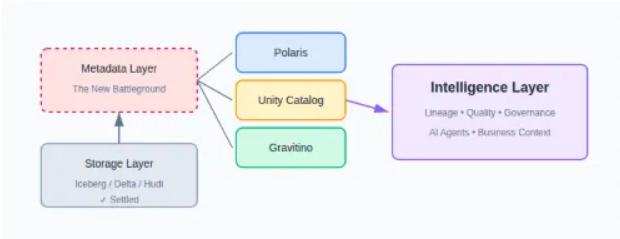
Core Insights - The infrastructure supporting artificial intelligence is undergoing a significant transformation, driven by the convergence of open formats, AI capabilities, and the unsustainable costs of integrating numerous tools [1][2]. Group 1: Importance of Fundamentals - Basic skills remain crucial as architecture changes can disrupt pipelines, and data quality issues continue to plague organizations, costing an average of $12.9 million annually due to poor data quality [2][11]. - The key challenge by 2026 will not be the existence of these issues but the speed and method of their detection and resolution [2]. Group 2: Metadata Layer as a Battleground - The storage layer competition has concluded with Iceberg, Delta Lake, and Hudi emerging as winners, while Parquet has become the common language for data storage [3][6]. - The focus is shifting upstream to the metadata layer, which is becoming the operational backbone of data management, encompassing data lineage, quality rules, access policies, and business context [6][20]. Group 3: Simplification of Data Stacks - Organizations are experiencing tool fatigue, managing an average of 15 to 30 different tools across various data functions, which is unsustainable [7][9]. - By 2026, the integration process will accelerate, with platforms like Snowflake and Databricks consolidating functionalities to streamline data operations [10]. Group 4: Data Quality as a Business Function - Data quality metrics will shift from engineering-focused indicators to business outcomes, with organizations increasingly linking data pipeline failures to revenue impacts [11][12]. - By 2026, 80% of organizations are expected to deploy AI/ML-driven data quality solutions, emphasizing the need for accountability through data contracts between producers and consumers [12]. Group 5: AI Agents Replacing Dashboards - The traditional model of data observability through dashboards is becoming obsolete, with AI agents expected to take over operational responsibilities by 2026 [13][15]. - These AI agents will be capable of understanding business context, automatically tracing issues, and applying fixes, fundamentally changing the approach to data observability [15]. Group 6: AI Reshaping Data Infrastructure - The initial design of data stacks was for dashboard services, not AI workloads, but AI is now a primary user of data [16]. - By 2026, two types of companies will emerge: AI-native architectures designed for AI workloads and traditional stacks with AI capabilities added later [16]. Group 7: The Rise of Semantic Layers - Semantic layers, previously seen as optional, are becoming essential for AI applications, providing necessary context for data interpretation and ensuring data quality [17]. - These layers serve as a bridge between technical data and business meaning, crucial for AI agents to function effectively [17]. Group 8: Common Theme - A common theme across the predictions is the shift from passive to proactive data infrastructure, where systems will not only store and visualize data but also understand, reason, and act based on interactions [18][19].

2 Software Stocks to Buy Now to Profit from the Fourth Industrial Revolution
Yahoo Finance· 2026-01-21 12:30
The artificial intelligence (AI) revolution is entering a critical phase, and two software companies are positioned to capitalize on what analysts are calling a once-in-a-generation opportunity. Wedbush analyst Dan Ives believes the upcoming tech earnings season will validate the massive AI buildout. Ives expects Q4 results will be led by Big Tech and backed by field checks, indicating robust enterprise AI demand. More News from Barchart Ives projects that AI spending will reach $3 trillion over the n ...

Zinnia collaborates with Snowflake on real-time insurance analytics and AI
Yahoo Finance· 2026-01-21 11:00
Core Insights - Zinnia has partnered with Snowflake to integrate its insurance platform with Snowflake's AI data cloud, enhancing machine learning and AI-driven applications [1][2] - The collaboration aims to provide insurers with real-time business metrics and analytical tools, supporting digital transformation efforts [2][3] Group 1: Integration and Implementation - Zinnia will serve as an implementation partner for insurers adopting Snowflake's AI data cloud, leveraging its expertise in the insurance sector [2] - The integration is designed to ensure enterprise-level security and scalability for insurance companies [2] Group 2: Data Utilization and Analytics - Zinnia's chief data officer highlighted that many insurance companies struggle to unlock the potential of their vast data, and the partnership with Snowflake aims to change that [3] - The combined platform will support predictive analytics, risk modeling, and automated decision-making through embedded machine learning and AI capabilities [3] Group 3: Application Development and Client Use - The integration will enable the development of self-hosted applications using Streamlit and scalable cloud data warehousing [4] - Security Benefit, a client of Zinnia, is already utilizing the data and AI capabilities from the integration, allowing for secure information exchange and faster decision-making [4][5]
全球软件 2026 年初步展望及重点标的-Global Software Initial thoughts for 2026 and our software names
2026-01-21 02:58
Summary of Global Software Conference Call Industry Overview - The software industry is experiencing a significant shift in focus from macroeconomic concerns to the disruptive rise of AI, with investor discussions centered around whether an AI bubble exists and the potential impact of AI on enterprise software [1][11][15]. Key Themes for 2026 - **Valuation Reset**: Software valuations have halved over the past year, creating opportunities for investors to acquire high-quality stocks at discounted prices [14][31]. - **IT Spending Outlook**: Recent CIO surveys indicate one of the strongest IT spending outlooks since 2018, with expectations for a stable macro environment and lower interest rates supporting demand, particularly among small and medium-sized businesses (SMBs) [3][13][23]. - **Generative AI Impact**: While Generative AI is a major topic, its actual revenue impact on software companies is still limited. Most companies are not yet seeing significant revenue from AI, and the focus is shifting towards company-specific opportunities [6][15][19]. Company Recommendations - **Buy Recommendations**: - **Oracle (ORCL)**: Strong core business with significant cloud transition and market share gains in IaaS/PaaS, driven by unique offerings [4][27]. - **Microsoft (MSFT)**: Durable business with multiple growth levers and a reset valuation, positioned well for AI monetization [4][27]. - **SAP (SAP)**: Consistent double-digit revenue growth and margin improvement, despite AI cycle noise [4][27]. - **HubSpot (HUBS)**: Attractive entry point with strong SMB market positioning and potential benefits from AI adoption [4][27]. - **Cautionary Recommendations**: - **Salesforce (CRM)**: Concerns over underperformance and potential reliance on acquisitions to drive growth [4][29]. - **Snowflake (SNOW)**: Long-term growth concerns due to market saturation and competitive pressures [4][30]. - **Workday (WDAY)**: Growth deceleration and investor skepticism regarding AI's impact on its business model [4][28]. Financial Metrics - **Valuation Comparisons**: - Adobe (ADBE): Adjusted P/E ratios have decreased significantly, with a current valuation of 12.0x for 2026E [5][32]. - Microsoft (MSFT): Current P/E at 27.5x for 2026E, reflecting a reset from previous highs [5][32]. - Oracle (ORCL): Trading at a 0.9x PEG ratio, down from 1.4x a year ago, indicating a significant valuation adjustment [32]. Macro Considerations - **Economic Environment**: The macroeconomic landscape is expected to stabilize, with potential benefits from deregulation and tax cuts in the U.S. impacting SMB spending positively [6][23]. - **AI Adoption Timeline**: Enterprise adoption of AI is anticipated to take longer than expected, with significant visibility likely not occurring until 2027 or 2028 [22][23]. Conclusion - The software sector is at a pivotal moment, with significant valuation resets providing investment opportunities. However, the actual impact of AI on revenue generation remains uncertain, necessitating a cautious approach to investment in this space. The focus should be on companies with strong fundamentals and clear growth trajectories amidst the evolving landscape of AI and macroeconomic conditions [1][14][19].

Markets Juggle Policy And Positioning - Adobe (NASDAQ:ADBE), American Express (NYSE:AXP)
Benzinga· 2026-01-20 20:22
Group 1 - EU retaliation tariffs are back in focus, reviving trade risk and raising concerns about second-order effects on supply chains and margins, particularly for globally exposed companies [1][3] - Industrials and multinationals with European exposure are likely to feel the pressure first when tariff narratives resurface [3] Group 2 - The introduction of credit card APR caps starting January 20 poses a risk for financials, raising questions about margin compression and reduced credit availability [4] - Stocks related to consumer lending and payments, such as SOFI, AXP, COF, SYF, and NU, are reacting to headline risks ahead of any finalized policy [4] Group 3 - The software sector is experiencing a risk-off rotation, with investors selling high-multiple growth names to de-risk portfolios amid policy uncertainty [5] - High-multiple software and data platforms like Snowflake, MongoDB, Salesforce, Adobe, and Datadog are under pressure as investors seek perceived safety and liquidity [5]


MDB vs. SNOW: Which Data Platform Stock is the Better Buy Now?
ZACKS· 2026-01-20 16:55
Core Insights - MongoDB (MDB) and Snowflake (SNOW) are leading cloud-based data platform providers, with MongoDB focusing on flexible database solutions and Snowflake on enterprise data warehousing and analytics [2] - The database market is projected to grow from $171.36 billion in 2026 to $329.05 billion by 2031, at a CAGR of 13.95%, driven by generative AI adoption, data-sovereignty regulations, and IoT data streams [3] MongoDB (MDB) Highlights - MongoDB's growth is supported by product innovation and strong adoption of its cloud platform, MongoDB Atlas, which accounts for over 75% of total revenues [4] - The company is enhancing its capabilities for analytics and AI applications, integrating features like vector search and text search into its core database [5] - MongoDB has a robust partner ecosystem and serves over 70% of the Fortune 100, with a customer base exceeding 62,500 [6] - The Zacks Consensus Estimate for MDB's fiscal 2026 EPS is $4.79, indicating a year-over-year growth of 30.87% [7] Snowflake (SNOW) Highlights - Snowflake's business model focuses on a cloud data warehouse platform that consolidates structured and semi-structured data, with product revenue reaching $1.16 billion in the fiscal third quarter, reflecting 29% year-over-year growth [8] - The company has launched Snowflake Intelligence, an AI platform that quickly gained 1,200 customers and a $100 million annual run rate [10] - The Zacks Consensus Estimate for SNOW's fiscal 2026 EPS is $1.2, suggesting a year-over-year growth of 44.58% [11] Price Performance and Valuation - Over the past six months, MongoDB's shares have increased by 79.9%, while Snowflake's shares have declined by 2.5% [12] - MongoDB trades at a forward price-to-sales ratio of 11.4x, compared to Snowflake's 12.66x, indicating a favorable valuation for MongoDB despite its stronger performance [14] Conclusion - Both MongoDB and Snowflake are well-positioned to benefit from the expanding database market, but MongoDB's growth profile appears more compelling due to its accelerating Atlas momentum and efficient customer acquisition [16][19] - MongoDB holds a Zacks Rank 1 (Strong Buy), while Snowflake has a Zacks Rank 3 (Hold), suggesting a more favorable investment outlook for MongoDB [20]