仙琚制药

Search documents
天津市市场监督管理委员会行政处罚决定书 津市监垄处〔2025〕1号
Zhong Guo Zhi Liang Xin Wen Wang· 2025-06-13 14:31
Group 1 - The company involved is Tianjin Pharmaceutical Co., Ltd., which is engaged in the production of pharmaceuticals, veterinary drugs, cosmetics, and food additives [1][2] - The company and its representatives are accused of violating the Anti-Monopoly Law by engaging in monopolistic behavior with competitors [2][3] - The investigation was initiated based on a tip-off from the State Administration for Market Regulation, leading to a formal inquiry into the company's practices [2][3] Group 2 - The primary product involved is Dexamethasone Sodium Phosphate, a key raw material for producing Dexamethasone injection, which is used for treating various inflammatory diseases and has been included in COVID-19 treatment protocols [4][6] - The company, along with three other competitors, was found to have a direct competitive relationship in the production and sale of this raw material [6][7] Group 3 - Evidence indicates that the company participated in a price-fixing agreement for Dexamethasone Sodium Phosphate, which included a meeting on November 20, 2021, to discuss price increases and the cessation of price competition [7][8] - The company raised the price of Dexamethasone Sodium Phosphate from 9,000 yuan per kilogram to 13,800 yuan per kilogram in February 2022, following the agreement [7][9] Group 4 - The company reported illegal earnings of 42,764,400 yuan from the price-fixing activities [9] - Following the investigation, the company applied for leniency and began to lower prices in June 2024, indicating a willingness to rectify its actions [10][13] Group 5 - The administrative penalties imposed include the confiscation of illegal earnings and a fine based on the company's sales revenue, with a total penalty amounting to 69,192,350.36 yuan [13][14] - The company's general manager, Liu Xin, was also fined 600,000 yuan for personal responsibility in the monopolistic practices [15]

四家药企联合涨价被罚
券商中国· 2025-06-13 12:56
Core Viewpoint - The article discusses two significant antitrust enforcement cases in the pharmaceutical sector, highlighting the illegal price-fixing activities of four companies regarding the raw material dexamethasone phosphate, which led to substantial fines and penalties [1][2]. Group 1: Antitrust Cases - The first case involves the price-fixing of dexamethasone phosphate raw materials, where four companies collectively raised the price from 8,000 yuan per kilogram to 13,000 yuan, resulting in a total fine and confiscation of 362 million yuan [1]. - The companies involved in the price-fixing scheme include Tianjin Pharmaceutical Co., Zhejiang Xianju Pharmaceutical Co., Jiangsu Lianhuan Pharmaceutical Co., and Xi'an Guokang Ruijin Pharmaceutical Co. [1]. - The investigation revealed that starting from November 2021, an individual named Guo organized meetings and discussions among the companies to agree on price increases, leading to a significant reduction in market competition and increased healthcare costs for consumers [1]. Group 2: Penalties and Enforcement Actions - The Tianjin Market Supervision Administration imposed a maximum fine of 5 million yuan on the individual Guo, while the four companies were fined a total of 354 million yuan based on 8% of their previous year's sales [2]. - Additionally, four responsible individuals from the companies were fined 600,000 yuan each for their roles in the antitrust agreement [2]. - In a related case, a separate antitrust investigation into the injection of neostigmine methylsulfate resulted in fines totaling 223 million yuan, marking the first time personal responsibility for antitrust agreements was pursued against individuals [2].



依法精准规制反垄断法上自然人经营者 法律责任
Zhong Guo Jing Ji Wang· 2025-06-13 10:31
Group 1 - The case involves administrative penalties against four pharmaceutical companies for reaching and implementing a monopoly agreement regarding the price of dexamethasone phosphate raw materials, violating the Anti-Monopoly Law of the People's Republic of China [2][4] - The penalties highlight a significant shift in anti-monopoly enforcement in China, extending legal responsibility from corporate entities to individuals, marking a breakthrough in combating monopolistic behavior [1][5][10] - The raw material in question, dexamethasone, is crucial for producing injections used in treating various inflammatory diseases and has been included in treatment protocols for severe COVID-19 cases, indicating its importance in public health [3][4] Group 2 - The enforcement action against the individual organizer of the monopoly agreement represents a notable development in anti-monopoly law, emphasizing the legal accountability of individuals in addition to corporations [5][10] - The case demonstrates the potential for significant market distortion when companies collude to fix prices, which can adversely affect drug accessibility and pricing for consumers [3][4][10] - The penalties imposed on the individual organizer, amounting to 5 million yuan, reflect the law's intent to deter such monopolistic practices and reinforce the importance of individual accountability in maintaining market competition [2][9][10] Group 3 - The case serves as a precedent for future enforcement actions, indicating that anti-monopoly responsibilities will not be limited to corporate entities but will also encompass key individuals involved in orchestrating such agreements [10][12] - The recent amendments to the Anti-Monopoly Law, particularly the inclusion of provisions targeting individuals who organize or assist in forming monopoly agreements, aim to close loopholes that previously allowed key actors to evade responsibility [12][13] - The implications of this case extend to the broader regulatory landscape, suggesting a more rigorous approach to monitoring and penalizing anti-competitive behavior in sensitive industries such as pharmaceuticals [19]
药品领域反垄断执法的立体化突破
Zhong Guo Jing Ji Wang· 2025-06-13 10:31
Core Viewpoint - The enforcement of antitrust laws in the pharmaceutical sector is crucial for maintaining fair competition, ensuring effective drug supply, and protecting patient rights, as demonstrated by the recent administrative penalties exceeding 360 million yuan against four companies involved in price-fixing agreements [1][2]. Group 1: Antitrust Enforcement Actions - The Tianjin Municipal Market Supervision Administration has imposed penalties on four major domestic producers of sodium dehydrocholate, which is essential for producing sodium dehydrocholate injection, for engaging in a price-fixing agreement that disrupted market competition and increased drug prices [2][3]. - The organizer of the price-fixing scheme, identified as Guo, was subjected to a fine of 5 million yuan, highlighting the focus on punishing not just the companies but also the individuals orchestrating such anticompetitive behaviors [3][4]. Group 2: Penalties and Compliance - The four companies were fined 8% of their previous year's sales revenue, reflecting the seriousness of antitrust enforcement and serving as a deterrent against future violations [4][5]. - Individual penalties were also imposed on key personnel from the involved companies, reinforcing the principle of personal accountability in antitrust violations [5][6]. Group 3: Market Impact and Benefits - The enforcement actions are expected to restore competition in the sodium dehydrocholate market, encouraging companies to innovate and improve product quality while reducing costs [10][11]. - The reduction in raw material prices is anticipated to lower production costs for sodium dehydrocholate formulations, benefiting national healthcare and patients by alleviating financial burdens [11][12]. Group 4: Regulatory Improvements - The case emphasizes the need for enhanced regulatory oversight across the pharmaceutical supply chain, including production and sales, to prevent future monopolistic practices [14][15]. - Strengthening investigation and evidence-gathering capabilities is essential for effective antitrust enforcement, ensuring that regulatory bodies can address increasingly complex anticompetitive behaviors [15][16]. - The case also highlights the necessity for refining legal frameworks and enforcement standards to improve transparency and predictability in antitrust actions [16].
四家药企联合涨价被罚
Zhong Guo Xin Wen Wang· 2025-06-13 09:56
Group 1 - The State Administration for Market Regulation announced two antitrust enforcement cases in the pharmaceutical sector during a press conference on June 13, 2023 [1] - In the case involving the raw material drug Dexamethasone Sodium Phosphate, four companies collectively raised the price from 8,000 yuan per kilogram to 13,000 yuan, resulting in a total fine of 362 million yuan [1][2] - The companies involved in the price-fixing agreement included Tianjin Jiyuan Pharmaceutical Co., Zhejiang Xianju Pharmaceutical Co., Jiangsu Lianhuan Pharmaceutical Co., and Xi'an Guokang Ruijin Pharmaceutical Co. [1] Group 2 - The Tianjin Market Regulation Commission imposed administrative penalties, including a maximum fine of 5 million yuan on individual Guo, and confiscated illegal gains from the four companies, totaling 354 million yuan [2] - Each of the four companies was fined 8% of their previous year's sales for participating in the price-fixing agreement, and four responsible individuals were fined 600,000 yuan each [2] - In March 2023, authorities also penalized companies involved in a separate case regarding the injection of Neostigmine Methylsulfate, with total fines amounting to 223 million yuan [2]
联环药业因垄断协议被罚没6100余万元
Qi Lu Wan Bao· 2025-06-13 08:00
Core Viewpoint - Lianhuan Pharmaceutical (600513.SH) has been fined approximately 61.04 million yuan for violating antitrust laws by engaging in price-fixing agreements related to the raw material dexamethasone phosphate sodium, which restricted competition in the market [1][2]. Group 1: Regulatory Actions - The Tianjin Municipal Market Supervision Administration issued an administrative penalty decision against Lianhuan Pharmaceutical for colluding with competitors to fix prices, violating antitrust regulations [1]. - The company has submitted a hearing application to contest the decision, but the hearing did not overturn the factual findings of the enforcement personnel [4]. Group 2: Financial Impact - The penalty amount represents 2.83% of the company's audited revenue and 72.53% of its net profit attributable to shareholders for the most recent fiscal year [2]. - In 2024, Lianhuan Pharmaceutical reported total revenue of 2.16 billion yuan, a decrease of 0.63% year-on-year, and a net profit of 84.16 million yuan, down 37.66% from the previous year [5][6]. Group 3: Market Context - Dexamethasone is a corticosteroid used for its anti-inflammatory and immunosuppressive properties, and it has been included in the treatment protocols for severe COVID-19 cases in China [4]. - Lianhuan Pharmaceutical, along with Tianjin Pharmaceutical and Xianju Pharmaceutical, are the only domestic companies with approval for dexamethasone phosphate sodium injection [4].
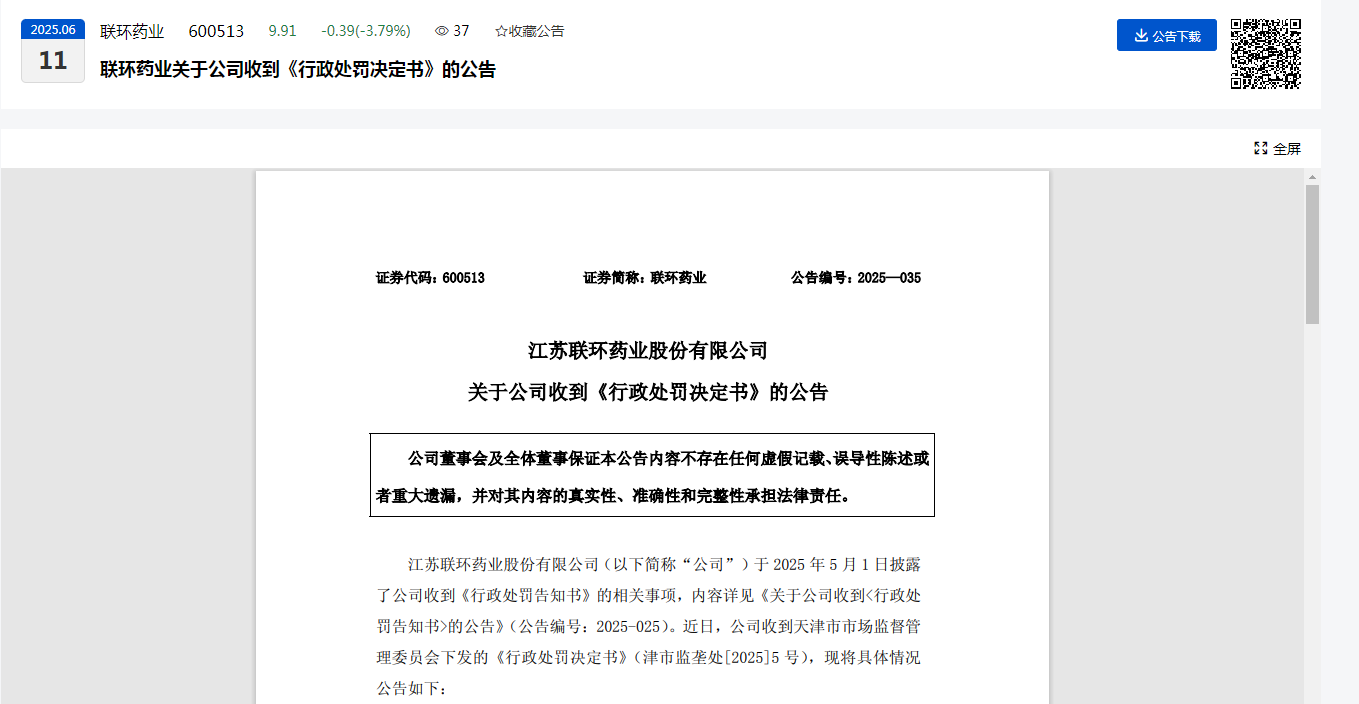
四药企及组织者因垄断协议被罚3.6亿:首例个人顶格处罚
3 6 Ke· 2025-06-12 23:32
Core Viewpoint - Jiangsu Lianhuan Pharmaceutical Co., Ltd. was fined approximately 61.04 million yuan for violating the Anti-Monopoly Law during the sale of the raw material dexamethasone phosphate sodium, marking a significant enforcement action under the revised law [1][2][4][5]. Summary by Relevant Sections Administrative Penalties - The total fines from this series of cases exceed 360 million yuan, with Lianhuan Pharmaceutical's fine being a substantial part of this total [7]. - Lianhuan Pharmaceutical was fined 61.04 million yuan, which includes the confiscation of illegal gains of 17.89 million yuan and a fine of approximately 43.14 million yuan based on 8% of its 2023 sales [4][8]. Case Background - The case involved four pharmaceutical companies colluding to raise prices of dexamethasone phosphate sodium, a critical drug for treating severe COVID-19 cases, leading to increased costs for patients and healthcare systems [8][10]. - The collusion lasted for about two and a half years, starting from November 20, 2021, when the agreement was made during a meeting organized by an individual named Guo [8][21]. Enforcement Trends - The case highlights a trend of stricter enforcement of anti-monopoly laws, particularly in the pharmaceutical sector, where raw material monopolies have become a focus for regulatory bodies [10][11]. - The penalties reflect a dual approach of strict punishment for violations and incentives for compliance, as seen in the differentiated penalties based on cooperation with investigations [13][14]. Implications for the Industry - The case serves as a warning for pharmaceutical companies regarding the risks of horizontal agreements and the need for comprehensive compliance systems to prevent anti-competitive behavior [14]. - Companies are encouraged to establish internal reporting mechanisms and crisis response strategies to mitigate risks associated with anti-monopoly violations [14].
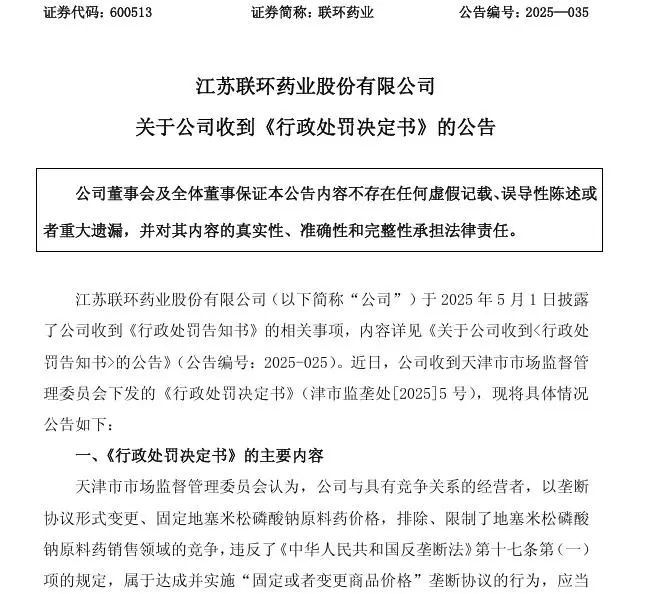
“救命药”变“暴利药”!3家药企被重罚3.26亿
21世纪经济报道· 2025-06-12 15:39
Core Viewpoint - The article discusses a recent monopoly case in the raw material drug sector, highlighting the significant penalties imposed on several pharmaceutical companies for price manipulation of dexamethasone phosphate sodium, which has seen a dramatic price increase during the COVID-19 pandemic [3][5][9]. Group 1: Penalties and Financial Impact - Lianhuan Pharmaceutical was fined 61.0382 million yuan, accounting for 72.53% of its projected net profit for 2024 [3][10]. - The total fines for the three involved companies reached 326 million yuan [3]. - The price of dexamethasone surged from 0.35 yuan to 98.76 yuan per unit, a staggering increase of 282 times [5][8]. Group 2: Nature of the Monopoly - The involved companies engaged in a horizontal monopoly agreement, agreeing to stop price competition and raise prices collectively [6][9]. - The actions of these companies are characterized as typical collusion, which is often difficult to detect externally [6][11]. - A key individual organized meetings among the companies to discuss price increases, ensuring the implementation of the monopoly agreement [16][17]. Group 3: Regulatory Environment and Future Implications - The article emphasizes the need for stricter compliance and internal management within pharmaceutical companies to avoid similar incidents in the future [21]. - The penalties serve as a warning to the industry, indicating that both state-owned and private enterprises will face legal consequences for monopolistic behavior [21][22]. - The regulatory framework is evolving, with new guidelines set to enhance oversight in the pharmaceutical sector, including provisions for reverse payment agreements and indirect price fixing [22][23].

合规管理怎么干?看了这50多个合规案例就知道了
梧桐树下V· 2025-06-12 12:49
Core Viewpoint - The article emphasizes the transition to a "penetrating supervision" era in China's anti-corruption governance, highlighting the increased compliance management requirements for enterprises following the implementation of the new "Supervision Law" and related guidelines [1]. Group 1: Compliance Management Trends - The new "Supervision Law" officially took effect on June 1, marking a significant shift in compliance management expectations for enterprises [1]. - In 2024, a total of 1,011 listed companies faced penalties for violations, resulting in 2,289 fines totaling 1.033 billion yuan, with industries such as banking, computer, and power equipment being heavily impacted [1]. - The integration of AI into compliance decision-making processes indicates a trend towards "penetrating regulation" and "intelligent tools" in compliance management [1]. Group 2: Key Compliance Issues and Risk Prevention - The article outlines six core modules where compliance issues are most concentrated, which will be detailed in the "Enterprise Compliance Practice Analysis - 2025 Mid-Year Special" [1]. - The six major compliance issues include corporate governance, responsibilities of directors and supervisors under the new company law, and human resources compliance management [2][4][15]. Group 3: Specific Compliance Areas - Corporate governance compliance issues focus on shareholder contribution disputes, equity transfer risks, and related party transaction compliance, supported by six real case studies [5]. - The responsibilities of directors and supervisors under the new company law will be analyzed, including criminal and civil liabilities related to insider trading and illegal disclosures [8]. - Human resources compliance management will address potential pitfalls throughout the employment process, including discrimination disputes and trial period termination controversies [15]. Group 4: ESG Disclosure and Compliance - The article highlights the increasing regulatory scrutiny on ESG disclosures, urging listed companies to enhance the quality of their disclosures in line with the latest requirements from stock exchanges [17]. - A comparative analysis of different ESG rating methodologies will be provided, along with case studies from companies like SMIC and GoerTek to illustrate practical disclosure points [17].
合规管理怎么干?看了这50多个合规案例就知道了
梧桐树下V· 2025-06-12 12:48
Core Viewpoint - The new Anti-Corruption Law marks the beginning of a "penetrative supervision" era in China, emphasizing the protection of enterprise property rights and autonomy, leading to heightened compliance management requirements for companies [1] Group 1: Regulatory Changes - The implementation of the new Anti-Corruption Law and related guidelines indicates a comprehensive strengthening of compliance supervision across various sectors [1] - In 2024, a total of 1,011 listed companies faced penalties for violations, resulting in 2,289 fines amounting to 1.033 billion yuan, with banking, computer, and power equipment industries being the most affected [1] Group 2: Compliance Management Trends - The integration of AI into compliance decision-making reflects a trend towards "regulatory penetration" and "intelligent tools" in compliance management [1] - Companies are urged to establish comprehensive and effective compliance management systems to achieve sustainable development [1] Group 3: Compliance Issues and Training - The article outlines six core modules where compliance issues are most concentrated, highlighting the need for targeted training and risk identification [1] - The "Enterprise Compliance Practice Analysis - 2025 Mid-Year Special" is introduced to assist companies in navigating compliance challenges [1]