NVIDIA

Search documents
SuperX Launches Rack-Scale AI Platform Powered by NVIDIA GB300 Chips, Redefining Data Center Infrastructure
Prnewswire· 2025-10-16 10:05
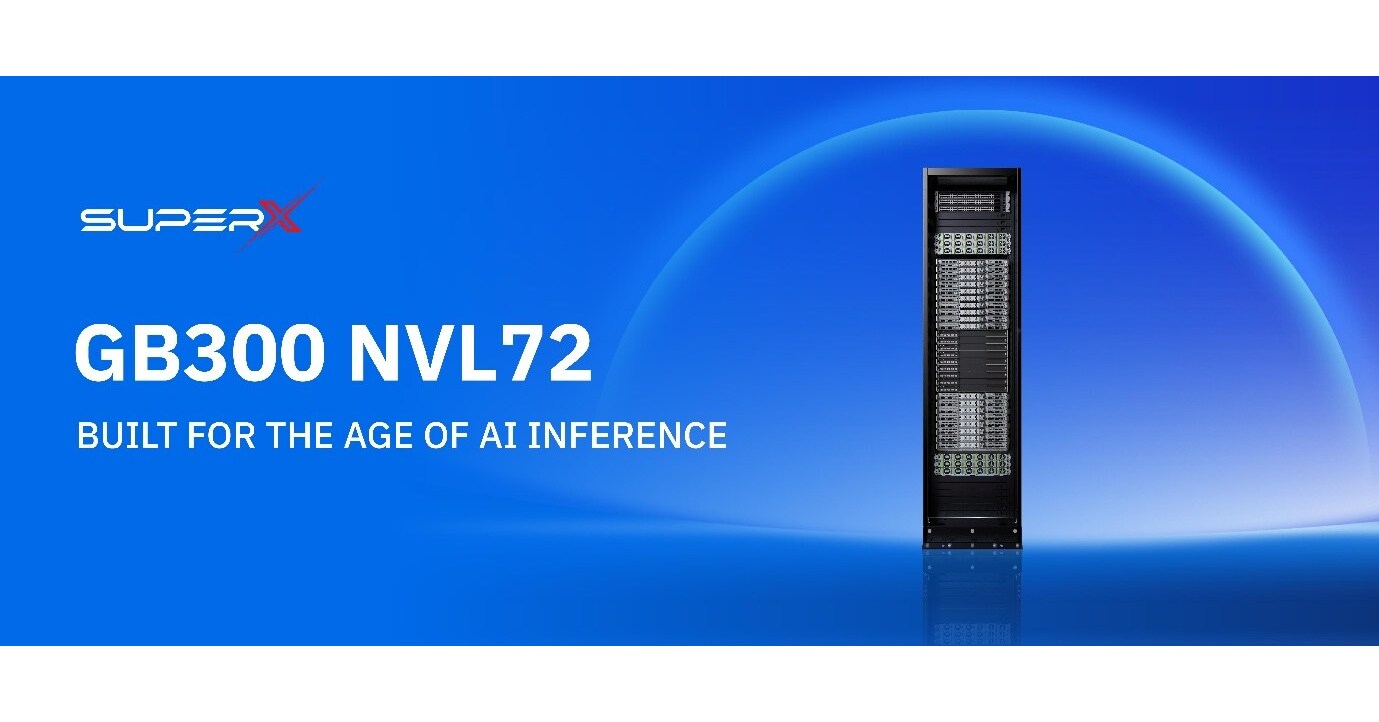
Core Insights - SuperX AI Technology Limited has launched the SuperX GB300 NVL72 System, a cutting-edge AI supercomputing platform utilizing the NVIDIA GB300 Grace Blackwell Ultra Superchip, aimed at overcoming the limitations of traditional data center infrastructure [1][2][3] Product Overview - The SuperX GB300 NVL72 System delivers up to 1.8 exaFLOPS of AI performance in a single liquid-cooled rack, representing a significant advancement in compute density and energy efficiency [2][5] - The system integrates 72 NVIDIA Blackwell Ultra GPUs and 36 NVIDIA Grace CPUs, achieving a chip-to-chip link bandwidth of 900GB/s and a total memory of 165TB HBM3E and 17TB LPDDR5X [4][6] Technological Advancements - The system's design necessitates advanced power solutions, particularly 800 Voltage Direct Current (800VDC), to ensure stability and operational viability for next-generation workloads [3] - The GB300 System is optimized for massive horizontal scaling, allowing for the connection of multiple GPUs into a single system, thus redefining standards for large-scale AI training and inference [5][6] Market Positioning - SuperX positions the GB300 NVL72 System as a foundational infrastructure for organizations developing future AI capabilities, catering to sectors such as hyperscale computing, scientific research, and industrial applications [7][10]


CoreWeave Announces Partnership with Foundation Model Company Poolside to Deliver AI Cloud Services
Businesswire· 2025-10-15 13:31
Core Viewpoint - CoreWeave, Inc. has announced a partnership with Poolside to enhance AI cloud services aimed at developing artificial general intelligence [1] Company Summary - CoreWeave will provide a cutting-edge cluster of NVIDIA GB300 NVL72 systems, featuring over 40,000 GPUs to support Poolside's initiatives [1]


Nscale Contracts Approximately 200,000 NVIDIA GB300 GPUs with Microsoft to Deliver NVIDIA AI Infrastructure Across Europe and the U.S.
Globenewswire· 2025-10-15 12:00
Core Insights - Nscale has signed a significant deal with Microsoft to provide approximately 200,000 NVIDIA GB300 GPUs for AI infrastructure across Europe and the U.S., marking one of the largest contracts in this sector [1][3][8] - The partnership aims to meet the increasing demand for AI infrastructure, with Nscale planning to expand its capacity to support future advancements in AI technology [2][3] Company Overview - Nscale is a vertically integrated AI cloud provider with data centers, GPU clusters, and AI services, focused on delivering advanced AI infrastructure [2][7] - The company is headquartered in Europe and operates globally, emphasizing its commitment to sustainability and efficiency in AI technology delivery [3][7] Contract Details - Nscale will deliver approximately 104,000 NVIDIA GB300 GPUs at a 240MW hyperscale AI campus in Texas, with phased delivery starting in Q3 2026 [3][4] - An additional 12,600 NVIDIA GB300 GPUs will be delivered at the Start Campus data center in Sines, Portugal, starting from Q1 2026 [4] - The deal also includes plans for the UK's largest NVIDIA AI supercomputer at Nscale's Loughton AI Campus, housing around 23,000 GPUs from Q1 2027 [5][8] Strategic Importance - This agreement strengthens the UK-US Tech Partnership, highlighting the collaboration between Nscale and Microsoft in advancing AI infrastructure [6][8] - The contract will be executed across four countries and two continents, showcasing the global scale of the AI infrastructure rollout [8]


大中华区科技硬件 - 宣布 800 伏直流生态系统,助力下一代高效千兆瓦级人工智能工厂-Greater China Technology Hardware-800 VDC Ecosystem Announced to Drive Next-Gen Efficient Gigawatt AI Factories
2025-10-15 03:14
Summary of Key Points from the Conference Call Industry Overview - The conference call focused on the **Greater China Technology Hardware** industry, particularly the advancements in **800 VDC (800-volt direct current)** infrastructure for data centers and AI factories [1][5][78]. Core Insights and Arguments - **800 VDC Infrastructure Announcement**: NVIDIA announced its partner list for the 800 VDC ecosystem, which is expected to enhance power transmission efficiency by over **150%** without the need for additional copper busbars [1][2]. - **Cost and Weight Savings**: The implementation of 800 VDC technology will save costs and reduce the weight of server racks, making data centers more efficient [2]. - **Market Growth**: The 800 VDC technology is projected to contribute to the total addressable market (TAM) for data center power and cooling, with an estimated **30% CAGR** from **2026 to 2030** [3]. - **Key Players**: Notable companies involved in the 800 VDC ecosystem include **Hon Hai (Foxconn)**, which is leading the way in building data centers with this technology [3][2]. Important but Overlooked Content - **Ecosystem Partners**: The 800 VDC ecosystem comprises various partners, including infrastructure providers, power and cooling partners, and silicon manufacturers. Key partners include **CoreWeave, Oracle Cloud Infrastructure, and Analog Devices** [3]. - **Company Ratings**: Morgan Stanley has an **Overweight (OW)** rating on **Delta Electronics (2308.TW)** and **BizLink (3665.TW)**, while maintaining an **Equal-weight (EW)** rating on **Lite-On Technology (2301.TW)** [3]. - **Valuation Methodologies**: The report outlines the valuation methodologies for several companies, including **Lite-On Technology** with a cost of equity of **9%** and a medium-term growth rate of **12%** [8]. Risks and Opportunities - **Upside Risks**: Potential for stronger growth in optical business, data center demand, and improvements in margins due to falling raw material prices [12][13]. - **Downside Risks**: Risks include macroeconomic demand weakness, geopolitical developments, and potential slowdowns in data center/server demand [12][17]. Conclusion - The advancements in 800 VDC technology represent a significant opportunity for growth in the Greater China Technology Hardware sector, with key players positioned to benefit from the expected market expansion. The insights provided in the conference call highlight both the potential and the risks associated with this evolving landscape.
NVTS Stock Rises 90% in 3 Months: Time to Hold or Book Profits?
ZACKS· 2025-10-14 14:56
Core Insights - Navitas Semiconductor (NVTS) shares have surged 90.3% over the past three months, significantly outperforming the Zacks Electronics - Semiconductors industry's growth of 14.9% [1][8] - The company's focus on power chips for AI data centers and cost-efficient manufacturing has generated optimism regarding its growth prospects [2][5] - The stock's performance raises questions about its future potential and whether investors should consider taking profits [2] Market Opportunity - Navitas Semiconductor is targeting the growing power needs of AI data centers, with power demand projected to increase from 7 gigawatts in 2023 to over 70 gigawatts by 2030 [5][9] - The shift to 800-volt architectures for data centers, as announced by NVIDIA, is expected to create significant demand for advanced power chips made from gallium nitride (GaN) and silicon carbide (SiC) [6][12] - The company estimates that the market for these chips could reach $2.6 billion annually by 2030, with plans to develop products for all stages of the new 800-volt setup [7][9] Production and Cost Efficiency - Navitas Semiconductor is transitioning its GaN chip production from 6-inch to 8-inch wafers in collaboration with Powerchip, aiming to produce 80% more chips at lower costs [11][14] - The new 8-inch platform is expected to enhance efficiency and margin gains, supporting the company's long-term growth strategy [11][14] - The production of high-voltage GaN chips is set to begin in 2026, with samples expected to be sent to customers later this year [12][13] Financial Performance and Estimates - The Zacks Consensus Estimate for NVTS' revenues in 2026 is $66.68 million, reflecting a year-over-year growth of 23.2% [9][10] - Current revenue estimates indicate a decline due to tariff risks in China, but long-term growth is anticipated as AI data centers expand [9][20] Valuation - Navitas Semiconductor is currently trading at a higher price-to-sales (P/S) ratio of 33.21X compared to the industry average of 8.81X [15][18] - The company's P/S multiple is also higher than that of peers such as Lam Research, Marvell Technology, and Ambarella, which have P/S multiples ranging from 8.49X to 8.61X [15][18] Conclusion - Navitas Semiconductor is well-positioned to benefit from the rapid growth of AI data centers, with its GaN and SiC chips suited for high-voltage systems [19] - The shift to 8-inch wafer production is expected to improve cost efficiency and margins over time [19][20] - Despite near-term challenges, the company's focus on the AI data center boom supports its long-term potential, making it an attractive long-term hold [20]

博通公司 - AVGO 宣布与 OpenAI 建立合作伙伴关系
2025-10-14 14:44
Summary of Broadcom Inc. (AVGO) and OpenAI Partnership Conference Call Company and Industry Overview - **Company**: Broadcom Inc. (AVGO) - **Industry**: Semiconductors - **Market Cap**: $1,733,562 million - **Current Stock Price**: $356.70 (as of October 13, 2025) - **Price Target**: Increased from $382.00 to $409.00 Key Takeaways - **Partnership Announcement**: Broadcom and OpenAI have announced a multi-year partnership to co-develop 10 GW of custom AI accelerators and network systems, with deployment starting in the second half of 2026 and ramping over three years [3][9] - **Customer Count**: This partnership brings Broadcom's XPU customer count to five, joining Google, Meta, ByteDance, and a potential fifth customer [4][10] - **Revenue Projections**: The partnership is expected to generate approximately $10 billion in rack revenue by the second half of 2026, although this projection is viewed as ambitious given the complexities involved in developing custom accelerators [4][12] - **Market Demand**: The announcement highlights the significant demand for AI inference capacity and OpenAI's growth ambitions, following similar partnerships with NVIDIA and AMD [3][12] Financial Metrics and Estimates - **Revenue Growth**: Broadcom's AI data center revenue estimates for CY27 have been raised by approximately $8 billion to $73.2 billion [9][16] - **Earnings Projections**: Non-GAAP EPS estimates for CY27 have been increased from $11.47 to $11.87, reflecting a strong growth outlook [17][18] - **Gross Margins**: Expected gross margins from rack sales are projected to be lower than Broadcom's XPU business, estimated around 45% compared to mid-50s [17][15] Strategic Insights - **Market Positioning**: Broadcom is positioned to benefit from the diversification of the AI hardware ecosystem as a leading ASIC provider, despite the competitive landscape dominated by NVIDIA [12][14] - **Investment Risks**: The partnership's success is contingent on financing conditions and technology execution, with the potential for underinvestment being a significant risk [12][14] - **Long-term Outlook**: The overall Total Addressable Market (TAM) for AI is growing rapidly, but convergence around the highest ROI solutions is expected in the long term [14] Analyst Ratings and Recommendations - **Stock Rating**: Overweight, indicating expected performance to exceed the average total return of the industry [6][19] - **Consensus Rating Distribution**: 96% Overweight, 4% Equal-weight [29] Additional Considerations - **Market Sentiment**: The increasing number of partnerships in the AI space may dilute the significance of individual announcements, but Broadcom's engagement with key customers is seen as a positive indicator [12][14] - **Future Projections**: Analysts remain cautious about the aspirational nature of the 10 GW announcement, suggesting that actual deployment may vary significantly [15][12] This summary encapsulates the critical insights from the conference call regarding Broadcom's strategic partnership with OpenAI, financial projections, and market positioning within the semiconductor industry.

A股,盘中突变!
证券时报· 2025-10-14 04:42
Core Viewpoint - A-shares experienced a gap up followed by a pullback, with significant adjustments in technology stocks, particularly in the semiconductor sector, while the financial sector showed strength [1][2][10]. Market Performance - The A-share market opened higher but saw a decline, with the ChiNext Index and the Sci-Tech 50 Index leading the losses [3][4]. - By midday, the Shanghai Composite Index rose by 0.21% to 3897.56 points, while the Shenzhen Component Index fell by 1.02% to 13096.03 points, and the ChiNext Index dropped by 2.24% [5][6]. Sector Performance - The financial sector was a highlight, with the banking sector rising over 2%, including notable gains from Chongqing Bank, Xiamen Bank, Jiangsu Bank, and China Merchants Bank, all exceeding 3% [6][7]. - Non-bank financials also saw gains of over 1%, with New China Life Insurance rising over 6% and Guoyuan Securities increasing by over 5% [8]. - The coal sector experienced significant gains, with some stocks like Dayou Energy and Baotailong hitting the daily limit [9]. Technology Sector - Technology stocks overall declined, with communication, electronics, and computer sectors showing the most significant drops. Notable declines included Xinyisheng down nearly 8% and Tongfu Microelectronics down over 7% [10][11]. Hong Kong Market - The Hong Kong market opened high but fell back, with technology stocks leading the decline. Notable stocks like SMIC and Stone Pharmaceutical faced significant losses, while InnoPhase saw a surge of over 18% [12][13]. InnoPhase Announcement - InnoPhase announced a collaboration with NVIDIA to support an 800VDC power architecture, which aims to enhance efficiency and reduce energy consumption in AI data centers [15][16].

Baidu Inc. (NASDAQ:BIDU) Maintains Positive Outlook from Citigroup
Financial Modeling Prep· 2025-10-14 01:00
Core Viewpoint - Baidu Inc. is experiencing positive sentiment in the market, driven by advancements in artificial intelligence and a favorable outlook from analysts, particularly Citigroup, which has raised its price target for the stock [2][4][6]. Company Overview - Baidu Inc. is a leading Chinese technology company known for its internet-related services and products, including a popular search engine, and is a major player in AI and autonomous driving technology [1]. Stock Performance - As of October 13, 2025, Baidu's stock price is $125.72, reflecting a 3.31% increase for the day, with a trading range between $123.42 and $128.20 [2][3][6]. - Over the past year, Baidu's stock has experienced significant volatility, with a high of $149.51 and a low of $74.71 [3]. Market Capitalization - Baidu's current market capitalization is approximately $42.74 billion, indicating its substantial presence in the tech sector [3]. Analyst Ratings - Citigroup has maintained a "Buy" rating for Baidu and raised its price target from $143 to $166, reflecting a positive outlook on the company's future performance [2][6]. Trading Activity - The trading volume for Baidu on the day is 4,970,440 shares, indicating active investor interest in the stock [5]. Industry Context - The positive sentiment towards Baidu is part of a broader trend among major Wall Street firms upgrading their outlook on several tech giants, driven largely by advancements in artificial intelligence [4].


The AI Infrastructure Opportunity
Yahoo Finance· 2025-10-13 18:44
Core Insights - The combined projected spending on AI infrastructure by Amazon, Microsoft, Alphabet, Meta, and OpenAI is estimated to reach $325 billion by the end of the year [1][2][4]. - Major tech companies are significantly increasing their capital expenditures (CapEx) for AI, with Microsoft at $64.6 billion, Amazon at $107.7 billion, Alphabet at $66.9 billion, and Meta at $52.2 billion, while Apple is comparatively lower at $12.4 billion [4][6]. AI Infrastructure Investment - The AI infrastructure opportunity is seen as a paradigm shift, with companies integrating AI into their workflows and operations [3][4]. - Alibaba is highlighted as a strong investment opportunity in AI, with significant investments in AI capabilities, including data centers and custom chips, and a rapidly growing Cloud Intelligence unit [6][8]. - AMD is positioned as a competitor to NVIDIA, having signed a multi-year deal with OpenAI to supply compute capacity, which is expected to generate substantial revenue [9][10]. Market Predictions and Trends - There is a prediction of a mini crash in the AI infrastructure investment theme within the next three years, leading to a reevaluation of spending by major hyperscalers [12][13]. - Despite potential downturns, there is a belief that the demand for AI infrastructure will remain strong, with forecasts suggesting $2 trillion in investment by 2026 and $4 trillion by 2030 [13][14]. - The emergence of specialist AI models is anticipated, which could lead to more efficient use of resources and quicker returns on investment [14][15]. Company Evaluations - Klarna is viewed as a "breaker" due to its pioneering role in the buy now pay later industry, despite concerns about reliance on consumer spending [17][18]. - StubHub is considered a "faker" due to its struggles with margins and potential regulatory scrutiny, indicating challenges in sustaining its market position [19][20]. - Fermi, a new company focused on building data center scale electric power, is labeled a "faker" as it is seen as a business plan without substantial revenue or operational history [22][24].

From Vision to Readiness: Vertiv Collaborates with NVIDIA to Advance 800 VDC Platform Designs to Power the Next Generation of AI Factories
Prnewswire· 2025-10-13 16:09
Core Insights - Vertiv has made significant progress in its collaboration with NVIDIA to develop 800 VDC power architectures, moving from concept to engineering readiness, with a planned release in the second half of 2026 to support NVIDIA's 2027 rollout of Rubin Ultra platforms [1][2][3] Group 1: Industry Context - The data center industry is facing a critical transition as traditional 54 VDC systems cannot meet the megawatt-scale demands of accelerated computing, prompting the need for scalable 800 VDC systems integrated with energy storage [2][4] - Larger AI workloads are reshaping data center design, necessitating a fundamental shift in power architectures to support the unprecedented power demands of AI workloads [3][4] Group 2: Company Developments - Vertiv is finalizing component specifications for its 800 VDC platform designs, which include centralized rectifiers, high-efficiency DC busways, and rack-level DC-DC converters to meet future NVIDIA compute demands [2][3] - The company is actively engaged in early design phases of several large AI factory projects, validating its reference designs against real-world gigawatt-scale demands [4][5] Group 3: Service and Support - Vertiv's global service model is crucial for safely servicing complex 800 VDC environments, providing operational confidence for mission-critical AI deployments [5][6] - The company has over 4,000 field service engineers, enhancing its serviceability for both AC and DC systems [5][6]