
Samsung Electronics

Search documents
5 International ETFs to Buy for 2026
Benzinga· 2025-12-17 17:47
Core Insights - Diversification remains a successful investment strategy, with international stocks significantly outperforming U.S. equities in 2025, as evidenced by the S&P 500's 15% increase compared to Spain's 40% and South Korea's 65% gains [1] Group 1: International Stock Performance - South Korea's KOSPI Composite Index has risen over 65% YTD, driven by favorable domestic policies and a tech sector buoyed by AI advancements [3] - Spain's IBEX 35 index has increased more than 40% YTD, supported by a booming banking sector and a GDP growth of 3%, nearly tripling the overall EU GDP growth [5][7] - The Canadian stock market has seen gains exceeding 30% in 2025, with the iShares MSCI Canada Index Fund up nearly 35%, benefiting from reduced tariffs and strong performance in megacap banks [12][15] Group 2: ETFs for International Exposure - The Franklin FTSE South Korea ETF (NYSE:FLKR) offers exposure to South Korean equities with a low expense ratio of 0.09%, heavily weighted towards Samsung Electronics and SK Hynix [4] - The iShares MSCI Spain ETF (NYSE:EWP) has a 0.50% expense ratio and $1.6 billion in AUM, with over 40% of its holdings in the finance sector, including major banks like Santander and BBVA [7] - The Franklin FTSE Latin America ETF (NYSE:FLLA) provides broad exposure to Latin American markets with a 0.19% expense ratio, focusing on Brazilian and Mexican stocks [10] - The Vanguard FTSE Europe ETF (NYSE:VGK) has gained nearly 35% YTD, with a low expense ratio of 0.06% and a diverse portfolio of over 1,200 stocks [11] - The iShares MSCI Canada Index Fund (NYSE:EWC) has a 0.50% expense ratio and focuses on major banks, with top 10 holdings accounting for over 43% of its assets [15]


Asian shares gain, while oil prices jump as Trump orders a blockade of oil tankers to Venezuela
ABC News· 2025-12-17 08:05
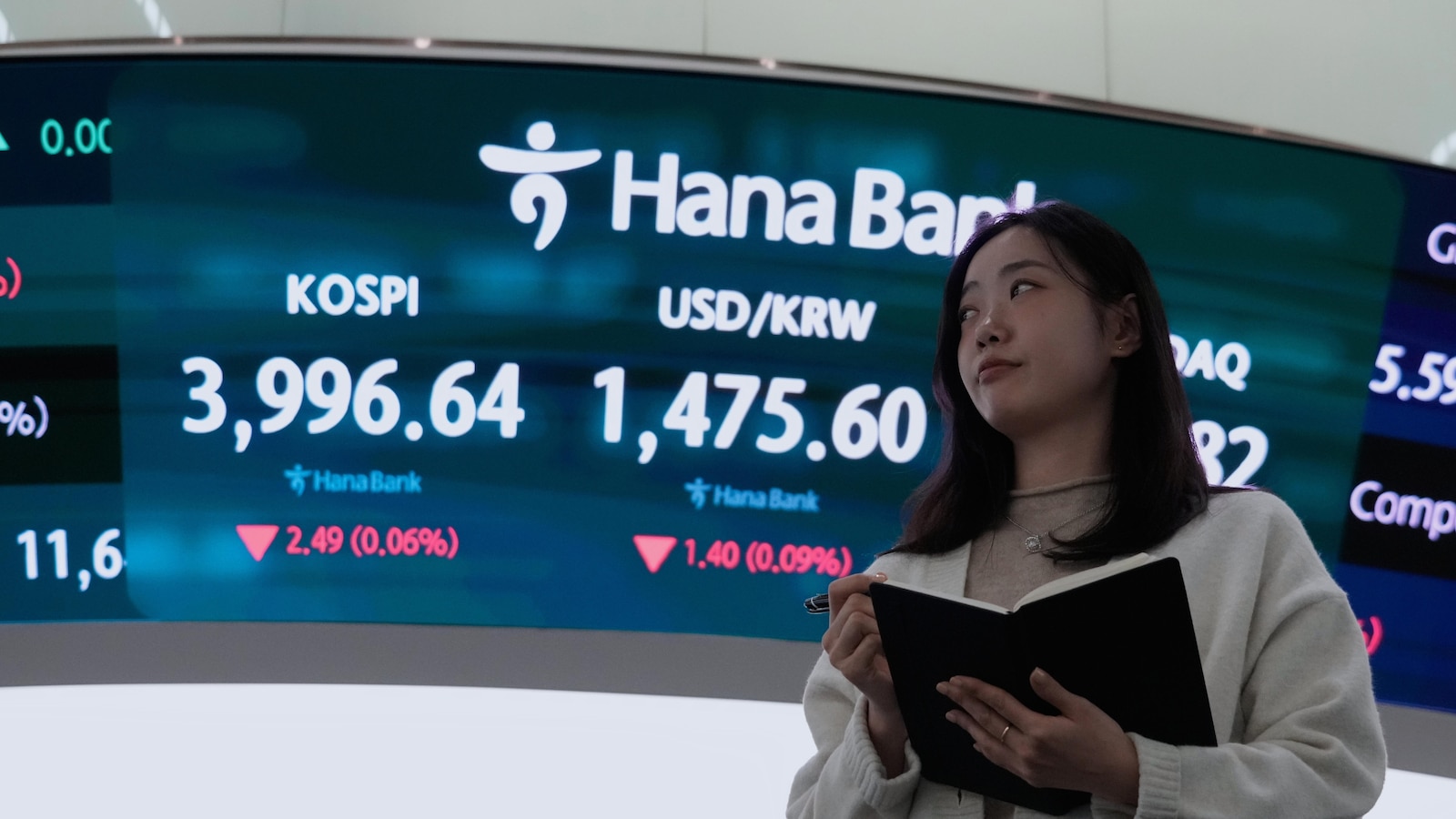
Asian shares have advanced as strong buying of technology shares helped lift some benchmarks, while oil prices surged more than 1% after President Donald Trump ordered a blockade of all “sanctioned oil tankers” into VenezuelaA currency trader stands near a screen showing the Korea Composite Stock Price Index (KOSPI), top left, and the foreign exchange rate between U.S. dollar and South Korean won at the foreign exchange dealing room of the Hana Bank headquarters, in Seoul, South Korea, Wednesday, Dec. 17, 2 ...

Global stock markets in turmoil: Japan’s Nikkei, Hong Kong’s Hang Seng, and Korea’s Kospi sink as U.S. stock futures fall before jobs data
The Economic Times· 2025-12-16 11:39
Market Overview - Global stock markets experienced a decline, particularly in Asia and Europe, as investors adopted a cautious stance ahead of significant U.S. employment and inflation data [1][12] - U.S. stock futures indicated a lower opening, with S&P 500 futures down 0.5% and Dow Jones Industrial Average futures down 0.3% [2] Sector Performance - Technology stocks were a major contributor to the market decline, with notable volatility observed in AI-linked stocks [6][12] - Speculative stocks showed gains, with Biodexa Pharmaceuticals surging nearly 60% to $7.63, AMC Robotics rising 35% to $9.83, and B. Riley Financial climbing almost 28% to $4.75 [3] Regional Insights - Japan's Nikkei 225 fell 1.6% to 49,383.29, influenced by weak manufacturing data, with the S&P Global Flash PMI rising to 49.7 in December from 48.7 in November, still below the expansion threshold [7][8] - Chinese stocks declined due to disappointing economic figures, with retail sales increasing only 1.3% year over year, the slowest since 2022 [9][10] - South Korea's Kospi dropped 2.2% to 3,999.13, heavily impacted by losses in chipmakers like SK Hynix and Samsung Electronics [11] Oil Market - Oil prices decreased, with U.S. crude falling $1.08 to $55.74 per barrel and Brent crude dropping $1.06 to $59.50 [12] Economic Data Focus - The upcoming U.S. jobs report is expected to show a net gain of about 40,000 jobs, with unemployment projected to remain near 4.4% [13] - Inflation data due Thursday is forecasted to indicate a 3.1% year-over-year rise in consumer prices [13]

Asian shares, US futures sink ahead of US jobs report
ABC News· 2025-12-16 07:09
Market Overview - Shares in Asia and U.S. futures have declined ahead of the U.S. employment and inflation reports that may influence interest rates [1] - Tokyo's Nikkei 225 fell by 1.6% to 49,383.29 due to preliminary factory data indicating a slight slowdown in manufacturing [2] - Chinese markets retreated as November retail sales grew at the slowest rate since 2022, increasing by only 1.3% year-over-year [3] Regional Indices Performance - Hong Kong's Hang Seng index dropped 1.6% to 25,211.24, while the Shanghai Composite index lost 1.1% to 3,825.71 [4] - South Korea's Kospi decreased by 2.2% to 3,000.13, with technology shares, including SK Hynix and Samsung Electronics, experiencing significant declines [4] - Taiwan's Taiex fell by 1.1%, and Australia's S&P/ASX 200 declined by 0.4% to 8,598.90 [4] Company-Specific News - iRobot's shares plummeted by 9.3% in after-hours trading following its Chapter 11 bankruptcy filing, adding to a nearly 73% decline on the previous day [5] - The S&P 500 index slipped by 0.2%, with mixed performance among AI-related stocks; Nvidia rose by 0.7%, while Oracle and Broadcom saw declines of 2.7% and 5.6%, respectively [6][7] Economic Indicators - Economists anticipate that the November jobs report will show an addition of 40,000 jobs, with an unemployment rate expected to remain at 4.4% [7][8] - Inflation data is projected to indicate a 3.1% increase in consumer prices year-over-year for November [7][8]

全球股票布局:资金转向亚洲市场-Global Positioning in Stocks_ Rotation to Asia
2025-12-16 03:26
Summary of Key Points from the Conference Call Industry Overview - **Global Positioning in Stocks**: The report discusses the rotation of long-only funds from the US to Asia, highlighting significant shifts in investment patterns across various sectors and regions [1][20]. Core Insights - **Investment Trends**: In November, long-only funds purchased $18.8 billion in Asia Pacific excluding Japan while selling $42.5 billion in the US. Year-to-date, funds have added $89.3 billion to Asia Pacific excluding Japan and reduced US exposure by $223.2 billion [1]. - **Sector Performance**: The global Banks sector saw the largest inflow of $24.3 billion, followed by Utilities at $20.3 billion. Conversely, there was a reduction in exposure to Industrials (-$80.2 billion) and Health Care (-$57.7 billion) [1]. - **Top Stock Purchases**: The largest share purchases globally by long-only funds included TSMC, Rocket Companies, Apple, Tencent, and Robinhood Markets. In contrast, the largest sales were for Meta, Naspers, NVIDIA, SanDisk, and JPMorgan Chase [2]. - **Ownership Statistics**: TSMC is the most held stock globally by long-only funds at 91%, followed by SRM at 88%, and Microsoft at 84% [2]. Crowded Positions Analysis - **Crowded Positives**: Stocks with high ownership and positive momentum, such as Broadcom, TSMC, Tencent, Samsung Electronics, SK Hynix, and Wells Fargo, are expected to outperform [3][4]. - **Crowded Negatives**: Stocks with high ownership but negative momentum, including Walmart, Costco, Meituan, Coca-Cola, Home Depot, and Accenture, are likely to underperform [3]. Fund Ownership and Active Exposure - **Fund Ownership Calculation**: The report details how fund ownership is calculated based on the proportion of active long-only funds that own a stock, with examples illustrating the methodology [33]. - **Active Exposure**: The analysis compares stock holdings against benchmarks to establish relative overweight and underweight positions, providing insights into fund managers' strategies [21][57]. Equity Flow Insights - **Monthly Equity Flow**: The report introduces an analysis of the value of shares bought and sold by long-only funds, emphasizing the importance of understanding fund flows in relation to market movements [26][27]. - **Cumulative Equity Flow**: Long-only funds have consistently bought into passive funds while selling shares in active funds, indicating a shift in investment strategy [30]. Stock Screens and Performance - **Four Stock Screens**: The report outlines four stock screens based on fund ownership, active exposure, and Triple Momentum, which help identify investment opportunities and risks [37][42]. - **Performance Metrics**: Crowded Positives have outperformed the global combined universe by an average of 4.4% since January 2015, highlighting the effectiveness of the screening methodology [79][81]. Additional Considerations - **Methodology Changes**: The report notes updates to the methodology for analyzing fund positioning and performance, incorporating client feedback and enhancing the analysis of equity flows and stock screens [44][50]. - **Limitations**: The analysis acknowledges limitations, including the exclusion of funds that do not regularly declare holdings and the impact of currency fluctuations on results [77][78]. Conclusion - The report provides a comprehensive overview of current trends in global stock positioning, highlighting significant shifts in investment strategies, sector performance, and stock ownership dynamics. Investors are encouraged to consider these insights when making investment decisions.
Nasdaq International Patent Leaders™ Index: Tracking Top Innovators Outside the US
Yahoo Finance· 2025-12-15 22:30
R&D Spending and Performance - R&D spending has significantly increased in the 21st century, with total R&D spending in the Nasdaq Global Large Cap™ Index tripling from $342 billion in 2008 to over $1 trillion by 2023 [1] - The top quartile of R&D spenders increased their R&D as a percentage of sales from approximately 13% in 2008 to around 18% in 2024, reinvesting six times more of their revenue into R&D compared to the bottom three quartiles [1] - Companies in the top quartile experienced revenue growth of approximately 115%, compared to 27% for others, indicating a strong correlation between R&D intensity and revenue growth [1] - An equal-weighted portfolio of top R&D spenders outperformed bottom spenders by about three times, achieving a total return of 713% versus 271% from July 2009 to December 2024 [1] - Companies in the bottom three quartiles of R&D spending showed performance nearly identical to those that spent nothing on R&D, suggesting that R&D intensity is more critical than nominal spending [1] Nasdaq International Patent Leaders Index (NQIPL) - The NQIPL consists of the top 100 companies ranked by patent valuation in the Nasdaq Global Ex United States Large Mid Cap™ Index, capturing over 80% of aggregate patent value generated outside the US [4] - The index was launched on June 24, 2024, to provide a benchmark for innovation-driven companies based outside the US, reflecting significant international R&D spending and patent filings [4] - As of June 30, 2025, the NQIPL had a price-to-earnings ratio of 17.6, which is 28% lower than the S&P 500, indicating a valuation discount for innovative companies outside the US [19] - The index's top 20 constituents represent approximately 65% of total exposure, including major companies like Taiwan Semiconductor and Tencent, with a combined market value of $5.4 trillion as of June 30, 2025 [13] Geographic and Sector Exposure - The NQIPL has a significant concentration in Japan, which accounts for nearly 25% of the index weight, with major companies like Sony and Toyota leading in patent development [11] - Technology companies make up about 36% of the index weight, followed by Industrials at 18%, and Consumer Discretionary and Healthcare at 14% each, reflecting a focus on innovation-driven sectors [12] - The index has shown a trend of increasing exposure to Taiwan, South Korea, and China, while Japan and Switzerland's exposure has generally trended lower [24] Performance Analysis - Since its launch, the NQIPL has generated a price return of 11.3% and a total return of 13.9%, with significant contributions from Technology and Industrials sectors [15] - In the first half of 2025, the NQIPL achieved a price return of 15.8%, slightly outperforming the MSCI ACWI Ex-USA [16] - Backtested performance from June 21, 2013, to June 21, 2024, indicates a total return of 202%, significantly outperforming leading international equity benchmarks [21]
Best-Performing Leveraged ETF Areas of 2025
ZACKS· 2025-12-15 16:01
Market Overview - The year 2025 began with optimism but faced challenges from low-cost AI initiatives from China, Trump tariffs, sticky inflation, and high interest rates, leading to market turbulence in April before stabilization in May [1] - Market euphoria solidified midyear due to easing trade tensions and three Federal Reserve rate cuts starting in September, but momentum faded with a government shutdown halting economic progress and raising overvaluation concerns in the AI sector [2] Performance of Major Indices - Wall Street showed resilience in 2025, with the SPDR S&P 500 ETF Trust (SPY) up 16.6%, the Invesco QQQ Trust (QQQ) up 20.3%, and the SPDR Dow Jones Industrial Average ETF Trust (DIA) up 14.5% year-to-date as of December 12, 2025 [3] Winning Leveraged ETFs - **Gold Miners**: MicroSectors Gold Miners 3X Leveraged ETNs (GDXU) surged 794.9% as gold prices rose over 60% year-to-date, driven by central bank buying and safe-haven demand amid U.S. debt concerns [4] - **Rocket Lab**: Defiance Daily Target 2X Long RKLB ETF (RKLX) increased 529.2%, with Rocket Lab USA (RKLB) stock gaining over 146% due to NASA contracts and excitement in the space sector [5] - **Micron**: Direxion Daily MU Bull 2X Shares (MUU) rose 408.3%, with Micron Technology (MU) stock up 176% driven by high demand for high-bandwidth memory and pricing recovery for DRAM [6] - **Robinhood**: Defiance Daily Target 2X Long HOOD ETF (HOOX) climbed 368.8%, with Robinhood Markets Inc (HOOD) stock up 203% due to increased trading volumes and retail investor interest [7] - **South Korea**: Direxion Daily MSCI South Korea Bull 3x Shares (KORU) increased 336.2%, with South Korea's KOSPI climbing about 73% driven by the AI boom and strong performance from Samsung Electronics and SK Hynix [8] - **D-Wave Quantum**: Tradr 2X Long QBTS Daily ETF (QBTX) rose 312.0%, with D-Wave Quantum Inc (QBTS) stock up 171.6% due to enthusiasm for quantum technologies [10] - **Applovin**: Tradr 2X Long APP Daily ETF (APPX) increased 307.0%, with Applovin Corp (APP) stock up 96.2% driven by its AI-driven advertising platform and strong financial results [11] - **Silver**: ProShares Ultra Silver (AGQ) rose 272.4%, with rising industrial demand and supply shortages boosting silver prices [12]

Futures Pointing To Initial Rebound On Wall Street
RTTNews· 2025-12-15 13:55
Market Overview - Major U.S. index futures indicate a higher open on Monday, suggesting a potential recovery from last Friday's significant weakness, particularly in tech stocks [1] - Trading activity may remain subdued as traders anticipate key U.S. economic data releases in the coming days [1] Economic Data Releases - The monthly jobs report for November and October retail sales data are set to be released on Tuesday, while consumer price inflation data for November is scheduled for Thursday [2] - These reports could influence the outlook for interest rates following the Federal Reserve's recent monetary policy announcement, which included a quarter-point rate cut [2] Stock Market Performance - On Friday, stocks experienced a notable decline, with the Nasdaq dropping 398.69 points (1.7%) to 23,195.17 and the S&P 500 falling 73.59 points (1.1%) to 6,827.41 [3] - The Dow posted a more modest loss of 245.96 points (0.5%) to 48,458.05 after reaching a new record intraday high earlier in the session [4] - For the week, the Dow increased by 1.1%, while the S&P 500 decreased by 0.6% and the Nasdaq fell by 1.6% [4] Sector Performance - Broadcom (AVGO) led the tech sector lower, plunging over 11% despite reporting better-than-expected fiscal fourth-quarter results and providing positive guidance [5] - Other tech stocks, including Micron Technology (MU), Oracle, AMD, and Nvidia, also saw significant declines, indicating a continued rotation out of tech stocks [5] - The NYSE Arca Computer Hardware Index experienced a 5.2% drop, reflecting poor performance in computer hardware stocks [7] International Market Reactions - Asian stocks fell as investors expressed concerns over tech valuations and reacted to disappointing economic data from China [10] - Chinese industrial production grew 4.8% year-on-year in November, missing forecasts, while retail sales rose only 1.3%, significantly below expectations [12] - The Japanese market also declined, with the Nikkei 225 Index dropping 1.3% amid concerns over tech share valuations [13] European Market Trends - European stocks mostly moved higher ahead of a busy week for U.S. economic data and central bank decisions, with the German DAX Index up by 0.3% and the U.K.'s FTSE 100 Index rising by 1.0% [18][19] - However, technology company Royal Philips and pharmaceutical firm Sanofi faced declines due to corporate news impacting their stock prices [19][20]

Asian Shares Decline On Tech Concerns
RTTNews· 2025-12-15 08:37
Market Overview - Asian stocks experienced a decline as investors expressed concerns over technology valuations and reacted to disappointing economic data from China [1] - Chinese shares fell due to bondholders of distressed developer China Vanke rejecting a bond payment extension proposal, highlighting structural weaknesses in the economy [2] - The Japanese market also tumbled, with tech shares following their U.S. counterparts lower amid valuation concerns [4] Economic Data - China's industrial production grew by 4.8 percent year-on-year in November, missing forecasts of 5.0 percent and down from 4.9 percent in October [2] - Retail sales in China rose by 1.3 percent annually, falling short of the expected 3.0 percent increase and down from 2.9 percent in the previous month [3] - Fixed asset investment in China decreased by 2.6 percent year-on-year, missing forecasts for a loss of 2.4 percent [3] Sector Performance - In Japan, the Nikkei average dropped by 1.31 percent, while the broader Topix index saw a slight increase of 0.22 percent [4] - Major decliners included Advantest, which plunged by 6.4 percent, and SoftBank Group, which lost 6 percent [4] - In South Korea, the Kospi average fell by 1.84 percent, with Samsung Electronics and SK Hynix losing 3.8 percent and 3 percent, respectively, due to concerns over AI margins [5] Commodity and Currency Movements - Gold prices surged nearly 1 percent to a seven-week high as the U.S. dollar struggled ahead of key economic data releases [1] - Oil prices increased slightly due to supply disruptions in Venezuela, despite concerns over oversupply in the new year [1] Investor Sentiment - U.S. stocks ended significantly lower as investors took profits from high-flying AI-related stocks amid valuation concerns [7] - Higher Treasury yields negatively impacted market sentiment, with the tech-heavy Nasdaq Composite dropping by 1.7 percent [8]
Q425 智能手机调研:内存短缺会影响需求吗-UBS Evidence Lab inside 4Q25 Smartphone Survey_ Will memory shortages impact demand_
UBS· 2025-12-15 01:55
Investment Rating - The report maintains a cautious outlook on the smartphone industry, with a preference for component suppliers over OEMs due to rising memory prices and supply challenges [5][8]. Core Insights - The smartphone industry is expected to face challenges in 2026, with limited unit growth forecasted at +1.0% YoY in 2026 and +2.0% YoY in 2027, following a +3.5% YoY growth in 2025 [2][8]. - The UBS Evidence Lab 4Q25 Smartphone Survey indicates a moderate increase in purchase intent, with 40% of respondents planning to buy a smartphone in the next 12 months, up from 36% in 2Q25 [3][19]. - Rising memory prices are projected to significantly impact Bill of Material (BOM) costs, potentially accounting for approximately 14% of flagship smartphone BOM costs and 34% of mid-range/lower-end smartphone BOM costs by 4Q26 [4][101]. Summary by Sections Industry Outlook - The smartphone market is anticipated to grow moderately, with unit sell-in forecasts slightly raised to 1.27 billion units in 2025 and 1.28 billion units in 2026, reflecting a +3.5% and +1.0% YoY growth respectively [50][55]. - The average age of the smartphone installed base has decreased to 22.0 months, indicating a normalization in the replacement cycle [30][44]. Purchase Intent Trends - Purchase intent for the iPhone 17 series is strong, with 66% of respondents interested in this model, up from 61% for the iPhone 16 series [3][89]. - Retention rates for Apple and Samsung remain stable at 87% and 75% respectively, while Chinese OEMs have seen declines in retention rates [59][61]. Component Supplier Preference - The report favors component suppliers such as ASE, SK Hynix, and TSMC, while maintaining neutral ratings on major OEMs like Apple, Lenovo, and Xiaomi, and a buy rating on Samsung Electronics [5][8]. - The memory supply shortage is expected to create significant challenges for OEMs, particularly smaller ones, as they may struggle to secure adequate memory supply [4][110].
