
Twitter

Search documents
他救了OpenAI、年赚过亿、三家明星CTO,却自曝跟不上AI发展了,硅谷大佬告诫:不是马斯克,就别碰大模型
3 6 Ke· 2025-08-07 10:47
Core Insights - Bret Taylor's involvement in OpenAI's crisis management highlights the complexity of decision-making in high-stakes environments, emphasizing the importance of understanding the nuances of the situation [2][3] - The AI market is expected to evolve into three main segments: foundational models, AI tools, and application-based AI, with a particular focus on the potential of AI agents [30][31][34] Group 1: Bret Taylor's Background and Role - Bret Taylor has a diverse background, having held multiple leadership roles in various tech companies, including Salesforce and Google, and is currently the chairman of OpenAI [1] - Taylor's decision to re-engage with OpenAI's board was influenced by personal reflections on the significance of the organization in the AI landscape [2] - His reputation as a "board problem fixer" positioned him uniquely to mediate the crisis at OpenAI, showcasing his ability to navigate complex corporate dynamics [2][3] Group 2: OpenAI Crisis Management - During the crisis, OpenAI employees expressed their discontent through a public letter, demanding the return of Sam Altman, which prompted a restructuring of the board [3] - Taylor's approach to resolving the crisis involved a thorough and independent review process to ensure transparency and accountability [3] Group 3: AI Market Segmentation - The foundational model market is characterized by high capital requirements, making it difficult for startups to compete, leading to a consolidation of major players [31][32] - The AI tools market, while promising, faces risks from larger infrastructure providers who may introduce competing products [33] - The application-based AI market is seen as the most promising, with a focus on AI agents that can deliver measurable business outcomes, thus aligning closely with customer goals [34][40] Group 4: Insights on Product Development and Management - Taylor emphasizes the importance of understanding user needs and creating differentiated products, as demonstrated by his experience with Google Maps [8] - The shift towards AI-driven solutions necessitates a reevaluation of traditional software development practices, focusing on system thinking and user experience [24][25] Group 5: Future of Software Development - The emergence of AI is expected to transform software development, with a shift towards code generation and system-level thinking becoming increasingly important [23][29] - The concept of "results-based pricing" is gaining traction, where companies charge based on the outcomes delivered by AI solutions, rather than traditional usage metrics [40]
他救了OpenAI、年赚过亿、三家明星CTO,却自曝跟不上AI发展了!硅谷大佬告诫:不是马斯克,就别碰大模型
AI前线· 2025-08-07 10:08
Core Viewpoint - The article discusses the complexities and dynamics within OpenAI, particularly during a crisis involving the board and the return of Sam Altman, highlighting the importance of leadership and decision-making in the tech industry [2][3][4]. Group 1: OpenAI Crisis and Leadership - Bret Taylor, a key figure in OpenAI's board, was initially reluctant to get involved but felt compelled to help after reflecting on the significance of OpenAI's impact on the AI landscape [2][3]. - Taylor emphasized the need for a transparent and fair process to address the crisis, aiming to restore trust among employees and stakeholders [3][4]. - The crisis led to a collective employee response, with a public letter demanding Sam Altman's return, indicating the strong connection between leadership and employee morale [3][4]. Group 2: AI Market Dynamics - The AI market is expected to evolve into three main segments: foundational models, AI tools, and application-based AI, with a particular focus on the potential of AI agents [5][33]. - Foundational models will likely be dominated by a few large companies due to the high capital requirements for training these models, making it a challenging area for startups [34][35]. - The AI tools market presents risks as larger infrastructure providers may introduce competing products, necessitating careful strategic planning for smaller companies [36][37]. Group 3: Application-Based AI and Business Models - The application-based AI market is seen as the most promising, with companies developing AI agents to handle specific business tasks, leading to higher profit margins [37][38]. - The shift towards AI agents represents a significant change in how software is perceived, moving from tools that assist humans to systems that can autonomously complete tasks [41][42]. - The concept of "outcome-based pricing" is gaining traction, where companies charge based on the results delivered by AI agents, aligning business goals with customer satisfaction [44][46].


大部分AI赛道已然定型
Hu Xiu· 2025-08-06 23:10
Group 1 - The AI market has significantly evolved over the past four years, with the emergence of generative AI companies and a clearer understanding of potential winners [3][4][33] - Core players in the LLM market include Anthropic, Google, Meta, Microsoft, Mistral, OpenAI, and X.AI, with several companies showing strong performance in benchmarks and widespread adoption [6][8] - The revenue growth of foundational model companies has reportedly reached billions of dollars within three years, driven by partnerships with major cloud providers [5][6] Group 2 - The legal market is currently led by companies like Harvey and CaseText, with new startups emerging to address specific workflows [11][12] - In the medical documentation sector, key players include Abridge, Ambience, Commure/Athelas, and Nuance, with a focus on expanding their products across the healthcare continuum [13][14] - The customer experience market in the U.S. has consolidated around a few core startups, with existing giants like Intercom and Zendesk integrating generative AI features [15][16] Group 3 - Future important areas for investment include accounting, compliance, financial tools, and sales tooling, with several exciting companies already in these fields [20][21] - The transition from traditional AI chat tools to agentic workflows is becoming significant, with many startups developing frameworks to support this shift [25][26] - AI-driven roll-ups are gaining traction as a strategy for faster adoption and economic benefits, emphasizing the need for organizational restructuring around AI tools [27][28] Group 4 - The AI market landscape is clearer than ever, with established leaders in early generative AI markets like code and law, while new markets are maturing and ready for disruption [33]



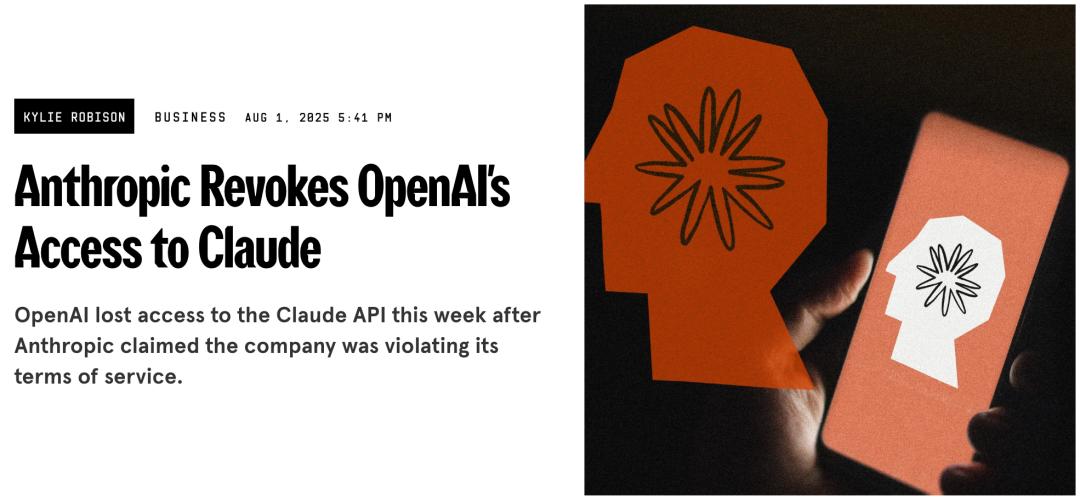
Anthropic官宣“封杀”OpenAI,GPT-5发布在即,竟被曝用Claude Code做开发?
3 6 Ke· 2025-08-04 03:03
Core Viewpoint - Anthropic has cut off OpenAI's access to its Claude API, accusing OpenAI of breaching service terms by using Claude to support the development and safety testing of the upcoming GPT-5 model, indicating a new phase of competition and data/interface lockdown in the AI industry [1][4][10]. Group 1: Actions and Reactions - Anthropic's spokesperson stated that OpenAI's use of Claude for internal tools violated their service terms, which prohibit using their services to build competing products or reverse-engineering [9][12]. - OpenAI expressed disappointment over the ban, emphasizing that evaluating other AI systems is a common industry practice and highlighting that their own API remains open to Anthropic [14]. - Anthropic's contradictory statement about allowing OpenAI access for benchmarking and safety assessments raises questions about their intentions [14]. Group 2: Competitive Landscape - The incident reflects a broader trend in the tech industry where companies use API access as a strategic weapon against competitors, similar to past actions by Facebook and Salesforce [15]. - Anthropic's decision to revoke access is seen as a tactical move in the escalating competition for AI dominance, particularly as OpenAI prepares to launch GPT-5, which is rumored to have enhanced programming capabilities [10][19]. - The AI sector is entering a phase where APIs are not just technical details but strategic resources crucial for market access and innovation freedom [19]. Group 3: Market Implications - The recent actions by Anthropic highlight the intensifying competition in the AI space, with companies increasingly focusing on data and interface control as a means to secure their market position [19][20]. - The situation underscores the potential for regulatory scrutiny as the industry grapples with issues of access and competition [19].
X @Ivan on Tech 🍳📈💰
Ivan on Tech 🍳📈💰· 2025-08-01 14:41
BULLISH ETH!!!NO MORE DEIJUST LIKE WHEN @elonmusk TOOK OVER TWITTER https://t.co/7UrUX4oDMV ...
X @Mike Benz
Mike Benz· 2025-07-31 23:29
Censorship & Misinformation - DHS's social media censorship council was led by Vijaya Gadde and Kate Starbird [1] - The council was named "Protecting Critical Infrastructure from Misinformation & Disinformation" [1] - The council's censorship group EIP targeted 22 million tweets as disinformation about the 2020 election [1]
X @TechCrunch
TechCrunch· 2025-07-31 20:28
Decentralized Social Platforms Challenges - Decentralized social platforms face challenges similar to those encountered by centralized platforms regarding trust and safety [1] - The former Trust & Safety head of Twitter highlights the difficulties in moderating content on decentralized platforms [1] Content Moderation - Content moderation remains a significant hurdle for decentralized social networks [1] - Ensuring user safety and preventing abuse are key concerns for decentralized social platforms [1]
用生物进化论解构科技企业兴衰史
Sou Hu Cai Jing· 2025-07-31 13:38
Core Insights - The lifecycle of technology companies mirrors biological evolution, where only a small fraction survive through continuous adaptation and innovation [1][8] - Successful companies like Amazon and Netflix exemplify beneficial mutations, while failures like Kodak highlight the consequences of resistance to change [1][6] - The tech ecosystem is shaped by collaborative evolution, where partnerships can lead to mutual benefits but also pose risks of dependency [4][6] Group 1: Evolution and Adaptation - The principle of natural selection in the tech industry is represented by user choice, where products that best meet user needs thrive [2][4] - Companies must continuously optimize their offerings to survive in a competitive landscape, creating a feedback loop between user preferences and corporate evolution [2][4] - Extinction events, such as financial crises and pandemics, can reshape the tech landscape by eliminating weaker players and allowing survivors to expand [6][8] Group 2: Innovation and Competition - The Red Queen effect illustrates the relentless competition in the tech sector, where companies must innovate continuously to maintain their market position [6][8] - Random innovations, akin to genetic drift, can lead to unexpected successes, but companies must also establish systematic innovation processes to sustain growth [7][8] - The history of tech companies reveals that adaptability is more crucial than current advantages, emphasizing the importance of learning and transformation [8] Group 3: Collaborative Ecosystems - Symbiotic relationships between companies and their partners can enhance ecosystem health, but over-reliance on a single platform can lead to collective failure [4][6] - Geographic isolation fosters differentiated competition, allowing local companies to innovate without direct competition from global giants [4][6] - The decline of certain technologies, like Flash, demonstrates the risks associated with dependency on specific platforms within the tech ecosystem [4][6]

Elon Musk announces Vine reboot in 'AI form'
NBC News· 2025-07-26 00:58
The video sharing platform Vine, believe it or not, is coming back after almost 9 years when it was discontinued. Elon Musk said X is bringing back the platform in AI form. He did not provide any other details.You may recall Twitter introduced Vine back in 2013. It allowed users to share short form videos that were 6 seconds or less. It was discontinued in 2016.So what is old is new. ...

X @BBC News (World)
BBC News (World)· 2025-07-24 19:30
Israel and US leave Gaza ceasefire talks in Qatar https://t.co/4x2vJ3YOys ...