
海尔生物

Search documents
中证互联网医疗主题指数上涨0.25%,前十大权重包含久远银海等
Sou Hu Cai Jing· 2025-08-13 11:06
Group 1 - The core index of the China Securities Internet Medical Theme Index (CS Mutual Medical, 930720) rose by 0.25% to 2762.05 points, with a trading volume of 8.387 billion yuan [1] - The CS Mutual Medical Index has increased by 3.77% over the past month, 4.28% over the past three months, and 16.80% year-to-date [1] - The index reflects the overall performance of representative companies providing hardware, software, or services for medical information and intelligence [1] Group 2 - The top ten holdings of the CS Mutual Medical Index include Lepu Medical (6.7%), Jiahe Meikang (5.83%), Haier Biomedical (5.52%), Jiuyuan Yinhai (5.46%), Yaoyigou (5.1%), Weining Health (5.06%), Aier Eye Hospital (5.04%), Sichuang Medical (5.0%), Donghua Software (4.95%), and Daclin (4.92%) [1] - The market share of the CS Mutual Medical Index holdings is 55.77% from the Shenzhen Stock Exchange and 44.23% from the Shanghai Stock Exchange [1] - The industry composition of the index holdings shows that 64.12% is in pharmaceuticals and healthcare, 30.88% in information technology, and 5.00% in communication services [1] Group 3 - The index samples are adjusted quarterly, with adjustments implemented on the next trading day following the second Friday of March, June, September, and December [2] - Weight factors are generally fixed until the next scheduled adjustment, with temporary adjustments made under special circumstances [2] Group 4 - Public funds tracking the CS Mutual Medical Index include Huatai-PineBridge China Securities Internet Medical A and Huatai-PineBridge China Securities Internet Medical C [3]

一张信息网,兜牢健康保障底线(民生一线)
Ren Min Ri Bao· 2025-08-12 22:30
Core Insights - The article highlights the implementation of a smart medical community project in the Shigatse region of Tibet, which utilizes advanced technologies such as 5G, big data, and AI to enhance healthcare services and data connectivity across different levels of medical institutions [1][8]. Group 1: Project Implementation and Technology - The smart medical community project was initiated by the Qingdao aid team, integrating various technologies to create a comprehensive health management system that connects district, township, and village medical data [1][8]. - The project has established a network of 161 village clinics, 10 township health centers, and 2 community health service centers, facilitating better communication and collaboration among healthcare providers [7]. Group 2: Patient Care and Health Records - Village doctors are now equipped with digital tools to create electronic health records, allowing for better tracking of patient health and more informed medical decisions [2][5]. - The introduction of health records has improved the accuracy of diagnoses, as seen in the identification of a previously undetected diabetes case through comprehensive patient data [3][5]. Group 3: Emergency Response and Treatment Efficiency - The system allows for real-time sharing of diagnostic information, significantly improving emergency response capabilities, as demonstrated by a case of a patient with a heart attack who was quickly referred to a higher-level hospital [6][7]. - The integration of telemedicine and remote guidance from specialists has enhanced the treatment capacity of local healthcare providers, enabling timely interventions [6][7]. Group 4: Operational Efficiency and Cost Reduction - The project has streamlined data management processes, reducing the need for multiple systems and improving overall operational efficiency in healthcare facilities [8][9]. - Electronic inventory management has minimized medication shortages and improved the responsiveness of healthcare providers to patient needs [9]. Group 5: Overall Impact on Healthcare Delivery - The smart medical community project has significantly improved the healthcare experience for patients, reducing redundant tests and simplifying medical reimbursement processes [7][9]. - The initiative has also enabled better government oversight and management of healthcare resources, leading to more precise decision-making and improved public health outcomes [9][10].



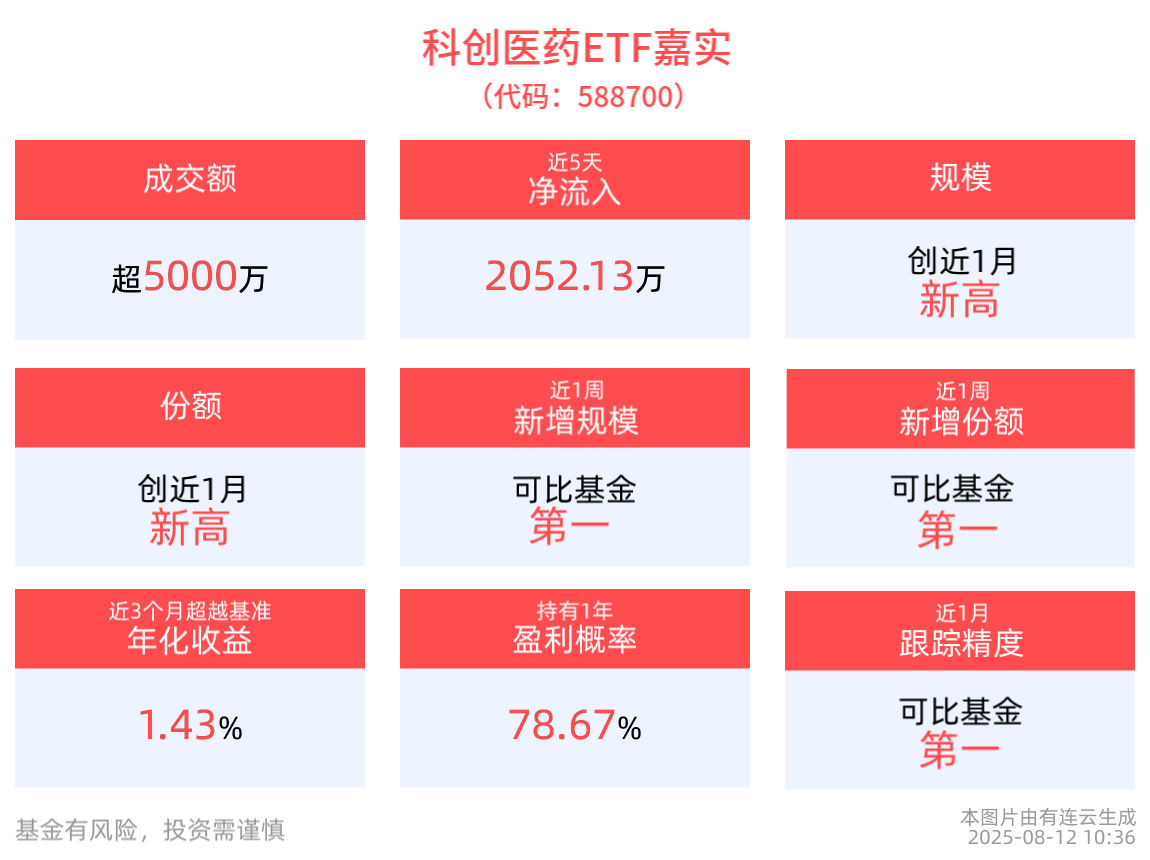
创新药板块景气度可持续,科创医药ETF嘉实(588700)近5日“吸金”超2000万元,规模创近1月新高
Sou Hu Cai Jing· 2025-08-12 03:15
Group 1: ETF Performance - The liquidity of the Kexin Pharmaceutical ETF managed by Jiashi has a turnover rate of 24.54%, with a trading volume of 59.44 million yuan, indicating active market trading [2] - As of August 11, the Kexin Pharmaceutical ETF managed by Jiashi has reached a recent high in scale of 243 million yuan, ranking first among comparable funds [2] - The latest share count for the Kexin Pharmaceutical ETF managed by Jiashi is 205 million shares, also a recent high, and ranks first among comparable funds [2] Group 2: Fund Inflows and Returns - The Kexin Pharmaceutical ETF managed by Jiashi has seen a net inflow of 2.94 million yuan recently, with 4 out of the last 5 trading days showing net inflows totaling 20.52 million yuan [2] - As of August 11, the Kexin Pharmaceutical ETF managed by Jiashi has achieved a net value increase of 52.43% over the past year, ranking 584 out of 2954 in the index stock fund category, placing it in the top 19.77% [2] - Since its inception, the Kexin Pharmaceutical ETF managed by Jiashi has recorded a highest monthly return of 23.29%, with the longest consecutive monthly gains being 6 months and a maximum cumulative increase of 41.76% [2] Group 3: Top Holdings and Market Trends - As of July 31, the top ten weighted stocks in the Shanghai Stock Exchange Science and Technology Innovation Board Biopharmaceutical Index account for a total of 49.14%, with leading companies including United Imaging Healthcare and BeiGene [2] - The innovative drug sector has maintained rapid growth in product revenue and external licensing over the past three years, with significant BD transactions this year driving the overall market trend [4] - The innovative drug sector is expected to sustain its growth due to ongoing policy support and increasing global competitiveness, while the medical device industry is anticipated to improve by 2025 [5]
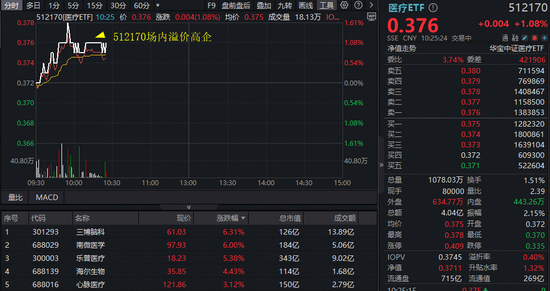
七部门重磅发布!脑机接口概念走强,三博脑科飙升逾8%!A股最大医疗ETF(512170)溢价涨逾1%!
Xin Lang Ji Jin· 2025-08-12 02:46
Group 1 - The medical sector is experiencing a strong upward trend, with the largest medical ETF in A-shares (512170) rising by 1.61% after a previous increase of 1.64%, indicating strong buying interest with over 4 billion in trading volume [1] - Notable stocks include Sanbo Brain Science, which surged over 8%, and medical device companies Lepu Medical and Nanwei Medical, both rising over 6% [1] - The Ministry of Industry and Information Technology and six other departments recently released implementation opinions to promote the innovation and development of the brain-computer interface industry, aiming for breakthroughs in key technologies by 2027 [1] Group 2 - Institutional reports suggest that the medical device industry may have reached a turning point, highlighting high-growth targets for Q2-Q3, international leaders, and new technology sectors like brain-computer interfaces [2] - The medical market is expected to expand from innovative drugs to lower-priced medical devices, with core assets gradually rebounding [3] - The largest medical ETF (512170) focuses on medical devices (52%) and medical services (40%), showing a strong correlation with AI medical applications and covering six leading CXO stocks [3]

2025年中国医用雾化器行业政策汇总、产业链、市场规模及发展趋势研判:人口老龄化加剧,医用雾化器市场规模增长至42.81亿元[图]
Chan Ye Xin Xi Wang· 2025-08-12 01:12
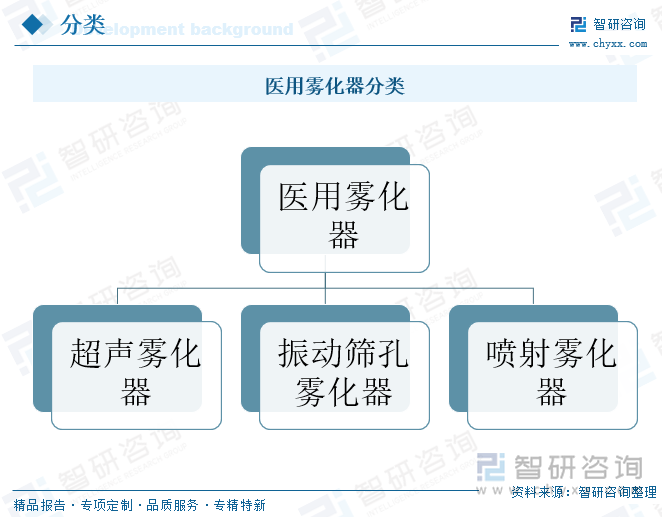
Core Viewpoint - The medical nebulizer industry is experiencing significant growth driven by the aging population and the increasing prevalence of chronic respiratory diseases, with the market size in China projected to reach 4.281 billion yuan by 2024, reflecting an 11.4% year-on-year increase [1][14]. Industry Overview - Medical nebulizers are devices that convert liquid medication into aerosol particles for inhalation, primarily used to treat various respiratory diseases [3]. - The main types of nebulizers include compressed air nebulizers, ultrasonic nebulizers, and mesh nebulizers, each with distinct mechanisms and applications [4][5]. Market Dynamics - The market for medical nebulizers is expected to grow due to the rising number of healthcare institutions, which reached 1,093,600 in China by the end of 2024, a 2.13% increase year-on-year [12]. - The production of medical nebulizers in China is also on the rise, with an expected output of 22.37 million units in 2024, marking a 12.6% increase [18]. Competitive Landscape - The market features numerous participants, including both international brands like Omron and Philips, and domestic companies such as Yuyue Medical and Haier Medical, which are enhancing their competitiveness through R&D and quality improvements [20]. Product Segmentation - Compressed nebulizers dominate the market with a 78% share due to their efficiency, while ultrasonic nebulizers hold a smaller share of 3%, and mesh nebulizers have gained traction with a 19% market share [16]. Regulatory Environment - The Chinese government is actively promoting the development of the medical nebulizer industry through various policies aimed at enhancing innovation and regulatory frameworks [7]. Future Trends - The industry is moving towards precision medication delivery, smart nebulizers for remote monitoring, and portable, eco-friendly designs to enhance user experience [26][27][28].

海尔生物收盘上涨2.85%,滚动市盈率32.17倍,总市值109.15亿元
Sou Hu Cai Jing· 2025-08-11 11:57
Group 1 - The core viewpoint of the news highlights Haier Biomedical's stock performance, with a closing price of 34.33 yuan, an increase of 2.85%, and a rolling PE ratio of 32.17, marking a new low in 88 days, with a total market value of 10.915 billion yuan [1] - As of March 31, 2025, Haier Biomedical has 12,793 shareholders, a decrease of 453 from the previous count, with an average holding value of 352,800 yuan and an average holding quantity of 27,600 shares [1] Group 2 - Haier Biomedical focuses on providing comprehensive digital solutions for life sciences and healthcare, targeting pharmaceutical companies, research institutions, hospitals, and public health organizations [2] - The company offers a wide range of products including low-temperature storage boxes, automated biological sample storage libraries, and various laboratory automation equipment, enhancing its innovation capabilities in life sciences and medical fields [2] - In 2022, Haier Biomedical received several prestigious awards and certifications, including the National Postdoctoral Research Workstation and the China Industrial Award, reflecting its growing strength in scientific and technological innovation [2] Group 3 - In the latest quarterly report for Q1 2025, Haier Biomedical reported an operating income of 689 million yuan, a year-on-year increase of 0.30%, and a net profit of 110 million yuan, a year-on-year decrease of 19.88%, with a gross profit margin of 48.35% [3] - The company ranks 63rd in the medical device industry based on its PE ratio, which is significantly lower than the industry average of 56.56 and the median of 39.76 [3]
中证互联网医疗主题指数下跌1.42%,前十大权重包含爱尔眼科等
Sou Hu Cai Jing· 2025-08-08 11:21
Group 1 - The core viewpoint of the news is the performance of the CSI Internet Healthcare Theme Index, which has shown a monthly increase of 6.19%, a three-month increase of 6.77%, and a year-to-date increase of 18.05% [1] - The CSI Internet Healthcare Theme Index is designed to reflect the overall performance of representative companies providing hardware, software, or services for medical informationization and intelligence [1] - The index's top ten holdings include Lepu Medical (6.48%), Jiahe Meikang (6.01%), Jiuyuan Yinhai (5.63%), Yaoyigou (5.31%), Haier Biomedical (5.23%), Weining Health (5.14%), Sichuang Yihui (5.02%), Dashenlin (5.01%), Aier Eye Hospital (4.96%), and Rundar Medical (4.93%) [1] Group 2 - The market share of the CSI Internet Healthcare Theme Index holdings is 55.79% from the Shenzhen Stock Exchange and 44.21% from the Shanghai Stock Exchange [1] - In terms of industry distribution, the holdings are composed of 63.81% in pharmaceuticals and healthcare, 31.17% in information technology, and 5.02% in communication services [1] - The index samples are adjusted quarterly, with adjustments occurring in the second Friday of March, June, September, and December [2]

上证科创板医疗指数报807.76点,前十大权重包含奕瑞科技等
Sou Hu Cai Jing· 2025-08-04 09:15
Core Insights - The Shanghai Stock Exchange Science and Technology Innovation Board Medical Index (Sci-Tech Medical Index) reported a value of 807.76 points, showing a low opening and a high closing on August 4 [1] - The Sci-Tech Medical Index has increased by 8.56% over the past month, 13.65% over the past three months, and 11.39% year-to-date [2] Index Composition - The Sci-Tech Medical Index includes no more than 30 listed companies in the medical field from the Sci-Tech Innovation Board, reflecting the overall performance of these securities [2] - The index is based on a starting point of 1000.0 points as of December 30, 2022 [2] - The top ten weighted companies in the index are: - Huatai Medical (9.47%) - United Imaging (9.08%) - Hotgen Biotech (8.33%) - Aibo Medical (6.07%) - Yirui Technology (6.05%) - Nanwei Medical (5.62%) - Xinmai Medical (4.81%) - Shengxiang Biotech (4.6%) - Haier Biomedical (3.76%) - Tianzhihang (3.29%) [2] Market and Sector Breakdown - The Sci-Tech Medical Index is fully composed of companies listed on the Shanghai Stock Exchange [3] - The sector distribution of the index's holdings is as follows: - Medical consumables: 42.88% - Medical devices: 28.80% - In-vitro diagnostics: 28.32% [3] - The index samples are adjusted quarterly, with adjustments occurring in the second Friday of March, June, September, and December [3]

青岛海尔生物医疗股份有限公司 关于以集中竞价交易方式回购公司股份的进展公告
Zhong Guo Zheng Quan Bao - Zhong Zheng Wang· 2025-08-01 23:13
Group 1: Share Buyback Overview - The company approved a share buyback plan on January 13, 2025, allowing the repurchase of shares using its own funds through the Shanghai Stock Exchange, with a maximum price of 50 CNY per share and a total fund amount between 100 million CNY and 200 million CNY [1] - The buyback period is set for 12 months from the approval date [1] Group 2: Price Adjustment - Following the annual equity distribution in 2024, the maximum buyback price was adjusted to 49.5367 CNY per share starting June 6, 2025 [2] Group 3: Buyback Progress - As of July 31, 2025, the company had repurchased a total of 1,845,488 shares, representing 0.5804% of the total share capital, with a total expenditure of approximately 59.25 million CNY [3] - The highest and lowest prices for the repurchased shares were 34.69 CNY and 29.86 CNY, respectively [3] Group 4: Compliance and Disclosure - The company will adhere to relevant regulations and will make buyback decisions based on market conditions, ensuring timely disclosure of progress to investors [4]
青岛海尔生物医疗股份有限公司关于以集中竞价交易方式回购公司股份的进展公告
Shang Hai Zheng Quan Bao· 2025-08-01 20:08
Group 1 - The company has approved a share repurchase plan to buy back its issued A-shares using its own funds through the Shanghai Stock Exchange, with a maximum repurchase price of 50 RMB per share and a total repurchase amount between 100 million RMB and 200 million RMB within 12 months [2][5] - Following the annual equity distribution in 2024, the maximum repurchase price was adjusted to 49.5367 RMB per share starting June 6, 2025 [3] - As of July 31, 2025, the company has repurchased a total of 1,845,488 shares, accounting for 0.5804% of the total share capital, with a total expenditure of approximately 59.25 million RMB [4] Group 2 - The company will continue to make repurchase decisions based on market conditions and will fulfill its information disclosure obligations regarding the progress of the share repurchase [6]