北京银河通用机器人有限公司

Search documents
银河通用机器人、百达精工等新设机器人公司
Xin Lang Cai Jing· 2025-10-09 03:12
Core Insights - A new company, Taizhou Baiyin General Robotics Co., Ltd., has been established, focusing on the development and sales of intelligent robots and related mechanical equipment [1] Company Overview - The legal representative of the company is Zhang Qibin [1] - The business scope includes research and development of intelligent robots, sales of intelligent robots, research and development of mechanical equipment, and manufacturing of mechanical and electrical equipment [1] - The company is jointly held by Baida Precision Engineering and Beijing Galaxy General Robotics Co., Ltd. [1]

百达精工、银河通用机器人等在台州成立新公司 注册资本600万
Xin Lang Cai Jing· 2025-10-08 06:31
Group 1 - A new company, Taizhou Baiyin General Robotics Co., Ltd., has been established with a registered capital of 6 million RMB [1] - The legal representative of the company is Zhang Qibin [1] - The business scope includes manufacturing and sales of industrial robots, as well as manufacturing of service consumer robots [1] Group 2 - The company is jointly held by Baida Precision Engineering (603331), Beijing Galaxy General Robotics Co., Ltd., and Taizhou Baiju Candar Enterprise Management Partnership (Limited Partnership) [1]
银河通用机器人在成都设立新公司
Qi Cha Cha· 2025-09-25 07:12
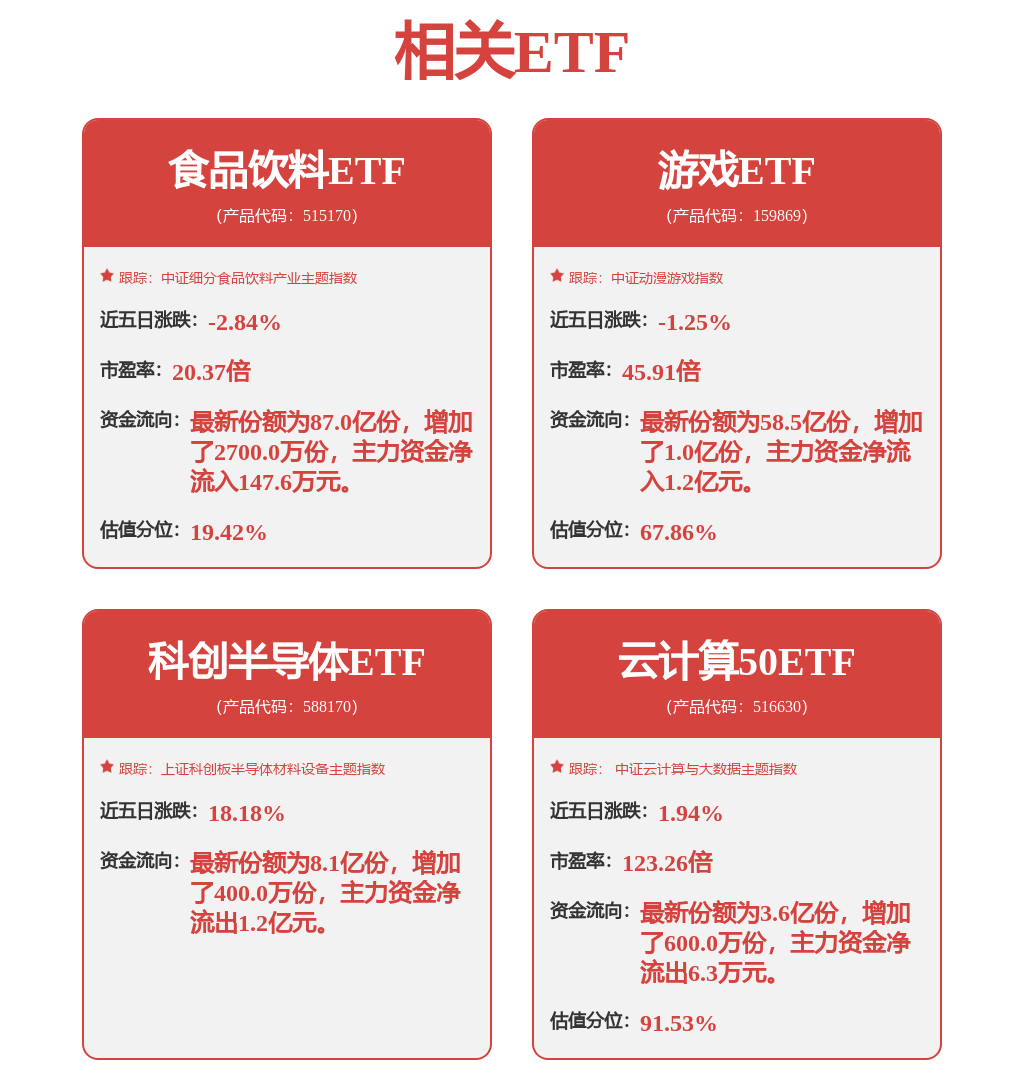
Group 1 - Chengdu Galaxy General Robot Co., Ltd. has been established, with Yao Tengzhou as the legal representative, focusing on service consumer robot manufacturing and sales, as well as software sales [1] - The company is wholly owned by Beijing Galaxy General Robot Co., Ltd. [1] Group 2 - Food and Beverage ETF (Product Code: 515170) tracks the CSI Sub-Industry Food and Beverage Theme Index, with a recent five-day decline of 2.84% and a price-to-earnings ratio of 20.37 times [3] - The latest share volume for the Food and Beverage ETF is 8.7 billion shares, with an increase of 27 million shares and a net inflow of 1.476 million yuan [3] Group 3 - Gaming ETF (Product Code: 159869) tracks the CSI Animation and Gaming Index, experiencing a five-day decline of 1.25% and a price-to-earnings ratio of 45.91 times [4] - The latest share volume for the Gaming ETF is 5.85 billion shares, with an increase of 100 million shares and a net inflow of 120 million yuan [4] Group 4 - Sci-Tech Semiconductor ETF (Product Code: 588170) tracks the Shanghai Stock Exchange Sci-Tech Board Semiconductor Materials and Equipment Theme Index, with a five-day increase of 18.18% [5] - The latest share volume for the Sci-Tech Semiconductor ETF is 810 million shares, with an increase of 4 million shares and a net outflow of 120 million yuan [5] Group 5 - Cloud Computing 50 ETF (Product Code: 516630) tracks the CSI Cloud Computing and Big Data Theme Index, with a five-day increase of 1.94% and a price-to-earnings ratio of 123.26 times [6] - The latest share volume for the Cloud Computing 50 ETF is 360 million shares, with an increase of 6 million shares and a net outflow of 63,000 yuan [6]


均胜电子发布机器人AI头部总成等多款新产品
Zheng Quan Ri Bao Wang· 2025-09-18 12:21
Core Insights - Junsheng Electronics has launched new robotic components, including an AI head assembly, a global controller based on NVIDIA's Jetson Thor chip, and a next-generation energy management product for robots [1][2][3]. Group 1: AI Head Assembly - The AI head assembly is designed for embodied intelligent robots, integrating a flexible display, microphone array, depth camera, and rotation control, providing advanced human-machine interaction capabilities [1]. - The assembly features a multimodal AI interaction system that includes active voice interaction, facial recognition tracking, precise intent recognition, and real-time image generation [1]. Group 2: Global Controller - The new global controller boasts an AI computing power of 2070 TOPS, which is 7.5 times that of the previous generation Orin, with a CPU performance increase of 3.1 times and overall energy efficiency improvement of 3.5 times [2]. - It supports real-time inference for large models with billions of parameters and is designed to handle high-dynamic and high-precision complex scenarios [2]. Group 3: Energy Solutions - Junsheng Electronics has introduced an embedded high-energy density battery pack with an energy density greater than 280Wh/kg, capable of supporting continuous discharge of up to 36A, and can charge from 0% to 80% in just 10 minutes [3]. - The new wireless charging solution allows robots to charge automatically in various environments, eliminating the need for manual intervention [4]. Group 4: Strategic Partnerships and Future Plans - Junsheng Electronics has formed a strategic partnership with RIVR Technologies AG to provide customized robotic domain controller solutions and energy management systems, leveraging its global supply chain and manufacturing capabilities [2]. - The company aims to build a comprehensive product matrix for robotic solutions, enhancing its ability to support the research and manufacturing of robotic products in collaboration with global partners [4].

融资超24亿元,“北大”系人形机器人创企估值超百亿!
Robot猎场备忘录· 2025-09-16 00:02
Core Insights - The article highlights that "Yinhe General," a humanoid robot startup from the "Peking University" system, has achieved a valuation exceeding 10 billion yuan, making it the third domestic humanoid robot company to reach this milestone after "Zhiyuan Robotics" and "Yushu Technology" [2][5]. Group 1: Company Overview - "Yinhe General" was established in May 2023 in Beijing, focusing on providing general robot products for global users and has already been widely applied in commercial, industrial, and medical scenarios [6]. - The founding team consists of experienced professionals from the robotics industry and academia, including Wang He, a Stanford PhD and assistant professor at Peking University, and Yao Tengzhou, a master's graduate from Beihang University with extensive experience in industrial and service robotics [7]. Group 2: Financing and Valuation - "Yinhe General" has completed over 2.4 billion yuan in financing across three rounds, with the latest round raising 1.1 billion yuan led by CATL, along with participation from top investors [8][11]. - The company’s valuation has reached over 10 billion USD following significant funding rounds, positioning it as a key player in the domestic humanoid robotics sector [8]. Group 3: Product and Technology - The company has launched its first wheeled bionic robot, Galbot G1, which is claimed to be the world's first robot capable of demonstrating generalized skills in real-world settings [12]. - At the 2025 World Robot Conference, "Yinhe General" introduced the Galbot G1 Premium, featuring the NVIDIA Jetson Thor chip, marking a significant technological advancement [14]. Group 4: Commercialization Efforts - "Yinhe General" has developed a "smart pharmacy solution" utilizing its self-developed end-to-end model technology, enabling efficient inventory management and delivery in pharmacies [22]. - The company has secured orders from 100 stores and aims for nationwide deployment by the end of the year, with several stores in Beijing already operational [24]. - In the industrial sector, a joint venture with Bosch China focuses on high-precision manufacturing scenarios, leveraging "Yinhe General's" simulation training and synthetic data technology [26]. Group 5: Market Position and Future Outlook - The article emphasizes that "Yinhe General" is positioned at the forefront of the domestic humanoid robot industry, with significant advancements in AI capabilities and practical applications [30]. - The company is part of a broader trend where major tech firms are entering the humanoid robotics space, indicating a growing interest and investment in this sector [36].
数据:99%+1%,能实现“从0到10000”——银河通用王鹤:让机器人甩掉遥控器,“睁开眼”干活
Xin Hua She· 2025-09-15 21:46
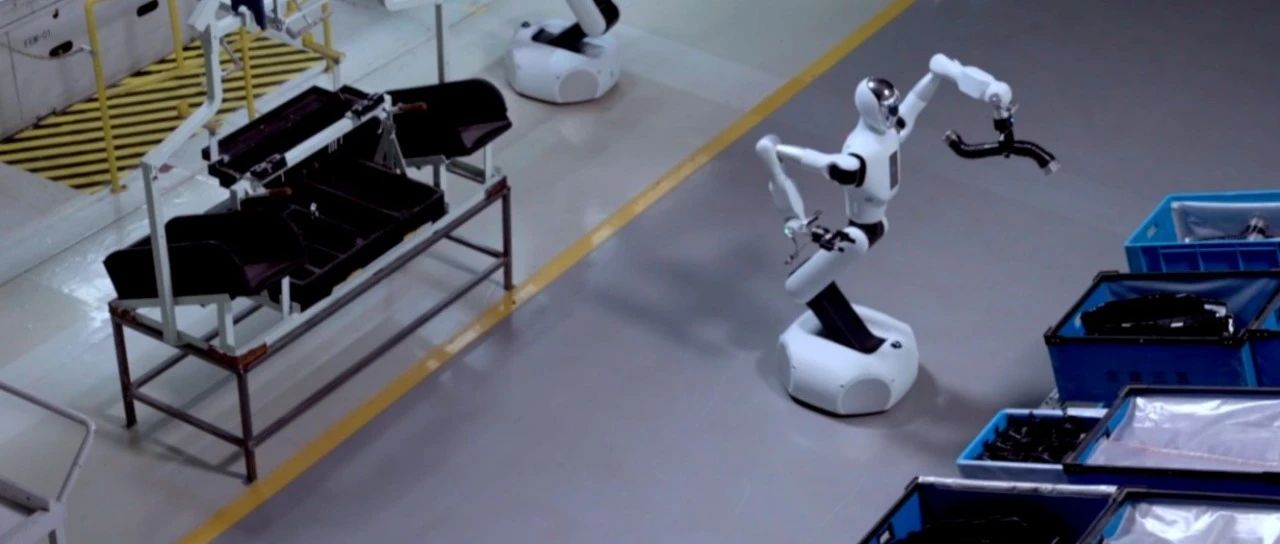
Core Insights - The article discusses the advancements in humanoid robots, particularly focusing on the capabilities of the Galbot developed by Beijing Galaxy General Robotics Co., which can operate autonomously without remote control [2][3][6] - The key challenge in achieving true autonomy in robots lies in the quality and richness of data, which is essential for enhancing their cognitive abilities and adaptability [3][9][10] Group 1: Company Developments - Beijing Galaxy General Robotics has launched the world's first city-level humanoid robot demonstration zone, featuring an unmanned supermarket operated by robots [2] - The company has successfully implemented humanoid robots in various sectors, including industrial applications like assembly line handling and sorting, as well as retail, with plans to open 100 smart pharmacies nationwide by the end of the year [5][12] - The Galbot has achieved notable success in competitions, showcasing its advanced capabilities compared to other robots that often rely on pre-programmed sequences and remote control [2][5] Group 2: Technological Challenges - The transition from action intelligence to cognitive intelligence in robots is heavily dependent on the availability of high-quality data, which is crucial for improving their robustness and generalization capabilities [3][9] - The current landscape shows a division among robotics companies, with some focusing on showcasing impressive movements while others, like Galaxy General, prioritize practical applications in real-world scenarios [4][12] - The company emphasizes that achieving a commercial breakthrough in robotics will depend on identifying scalable applications that can be replicated across various environments [12] Group 3: Data and Model Development - High-quality synthetic data is deemed essential for training robots, with 99% of their capabilities potentially derived from such data, while only 1% requires real-world data collection [9][10] - The development of a closed-loop feedback model is critical for enabling robots to perform tasks autonomously across different scenarios, which Galaxy General is actively pursuing [6][7] - The company believes that the quality of data is more important than quantity, as diverse and representative data sets lead to more effective learning and adaptability in robots [10][11]
机器人跨越“三重门”——具身智能创新者亲历的现实与趋势
Xin Hua Wang· 2025-09-15 08:08
Core Insights - The humanoid robot industry is experiencing a dichotomy of rapid advancements in capabilities and significant challenges in commercial viability, with a notable gap between technological achievements and actual orders received [1][5][41] - Investment in humanoid robotics has surged, with over 20 companies in the sector moving towards IPOs, marking a pivotal year for mass production in humanoid robots [1][12] - The development of embodied intelligence is at a crossroads, requiring a balance between technological innovation and practical application in real-world scenarios [1][18] Group 1: Industry Developments - The first city-level operational humanoid robot demonstration zone was established in Beijing, featuring a robot-operated unmanned supermarket, indicating a significant step towards integrating humanoid robots into daily life [5] - Companies like Beijing Galaxy General Robotics are leading the way in deploying humanoid robots in various sectors, including industrial and retail applications, with plans to open 100 smart pharmacies nationwide [12][41] - The industry is witnessing a shift from merely showcasing capabilities to focusing on practical applications that can generate revenue and sustain growth [1][41] Group 2: Technological Challenges - The primary challenge for humanoid robots lies in their ability to operate autonomously without remote control, which is contingent on the development of advanced models that can generalize across different scenarios [7][13] - Data quality and diversity are critical for enhancing the capabilities of humanoid robots, with a focus on using high-quality synthetic data to train models effectively [15][33] - The current models used in humanoid robotics are not fully mature, and the industry is still grappling with the need for a unified approach to model architecture that can handle the complexities of the physical world [27][34] Group 3: Market Dynamics - The humanoid robot market is characterized by a "chicken or egg" dilemma, where the lack of orders hampers technological iteration, while insufficient technology prevents securing orders [41] - The cost of humanoid robots remains high, with individual units exceeding 100,000 yuan, making them less competitive compared to traditional labor in industrial settings [46][47] - The focus is shifting towards household applications as the ultimate goal for humanoid robots, with the belief that their true value lies in versatility and the ability to create new ecosystems [47]

机器人跨越“三重门”——具身智能创新者亲历的现实与趋势丨议事厅
Xin Hua Wang· 2025-09-15 03:44
Group 1 - The humanoid robot industry is experiencing a dichotomy, with significant advancements in practical applications contrasted by challenges in scaling production and securing orders [1][5][36] - Investment in humanoid robotics has surged, with over 20 companies in the sector pursuing IPOs, marking a transformative year for mass production of humanoid robots [1][5] - The development of embodied intelligence is at a crossroads, requiring a balance between technological innovation and practical profitability [1][15] Group 2 - Companies like Beijing Galaxy General Robotics are leading the way in deploying humanoid robots in various sectors, achieving significant milestones in industrial and retail applications [5][8] - The key challenge for humanoid robots lies in their ability to operate autonomously without remote control, which is dependent on advanced data and model training [10][12] - High-quality data is crucial for enhancing the capabilities of humanoid robots, with a focus on diverse and rich datasets to improve their performance in real-world scenarios [12][30] Group 3 - The success of humanoid robots in competitive environments, such as soccer, demonstrates their potential for real-world applications and helps in refining their operational capabilities [36][41] - The industry faces a "chicken or egg" dilemma, where technological advancements must align with market demand to create a sustainable business model [37][42] - The transition from demonstration to practical application is essential for the industry, with a focus on creating a commercial ecosystem that supports ongoing development and deployment [35][42]
上交所发布!王兴兴等入选
Zheng Quan Ri Bao Wang· 2025-09-14 09:46
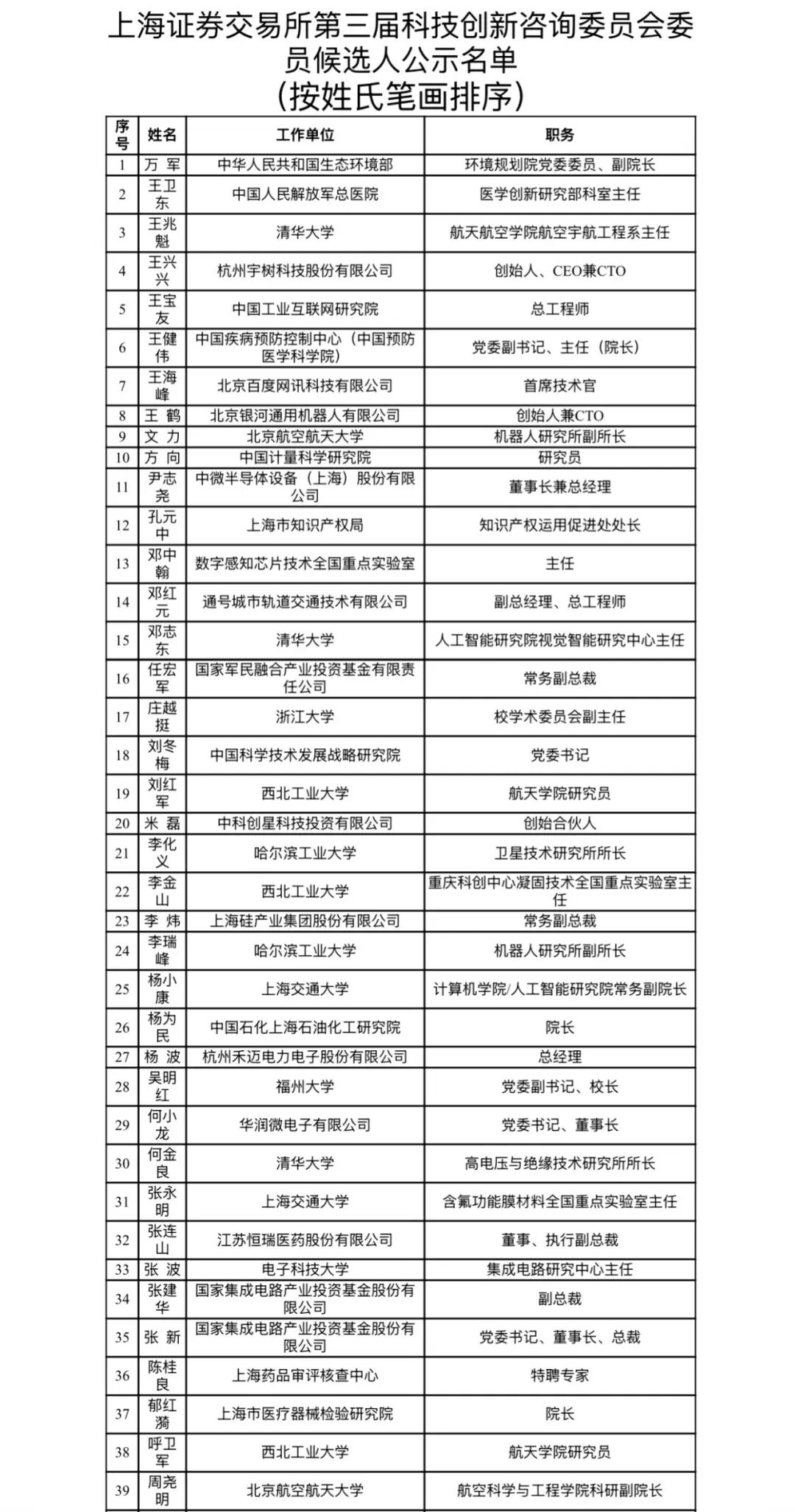
Core Points - The Shanghai Stock Exchange has released the candidate list for the third Technology Innovation Advisory Committee, consisting of 60 members [1] - The committee includes founders and executives from various technology companies, as well as leaders from semiconductor and biopharmaceutical sectors [1] - Experts from aerospace, robotics, satellite, and communication industries have also been nominated for the new advisory committee [2] Group 1: Technology Company Representatives - Founders and executives from notable technology firms are included in the candidate list, such as Wang Xingxing from Yushu Technology, Wang He from Galaxy General Robotics, and Peng Zhihui from Zhiyuan Innovation [1] - Executives from listed companies in the semiconductor and biopharmaceutical sectors are also part of the candidates, including Yin Zhiyao from AMEC and Zhang Lianshan from Jiangsu Hengrui Medicine [1] Group 2: Industry Experts - The new advisory committee features experts from various fields, including Wang Zhaokui from Tsinghua University and Wei Liang from the China Academy of Information and Communications Technology [2] - The previous committee played a significant role in supporting the construction of the Sci-Tech Innovation Board and assessing the innovation attributes of enterprises [2]
上交所公示,王兴兴等,或有新身份
Zhong Guo Zheng Quan Bao· 2025-09-14 01:07
Group 1 - The Shanghai Stock Exchange has announced the candidate list for the third Technology Innovation Advisory Committee, consisting of 60 individuals primarily from the technology innovation sector [1][6][9] - The candidate list includes founders and CEOs from leading technology companies, such as Wang Xingxing from Yushutech and Han Bicheng from Qiangnao Technology [5][11] - The committee aims to provide consulting opinions on industry status, technological levels, and development prospects, contributing to the construction of the Shanghai Stock Exchange's sectors and policy recommendations [9][10] Group 2 - The candidate list features numerous professionals focused on cutting-edge fields like artificial intelligence and commercial aerospace, including experts from Tsinghua University and Harbin Institute of Technology [11] - The recent regulatory changes by the China Securities Regulatory Commission support the inclusion of more emerging industries in the Sci-Tech Innovation Board, enhancing the adaptability of the listing standards [10][11] - Wang Xingxing has highlighted challenges in the field of embodied intelligence, particularly regarding data collection and model alignment, while expressing optimism about the future of innovation and entrepreneurship [12]