Cargill

Search documents
Hafnia Limited(HAFN) - 2025 Q3 - Earnings Call Transcript
2025-12-02 11:00
Financial Data and Key Metrics Changes - In Q3, the company reported a TCE income of $247 million, with an adjusted EBITDA of $150.5 million, leading to a net profit of $91.5 million or $18 per share [16][17] - The company has a dividend payout ratio of 80% of net profit, resulting in a distribution of $73.2 million or $14.7 per share [17][18] - The company has paid dividends consistently over the last 15 quarters, with a projected dividend of $1.16 per share for 2024 [9][17] Business Line Data and Key Metrics Changes - The company operates a fleet of 126 vessels, including 117 owned and nine long-term time chartered vessels, with a focus on product and chemical tankers [6][7] - The company has seen a strong market in Q3, contrary to typical seasonal trends, due to increased ton miles and tighter supply from sanctioned vessels [16] Market Data and Key Metrics Changes - As of mid-November, the company had booked 71% of its bookings for Q4, indicating an improvement in rates, with current bookings around $26,040-$25,600 [30][31] - The company experienced 230 extra dry docking days in Q3, impacting operations, but this is expected to taper off in the current quarter [31] Company Strategy and Development Direction - The company is focused on strategic growth through acquisitions, joint ventures, and fleet modernization, including a recent acquisition of 14.1 million shares in TORM [11][23] - The company aims to maintain a low-cost operation while ensuring strong shareholder distributions, with a clear dividend policy linked to the loan-to-value ratio [9][25] Management's Comments on Operating Environment and Future Outlook - Management noted that the geopolitical environment, including the reopening of the Red Sea, could impact market dynamics, but the overall sentiment may not significantly affect trading volumes [37][40] - The company anticipates a strong winter market, driven by refinery closures in Europe and increased demand from the US, leading to a tight tonnage situation [50][51] Other Important Information - The company has a strong focus on innovation and has established a joint venture in the bunkering space with Cargill [8] - The company is actively managing its fleet, with a strategy to extend the life of vessels rather than ordering new builds in a high-price environment [55][56] Q&A Session Summary Question: Why has the order book fallen in Q3? Is scrapping increasing? - Management indicated that the order book has fallen due to a shift in vessels going into dirty trades, rather than an increase in scrapping [52][54] Question: Can you share thoughts on fleet renewal schemes? - The company is focusing on life extension of existing vessels and is open to various opportunities, including resales and M&A, rather than committing to new builds at high prices [55][56]

Tyson Foods To Shut Down Major Beef Plant In Nebraska Weeks After Trump Launched Probe On Meatpackers - Tyson Foods (NYSE:TSN)
Benzinga· 2025-11-24 08:38
Core Insights - Tyson Foods Inc. has announced the closure of its beef plant in Lexington, Nebraska, to position itself for long-term success amid historic cattle lows [1][2] - The decision to close the plant is driven by the lowest U.S. cattle supplies in nearly 75 years, leading to a scaling back of operations at the Amarillo, Texas facility [2] - Tyson Foods plans to increase production at other facilities to meet customer demand despite the impact of these closures on team members and local communities [3] Industry Context - The U.S. beef industry is facing significant challenges, including a shortage of cattle and rising prices, attributed to various factors including alleged price manipulation by major meatpacking companies [4] - The "Big Four" meat packers, including Tyson Foods, dominate 85% of the U.S. beef processing market, which has drawn scrutiny from the government [5] - The Trump Administration's decision to eliminate tariffs on certain Brazilian exports aims to address rising grocery prices, including beef, amid ongoing trade negotiations with Brazil [6] Company Performance - Despite challenges in the beef sector, Tyson Foods maintains financial stability through its chicken business, with projected sales growth of 2%–4% by 2026, outpacing analyst expectations [7] - Tyson Foods is ranked in the 16th percentile for quality and the 44th percentile for growth, indicating average performance, with a year-to-date stock decline of 7.7% [8]


The Trump Market: Where Every Tweet is a Catalyst (or a Catastrophe)
Stock Market News· 2025-11-23 18:00
Economic Impact of Tariffs - Trump's tariff policies are central to his economic strategy, with claims of strengthening the U.S. economy and curbing inflation, while the stock market has reportedly hit an "ALL-TIME HIGH for the 48th time in 9 months" [2][3] - A proposed $2,000 "tariff stimulus check" for middle-income Americans, funded by tariff revenues, raises skepticism among economists who argue that tariffs are typically paid by U.S. importers, leading to higher consumer prices [3][4] - Historical data shows that a significant increase in tariffs can negatively impact S&P 500 earnings, with Goldman Sachs estimating a 1-2% reduction in earnings per share for every five-percentage-point increase in tariff rates [4][6] Market Reactions and Volatility - Trump's announcements have led to significant market volatility, with major indices experiencing fluctuations despite achieving record highs, as seen on November 21, 2025, when the S&P 500 was down 2% despite a 0.92% rise in the US500 [5][12] - The VIX, a measure of market volatility, reached the mid-40s in April 2025, indicating extreme investor anxiety following tariff announcements [6][12] - The market's relationship with Trump's economic statements is characterized by unpredictability, with analysts noting that his pronouncements can trigger significant intraday market swings [11] Sector-Specific Impacts - Trump's directive for the Department of Justice to investigate the meatpacking industry over alleged price manipulation caused immediate stock price drops for major companies like JBS and Tyson Foods [8] - The pharmaceutical sector reacted sharply to Trump's price reduction promises for GLP-1 weight loss drugs, with stocks of companies like Novo Nordisk and Eli Lilly experiencing declines following his announcements [9][10] - Subsequent agreements to set drug prices at around $350 per month for Medicare and Medicaid recipients indicate a significant shift in the market landscape, although initial reactions were negative [10] Overall Market Sentiment - As of late November 2025, major indices showed a mix of gains and losses, reflecting the ongoing volatility and uncertainty in the market, with the S&P 500 down 2% despite a 1% increase on the same day [12] - The market continues to grapple with the implications of Trump's policies, oscillating between moments of optimism and underlying concerns about potential policy shifts [12]



JBS US venture buys Hickman’s Egg Ranch
Yahoo Finance· 2025-11-17 11:23
Mantiqueira USA, the US egg supplier co-owned by meat giant JBS, has struck a deal to acquire local peer Hickman’s Egg Ranch. Financial terms were not disclosed. Mantiqueira USA is an egg producer and distributor established earlier this year via a joint venture between the Pinto family, who founded Mantiqueira, a South American egg company, and Brazil-based JBS. JBS acquired a 50% stake in Mantiqueira in January. The deal represents Mantiqueira USA's formal entry into the US market. The partners say t ...
McDonald's is losing its low-income customers. Economists call it a symptom of the stark wealth divide
Yahoo Finance· 2025-11-16 11:00
Core Insights - The earnings report from Delta highlights a disparity in consumer spending, with premium ticket sales increasing by 5% while main cabin revenue fell by 5% [1] - Economists describe a "K-shaped economy," where affluent consumers are thriving while low-income consumers are struggling due to inflation and rising costs [2][3] Consumer Behavior Trends - Low-income consumers are reducing spending, impacting industries like food, automotive, and airlines, while wealthier customers are increasing their purchases [2][3] - Fast food chains, particularly McDonald's, have seen a significant drop in traffic from low-income households, with declines reported in double digits [4] Financial Performance and Pricing - McDonald's has experienced a 40% increase in menu item prices from 2019 to 2024, with specific items like the Big Mac rising from $4.39 to $5.29 [14] - The company attributes price increases to rising costs of labor and ingredients, particularly beef, which has seen a 13% year-over-year increase [15][14] Economic Pressures on Low-Income Households - Consumer credit delinquency rates for households earning less than $45,000 have significantly increased, indicating financial strain [8][9] - A Harvard study found that 50% of renters are cost-burdened, spending over 30% of their income on housing, a rise of 3.2 percentage points since 2019 [10][11] Industry Responses - McDonald's has attempted to attract cash-strapped customers with promotional deals, but initial marketing efforts did not yield immediate results [23][24] - The fast food industry is cautious about passing on higher costs to consumers, reflecting a broader concern about consumer tolerance for price increases [25]

KKR's Peter Stavros on employee ownership: An opportunity to give workers a chance to build wealth
Youtube· 2025-11-12 13:40
Core Idea - The concept of employee ownership is being promoted as a means to enhance worker engagement and retention while allowing employees to build wealth, addressing issues such as high quit rates and low job satisfaction in the workforce [3][4][15]. Employee Ownership Model - Employee ownership is structured to provide workers with stock or options without requiring them to invest out of pocket, aiming to offer a year’s worth of income as a benefit [5][8]. - The model involves placing a block of ownership in a trust, which is liquidated upon a company sale or IPO, allowing employees to receive cash or tradable stock [6][11]. Case Study: Ingersoll Rand - Ingersoll Rand serves as a case study where employee ownership transformed the company culture, increasing stock ownership from 86 senior executives to 20,000 employees, resulting in workers earning approximately $1 billion and reducing the quit rate by 90% [7][19]. Challenges and Transparency - Implementing employee ownership is complex, requiring education on business operations and financial transparency to ensure employees understand their contributions and the value of their ownership [16][12]. - Regular updates on company performance and valuations are provided to employees to maintain transparency and engagement [12][13]. Policy and Future Aspirations - The initiative aims to modernize existing policies like the Employee Stock Ownership Plan (ESOP) to encourage broader participation in employee ownership, with aspirations to expand this model to more companies and workers [20][21]. - There is bipartisan support for the idea of employee ownership, indicating a potential for policy changes that could incentivize companies to adopt this model [19][20].


Harris Teeter kicks off annual Harvest Feast campaign with holiday meal donations and bag packing events
Prnewswire· 2025-11-05 23:58
Core Points - Harris Teeter is actively participating in its annual Harvest Feast campaign, aiming to provide holiday meals for families facing food insecurity in the Southeast [1][2] - The company will donate 9,500 meal bags, which are expected to feed approximately 38,000 people [1][4] - The meal kits include a variety of holiday foods and are assembled by Harris Teeter associates, known as "VolunTeeters," at local food banks [1][4][3] Company Initiatives - The Harvest Feast Round Up campaign allows customers to round up their transactions to benefit local hunger relief partners, running through December 30 [5][6] - Last year, the campaign raised over $830,000, contributing to a total of nearly $14 million since its inception in 2005 [6] - In 2024, Harris Teeter donated 5.9 million meals through its Food Rescue program and partnerships with local food banks [7] Community Engagement - The bag packing events will occur at various food banks from North Carolina to Washington, D.C., showcasing the company's commitment to hunger relief across its operational areas [2][3] - The meal kits are created in partnership with several food brands, emphasizing collaboration in addressing food insecurity [4]

How regenerative agriculture – and funding – is slowly taking root
Yahoo Finance· 2025-11-05 11:49
Core Insights - The transition to regenerative agriculture in Europe is significantly underfunded, with only 2-6% of the required funding currently available [1] - Global agri-food systems need annual investments of $1.1 trillion over the next five years, but current investment flows account for barely 5% of that amount [2] - Major food companies are increasingly recognizing the need for collaborative financing structures to support the transition to sustainable practices [3][4] Investment and Financial Models - Food companies are shifting from a payment-for-services model to an investment model, focusing on leveraging financial resources to create more investment opportunities [4] - The financial services industry is encouraged to invest in food systems transformation, but unlocking large-scale action has proven challenging [12] - New financing models are emerging, including de-risking strategies that lower risk exposure for capital providers and enhance the business case for farmers [29][30] Corporate Initiatives and Commitments - Companies like PepsiCo and Cargill are setting ambitious targets for regenerative farming, with PepsiCo increasing its target from seven million acres to ten million [5] - Nestlé has invested SFr1.2 billion ($1.48 billion) since 2020 into regenerative approaches, initiating hundreds of pilot projects [16] - McDonald's has announced a $200 million initiative to promote regenerative grazing practices across four million acres in the US [33] Challenges and Market Dynamics - Farmers face significant financial shortfalls when transitioning to regenerative practices, with potential payback periods still leaving them with a shortfall of €1,400 to €4,100 ($1,608 to $4,708) per hectare [7] - The current agricultural system is described as "badly broken," necessitating urgent changes to avoid long-term systemic failures [6][9] - There is a growing recognition among food companies of the need for long-term contracts and collaborative approaches to ensure shared environmental responsibility [23] Regulatory and Policy Environment - Governments are slowly introducing subsidies for sustainable practices, but critics argue these measures are insufficient [20] - The European Commission has projected significant agricultural losses due to climate change, highlighting the urgency for a shift to regenerative practices [9] - Political resistance remains a barrier to accelerating regenerative production, with some industry groups still hesitant to embrace necessary changes [19]
X @Bloomberg
Bloomberg· 2025-10-23 18:12
Cargill is turning to artificial intelligence to ensure it gets more beef from its processing plants as the US cattle herd dwindles to the lowest level in 70 years https://t.co/bl05lXSKQL ...
中方反制生效已满一周,关键在于这拳打开了
Guan Cha Zhe Wang· 2025-10-22 09:37
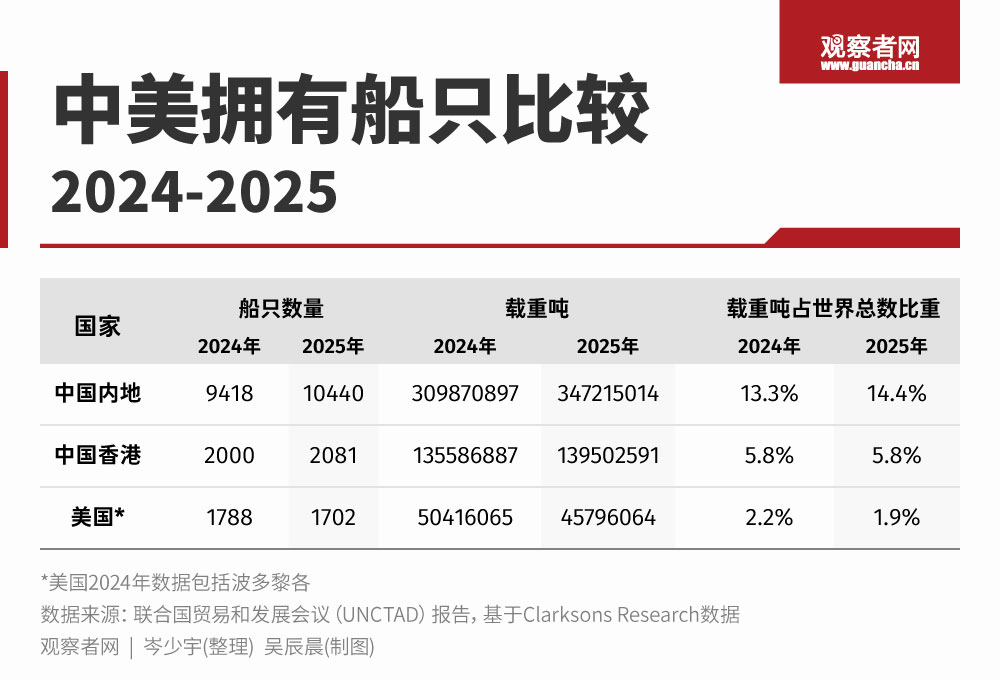
Core Points - The article discusses China's response to the U.S. imposition of special port fees on Chinese vessels, which is seen as a countermeasure to U.S. actions against China's maritime and logistics industries [1][2][34] - The implementation of the special port fee by China is viewed as a strategic move to maintain parity in the ongoing trade tensions between the two countries [2][34] Group 1: Impact on Shipping Industry - The U.S. will impose port service fees on Chinese-owned or operated vessels starting October 14, 2025, affecting a significant number of ships [1][3] - As of January 1, 2025, China is projected to have 10,440 vessels, an increase from 9,418 in 2024, while the U.S. will see a decrease from 1,788 to 1,702 vessels [4][6] - China's share of the global deadweight tonnage is expected to rise from 13.3% in 2024 to 14.4% in 2025, indicating a strengthening position in the global shipping market [6][8] Group 2: Financial Comparisons - The total value of Chinese vessels is projected to reach $255.236 billion in 2025, a 25.11% increase from 2024, while the U.S. total will be $116.447 billion, reflecting a 16.61% growth [13][17] - The value of bulk carriers in China is expected to be $68.454 billion in 2025, compared to $4.054 billion for the U.S., highlighting a significant disparity [17] - The value of container ships in China is projected to be $63.533 billion, while the U.S. will have $4.938 billion, further emphasizing China's dominance in this sector [17] Group 3: Regulatory Responses - The article notes that many U.S. companies have their own fleets, with significant numbers reported by major agricultural firms like Cargill and Bunge [19][22] - The complexity of ownership structures complicates the assessment of which vessels will be affected by the new fees, as many U.S. companies have foreign ownership or operations [25][29] - The article highlights that the U.S. has provided exemptions for certain vessels, which may influence the operational decisions of shipping companies [38] Group 4: Strategic Implications - China's countermeasures are seen as a way to disrupt U.S. efforts to weaken its shipping and shipbuilding industries, forcing global shipping companies to reconsider their strategies [34][39] - The article suggests that the ongoing situation may lead to a reevaluation of the relationships between shipping companies and their operational strategies in light of the geopolitical landscape [39]