NASA

Search documents
Why Viasat Stock Was Racing Higher This Week
The Motley Fool· 2025-05-16 12:25
Core Viewpoint - Viasat's stock has seen a significant increase of 17% due to its partnership with Blue Origin for space exploration initiatives [1] Group 1: Partnership and Collaboration - Viasat announced a collaboration with Blue Origin to demonstrate its InRange launch telemetry relay service [2] - The partnership includes plans for two future launches that will integrate InRange with Blue Origin's New Glenn heavy-lift rocket [2] Group 2: Technology and Services - The InRange launch telemetry relay service enables real-time data transmission and communication between launch vehicles and mission control, which is crucial for successful launches [4] - This demonstration is part of Viasat's work with NASA, aimed at developing advanced networking solutions through its Communications Services Project [4] Group 3: Market Impact and Reputation - Blue Origin, founded by Jeff Bezos, attracts significant media attention, and Viasat's involvement is expected to generate positive publicity [5] - Although no specific date has been set for the New Glenn launches, Viasat's association with Blue Origin and NASA is likely to enhance its reputation in the industry [6]



Viasat and Blue Origin to Partner on Launch Telemetry Demonstration for NASA Communications Services Project
Globenewswire· 2025-05-14 12:00
Core Points - Viasat has partnered with Blue Origin to demonstrate its InRange launch telemetry relay solution on the New Glenn rocket for two upcoming missions [1][2] - The collaboration aims to support NASA's transition from the TDRS system to commercial SATCOM solutions, as NASA will not onboard new missions to TDRS services [2][3] - InRange technology will provide real-time telemetry data during launches, enhancing communication capabilities beyond line-of-sight and reducing reliance on ground communications [3][4] Company Overview - Viasat is a global leader in satellite communications, focusing on high-quality, reliable, and secure connections for various sectors, including government and military [6] - The company completed its acquisition of Inmarsat in May 2023, enhancing its capabilities and resources in global communications [6] Industry Context - The shift from TDRS to commercial SATCOM solutions reflects a broader trend in the space industry, where providers are seeking alternative telemetry relay services for launch missions [2][4] - Viasat's InRange service is part of a portfolio of multi-band space-relay communications services aimed at supporting low-Earth orbit missions and constellation operations [4]

马斯克抛出终极预言:人类文明最终会被太阳摧毁
Sou Hu Cai Jing· 2025-05-07 14:06
Group 1 - The core argument presented is that Elon Musk's warning about the sun's eventual destruction of Earth is based on scientific predictions, specifically that in approximately 5 billion years, the sun will engulf the Earth as it evolves into a red giant [1][3] - The sun is currently in its "middle age" at 4.6 billion years old, with its brightness increasing at a rate of about 10% every billion years, leading to extreme temperatures on Earth and the extinction of complex life within the next 700 million years [3][4] - Musk's SpaceX Mars colonization plan is framed as a strategic response to the long-term threat posed by the sun, positioning Mars as a potential "Noah's Ark" for humanity [3][4] Group 2 - Research from MIT supports the idea that establishing a self-sustaining Mars base by 2100 could be crucial for the survival of human civilization in the face of solar threats [4] - The concept of building a Dyson Sphere, a theoretical megastructure to harness solar energy, is mentioned as a more radical solution, although current material science limitations hinder its feasibility [4] - The narrative emphasizes that the threat from the sun should not lead to despair but rather serve as a catalyst for human advancement and the exploration of space [6]
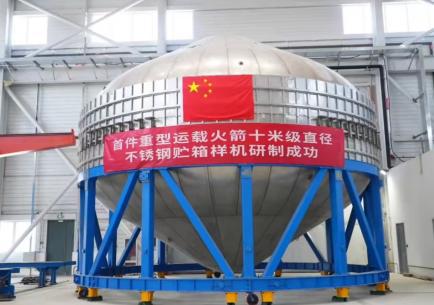
10米级不锈钢贮箱,是中国对星舰式体系的正面回应
Guan Cha Zhe Wang· 2025-05-01 01:37
Core Viewpoint - The successful development of China's first 10-meter diameter stainless steel storage tank prototype marks a significant leap in the country's heavy rocket manufacturing capabilities, positioning it to compete in the next generation of space exploration and heavy lift systems [1][3][12]. Group 1: Technical Significance - The 10-meter diameter represents a critical threshold in rocket design, as larger storage tanks are essential for heavy rockets, which are necessary for ambitious space missions such as lunar bases and Mars exploration [3][5]. - The introduction of stainless steel as a material for the storage tank signifies a shift in manufacturing philosophy, offering advantages in strength, cost, and reusability compared to traditional aluminum alloys [5][6]. - The prototype is not designed for current rockets but is intended for the next generation of heavy rockets, specifically the Long March 9, which aims to be a reusable system with significant thrust capabilities [6][12]. Group 2: Competitive Landscape - The development of the 10-meter storage tank is a strategic move for China to establish a foothold in the competitive landscape of super heavy rockets, where the U.S. has already made significant advancements with NASA's SLS and SpaceX's Starship [12][13]. - The global race for super heavy rockets is intensifying, with the U.S. focusing on high-reliability systems and commercial deep space capabilities, while China aims to leapfrog existing technologies by directly entering the super heavy and reusable rocket domain [12][15]. - The ability to manufacture large-diameter, modular, and high-temperature resistant structures is crucial for achieving high-frequency, low-cost space launches, which is the future of space transportation [15][16]. Group 3: Industrial Implications - The 10-meter stainless steel storage tank prototype is not merely a component but represents a foundational shift in China's space manufacturing logic, indicating a move towards a more industrialized approach to rocket production [17]. - The successful creation of this prototype demonstrates China's readiness to develop the necessary infrastructure and capabilities to support the next generation of space vehicles, which is essential for maintaining competitiveness in the global space race [16][17]. - The focus on building a robust manufacturing system capable of producing large components is a critical step towards achieving the goal of high-frequency space launches, which will be vital for future missions [15][17].
Intuitive Machines Selects SpaceX to Launch its Fourth Lunar Lander Mission and Lunar Data Relay Satellites
Newsfilter· 2025-04-08 12:30
Core Viewpoint - Intuitive Machines has selected SpaceX's Falcon 9 rocket for its fourth lunar delivery mission (IM-4), which will include two lunar data relay satellites to support NASA's Near Space Network Services contract [1][2]. Group 1: Mission Details - The IM-4 mission is scheduled for 2027 and will carry six payloads under NASA's Commercial Lunar Payload Services initiative, including a drill suite from the European Space Agency to search for water at the lunar south pole [4]. - The first of five lunar data relay satellites will be deployed on the third mission, introducing a pay-by-the-minute service, with the two additional satellites on the fourth mission aimed at scaling this service [2][4]. Group 2: Company Overview - Intuitive Machines is focused on disrupting lunar access economics and has successfully soft-landed its Nova-C class lunar lander on the Moon in 2024, marking the U.S. return to the lunar surface for the first time since 1972 [6]. - The company operates through three pillars of space commercialization: Delivery Services, Data Transmission Services, and Infrastructure as a Service [6]. Group 3: NASA Collaboration - NASA has awarded multiple task orders to Intuitive Machines under the NSNS contract for communication and navigation services, which include providing Direct-to-Earth services and a lunar data relay constellation to support NASA's Artemis campaign [5].

VSee Health Highlights: AI-Powered Telehealth Redefining the $787 Billion Digital Healthcare Market
Prnewswire· 2025-04-02 13:00
Core Insights - VSee Health, Inc. is revolutionizing the $787 billion digital healthcare market with AI-driven telehealth solutions, establishing itself as a leader in digital health technology [1][8] - The company has a diverse and rapidly growing client base, including major organizations such as NASA and the U.S. Department of Health and Human Services [1][8] Group 1: AI-Powered Telehealth Solutions - VSee Health offers a modular, no-code/low-code telehealth platform that allows healthcare organizations to create customized solutions, enhancing Electronic Health Record (EHR) integration and scalability [2][8] - The platform is described as "Lego-like," providing flexible digital health building blocks for healthcare institutions [2] Group 2: Strategic Partnerships and Growth - VSee Health is expanding its client portfolio through strategic partnerships, enhancing telehealth adoption and establishing a strong presence in the digital health space [3][6] - The company has secured various contracts, including a $444K county government contract for mental health services and a $560K contract for oncology telehealth solutions [5] Group 3: Operational Efficiency and Technology - VSee Health facilitates over 1.5 million HIPAA-compliant video encounters monthly, providing scalable telehealth solutions in critical care and teleradiology [3][9] - The technology improves hospital operations by increasing billable patient visits and optimizing provider efficiency, positioning VSee as a foundational infrastructure provider in digital healthcare [3][9] Group 4: Market Position and Future Outlook - Since its Nasdaq listing in mid-2024, VSee Health has expanded its market presence and continues to develop its AI-driven product offerings, with further updates anticipated in 2025 [6][7] - The company is positioned for significant revenue growth and expanding margins, transforming patient care and hospital workflows [9]

美国宇航员返回地球,却发现「变天」了
36氪· 2025-03-21 13:05
Core Viewpoint - The article discusses the return of NASA astronauts Sunita Williams and Butch Wilmore after a nine-month unexpected stay in space, highlighting the political implications and changes within NASA under the Trump administration [3][4][8]. Group 1: Astronauts' Return - NASA astronauts Sunita Williams and Butch Wilmore returned to Earth on March 18, after being stranded in space for nine months due to technical issues with their spacecraft [3][4]. - The astronauts were initially scheduled for an eight-day mission but faced delays caused by a malfunction in Boeing's Starliner spacecraft [10][19]. - Upon their return, there was significant public interest and political commentary surrounding their situation, with various narratives emerging about the reasons for their extended stay [4][5][15]. Group 2: Political Context - The article notes that the Trump administration has made significant changes to NASA, including the dismantling of diversity and inclusion initiatives and the reduction of budgets for various scientific projects [8][41]. - The political narrative surrounding the astronauts' return has been influenced by Trump's comments, positioning himself as a savior figure while downplaying the role of the Biden administration in the mission planning [4][18][39]. - The article suggests that the political maneuvering surrounding the astronauts' return reflects broader issues within NASA and the space exploration industry, particularly regarding funding and direction [41][44]. Group 3: NASA's Future - The article highlights concerns about NASA's future, including the impact of political changes on its scientific integrity and operational capabilities [41][43]. - There is a growing trend towards commercialization within NASA, with SpaceX emerging as a key player in future space missions, potentially at the expense of traditional NASA projects [39][40]. - The restructuring of NASA under the current administration raises questions about its ability to attract and retain talent, as well as its commitment to scientific exploration for the benefit of all humanity [43][44].

TOMI Environmental Solutions Selected by NASA for Biosecurity Operation
Globenewswire· 2025-03-20 12:30
Core Insights - TOMI Environmental Solutions, Inc. has successfully deployed its SteraMist iHP technology at NASA Johnson Space Center, marking its entry into the aerospace sector [1][2] - The technology is being utilized in a biosafety cabinet for handling samples from the Mars Perseverance Rover mission, demonstrating its application in space exploration [2][3] - This deployment is part of TOMI's strategic SteraMistX campaign, which aims to enhance biosecurity standards in aerospace and military fields [4] Company Overview - TOMI Environmental Solutions, Inc. is a global leader in disinfection and decontamination solutions, utilizing technology developed through DARPA [1][5] - The company's primary product, the Binary Ionization Technology (BIT) platform, employs a low percentage of hydrogen peroxide as its active ingredient, providing superior disinfection capabilities [5] - TOMI's products are designed for a wide range of environments, including hospitals, biosafety labs, pharmaceutical facilities, and more [5]


4 Leading Robotics Stocks to Watch Amid 2025 Automation Boom
ZACKS· 2025-03-17 15:10
Industry Overview - The robotics industry is expected to experience significant growth, with a projected market value of $169.8 billion by 2032, reflecting a robust annual growth rate of 15.1% [2] - The integration of artificial intelligence technologies is driving opportunities across various sectors, transforming industries from manufacturing to healthcare [1][7] Manufacturing Sector - Manufacturing is leading the way in robotics adoption, with the cost of industrial robots decreasing from $27,000 in 2017 to an estimated $10,856 by 2025, facilitating unprecedented adoption rates [3] - The emergence of collaborative robots (cobots) is expected to see a sales volume increase of 6,100% between 2025 and 2045, particularly in the food and beverage packaging and palletizing sectors [5] Healthcare Sector - The medical service robots market is projected to reach $84.8 billion by 2028, with advancements in robotic surgery being driven by research from institutions like Johns Hopkins and Stanford [4] - Intuitive Surgical is a leader in surgical robotics, with its da Vinci platform enhancing minimally invasive surgery and a market expansion from $12.5 billion in 2025 to $45.9 billion by 2034 [16][17] Defense and Space Exploration - Robotics is transforming defense and space exploration, with companies like Palantir and SpaceX securing major contracts and utilizing robotics for innovative applications [6] Key Companies - UiPath is revolutionizing enterprise automation through its agentic automation platform, enhancing decision-making capabilities in industries [9][10] - NVIDIA is positioned as a leader in the robotics revolution, with its Project GR00T enabling humanoid robots to perform complex tasks autonomously [13][15] - Tesla is expanding its robotics vision beyond automotive, with plans for mass production of its Optimus humanoid robot and ambitions for space exploration [19][20][21]


Could Buying Rocket Lab USA Stock Today Set You Up for Life?
The Motley Fool· 2025-03-10 11:45
Core Viewpoint - Rocket Lab USA has shown resilience and growth in the space industry, with significant stock performance and operational achievements since its SPAC merger in 2021 [1][2]. Company Overview - Rocket Lab specializes in launching small payloads into space using its reusable orbital rocket, Electron, which has successfully launched 60 times and deployed 210 satellites [2][4]. - The company is expanding its capabilities with the upcoming Neutron rocket, which will have a maximum capacity of 15,000 kilograms, set to debut in the second half of 2025 [5]. Financial Performance - From 2021 to 2024, Rocket Lab's annual revenue increased sevenfold, with projections for continued growth [3]. - Revenue figures are as follows: $62 million in 2021, $211 million in 2022, $245 million in 2023, and projected $436 million in 2024 [4]. - Adjusted EBITDA margins, while negative, have shown improvement, with expectations of turning positive by 2026 [4][9]. Growth Catalysts - Rocket Lab has secured multiple contracts, including launching satellites for NASA and deploying a constellation for Kinéis, indicating strong demand for its services [6][8]. - The company is also involved in testing hypersonic flights, with a potential contract value of $1.45 billion over five years [8]. Future Projections - Analysts forecast Rocket Lab's revenue to grow at a compound annual growth rate (CAGR) of 42% from 2024 to 2027, reaching $1.24 billion [9]. - If the company maintains a robust growth trajectory, annual revenue could reach $5.35 billion by 2035 and potentially $21.7 billion by 2045 [11]. Valuation Insights - Rocket Lab's current enterprise value is $9.66 billion, with a valuation of 17 times this year's sales, which may appear high but is more reasonable at 8 times projected 2027 sales [10]. - A hypothetical investment of $10,000 could grow to approximately $220,000 over 20 years if the company achieves its growth targets [12].