星舰系统

Search documents
商业航天-SpaceX复盘-技术与商业的极致平衡
2026-02-24 14:16
Summary of SpaceX Conference Call Industry Overview - The conference call focuses on the commercial space industry, specifically highlighting SpaceX's role in breaking the market monopoly previously held by the United Launch Alliance (ULA) through legal reforms and competitive practices initiated by the U.S. government [1][3]. Key Points and Arguments - **Legal and Market Environment**: The U.S. government revised laws to establish a legal framework for commercial space activities, promoting competition and breaking ULA's monopoly, which was heavily reliant on Boeing and Lockheed Martin [1][3]. - **Initial Funding and Support**: SpaceX benefited from NASA's funding and project support, alongside Elon Musk's personal investment of nearly $100 million, which facilitated the development of the Falcon 1 rocket and subsequent contracts [1][4]. - **Innovative Business Model**: SpaceX adopted a unique approach by focusing on rapid iteration of a single rocket model, aiming for the lowest average cost across the series rather than minimizing marginal costs for individual launches [1][5]. - **Cost Reduction through Reusability**: The company achieved significant cost reductions by mastering reusable rocket technology, which allowed it to secure over 80% of global commercial launch contracts [1][6]. - **Expansion of Market Demand**: SpaceX created new market demand by extending satellite communication services to end consumers, thus increasing launch frequency and leveraging low-cost access to space for scaling operations [1][7][8]. - **Performance Improvement of Falcon 9**: The Falcon 9 rocket improved its capabilities by approximately 30%-40% through high-frequency launches and rapid iterations, effectively controlling costs and enhancing performance [1][9]. - **Next-Generation Starship Innovations**: The Starship system incorporates several core improvements aimed at cost reduction, including full reusability, the use of liquid methane fuel, and advanced manufacturing techniques like 3D printing [1][10]. Additional Important Insights - **External Support for Development**: SpaceX's growth was significantly supported by U.S. policies, funding, and a robust aerospace industrial system, which domestic companies should emulate by seeking similar support and adopting rapid iteration strategies [1][11]. - **Current State of Domestic Commercial Space Industry**: The domestic commercial space industry is primarily focused on mid-to-upstream infrastructure development, with expectations of achieving a good commercial cycle by around 2030, aligning with government targets for satellite communication users [1][12].
中国成功发射可重复使用试验航天器,它究竟是什么?
Xin Lang Cai Jing· 2026-02-08 03:09
Core Insights - China has made significant advancements in the aerospace sector, particularly in reusable spacecraft technology, with recent successful launches and ongoing developments aimed at enhancing space exploration capabilities [1][12]. Group 1: Recent Developments - On February 7, China successfully launched a reusable experimental spacecraft using the Long March 2F rocket from the Jiuquan Satellite Launch Center, aimed at validating reusable spacecraft technology [1]. - The Long March 2F rocket is primarily used for launching crewed Shenzhou spacecraft and large target vehicles into low Earth orbit [1]. - Previous successful tests include a reusable spacecraft that flew for 276 days before returning on May 8, 2023, marking a significant breakthrough in China's reusable spacecraft technology [12]. Group 2: Technical Characteristics - Reusable spacecraft can include crewed ships, cargo ships, propulsion vehicles, planetary landers, and space shuttles, designed for rapid atmospheric re-entry and return to Earth [13]. - The ability to reuse spacecraft is crucial for reducing operational costs and shortening development cycles, making it a focal point in current aerospace research [14]. Group 3: International Comparisons - China's reusable spacecraft have achieved impressive in-orbit durations, with a record of 276 days, surpassing the U.S. X-37B's 224 days [15]. - The U.S. SpaceX has developed reusable systems like the Dragon cargo and crew spacecraft, which have significantly reduced costs for space missions [14]. Group 4: Future Plans and Innovations - The "Haolong" cargo spaceplane, designed by the Aviation Industry Corporation of China, is set to be a low-cost reusable vehicle for transporting goods to the Chinese space station [16]. - The new generation of crewed reusable spacecraft, "Mengzhou," is planned for its first flight in 2026 [17]. - Private companies like Ziwei Technology and ChuanYueZhe are also developing reusable spacecraft, with plans for various missions and commercial space operations by 2026 [18][19].


大运载时代:百箭争流,共绘天疆新图景
HUAXI Securities· 2025-12-14 11:16
Investment Rating - Industry Rating: Recommended [4] Core Insights - The successful launches of the Li Jian No.1 and Long March 12 rockets validate China's heavy-lift capabilities in commercial space [1][14] - Li Jian No.1 achieved a "one rocket, nine satellites" launch, marking its entry into large-scale operations with a payload capacity of 1.5 tons to a 500 km sun-synchronous orbit, outperforming similar Indian rockets by over four times [1][15] - Long March 12, China's strongest single-core rocket, demonstrated its capability to launch large satellite constellations with a near-Earth orbit capacity of at least 12 tons [1][16] Summary by Sections Section 1: Li Jian No.1 and Long March 12 Launches - Li Jian No.1 successfully launched nine satellites, including three for international clients, establishing a strong market presence in the commercial launch sector [14][25] - The rocket's innovative avionics system enhances reliability and supports remote one-click launches, transitioning from custom to generalized systems [25][33] - Long March 12's successful mission included launching 16 low-Earth orbit satellites, showcasing its adaptability and efficiency with a record short turnaround time [16][34] Section 2: Global Commercial Space Development - SpaceX is redefining launch capacity standards with its Starship system, achieving near-Earth orbit capacity of 150 tons and a single-use capacity of 250 tons [3][20] - The commercial space market is projected to exceed $500 billion by 2025, driven by low-cost reusable rockets and satellite constellations [20][54] - The emergence of differentiated technologies, such as Rocket Lab's Neutron rocket, indicates a competitive landscape where second-tier companies seek to carve out market niches [21][22] Section 3: Investment Recommendations - Beneficial stocks include aerospace companies like Aerospace Power, Superjet, and West Materials, as well as space computing firms like Shunhao and Putian Technology [7][23]
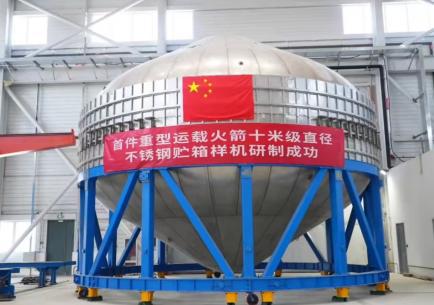
10米级不锈钢贮箱,是中国对星舰式体系的正面回应
Guan Cha Zhe Wang· 2025-05-01 01:37
Core Viewpoint - The successful development of China's first 10-meter diameter stainless steel storage tank prototype marks a significant leap in the country's heavy rocket manufacturing capabilities, positioning it to compete in the next generation of space exploration and heavy lift systems [1][3][12]. Group 1: Technical Significance - The 10-meter diameter represents a critical threshold in rocket design, as larger storage tanks are essential for heavy rockets, which are necessary for ambitious space missions such as lunar bases and Mars exploration [3][5]. - The introduction of stainless steel as a material for the storage tank signifies a shift in manufacturing philosophy, offering advantages in strength, cost, and reusability compared to traditional aluminum alloys [5][6]. - The prototype is not designed for current rockets but is intended for the next generation of heavy rockets, specifically the Long March 9, which aims to be a reusable system with significant thrust capabilities [6][12]. Group 2: Competitive Landscape - The development of the 10-meter storage tank is a strategic move for China to establish a foothold in the competitive landscape of super heavy rockets, where the U.S. has already made significant advancements with NASA's SLS and SpaceX's Starship [12][13]. - The global race for super heavy rockets is intensifying, with the U.S. focusing on high-reliability systems and commercial deep space capabilities, while China aims to leapfrog existing technologies by directly entering the super heavy and reusable rocket domain [12][15]. - The ability to manufacture large-diameter, modular, and high-temperature resistant structures is crucial for achieving high-frequency, low-cost space launches, which is the future of space transportation [15][16]. Group 3: Industrial Implications - The 10-meter stainless steel storage tank prototype is not merely a component but represents a foundational shift in China's space manufacturing logic, indicating a move towards a more industrialized approach to rocket production [17]. - The successful creation of this prototype demonstrates China's readiness to develop the necessary infrastructure and capabilities to support the next generation of space vehicles, which is essential for maintaining competitiveness in the global space race [16][17]. - The focus on building a robust manufacturing system capable of producing large components is a critical step towards achieving the goal of high-frequency space launches, which will be vital for future missions [15][17].