
Paxos

Search documents
Paxos推出欧盟合规稳定币USDG,联手Robinhood、万事达与USDC展开合规赛道争夺战
Zhi Tong Cai Jing· 2025-07-02 02:32
Group 1 - Paxos has launched the USDG stablecoin in the EU, supported by major institutions like Robinhood, Mastercard, and Kraken, providing access to over 450 million consumers across 30 countries [1][2] - USDG has received certification under the EU's Markets in Crypto-Assets (MiCA) regulation and is regulated by the Finnish Financial Supervisory Authority and the Monetary Authority of Singapore [1] - The stablecoin will be issued by Paxos Issuance Europe OY, which complies with the new EU crypto asset framework, and will maintain cash reserves in European banks for one-to-one redemption [1] Group 2 - There is a growing demand for dollar-pegged currencies, with USDG expected to compete with other regulated stablecoins like Circle's USDC, which is currently the largest MiCA-compliant token [2] - USDG is set to launch in November 2024 and will support the Global Dollar Network (GDN), a coalition of industry leaders aimed at promoting stablecoin adoption [2] - Robinhood has announced a comprehensive suite of crypto products, enhancing its competitive position in the crypto market and indicating the emergence of "tokenized Wall Street" [2]

X @CoinDesk
CoinDesk· 2025-07-01 18:22
Stablecoin Launch - Global Dollar (USDG) 在欧盟推出,由 Paxos 发行 [1] - 该稳定币现在面向欧盟 4.5 亿消费者开放 [1] Backing and Availability - USDG 获得了 Kraken 和 Robinhood 的支持 [1]
X @The Block
The Block· 2025-07-01 09:31
Global Dollar Network expands with EU launch of USDG stablecoin by Paxos with backing from Robinhood, Kraken and others https://t.co/ITzY1kmHWk ...
【首席观察】刷卡上“链” 万事达在改写支付的“入口法则”
经济观察报· 2025-06-30 12:43
2025年6月24日,万事达宣布与Chainlink(区块链预言机网络,旨在弥合链下数据与链上智能合约 之间的差距)建立战略合作伙伴关系。有分析认为,这意味着传统支付网络正主动上"链",在不拆 解合规架构的前提下,将 DeFi(去中心化金融)纳入自身轨道。 现在,一个用户无需理解区块链即可体验链上经济价值、推动Web3.0(基于区块链去中心化的第 三代互联网)从"极客工具"向"大众金融基础设施"转型的支付裂变时刻已至。 金融业正在经历"链改"而非"被颠覆",最终是否会形成一种 混合型金融服务生态:底层是区块链技术作为新金融基础设 施;中间层是合规框架下的加密资产纳入主流体系;应用层则 由传统金融机构主导。 作者:欧阳晓红 封图:图虫创意 想 象 一 下 : 2025 年 的 夏 天 , 在 纽 约 一 家 咖 啡 馆 , 一 位 年 轻 的 软 件 工 程 师 用 手 中 的 万 事 达 (Mastercard)信用卡轻轻一刷,购买了0.25枚以太坊。他既没有登录加密货币交易平台Binance 或Coinbase,也无需复制粘贴复杂的钱包地址,只是在一个名叫Swapper Finance(兑换者金融) 的小程 ...



【首席观察】刷卡上“链” 万事达在改写支付的“入口法则”
Jing Ji Guan Cha Wang· 2025-06-30 12:22
Core Insights - Mastercard is transforming the payment landscape by enabling users to purchase cryptocurrencies directly using their credit cards through a new service called Swapper Finance, in partnership with Chainlink [1][2][3] - This collaboration signifies a shift where traditional payment networks are integrating decentralized finance (DeFi) without dismantling existing compliance structures [1][5] Group 1: Strategic Partnerships - Mastercard has partnered with major cryptocurrency platforms like MetaMask, Crypto.com, and Kraken, allowing users to spend stablecoins at 150 million merchants globally [2][3] - The partnership with Chainlink aims to provide a secure bridge between off-chain data and on-chain smart contracts, facilitating seamless transactions [3][4] Group 2: User Experience and Accessibility - Users can now purchase cryptocurrencies like Bitcoin and stablecoins directly from decentralized exchanges (DEX) using their Mastercard, simplifying the process that previously required multiple steps [3][6] - The new system allows for a straightforward transaction process: input card number, select amount, and confirm payment, making it accessible to a broader audience [7][8] Group 3: Regulatory and Compliance Framework - The collaboration emphasizes compliance, consumer protection, and transparency, ensuring that on-chain activities are visible and off-chain identities are compliant [6][9] - The integration of stablecoins into mainstream payment channels represents a significant step towards bridging traditional finance and decentralized finance [5][10] Group 4: Future Implications - The partnership may signal a new era in digital currency competition, focusing on ecosystem connectivity rather than just payment efficiency [9] - The evolving landscape suggests a potential hybrid financial ecosystem where traditional financial services leverage blockchain technology for enhanced functionality [10]
X @Token Terminal 📊
Token Terminal 📊· 2025-06-26 20:12
RT Token Terminal 📊 (@tokenterminal)why did @RobinhoodApp not launch its own stablecoin?but instead partnered with @global_dollar, where @Paxos is the issuer of USDGfor reg arb reasons that allow RH to pass on yield to its users (which it could not do as an issuer) https://t.co/vJO5bb0t3g ...
美债供应洪峰将至 稳定币或成“救市”新买家?
智通财经网· 2025-06-26 07:06
Core Viewpoint - The potential impact of stablecoins on the demand for short-term U.S. Treasury securities is a key topic of discussion at the recent money market fund seminar in Boston, with expectations that these digital tokens will absorb a significant amount of government bond supply later this year [1][2]. Group 1: Stablecoin Market Dynamics - Currently, approximately 80% of stablecoin funds are allocated to Treasury bills or repurchase agreements, totaling around $200 billion, which accounts for less than 2% of the overall U.S. Treasury market [1]. - The rapid growth of the stablecoin market is likely to outpace the supply growth of U.S. Treasuries, creating substantial new demand for government bonds [1][2]. - As financial institutions and companies increasingly utilize stablecoins for payments, cross-border remittances, and decentralized finance, issuers must continuously increase their reserve assets to support this expansion [1]. Group 2: Market Supply and Demand - The market anticipates up to $1 trillion in new U.S. Treasury supply by the end of the year, necessitating new buyers to fill this gap, with stablecoin issuers emerging as a critical force in this regard [2]. - If the Treasury Department reduces long-term supply and shifts towards short-term financing, the demand increase from stablecoins could provide the Treasury Secretary with more policy adjustment flexibility [2]. - The total market capitalization of stablecoins currently stands at $256 billion, with projections suggesting that if the recently passed stablecoin regulatory framework becomes law, the market could exceed $2 trillion by 2028 [2]. Group 3: Future Outlook - The stablecoin market is expected to experience explosive growth over the next three to five years, potentially becoming a significant source of new demand for U.S. Treasuries [3].

RWA 代币化:下一个万亿级增长蓝海
Zhi Tong Cai Jing· 2025-06-25 11:17
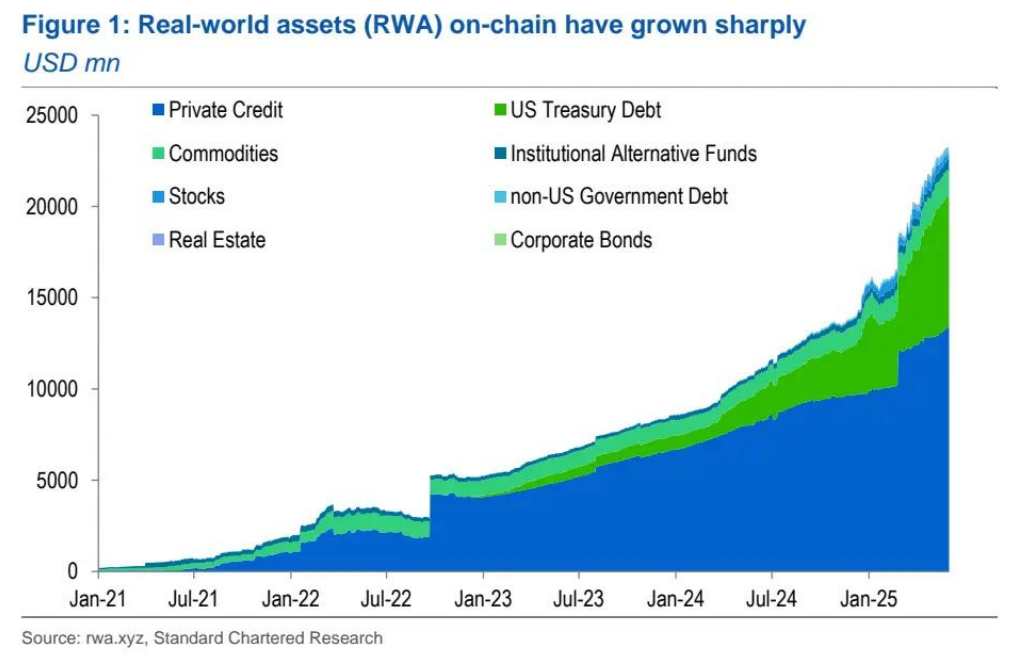
Core Insights - The report highlights the dominance of stablecoins in the Real-world asset (RWA) tokenization market, while non-stablecoin RWA tokenization shows significant growth potential as regulatory barriers are removed [1][2][3] - The current market size for non-stablecoin RWA tokenization is $23 billion, representing only 10% of the stablecoin market [3][9] - Regulatory reforms in jurisdictions like Singapore, Switzerland, the EU, and Jersey are supportive, but inconsistencies, particularly regarding KYC requirements, remain a challenge [3][19] Market Overview - The non-stablecoin RWA tokenization market is primarily dominated by private credit ($13 billion) and U.S. Treasury bonds ($7 billion) [9] - The tokenization of U.S. Treasury bonds is relatively mature, attracting traditional finance participants [9] - The private credit market, led by Figure, is gaining traction by simplifying loan verification and approval processes [9][13] Growth Potential - Private equity and illiquid commodities are expected to be the next growth areas for non-stablecoin tokenization [4] - Successful tokenization projects often address unmet needs that traditional products do not fulfill, such as the yield from tokenized U.S. Treasury bonds [12][18] - The growth of on-chain private credit is driven by improved access for investors, enhancing liquidity [13] Regulatory Challenges - Regulatory frameworks are evolving, but inconsistencies across jurisdictions pose challenges for tokenization [19] - Inefficiencies in KYC requirements for fund holders create friction, limiting accessibility and scalability [19] Other Challenges - The gap between decentralized finance (DeFi) and traditional finance (TradFi) participants affects the potential scale and speed of non-stablecoin tokenization [20] - Solutions are needed to bridge this gap, including trusted third-party custodians and distribution solutions for tokenized digital assets [20]
互联网Ⅱ行业专题:从Circle上市,探索稳定币与交易所的合作模式
Sou Hu Cai Jing· 2025-06-25 01:14
Core Insights - The global stablecoin market has surpassed $250 billion, accounting for 7.48% of the $3.35 trillion cryptocurrency market, with a compound annual growth rate (CAGR) exceeding 80% over the past five years, establishing a duopoly between USDT and USDC, which together hold 84% of the market share [1][17][29] - Circle, as the issuer of USDC, is set to go public on June 5, 2025, on the NYSE, with its stock price increasing over 675% within ten days of listing. Its business model primarily relies on interest income from reserve assets, which constitutes over 99% of its total revenue [1][4][31] - The passage of the GENIUS Act in the U.S. provides a regulatory framework for the stablecoin market, focusing on issuer qualifications, reserve requirements, compliance, and consumer protection, aiming to foster innovation while maintaining financial stability [1][11][12] Stablecoin Market Dynamics - The stablecoin market is characterized by a dual oligopoly, with USDT holding 60% and USDC holding 24% of the market share. USDC is backed by U.S. Treasury bonds and a 1:1 reserve of U.S. dollars, emphasizing compliance and transparency [1][17][29] - Circle's partnership with Coinbase is strategic, with Circle projected to pay Coinbase $900 million in distribution fees in 2024, representing 54% of its total revenue. This collaboration enhances USDC's integration into Coinbase's ecosystem, increasing its share of USDC from 5% in 2022 to 23% in Q1 2025 [2][20][25] Coinbase's Business Performance - Coinbase maintains a market share of 6%-7% in the cryptocurrency exchange sector, with a highly compliant business model that facilitated its status as the first publicly listed digital asset exchange in the U.S. [3][35] - In 2024, Coinbase's trading commission revenue is expected to reach $3.986 billion, a 262% year-over-year increase, while subscription and service revenue is projected at $2.307 billion, a 164% increase. Retail customers contribute over 90% of trading revenue, with stablecoin revenue accounting for 15% of total income [3][4][35] Financial Projections for Circle - The stablecoin market is projected to grow significantly, with a neutral assumption of a 50% CAGR, estimating a market size of approximately $1.1 trillion by 2028 and $2.5 trillion by 2030 [4][26][29] - Circle's revenue is closely tied to the market capitalization of USDC and Federal Reserve interest rates, with total revenue expected to reach $1.676 billion in 2024 and $2.58 billion in 2025 [4][28] Expanding Use Cases for Stablecoins - The application of stablecoins is rapidly expanding beyond cryptocurrency trading to include cross-border payments, foreign exchange savings, and decentralized finance (DeFi) [5][29] - For instance, USDC offers an annualized interest rate of 3.68% on the Ethereum-based Compound lending platform, showcasing its advantages in the DeFi space compared to other assets [5][32]

互联网行业专题:从Circle上市,探索稳定币与交易所的合作模式
Guoxin Securities· 2025-06-24 07:22
2025年06月24日 证券研究报告 | 从Circle上市, 探索稳定币与交易所的合作模式 行业研究 · 行业专题 互联网 · 互联网Ⅱ 投资评级:优于大市(维持) • 全球稳定币市场规模已突破2500亿美元,行业呈现双寡头格局,USDT和USDC两者合计占84%的市场份额。整个加密货币市场总市值达3.35 万亿美元,稳定币占比7.48%,稳定币市场规模过去五年复合增速超80%,应用场景不断拓展。其中,Tether发行的USDT是全球最早也是 最大的稳定币,占60%的市场份额。Circle发行的USDC是全球第二大稳定币,市占率24%。USDC底层为美债与美元1:1储备,以合规性和透 明度为核心优势。 • Circle:作为USDC发行方在2025年6月5日登陆纽交所,作为"稳定币第一股"股价在十余天内累计涨幅超675%。商业模式主要为储备资产 利息收入、占总收入比例超99%。伴随着2025年6月17日美国参议院通过《GENIUS法案》,政策环境逐渐明晰,为稳定币市场发展提供土 壤。本文对稳定币未来市场空间与Circle财务数据进行拆分预测,并对比讨论Circle与其他加密市场相关标的估值情况。 • Cir ...
