
Instagram

Search documents
TikTok美区200亿GMV攻坚:社交电商增量王遇“难越之峰”
Sou Hu Cai Jing· 2025-12-22 08:20
Core Insights - TikTok aims for a GMV target of $20 billion in the U.S. for 2025, but market research firm eMarketer predicts it will only reach $15.82 billion, reflecting a growth of 108% year-over-year, which indicates a potential shortfall in achieving its ambitious goal [1][4][5] Group 1: Market Performance - The first half of 2025 was challenging for TikTok in the U.S., facing issues such as regulatory scrutiny, tax increases, and internal layoffs, which increased operational pressures on sellers [2][4] - The second half showed improvement with user growth, surpassing 18 million monthly active users, and significant sales during the Black Friday event, where transactions exceeded $500 million [2][4] - Despite strong performance in the latter half, the overall annual target remains difficult to achieve due to earlier setbacks [4][5] Group 2: User Engagement and Growth - TikTok has become the fastest-growing social media platform in the U.S., with a monthly active user count of 183 million, reflecting a 16% growth rate [6][7] - The platform's user engagement is high, with users spending over 90 minutes daily on TikTok, significantly more than on competitors like Facebook and Instagram [8][6] Group 3: Competitive Landscape - TikTok holds an 18.2% market share in the U.S. social e-commerce sector, making it the third-largest player, while Facebook and Instagram dominate with a combined 75% share [9][10] - The platform's unique content ecosystem allows it to attract and retain users effectively, despite competition from established players [8][10] Group 4: Future Projections - eMarketer forecasts that TikTok Shop's sales will continue to grow at double-digit rates, potentially exceeding $30 billion by 2028, indicating resilience in its content-driven e-commerce model [5][4] - The U.S. e-commerce market is projected to reach $1.34 trillion by 2025, with TikTok aiming to capture a significant portion of this growth [12][11] Group 5: Brand Strategy and Market Positioning - TikTok is focusing on brand partnerships and content quality to enhance its market position, moving away from a purely volume-driven approach to a more strategic brand-building model [25][30] - The platform's internal communications indicate a commitment to maintaining control over its core business operations, which may boost confidence among sellers and brands [23][30]


TikTok signs joint venture to create TikTok USDS Joint Venture
Youtube· 2025-12-19 19:22
Core Insights - TikTok has made significant progress in maintaining its US operations by signing a deal to spin off its US unit, which has positively impacted Oracle shares, increasing nearly 8% [1] - The new US-based TikTok will be responsible for US data management, content moderation, and algorithm security, requiring retraining of its algorithm on US user data while integrating with the global TikTok [2] - TikTok currently holds only 4% of the US digital ad spending market, significantly lower than Meta's 23% and Google's 25%, indicating potential for growth if user engagement and advertiser results remain stable [3] Group 1 - TikTok's new US entity is preparing to compete with existing social media giants, raising questions about its ability to manage transitions for its 170 million US users and advertisers [1] - The transition may introduce challenges in consumer experience, advertiser infrastructure, and algorithmic performance, as highlighted by industry analyst Brian Weezer [1] - Maintaining a consistent experience for users, advertisers, and creators is crucial amid the upcoming changes [1] Group 2 - The new US TikTok will manage interoperability, e-commerce, and advertising, which must be globally integrated to sustain its value [2] - Successful execution of these transitions will directly impact TikTok's share of US digital ad spending [2] - If TikTok can navigate these changes effectively, it may gain market share from competitors like Snap, which is currently experiencing a decline in stock value [3]


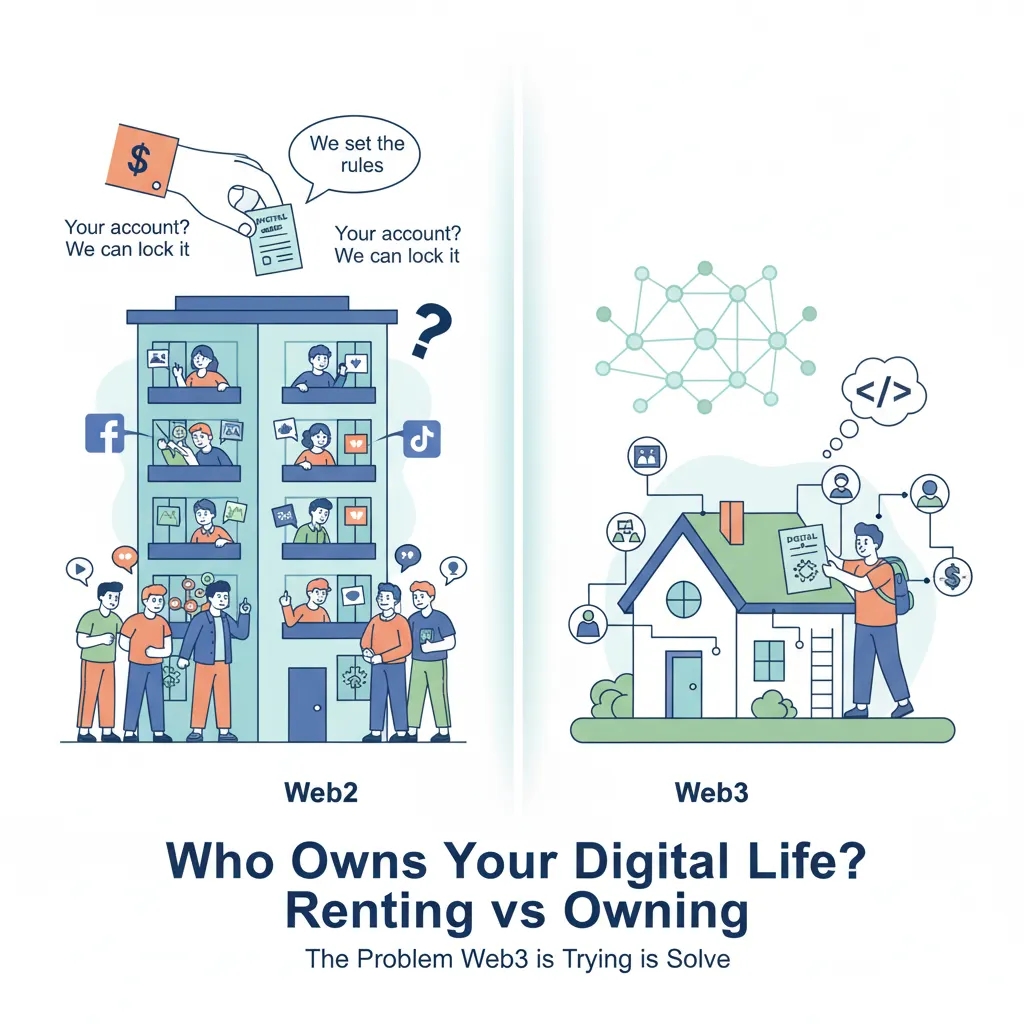
Web3 是什么以及它想解决什么问题?
3 6 Ke· 2025-12-17 23:11
Core Concept - Web3 represents a shift from being passive "platform tenants" to owning "digital property," emphasizing digital ownership and governance as fundamental issues in the digital landscape [1][3]. Group 1: Understanding Web3 - Web3 is not merely about cryptocurrencies or avatars; it fundamentally questions who owns and controls digital identities and assets [3][4]. - The current internet (Web2) is dominated by large tech companies that control user data and interactions, making users mere tenants rather than owners [4][6]. - The core idea of Web3 is to allow users to own their "digital land," where data, identity, and content are tied to individuals and stored in personal "wallets" [4][5]. Group 2: Blockchain and Ownership - Blockchain technology underpins the concept of digital ownership by providing a decentralized and transparent method of recording transactions, ensuring that ownership cannot be easily revoked by any single entity [5][7]. - The analogy of a neighborhood group chat illustrates how blockchain records transactions collectively, making it difficult for any individual to alter the truth [5]. Group 3: Issues Addressed by Web3 - Web3 aims to resolve structural issues in Web2, such as the lack of true ownership of digital assets, where users' followers and content are owned by platforms [7]. - It seeks to decentralize content moderation, allowing community governance rather than centralized control by a few companies [7]. - Web3 proposes a more inclusive financial system that eliminates barriers to entry, enabling anyone with internet access to participate in financial activities [7]. Group 4: Challenges Facing Web3 - Many Web3 applications currently have user-unfriendly experiences, with high barriers to entry and complex processes that can lead to asset loss [8]. - Some decentralized applications still rely on centralized infrastructure, which can recreate the power structures that Web3 aims to dismantle [8]. - The Web3 ecosystem is often marred by speculative activities, leading to scams and significant losses for inexperienced users, alongside environmental concerns related to energy consumption [8]. Group 5: Evaluating Web3's Value - The discussion around Web3 is crucial as it challenges the existing internet structure and explores potential alternatives [9]. - Web3 is still in its early stages, characterized by numerous failures and unresolved issues, but it raises important questions about digital ownership and governance [9]. - The future of the internet remains open for transformation, with Web3 serving as a catalyst for rethinking the current surveillance-based structures of large tech companies [9].
澳大利亚未满十六岁,禁止登录社媒
Zhong Guo Qing Nian Bao· 2025-12-17 02:32
Core Viewpoint - Australia has become the first country to implement strict legislation prohibiting minors under 16 from using social media platforms, with penalties of up to AUD 49.5 million for non-compliance [1][2]. Group 1: Legislative Impact - The new law requires social media platforms to implement measures to prevent access by users under 16, or face significant fines [1]. - The legislation has garnered support from leaders in other countries, including the UK, France, Denmark, and Norway, who are considering similar measures [1][2]. - A significant portion of the Australian population, 77%, supports the ban on minors using social media [5]. Group 2: Social and Psychological Concerns - The law is partly a response to tragic incidents of cyberbullying, such as the case of a 15-year-old girl who took her own life due to online harassment [3]. - Research indicates that excessive social media use among teenagers is linked to higher risks of depression, anxiety, and eating disorders [4]. - Parents express relief at the ban, feeling it alleviates the pressure of monitoring their children's social media use [5]. Group 3: Implementation Challenges - Social media companies are expected to use technology such as facial recognition and user data to verify ages, but the effectiveness of these measures is uncertain [7]. - Despite the ban, children are finding ways to circumvent age verification, indicating potential challenges in enforcement [11]. - The government acknowledges that some accounts may be missed in the initial enforcement phase, and ongoing checks will be necessary [11]. Group 4: Global Context and Comparisons - Other countries are exploring age verification technologies, with Malaysia planning to implement a similar ban by 2026 [1]. - The Australian approach contrasts with practices in the US and Europe, where parental consent is often required for minors to use social media [14]. - Discussions around the balance between protection and freedom in social media use continue globally, with various countries adopting different strategies [16].
X @TechCrunch
TechCrunch· 2025-12-16 16:02
Product Expansion - Instagram 将 Reels 功能扩展到大屏幕,首先在 Amazon Fire TV 上推出 [1] Platform Integration - 该举措表明 Instagram 正在寻求与更多平台集成,以扩大其 Reels 内容的覆盖范围 [1]
澳洲数字市场发展滞后 社媒禁令终将成为脱离国情的“空中楼阁”
Zhong Guo Xin Wen Wang· 2025-12-12 05:37
Core Viewpoint - The Australian Parliament's passage of the "2024 Cybersecurity (Minimum Age for Social Media) Amendment" has sparked global attention, prohibiting minors under 16 from using mainstream social media platforms, effective December 10. This ban raises concerns about its implications and effectiveness, revealing several issues with a one-size-fits-all approach [1][9]. Group 1: Children's Rights and Participation - The ban overlooks children's media rights and fails to respect their voices, as the execution of the social media ban lacks a solid foundation. In the digital age, access and participation rights for children are essential [1][2][3]. - The Australian government's approach deviates from fundamental principles by not involving minors in the policy-making process, raising questions about potential violations of children's basic rights [3]. Group 2: Political Motivations and Governance - The legislation appears driven by short-term electoral motives, reflecting a political struggle to secure parental votes, with 77% of parents supporting the ban. The rapid progression from proposal to approval indicates a lack of long-term governance strategy [4]. - The law's swift passage, with minimal public feedback opportunities, has led to skepticism from social media platforms regarding the underlying motives and the adequacy of scientific justification [4][5]. Group 3: Implementation Challenges - The ban simplifies complex issues of digital literacy and content governance into a physical isolation policy, revealing governmental inertia and a lack of nuanced strategies [5][6]. - The practical implementation of the ban faces significant challenges, including age verification difficulties and potential conflicts between parents and children, which may exacerbate existing issues rather than resolve them [6][7]. Group 4: Digital Market Context - Australia's digital market is underdeveloped, with the country ranking low in global internet quality and digital competitiveness. This context raises concerns about the feasibility and relevance of the social media ban [8][9]. - The government has allocated AUD 6.5 million to test age verification technologies, but the effectiveness of these systems remains uncertain, complicating the ban's implementation [8]. Group 5: Global Perspectives and Future Directions - The global trend in social media governance is shifting from rigid restrictions to more flexible guidance, emphasizing the need for a balanced approach that protects minors while allowing for their development [10]. - A more forward-looking strategy would focus on enhancing digital literacy and critical thinking among minors, rather than isolating them from digital environments, fostering a generation of informed digital citizens [10].
A new social media ban for children takes effect in Australia
MSNBC· 2025-12-10 16:36
Regulatory Landscape - Australia has implemented a social media ban for individuals under 16, requiring platforms to use age verification tools and facing potential fines for non-compliance [1][2][4] - The Australian law is facing a constitutional challenge from teenagers [1] - A Quinnipiac poll indicates approximately 60% of registered American voters support a similar ban in the US [6] Social Impact & Concerns - The law is designed to address the dangers young people face online, including rising suicide rates, teen depression, anxiety, and poor academic performance, with studies suggesting a causal link to social media [3] - A survey of over 17,000 Australians under 16 reveals that a majority (three out of four) believe the ban will not stop them from using social media [5] - Reddit expresses "deep concerns" that the law makes young people less safe online and undermines free expression, despite planning to comply [8] Company Compliance - Most of the 10 social media platforms affected by the Australian law have indicated they plan to comply [8]
X @TechCrunch
TechCrunch· 2025-12-10 13:32
Product Update - Instagram's new 'Your Algorithm' tool provides users with increased control over the Reels content they view [1]
Australia launches world's first social media ban for kids under 16
NBC News· 2025-12-10 05:02
Social Media Ban in Australia - Australia has implemented a ban on social media for individuals under 16, potentially affecting 1 million accounts across major platforms [3] - The law requires tech companies to take measures to prevent underage account creation, facing fines up to $32 million for non-compliance [4] - A national study revealed that 96% of Australian children aged 10-15 use social media, with 70% exposed to harmful content [9] Potential Impacts and Concerns - The ban aims to protect young people from negative effects of social media, such as unrealistic body image and online bullying [6] - Critics argue the ban may infringe on constitutional rights and drive young users to unregulated platforms [8] - There are concerns about the methods tech companies may use to verify age, potentially raising privacy issues [5] Global Implications - Australia's ban is considered a potential template for other countries, with the EU also considering similar measures [9] - Malaysia is set to implement a similar ban starting January 1st, and New Zealand and Denmark are discussing it [15] - Some social media apps are implementing more restrictions for children and teens [16] Workarounds and Reactions - Young people are exploring ways to circumvent the ban, such as using VPNs or requesting adults to create accounts [12][13][14] - 77% of Australians surveyed support the ban [12]
X @Bloomberg
Bloomberg· 2025-12-09 22:04
Young teenagers in Australia have now been barred from social media platforms such as Facebook, Instagram and TikTok in one of the toughest crackdowns on digital platforms in the democratic world https://t.co/748iszDMID ...