Unitree

Search documents
China warns of bubble risks in booming humanoid robots arena
Fortune· 2025-11-28 09:08
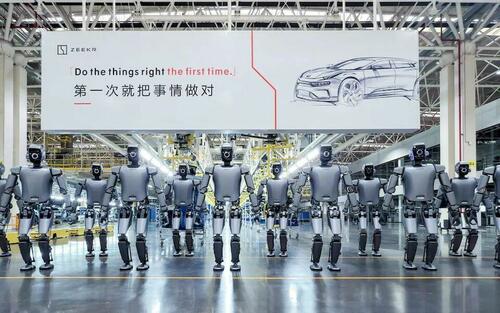
Core Viewpoint - The National Development and Reform Commission of China has expressed concerns about the potential formation of a bubble in the humanoid robotics industry, highlighting the risks associated with excessive investment in this pivotal technology sector [1][2][3]. Industry Overview - The humanoid robotics sector has seen a surge in the number of similar robots produced by over 150 companies, prompting the need for vigilance to prevent market saturation and to protect genuine research and development efforts [2][3]. - The rapid growth in humanoid robot development has been fueled by increased public interest, particularly following the performance of Unitree's robots during the Spring Festival Gala, leading to the designation of this industry as a key economic growth driver by the Communist Party [5][6]. Investment Trends - The Solactive China Humanoid Robotics Index, which tracks shares of robot-related companies, has increased nearly 30% this year, reflecting heightened investor interest in the sector [6]. - Citigroup Inc. projects that the market for humanoid robots could reach $7 trillion by 2050, although widespread adoption in households and factories is still years away [7]. Government Initiatives - The Chinese government plans to enhance mechanisms for market entry and exit to foster fair competition within the humanoid robotics industry [7]. - Efforts will be made to accelerate research and development of core technologies and to support the establishment of training and testing infrastructure [7][8]. - The government will also promote the consolidation and sharing of technology and industrial resources to expedite the practical application of humanoid robots [8].


硅谷人形机器人倒闭,朱啸虎的“剧透”应验了?
虎嗅APP· 2025-11-20 00:24
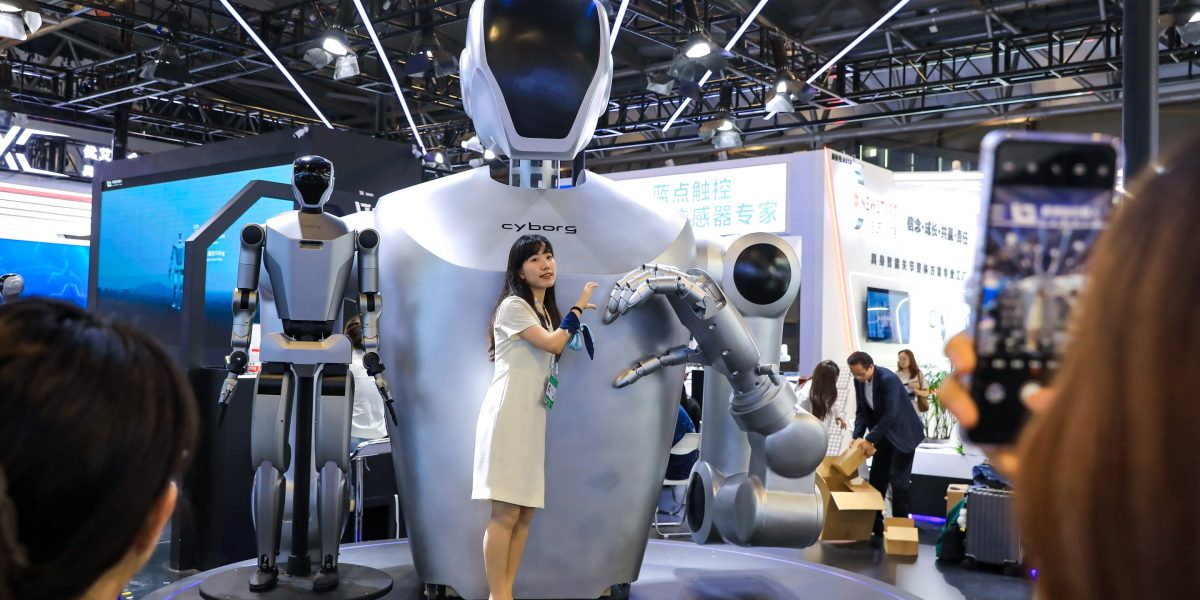
Core Insights - K-Scale Labs, a humanoid robot startup in Silicon Valley, has shut down, marking a significant shift in the narrative of the humanoid robotics industry from a "dream phase" to a "calculation phase" [4][18][29] - The company's failure is seen as a signal that many humanoid robot companies may face similar fates due to a lack of real customers and cash flow [18][29] Company Overview - K-Scale Labs was recognized for its unique approach of creating "open-source humanoid robots," contrasting with many competitors that followed a closed model [6][29] - Founded by Benjamin Bolte, who had experience at Meta and Tesla, K-Scale aimed to develop affordable humanoid robots for real users, starting with the Z-Bot priced under $1,000 [8][9] Funding and Development - K-Scale secured initial funding of $500,000 from Y Combinator, followed by additional investments totaling $4.4 million in early 2024 [7][8] - The company operated in a highly compressed environment, with team members living in the workspace, which fostered a strong mission-driven culture [8][9] Product Strategy - K-Scale's initial strategy focused on launching the Z-Bot to generate cash flow before developing larger robots like the K-Bot [9][10] - However, the company shifted its focus to the K-Bot after a conversation with a VC, which led to a misalignment between their narrative and market reality [10][12] Market Challenges - The transition to focusing on larger robots created significant risks, as the K-Bot was harder to produce and sell compared to the Z-Bot [12][14] - The company faced challenges in securing orders and financing, leading to a rapid decline in team morale and eventual shutdown [16][18] Industry Context - K-Scale's failure reflects a broader trend in the humanoid robotics sector, where many companies struggle to convert demos into stable, predictable cash flows [22][23] - The industry is witnessing a consolidation of investment towards a few leading companies, while mid-tier firms face longer funding cycles and tighter cash flows [26][28] Conclusion - K-Scale's story serves as a cautionary tale for the humanoid robotics industry, highlighting the critical need for real customer validation and sustainable business models [32][46] - The company's downfall emphasizes that the narrative of innovation must be supported by tangible market demand and financial viability [32][46]

总成本1250 美元!1分钟部署!TWIST2打造低成本人形机器人数据采集方案!
机器人大讲堂· 2025-11-16 05:41
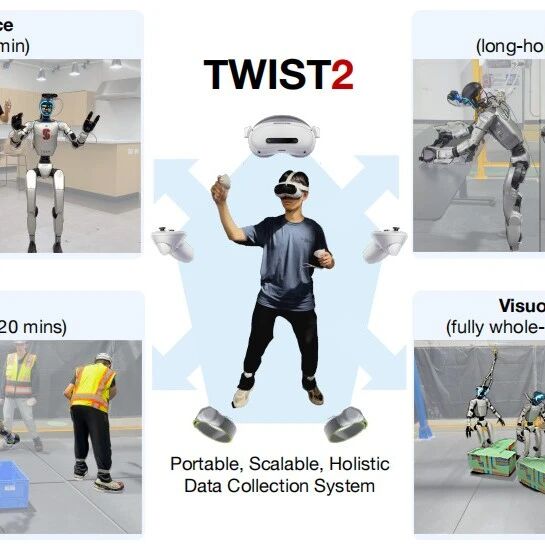
Core Insights - The article discusses the advancements in humanoid robotics, particularly focusing on the TWIST2 system, which integrates portability, scalability, and full-body control capabilities, overcoming the limitations of traditional motion capture systems [1][3][4]. Group 1: TWIST2 System Overview - TWIST2 is a new humanoid robot remote operation and data collection system developed by teams from Amazon FAR, Stanford University, and UC Berkeley, which allows robots to perform complex tasks autonomously [3][4]. - The system eliminates the need for expensive motion capture equipment, enabling quick deployment and operation [4][14]. Group 2: Key Innovations of TWIST2 - The system features a low-cost detachable neck module priced at $250, which provides egocentric vision capabilities when combined with a $400 stereo camera [9][14]. - TWIST2 utilizes a combination of PICO 4U VR devices and two leg motion trackers, with a total hardware cost of approximately $1,000, allowing for easy setup in just one minute [14][17]. - The system captures full-body human movements at a frequency of 100Hz, significantly improving data collection efficiency compared to previous systems [14][24]. Group 3: Data Collection Efficiency - TWIST2 allows a single operator to control the entire data collection process, achieving high efficiency with the ability to complete 100 successful demonstrations in just 20 minutes [22][25]. - The system's total data flow frequency exceeds 50Hz, with a latency of less than 0.1 seconds, enhancing the operator's ability to perform precise tasks [24]. Group 4: Autonomous Control Capabilities - TWIST2 introduces a hierarchical visual motion strategy framework that enables robots to execute tasks autonomously based on visual input, without relying on simplified speed commands [26][30]. - The framework has been successfully tested, allowing robots to perform complex tasks such as precise object manipulation and dynamic balance [32][35]. Group 5: Cost-Effectiveness and Accessibility - The total cost to set up a complete TWIST2 system is around $1,650, making high-quality humanoid robot research more accessible [37]. - The research team has made the system, data, and models open-source, positioning TWIST2 as a foundational infrastructure for humanoid robotics research [39].
北大等团队用“分层小脑+仿真分身”让G1零样本上岗
具身智能之心· 2025-11-14 16:03
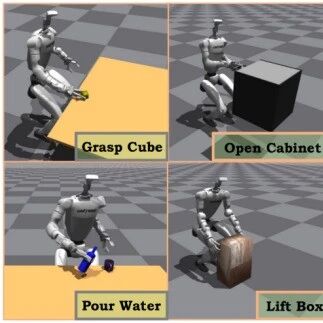
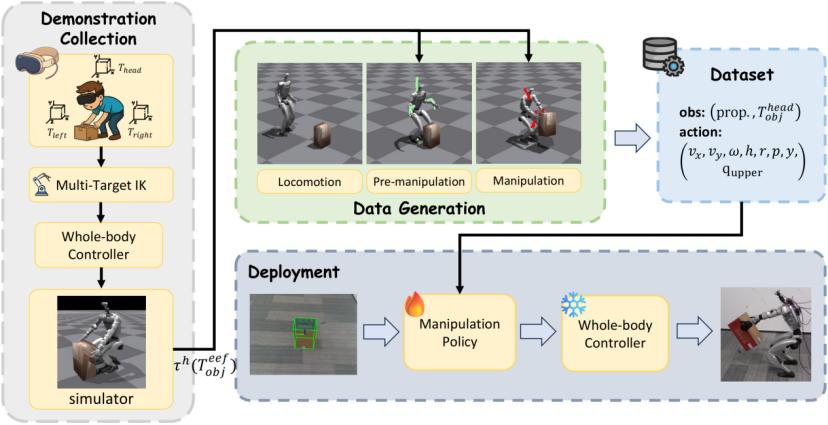
Core Insights - The article introduces the DemoHLM framework developed by a research team from Peking University and BeingBeyond, which addresses the challenges in humanoid robot loco-manipulation by generating vast amounts of training data from a single human demonstration in a simulated environment [1][3][20]. Group 1: Challenges in Humanoid Robot Loco-Manipulation - Humanoid robot loco-manipulation faces three main challenges: reliance on extensive real-world remote operation data, limited generalization across tasks, and difficulties in transferring simulation-trained strategies to real-world applications [3][5]. - Existing methods either remain confined to simulated environments or require hundreds of hours of real data, making them impractical for complex real-world scenarios [3]. Group 2: Innovations of DemoHLM - DemoHLM features a dual-engine approach combining hierarchical control and single demonstration data generation, ensuring stability in full-body movements while minimizing data costs for generalization [6][20]. - The hierarchical control architecture separates motion control from task decision-making, enhancing both flexibility and stability [7]. - The single demonstration data generation process allows for the creation of thousands of diverse training trajectories from just one simulated demonstration, significantly improving data efficiency and generalization capabilities [8][20]. Group 3: Experimental Validation - The framework was tested in both simulated environments and on a real Unitree G1 robot, demonstrating significant improvements in task success rates as the amount of synthetic data increased [9][11]. - For instance, the success rate for the "PushCube" task improved from 52.4% to 89.3% with increased data, showcasing the effectiveness of the data generation pipeline [11]. - The framework's adaptability was confirmed across various behavior cloning algorithms, with high success rates achieved in multiple tasks [14][16]. Group 4: Industry Implications and Future Directions - DemoHLM's advancements lower the cost of training humanoid robots, reducing the requirement from hundreds of hours of real operation to just hours of simulated demonstrations, thus lowering the barriers for industry applications [17][20]. - The framework's ability to generalize across different tasks without task-specific designs accelerates the transition of robots from laboratory settings to real-world environments [23]. - Future research will focus on addressing limitations related to simulation-to-reality discrepancies and enhancing performance in complex scenarios through mixed training with real data and multi-modal perception [19][23].
只演示一次,机器人就会干活了?北大&BeingBeyond联合团队用“分层小脑+仿真分身”让G1零样本上岗
3 6 Ke· 2025-11-14 02:36
Core Insights - The DemoHLM framework proposed by a research team from Peking University and BeingBeyond offers a novel approach to humanoid robot loco-manipulation, enabling the generation of vast training data from a single human demonstration in a simulated environment, addressing key challenges in traditional methods [1][20]. Group 1: Challenges in Humanoid Robot Loco-Manipulation - Humanoid robot loco-manipulation faces a "triple dilemma" due to limitations in existing solutions, which either rely on simulation or require extensive real-world remote operation data, making them impractical for complex environments like homes and industries [3][6]. - Traditional methods suffer from low data efficiency, poor task generalization, and difficulties in sim-to-real transfer, leading to high costs and limited scalability [6][22]. Group 2: Innovations of DemoHLM - DemoHLM's core innovation lies in its "layered control + single demonstration data generation" approach, ensuring stability in full-body movements while achieving generalization with minimal data costs [7][20]. - The framework employs a hierarchical control architecture that balances flexibility and stability, decoupling motion control from task decision-making [8][20]. Group 3: Data Generation Process - DemoHLM allows for the generation of diverse training data from just one demonstration, automating the process through three stages: pre-operation, operation, and batch synthesis, which enhances the generalization capability of the strategy [9][20]. - The automated data generation process mitigates the traditional challenges of data collection in imitation learning, significantly improving efficiency [9][20]. Group 4: Experimental Validation - The framework was validated in both simulated environments and on a real Unitree G1 robot, demonstrating stable performance across ten mobile operation tasks, with significant improvements in success rates as synthetic data volume increased [10][15]. - The results showed that as the number of synthetic data points increased from 100 to 5000, success rates for tasks like "PushCube" and "OpenCabinet" improved dramatically, indicating the effectiveness of the data generation pipeline [15][20]. Group 5: Industry Implications and Future Directions - The breakthroughs achieved by DemoHLM provide critical technological support for the practical application of humanoid robots in various sectors, including household, industrial, and service environments [19][20]. - Future research will explore mixed training with real data and multi-modal perception to enhance robustness and address current limitations, such as reliance on simulation data and performance in complex occlusion scenarios [19][22].

只演示一次,机器人就会干活了?北大&BeingBeyond联合团队用“分层小脑+仿真分身”让G1零样本上岗
量子位· 2025-11-13 09:25
Core Insights - The article introduces the DemoHLM framework, which allows humanoid robots to generate extensive training data from a single human demonstration in a simulated environment, addressing key challenges in loco-manipulation [1][22]. Group 1: Challenges in Humanoid Robot Manipulation - Humanoid robot manipulation faces a "triple dilemma" due to limitations in existing solutions, which either rely on simulation or require extensive real-world remote operation data, making them impractical for complex environments like homes and industries [3][6]. - Traditional methods suffer from low data efficiency, poor task generalization, and difficulties in sim-to-real transfer, leading to high costs and limited scalability [6][20]. Group 2: Innovations of DemoHLM - DemoHLM employs a hierarchical control architecture that separates motion control from task decision-making, enhancing both flexibility and stability [7][20]. - The framework's key innovation is the ability to generate a vast amount of diverse training data from just one demonstration, significantly improving data efficiency and generalization capabilities [8][20]. Group 3: Experimental Validation - Comprehensive validation was conducted in both simulated environments (IsaacGym) and on the real Unitree G1 robot, covering ten manipulation tasks with notable success rates [9][19]. - As synthetic data volume increased from 100 to 5000, success rates for tasks improved significantly, demonstrating the effectiveness of the data generation pipeline [14][20]. Group 4: Industry Implications and Future Directions - DemoHLM's advancements provide critical technical support for the practical application of humanoid robots, reducing training costs and enhancing generalization across various scenarios [19][20]. - The framework is designed to be compatible with future upgrades, such as tactile sensors and multi-camera perception, paving the way for more complex operational environments [21][20].
北大&智源研究院最新!RoboOS-NeXT:“记忆 + 分层架构” 实现通用多机器人协作
具身智能之心· 2025-11-06 00:03
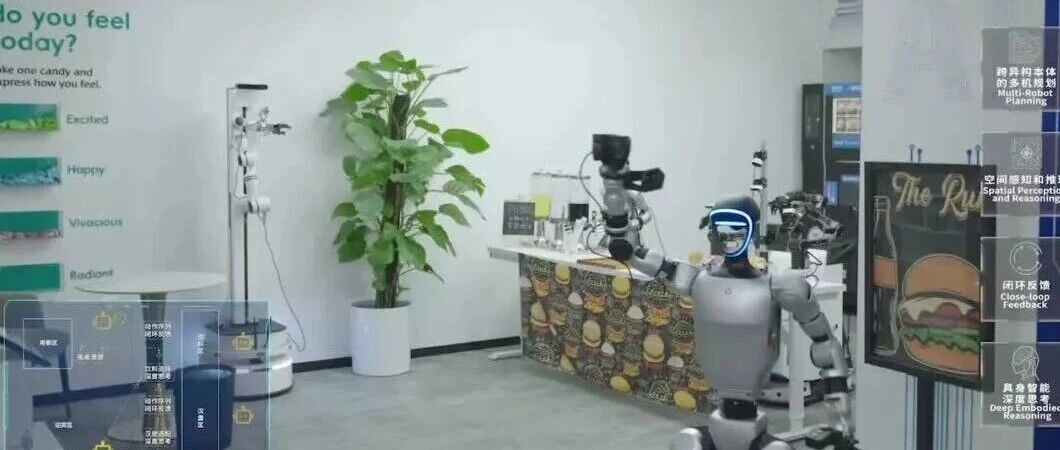
Core Insights - The article discusses the RoboOS-NeXT framework, which addresses the challenges in multi-robot collaboration by integrating a unified memory system and a hierarchical architecture for effective task execution and fault tolerance [1][4][23]. Group 1: Challenges in Multi-Robot Collaboration - Current multi-robot collaboration faces a "triple dilemma": reliance on single-robot memory, difficulty in adapting to heterogeneous robots, and lack of fault recovery capabilities [2][3]. - Existing solutions either fail to accumulate long-term experience or struggle with dynamic task allocation and fault tolerance [2][3]. Group 2: RoboOS-NeXT Framework - RoboOS-NeXT employs a "spatio-temporal entity unified memory (STEM)" and a "brain-cerebellum architecture" to facilitate global memory sharing and dynamic task execution [3][4]. - The framework consists of two core components: STEM for information integration and the brain-cerebellum model for planning and execution [4][9]. Group 3: Core Components of RoboOS-NeXT - **STEM** integrates spatial, temporal, and entity memories, providing a unified interface for all robots and eliminating information silos [6][7][8]. - **Brain-Cerebellum Architecture** separates global planning from local execution, ensuring efficient task decomposition and precise action control [9][10]. Group 4: Execution Workflow - The execution process involves four steps: task decomposition, dynamic scheduling, distributed execution, and dynamic memory updating [10][12]. - This workflow ensures that tasks are efficiently completed, even in the face of robot failures or tool malfunctions [10][12]. Group 5: Experimental Results - RoboOS-NeXT demonstrated superior performance in various scenarios, showing strong lifelong adaptability, collaboration scalability, and fault recovery capabilities [13][14][15]. - In adaptability tests, RoboOS-NeXT maintained a success rate of over 75% in long-sequence tasks, while the baseline without memory failed completely [13][14]. - The framework also showed significant improvements in execution efficiency, with average execution steps per task reduced by 20%-70% compared to the baseline [17][18]. Group 6: Key Conclusions and Future Directions - The unified memory is essential for collaboration, enabling lifelong adaptability and robust scheduling [23][25]. - Future enhancements may include multi-modal memory integration, end-to-end task optimization, and real-time performance improvements [25][26].
智源&悉尼大学等出品!RoboGhost:文本到动作控制,幽灵般无形驱动人形机器人
具身智能之心· 2025-10-27 00:02
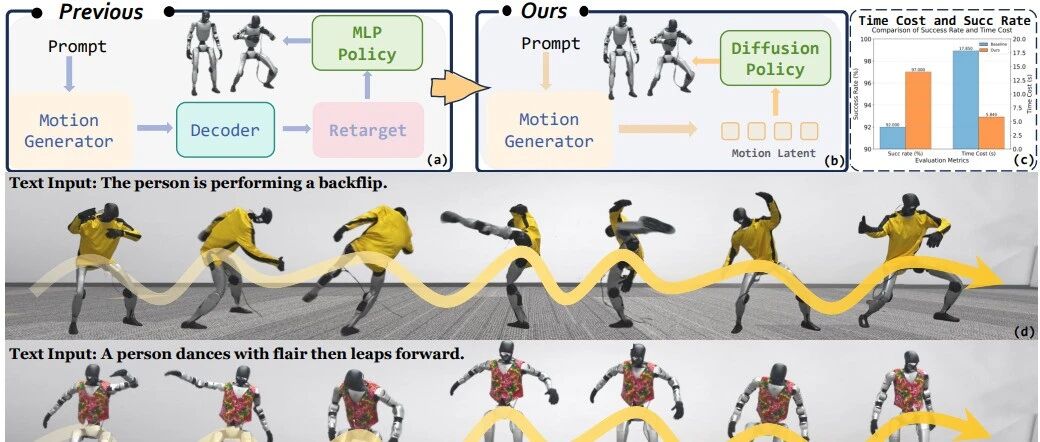
Core Insights - The article discusses the development of RoboGhost, an innovative humanoid control system that eliminates the need for motion retargeting, allowing for direct action generation from language input [6][8][14]. Group 1: Research Pain Points - The transition from 3D digital humans to humanoid robots faces challenges due to the cumbersome and unreliable multi-stage processes involved in language-driven motion generation [6][7]. - Existing methods lead to cumulative errors, high latency, and weak coupling between semantics and control, necessitating a more direct path from language to action [7]. Group 2: Technical Breakthrough - RoboGhost proposes a retargeting-free approach that directly establishes humanoid robot strategies based on language-driven motion latent representations, treating the task as a generative one rather than a simple mapping [8][10]. - The system utilizes a continuous autoregressive motion generator to ensure long-term motion consistency while balancing stability and diversity in generated actions [8][14]. Group 3: Methodology - The training process consists of two phases: action generation and strategy training, with the former using a continuous autoregressive architecture and the latter employing a mixture-of-experts (MoE) framework to enhance generalization [11][13]. - The strategy training incorporates a diffusion model that uses motion latent representations as conditions to guide the denoising process, allowing for direct executable action generation [11][14]. Group 4: Experimental Results - Comprehensive experiments demonstrated that RoboGhost significantly improves action generation quality, success rates, deployment time, and tracking errors compared to baseline methods [14][15]. - The results indicate that the diffusion-based strategy outperforms traditional multilayer perceptron strategies in terms of tracking performance and robustness, even when tested on unseen motion subsets [18][19].
四足机器人市场现状-宇树、波士顿动力、ANYbotics、深度智控及崛起的应用生态系统-Quadruped State of The Market - Unitree, Boston Dynamics, ANYbotics, DEEP Robotics, and The Rising Application Ecosystem
2025-10-21 01:52
Summary of Quadruped State of The Market Industry Overview - The quadruped robotics market is currently dominated by two main players: **Boston Dynamics** and **Unitree**, with **ANYbotics** and **DEEP Robotics** as notable competitors [4][37]. - Quadrupeds are recognized as the most advanced general-purpose robots, particularly with the advent of Level 2 Autonomy, which opens new market opportunities [3][9]. Key Players and Market Dynamics - **Unitree** holds an estimated **70% share** of global sales by volume in 2023, with annual revenues surpassing **1 billion RMB (~$140 million)** [46]. - **Boston Dynamics** generates an estimated **$100 million to $200 million** in annual revenue from its product line, including the quadruped **Spot** [38]. - **ANYbotics** focuses on environments requiring high protection ratings (IP67) and has an annual revenue of less than **$27 million** [44]. - **DEEP Robotics** is rapidly expanding, with around **600 deployments** across **40+ countries** [42]. Competitive Advantages - Unitree benefits from a substantial cost advantage compared to Western peers, with its high-end quadrupeds priced up to **50% lower** than those of competitors [8][108]. - The company has a broader product portfolio and faster product release cadence due to China's manufacturing capabilities [11]. Technological Developments - Recent advancements in **li-ion batteries** and **actuator technology** have significantly improved quadruped capabilities, reducing costs and increasing efficiency [33][134]. - Unitree employs a **Quasi-Direct-Drive (QDD)** actuator design, which offers a balance of cost and performance, although it may compromise robustness [137][143]. Market Opportunities - The Total Addressable Market (TAM) for quadrupeds includes industries such as **Oil & Gas**, **Semiconductor Fabs**, and **Datacenters** [6]. - Potential applications for quadrupeds include: - **Datacenters**: Inspecting electrical yards to prevent costly downtime [85]. - **Last-mile Delivery**: Offering a cost-effective alternative to human couriers [89]. - **Security Patrol**: Reducing costs associated with human security personnel [93]. Challenges and Risks - Security concerns have been raised regarding Unitree's technology, particularly in sensitive sectors like **semiconductor fabs** and **oil and gas** [132]. - The quadruped market remains fragmented, lacking a dominant player akin to a "hyperscaler" that could consolidate the market [84]. Conclusion - The quadruped robotics market is poised for growth, driven by technological advancements and increasing demand across various industries. Unitree's competitive pricing and strong market presence position it favorably, although challenges related to security and market fragmentation remain significant considerations for future developments.
'Most Humbling Thing I've Ever Seen': Western Business Leaders 'Terrified' After Touring Chinese Factories
ZeroHedge· 2025-10-14 22:00
Core Insights - Ford Motor Company CEO Jim Farley and other business leaders express concern over China's rapid technological advancements, which could threaten American companies if they do not respond quickly [1][3] - Farley noted the superior cost and quality of Chinese vehicles, highlighting advanced technologies such as self-driving software and facial recognition systems [3][5] - The shift in China's competitiveness is attributed to a highly skilled workforce and significant innovation, moving beyond just government subsidies and low wages [5][7] Industry Observations - Australian mining billionaire Andrew Forrest abandoned plans for electric vehicle powertrains after witnessing China's manufacturing dominance, emphasizing the global competition with China [7][8] - Forrest described highly automated factories in China where robots handle assembly with minimal human involvement, showcasing the advanced manufacturing capabilities [8] - The humanoid robotics market is projected to grow into a $5 trillion industry by 2050, with significant adoption expected by the late 2030s [10] - China's Unitree currently holds a 60% share of the global quadruped robot market, posing challenges for American companies like Boston Dynamics [11]