Huawei

Search documents
Trump says he asked for 20% cut from Nvidia, calls H20 an 'obsolete' chip
CNBC· 2025-08-11 17:11
Core Insights - Nvidia has agreed to pay a 15% cut of its sales to China in exchange for export control licenses to sell the H20 chip, down from an initial request of 20% by the U.S. government [2][8] - The H20 chip is considered obsolete by the U.S. government, with President Trump stating that it is an "old chip that China already has" [3][6] - The U.S. government is concerned that advanced chips could enhance China's AI capabilities, posing a national security threat [5] Group 1: Nvidia's Negotiations and Agreements - Nvidia's CEO Jensen Huang negotiated with President Trump to reduce the initial 20% cut to 15% for sales to China [2] - Huang visited the White House to discuss the export control licenses, which are crucial for Nvidia's sales strategy [2][8] - Nvidia was expecting to generate approximately $8 billion in sales from H20 chips before the export restrictions were implemented [7] Group 2: U.S. Government's Position on AI Chips - The U.S. government has implemented export controls to prevent advanced AI chips from being sold to China, fearing that it could allow China to surpass the U.S. in AI technology [5] - President Trump emphasized that the Blackwell chip, Nvidia's latest AI chip, would not be sold to China without significant performance downgrades [4] - The U.S. administration's stance is that allowing access to advanced chips could threaten national security [5] Group 3: Competitive Landscape - The H20 chip is specifically designed for the Chinese market and has been intentionally slowed down in performance [6] - AMD, another key player in the AI chip market, is also required to pay a 15% cut for its China-focused AI chip, the Instinct MI308, to secure export licenses [8] - The competition between U.S. chipmakers and the Chinese chip industry is highlighted, with concerns that denying access to U.S. technology could accelerate China's chip development [6]


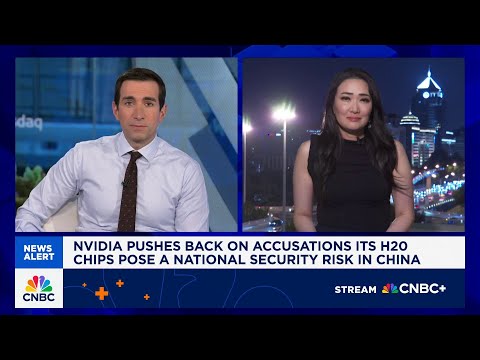
Nvidia pushes back on accusations its H20 chips pose a national security risk in China
CNBC Television· 2025-08-11 12:58
US-China Chip Trade Dynamics - Nvidia and AMD reportedly plan to give the US government a 15% revenue share from specific chips sold in China for market access [1][4] - China questions the safety and trustworthiness of Nvidia's H20 AI chip, with state media suggesting it may pose a national security risk [2][3][9] - The US government previously restricted H20 exports to China on national security grounds, a stance later reversed by the Trump administration [4] Export Control and Negotiation - China is reportedly seeking relaxation of export controls on advanced high bandwidth memory (HBM) chips as part of tariff pause extension discussions [5][11] - The discussion includes the potential impact on Huawei's ability to develop its own AI chips if China gains access to more advanced HBM chips [11][12] Company Statements and Market Impact - Nvidia denies having backdoors in its chips that could allow remote access or control [5] - Nvidia acknowledges following US government rules for worldwide market participation but does not directly address the 15% revenue cut [6] - Chinese companies like Huawei and SMIC may benefit if local customers question Nvidia's H20, potentially leading to increased domestic chip development and sourcing [13]
What Trump's Nvidia and AMD China deal means for the world
CNBC· 2025-08-11 12:27
Core Viewpoint - Nvidia and AMD have agreed to share 15% of their revenues from chip sales to China with the U.S. government in exchange for export licenses, raising questions about the impact on their business and potential for similar arrangements in the future [1][2][4]. Group 1: Agreement Details - The agreement allows Nvidia and AMD to sell their H20 and MI308 chips in China, which were previously restricted under export controls [2][5]. - Nvidia has not shipped H20 chips to China for months but anticipates receiving licenses to resume sales [3][5]. - The arrangement is seen as a way for both companies to secure access to the Chinese market, which is crucial for their revenue [4][6]. Group 2: Market Reaction - Despite the revenue sharing, Nvidia and AMD shares experienced only slight declines in premarket trading, indicating investor confidence in the deal [6]. - Analysts view the arrangement as a net positive, suggesting that 85% of revenue is preferable to losing access to the market entirely [7][11]. Group 3: Long-term Implications - There is uncertainty regarding the long-term implications of the deal, particularly if the U.S. government seeks a larger share of revenues as sales to China increase [8][12]. - The deal is characterized as unusual but reflects the transactional nature of the current administration, with analysts noting it sets a precedent for future agreements [11][12]. Group 4: Geopolitical Context - The semiconductor industry is viewed as strategic by the U.S., with export controls in place to protect national interests [13]. - Concerns have been raised in China regarding the security of Nvidia's chips, with Chinese regulators seeking clarifications on potential vulnerabilities [14][15]. - The arrangement may create mixed feelings in China, as local firms need these chips for AI advancements but may be deterred by the associated costs and security concerns [17][18].


KUKE Music and People's Music Publishing House Forge Strategic Partnership to Drive Global and Digital Advancement of Music Industry
Globenewswire· 2025-08-11 12:00
Group 1: Strategic Collaboration - KUKE Music and People's Music Publishing House have engaged in discussions to enhance global music collaboration and promote young Chinese musicians, resulting in multiple strategic agreements [1][2][4] - The partnership aims to build a digital music ecosystem by collaborating with platforms like Huawei Music and CMG Cloud Listening, focusing on integrated music data solutions and intelligent distribution models [3][4] Group 2: Young Musicians Support Program - The "Young Chinese Musicians Support Program" has been launched to provide comprehensive support for emerging artists, including album production, global distribution, and performance opportunities [2] - The initiative aims to identify promising talents and advance the heritage and innovation of Chinese music culture [2] Group 3: Future Vision and Industry Advancement - Both parties plan to hold regular progress meetings to implement cooperation details and deepen collaboration in areas such as music education and AI-driven copyright management [4] - The collaboration is expected to unlock new market opportunities and deliver premium Chinese music to global audiences [4] Group 4: Company Background - KUKE Music is recognized as China's premier classical music service platform, with extensive classical content licenses and a commitment to building a music ecosystem through copyright operations and digital distribution [5] - People's Music Publishing House, established in 1954, is the largest national professional music publishing authority in China, focusing on music publication and cultural exchange [6]


Adtran (ADTN) Q2 Revenue Jumps 17%
The Motley Fool· 2025-08-06 05:02
Core Viewpoint - Adtran reported strong Q2 2025 results with revenue exceeding expectations, but profitability remains a challenge despite improvements in certain metrics [1][5][12] Financial Performance - Q2 2025 GAAP revenue reached $265.1 million, surpassing management's guidance and analyst estimates of $260.2 million, marking a 17.3% increase from $226.0 million in Q2 2024 [1][2][5] - Non-GAAP operating margin improved to 3.0%, up from 0.6% in the prior year [2][6] - Free cash flow (non-GAAP) increased significantly from $3.9 million in Q2 2024 to $18.3 million [2][7] - Adjusted earnings per share (non-GAAP) were break-even, showing a 100% improvement from a loss of $0.13 in Q2 2024 [2] Business Segments - The Network Solutions business, focusing on fiber networking products, grew by 22.5% year-over-year, reaching $219.5 million [5] - The Services & Support segment saw a decline of 2.6% to $45.6 million compared to Q2 2024 [5] Operational Efficiency - Operating cash flow (GAAP) increased to $32.2 million from $19.9 million in Q2 2024 [7] - Research and development spending (GAAP) decreased to $51.9 million from $60.4 million in Q2 2024, while selling, general, and administrative costs remained stable [8] Market Position and Strategy - Adtran focuses on becoming a leader in fiber networking and expanding into international markets, emphasizing innovation and operational efficiency [4][10] - The company competes with larger providers like Nokia, Huawei, and Ciena, maintaining non-GAAP gross margins above 40% [11] Future Outlook - Management projects Q3 2025 revenue between $270.0 million and $280.0 million, indicating a sequential growth of 3.7% [12] - Non-GAAP operating margin is expected to range from 3.0% to 7.0%, aiming to build on recent improvements [12] - Key areas for investors include monitoring margin sustainability, R&D spending, and progress towards profitability [13]


Ambiq Micro Stock Pops on IPO Debut: What's Fueling the Surge?
The Motley Fool· 2025-08-05 05:00
Ambiq is focusing on chips with the lowest power consumption and also the highest computing performance. Software company Figma may have garnered the most attention from investors monitoring initial public offerings (IPOs) last week, but another tech name also nearly doubled in its market debut. Ambiq Micro (AMBQ -3.42%) priced its IPO at $24 per share on Wednesday, July 30, and shares were trading at over $50 on Thursday before closing at about $40 one day later. The semiconductor chip company could be tap ...

追踪中国半导体本土化进程_WAIC关键要点-中国人工智能半导体技术快速发展-Tracking China’s Semi Localization_ Shanghai WAIC key takeaways – rapid development of China AI semi technology
2025-08-05 03:20
Summary of Key Points from the Conference Call Industry Overview - The conference focused on the rapid development of China's AI and semiconductor localization efforts, particularly highlighted at the World AI Conference (WAIC) in Shanghai [1][5] - There is a strong demand for AI inference in China, with consumer-facing applications evolving beyond traditional chatbots [2] Core Company Insights - **Huawei**: - Unveiled the CloudMatrix 384 (CM384) server rack prototype, which is designed for AI large language model (LLM) training and competes with NVIDIA's offerings [3] - The CM384 integrates 384 Ascend 910C AI accelerators, delivering 215-307 PFLOPS of FP16 performance, surpassing NVIDIA's NVL72 [8][11] - Future plans include the next-generation CM384 A5, powered by Ascend 910D processors [8] - **Other Domestic AI Processors**: - Companies like MetaX, Moore Threads, and Alibaba T-Head are also making strides in AI processor development [4] - MetaX launched the C600 accelerator, fabricated using SMIC's 7nm process, supporting FP8 precision [8] - Moore Threads' AI processor enables LLM training at FP8 precision [8] Market Dynamics - The demand for AI inference is expected to grow, especially after the lifting of compute capacity restrictions [2] - Despite local advancements, Chinese AI developers still prefer NVIDIA's GPUs for training due to better software support [10] Semiconductor Equipment Trends - China's semiconductor equipment import value was $3.0 billion in June 2025, reflecting a 14% year-over-year increase [24] - The self-sufficiency ratio of China's semiconductor industry is projected to rise from 24% in 2024 to 30% by 2027, driven by advancements in local production capabilities [42][44] Stock Implications - Morgan Stanley maintains an Equal-weight rating on SMIC, noting that the launch of CM384 could enhance demand for SMIC's advanced nodes [10] - The performance of key Chinese semiconductor stocks has been strong, with SMIC and Hua Hong Semiconductor both seeing significant gains [29] Additional Insights - The CM384's architecture allows for pooled memory capacity, addressing constraints in LLM training [8] - The networking capabilities of CM384, while impressive, still lag behind NVIDIA's NVL72 in terms of speed [11] - The overall sentiment in the semiconductor market is positive, with expectations of stronger spending in the second half of the year [24] Conclusion - The conference highlighted significant advancements in China's AI and semiconductor sectors, with key players like Huawei leading the charge. The demand for AI inference is robust, and while local companies are making progress, they still face challenges in competing with established players like NVIDIA. The outlook for the semiconductor industry remains optimistic, with increasing self-sufficiency and investment opportunities.
中国汽车业_反内卷及其潜在受益者_将广州汽车和中升集团评级上调至增持-China Autos_ Anti-involution and its potential beneficiaries_ Upgrade Guangzhou Auto and Zhongsheng Auto to OW
2025-08-05 03:19
Summary of Key Points from the Conference Call Industry Overview - **Industry**: China Autos - **Key Focus**: The impact of the Chinese government's "anti-involution" initiatives aimed at curbing irrational competition and addressing overcapacity in the automotive sector, particularly in New Energy Vehicles (NEVs) [2][8][12] Core Insights - **Challenging Pricing Environment**: - The average industry capacity utilization rate was around 70% in 2024, with significant variance among OEMs [6][15] - The top 10 brands accounted for only 55% of the market share in 1H25, indicating a lack of market concentration [6][18] - The pricing environment worsened in 2Q25 due to price cuts initiated by key OEMs like BYD and Nissan [14] - **Government Initiatives**: - The government is implementing measures to stabilize pricing and improve margins by phasing out outdated capacity [12][14] - Initial signs of a stabilizing pricing environment are emerging, supported by government actions and company-level restructuring [6][12][37] - **Consolidation Trends**: - A two-phase consolidation is expected, with the first phase involving the exit of smaller OEMs and the second phase seeing Chinese brands gaining market share from foreign brands [6][23][32] Company-Specific Insights - **Guangzhou Auto (GAC)**: - Upgraded from Underweight (UW) to Overweight (OW) with a price target of Rmb11.00, implying a potential upside of 42% [40][58] - GAC is undergoing a comprehensive restructuring aimed at improving profitability, with expected benefits starting in 2026 [41][61] - The company plans to launch new NEV models and enhance its product offerings, focusing on technology and connectivity [44][46] - **Zhongsheng Auto**: - Upgraded to Overweight (OW) due to expected benefits from Mercedes-Benz's restructuring and a strong model cycle [2][40] Financial Projections - **Guangzhou Auto Financials**: - Revenue is projected to grow from Rmb107.78 billion in FY24 to Rmb139.34 billion in FY27 [57] - Adjusted net income is expected to improve significantly, with a forecast of Rmb1.33 billion in FY26 [57] - The company is currently trading at a low price-to-book (P/B) ratio of 0.2x for FY25E and FY26E, indicating favorable risk-reward dynamics [40][41] Risks and Considerations - **Downside Risks**: - Potential risks include worse-than-expected sales volume and profitability at major joint ventures, as well as slower-than-anticipated growth for GAC's own-brand operations [63] Conclusion - The Chinese automotive sector is poised for a turnaround driven by government initiatives and company-level restructuring, with specific companies like Guangzhou Auto and Zhongsheng Auto positioned to benefit significantly from these changes [2][8][40][58]

The Economist-2.08.2025
2025-08-05 03:16
Summary of Key Points from the Conference Call Industry or Company Involved - The conference call primarily discusses the **European Union (EU)** and its trade deal with **America**, as well as implications for various companies affected by tariffs, including **Mercedes-Benz**, **Ford**, and **Procter & Gamble**. Additionally, it touches on the **artificial intelligence (AI)** sector, particularly regarding **Nvidia** and its chip exports to **China**. Core Points and Arguments 1. **EU-US Trade Deal**: The EU reached a preliminary trade deal with America, imposing a **15% tariff** on EU exports to the US, significantly lower than the **30%** initially threatened by President Trump. The EU will eliminate tariffs on American industrial goods and increase energy purchases from the US [32][55][56]. 2. **Impact on Companies**: - **Mercedes-Benz** reported a decline in sales in North America and Asia due to tariffs, expecting full-year sales to be "significantly below" last year's figures [34]. - **Ford** incurred **$800 million** in tariff costs in Q2, resulting in a net loss [34]. - **Procter & Gamble** anticipates a **$1 billion** cost from trade levies, necessitating price increases across various consumer goods [34]. 3. **Federal Reserve's Interest Rate Decision**: The Federal Reserve maintained its benchmark interest rate between **4.25% and 4.5%**, indicating that inflation remains elevated while growth has moderated, hinting at potential future rate cuts [35]. 4. **AI Sector Developments**: The Trump administration reversed its ban on Nvidia's H20 chip exports to China, a decision seen as detrimental given the competitive landscape in AI. The ban had previously hindered China's AI development by limiting access to necessary computing capacity [66][68][70]. 5. **Nvidia's Market Influence**: Nvidia's status as the world's most valuable company gives it significant sway in market movements, and the decision to allow chip exports is viewed as a strategic misstep amid an ongoing AI arms race with China [66][67][72]. Other Important but Possibly Overlooked Content 1. **Geopolitical Context**: The trade deal and tariff discussions are set against a backdrop of broader geopolitical tensions, particularly concerning security and the ongoing situation in Ukraine [58]. 2. **Internal EU Challenges**: Critics argue that the EU's economic issues extend beyond the trade deal, highlighting the need for internal reforms and investment to address productivity gaps and market fragmentation [59][60]. 3. **AI Hardware vs. Software Development**: The easing of chip export controls may bolster China's hardware industry in the long term, despite immediate benefits for American firms. The complexity of chipmaking means that catching up will take years, making the current advantage critical [69][71]. This summary encapsulates the key discussions and implications from the conference call, focusing on the trade dynamics between the EU and the US, the impact on specific companies, and the strategic considerations in the AI sector.



Nvidia's set to regain some China access. But it still faces eroding AI chip market share
CNBC· 2025-08-04 07:35
Core Insights - Nvidia's H20 chips are set to return to the Chinese market following assurances from the Trump administration, but market experts predict a less enthusiastic reception due to increased competition and regulatory scrutiny [1][2] - Despite the return of H20 chips, Nvidia's market share in China's AI chip sector is expected to decline from 66% in 2024 to 54% by 2025, as domestic competitors gain traction [2] - The rise of Chinese AI chipmakers, such as Huawei, Cambricon, and Hygon, is attributed to U.S. export controls, which have limited competition from advanced global alternatives [4] Market Dynamics - The localization ratio of China's AI chip market is projected to increase significantly from 17% in 2023 to 55% by 2027, indicating a shift towards domestic production [4] - Analysts suggest that while Nvidia may experience some recovery in China, it faces potential market share erosion as customers may have found success with local rivals during the H20 export restrictions [4] - Bernstein's forecasts are based on the assumption that U.S. chip restrictions will remain stable, allowing Chinese companies to continue developing advanced chips, which could diminish demand for older U.S. products [5]