
中国国航

Search documents
出境游新增热门目的地,巴西即将对华免签|快讯
Xin Lang Cai Jing· 2026-01-24 06:12
文/王潇雨 中国和巴西之间的出入境政策在近两年里迅速放宽。2024年初两国宣布自2024年2月19日起互为以商 务、旅游、探亲为入境目的的对方国家公民颁发有效期最长为10年、可多次入境、每次停留不超过90日 的签证。2025年5月,中国宣布自2025年6月1日起至2026年5月31日,对巴西、阿根廷、智利、秘鲁、乌 拉圭持普通护照人员试行免签政策。上述5国持普通护照人员来华经商、旅游观光、探亲访友、交流访 问、过境不超过30天,可免办签证入境。而巴西在2026年初刚刚宣布对申请长期签证的中国公民提供电 子签服务,时隔不久便宣布提供对等的免签政策。 巴西官方旅游推广机构Embratur表示,随着2026年被定为中巴文化交流年,文化体验正逐渐成为中国游 客的出行亮点。 责任编辑:黄兴利 主编:寒丰 国内飞往圣保罗的搜索量一小时增22%,热门出发地中,北京、上海、广州、成都、厦门、深圳排名靠 前,其中成都、北京、深圳增速最高,达8-9倍,广州、厦门增2-4倍。 根据航班管家DAST数据,中国大陆—巴西航线于2020年4月断航,2024年4月恢复,目前中国大陆—巴 西暂无直飞航班,通航航线主要为由中国国际航空公司执飞 ...


中国国航:个别自媒体账号假冒我司飞行人员养蜂卖蜜,已对相关不实信息进行取证收集
Xin Lang Cai Jing· 2026-01-24 06:10
网络并非法外之地,相关自媒体账号恶意假冒国航飞行人员、凭空编造航空不安全事件,意图煽动公众 对民航安全不信任,并借机吸引流量营销其蜂蜜等产品,这一行为已严重影响国航的声誉和合法权益, 并对社会公众造成不良引导。国航提醒广大公众不信谣、不传谣。国航目前已对相关不实信息进行取证 收集,并将采取法律措施保障自身的合法权益,保留依法追究相关人员法律责任的权利。 近日,我司关注到个别自媒体账号(腾讯视频号"猪猪侠小卖部""一束花开始4314",抖音账号"米莱传 媒"等)陆续发布"从万米高空到深山养蜂 女机长的逆袭""前国航机长拒飞被解雇 真相被掩盖了整整8 年"等视频内容,视频中当事人声称为国航前飞行员,因航空不安全事件被国航解聘后开始养蜂卖蜜。 经认真核实查证,视频中所述"林筱雨""方静云"等人员均非国航员工,视频中所提及的2016年11月3日 CA1348航班、2017年10月15日CA1832航班的始发地与目的地均与国航当日正常执行的CA1348航班、 CA1832航班航线不符,上述日期国航执行的CA1348航班、CA1832航班也未出现视频中所提及的单发 迫降、发动机损伤等不正常情况。 ...

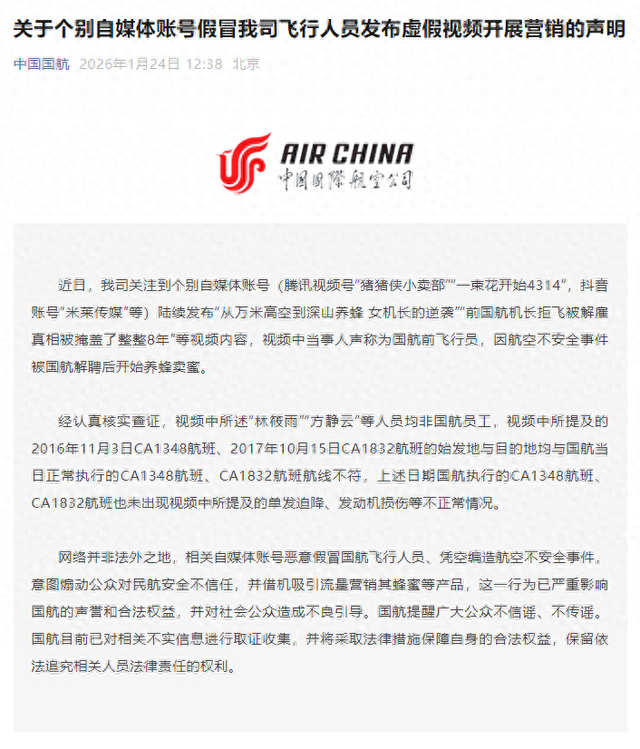
中国国航通报自媒体账号假冒前飞行员养蜂卖蜜:均非国航员工
Xin Lang Cai Jing· 2026-01-24 06:04
经认真核实查证,视频中所述"林筱雨""方静云"等人员均非国航员工,视频中所提及的2016年11月3日 CA1348航班、2017年10月15日CA1832航班的始发地与目的地均与国航当日正常执行的CA1348航班、 CA1832航班航线不符,上述日期国航执行的CA1348航班、CA1832航班也未出现视频中所提及的单发 迫降、发动机损伤等不正常情况。 网络并非法外之地,相关自媒体账号恶意假冒国航飞行人员、凭空编造航空不安全事件,意图煽动公众 对民航安全不信任,并借机吸引流量营销其蜂蜜等产品,这一行为已严重影响国航的声誉和合法权益, 并对社会公众造成不良引导。国航提醒广大公众不信谣、不传谣。国航目前已对相关不实信息进行取证 收集,并将采取法律措施保障自身的合法权益,保留依法追究相关人员法律责任的权利。 1月24日,中国国航发布关于个别自媒体账号假冒我司飞行人员发布虚假视频开展营销的声明: 近日,我司关注到个别自媒体账号(腾讯视频号"猪猪侠小卖部""一束花开始4314",抖音账号"米莱传 媒"等)陆续发布"从万米高空到深山养蜂 女机长的逆袭""前国航机长拒飞被解雇 真相被掩盖了整整8 年"等视频内容,视频中当事人 ...
巴西将对中国公民免签 相关旅游搜索量环比增5倍
Xin Jing Bao· 2026-01-24 05:56
Core Viewpoint - Brazil will implement visa exemptions for certain short-term visa categories for Chinese citizens in response to China's visa exemption policy for Brazilian citizens starting in 2025. The implementation date is yet to be announced [1]. Group 1: Impact on Tourism - The announcement has led to a significant increase in search volume for travel to Brazil from China, with cities like Rio de Janeiro, São Paulo, and Brasília seeing over a fivefold increase in search interest compared to the previous week [1]. - Rio de Janeiro's search volume increased by 27%, with Beijing, Shanghai, Guangzhou, Hangzhou, and Shenzhen being the top five departure cities [1]. Group 2: Current Visa Situation - Currently, the visa application process for traveling to Brazil is complex, requiring notarized key documents, and the rules vary slightly by consulate in China [1]. - The visa approval process takes between 10 to 20 working days, with some regions potentially requiring more time [1]. Group 3: Flight Connectivity - Direct flights between mainland China and Brazil were suspended in April 2020 and are set to resume in April 2024, with the current main route being operated by Air China from Beijing to São Paulo via Madrid [1]. - By December 2025, there will be 27 flights scheduled on this route [1].
中国国航通报网友假冒前飞行员养蜂卖蜜:均非国航员工
Bei Jing Ri Bao Ke Hu Duan· 2026-01-24 05:55
网络并非法外之地,相关自媒体账号恶意假冒国航飞行人员、凭空编造航空不安全事件,意图煽动公众 对民航安全不信任,并借机吸引流量营销其蜂蜜等产品,这一行为已严重影响国航的声誉和合法权益, 并对社会公众造成不良引导。国航提醒广大公众不信谣、不传谣。国航目前已对相关不实信息进行取证 收集,并将采取法律措施保障自身的合法权益,保留依法追究相关人员法律责任的权利。 来源:中国国航 近日,我司关注到个别自媒体账号(腾讯视频号"猪猪侠小卖部""一束花开始4314",抖音账号"米莱传 媒"等)陆续发布"从万米高空到深山养蜂 女机长的逆袭""前国航机长拒飞被解雇 真相被掩盖了整整8 年"等视频内容,视频中当事人声称为国航前飞行员,因航空不安全事件被国航解聘后开始养蜂卖蜜。 经认真核实查证,视频中所述"林筱雨""方静云"等人员均非国航员工,视频中所提及的2016年11月3日 CA1348航班、2017年10月15日CA1832航班的始发地与目的地均与国航当日正常执行的CA1348航班、 CA1832航班航线不符,上述日期国航执行的CA1348航班、CA1832航班也未出现视频中所提及的单发 迫降、发动机损伤等不正常情况。 1月24 ...
巴西将对中国公民免签,相关旅游搜索量环比增5倍
Xin Jing Bao· 2026-01-24 05:51
Core Viewpoint - Brazil will implement visa exemptions for certain short-term visa categories for Chinese citizens in response to China's visa exemption policy for Brazilian citizens starting in 2025, which is expected to significantly boost tourism from China to Brazil [1] Group 1: Visa Policy Changes - Brazilian President Lula announced the visa exemption for Chinese citizens, with the implementation date yet to be announced [1] - This policy is a reciprocal measure to China's planned visa exemption for Brazilian citizens starting in 2025 [1] Group 2: Impact on Tourism - Following the announcement, there was a surge in search volume for travel to Brazil, with cities like Rio de Janeiro, São Paulo, and Brasília seeing over a fivefold increase in search interest [1] - Specific data shows that Rio de Janeiro's search volume increased by 27%, with Beijing, Shanghai, Guangzhou, Hangzhou, and Shenzhen being the top five departure cities [1] Group 3: Current Visa Challenges - Currently, obtaining a visa to Brazil involves complex documentation, including notarization of key materials, and varies by region in China [1] - The visa approval process takes 10 to 20 working days, with some regions potentially requiring longer [1] Group 4: Flight Connectivity - Direct flights between mainland China and Brazil were suspended in April 2020 and are set to resume in April 2024, with no current direct flights available [1] - The main route is operated by Air China, flying from Beijing to São Paulo via Madrid, with 27 flights scheduled for December 2025 [1]
机票锁座将被规范
2 1 Shi Ji Jing Ji Bao Dao· 2026-01-24 03:44
Core Viewpoint - The Civil Aviation Administration of China (CAAC) is guiding the China Air Transport Association to establish a group standard for flight seat reservation rules, aiming to address consumer complaints regarding airlines' seat locking practices and to better meet diverse passenger needs [2][12]. Group 1: Seat Locking Practices - A recent survey by the Jiangsu Consumer Protection Committee revealed that the average seat locking ratio for ten major airlines in the economy class is 38.7%, with some routes exceeding 60% [5][6]. - Airlines justify seat locking as a means to reserve seats for special passengers and maintain flight load balance, but many consumers find this practice contradictory, as preferred seats are often locked while less desirable seats remain available [6][7]. - The locked seats are concentrated in desirable locations, such as front rows and exit rows, while the free seats are typically in less favorable areas [6][7]. Group 2: Revenue Generation - Airlines are increasingly relying on auxiliary revenue streams, such as seat selection fees, to offset rising operational costs and losses incurred during the pandemic [10][12]. - The global auxiliary revenue for airlines is projected to reach $148.4 billion in 2024, accounting for nearly 15% of total industry revenue, highlighting the importance of this revenue source [3][11]. - Domestic airlines in China have been slow to develop auxiliary revenue compared to international counterparts, with reported figures significantly lower than global averages [12]. Group 3: Regulatory Response - The CAAC's initiative to create standardized seat reservation rules is seen as a response to consumer complaints and aims to establish a more equitable market environment [12][13]. - Experts suggest that a reasonable proportion of free seats should be maintained to ensure fair access for all passengers, with recommendations for airlines to keep over 50% of seats available for free selection [14][15].
机票锁座将被规范
21世纪经济报道· 2026-01-24 03:30
1月23日,中航协发布公告,为进一步引导航空公司规范航班预留座位行为,更好满足旅客多 样化、差异化的座位选择需求, 在民航局的指导下, 中国航空运输协会正组织各航空公司研 究制定《公共航空运输企业航班预留座位规则》团体标准,拟对预留座位的种类、范围、比例 及旅客信息告知等关键内容进行规范。 "这就是回应了旅客的呼声"。民航业内人士林智杰向21世纪经济报道表示。近两年众多消费者 投诉航司锁座行为,江苏省消费者权益保护委员会近期发布的一份调查显示, 十家主流航司 的经济舱平均锁座比例高达38.7%,部分航线甚至超过60%。 超三成优质座位被锁定 记者丨高江虹 编辑丨高梦阳 在中航协下场前,江苏省消费者权益保护委员会近期发布的专项调查报告,指出了国内航空服 务中"锁座"现象的普遍性。 一位不愿具名的国内航司工作人员向21世纪经济报道坦言, 航司锁座的小心思是想增长辅助 收入,但付费选座被国家发改委处罚后,通过锁座曲线获得多元产品收益成了新路径。 只不 过疫情前锁座没那么高,疫情后航司连年亏损,经营压力下锁座比例才节节攀升,最终令旅客 忍无可忍。 不过,与国际通行的锁座比例相比,中国航司并不算出格,国内航司也颇为委屈 ...

航司锁座“惹众怒”,中航协要规范预留座位等行为
2 1 Shi Ji Jing Ji Bao Dao· 2026-01-24 00:48
Core Viewpoint - The Civil Aviation Administration of China (CAAC) is guiding the China Air Transport Association to establish a group standard for flight seat reservation rules, aiming to address consumer complaints regarding airlines' seat locking practices and to better meet diverse passenger needs [1][10]. Group 1: Seat Locking Practices - A recent survey by the Jiangsu Consumer Protection Committee revealed that the average seat locking ratio for ten major airlines in the economy class is 38.7%, with some routes exceeding 60% [2][3]. - Specific routes, such as Spring Airlines' "Nanjing-Lanzhou," have a seat locking ratio over 60%, while Shenzhen Airlines' "Shenzhen-Zhanjiang" exceeds 50% [3]. - Airlines justify seat locking for reasons such as reserving seats for special passengers and maintaining flight balance, but many locked seats are in preferred locations, contradicting these claims [4][5]. Group 2: Revenue Generation - Airlines are increasingly relying on auxiliary revenue, which is projected to reach $148.4 billion in 2024, accounting for nearly 15% of total industry revenue [2][7]. - Domestic airlines face challenges in diversifying revenue streams and often receive public complaints about their practices, which may change with the CAAC's new standards [2][10]. - The auxiliary revenue model in international airlines is more developed, with Delta Airlines reporting that its diversified income streams account for 60% of total revenue [6][8]. Group 3: Consumer Rights and Transparency - Consumers often need to pay or use points to unlock preferred seats, which raises concerns about transparency and the potential infringement of consumer rights [5][10]. - Airlines have been criticized for not clearly communicating seat locking rules and fees during the ticket purchasing process, leading to consumer confusion [5][10]. - Legal experts argue that airlines should include all services in the ticket price and clearly inform consumers about any additional charges related to seat selection [5][10]. Group 4: Industry Standards and Future Outlook - The CAAC's initiative to create a standard for seat reservation practices is seen as a positive step towards improving industry governance and protecting consumer interests [10][11]. - Industry experts suggest that a reasonable seat locking ratio should be established to balance market operations and public service, with recommendations for at least 50% of seats to remain available for free selection [11].
航司锁座“惹众怒” 中航协要规范预留座位等行为
2 1 Shi Ji Jing Ji Bao Dao· 2026-01-24 00:36
1月23日,中航协发布公告,为进一步引导航空公司规范航班预留座位行为,更好满足旅客多样化、差 异化的座位选择需求,在民航局的指导下,中国航空运输协会正组织各航空公司研究制定《公共航空运 输企业航班预留座位规则》团体标准,拟对预留座位的种类、范围、比例及旅客信息告知等关键内容进 行规范。 "这就是回应了旅客的呼声"。民航业内人士林智杰向21世纪经济报道表示。近两年众多消费者投诉航司 锁座行为,江苏省消费者权益保护委员会近期发布的一份调查显示,十家主流航司的经济舱平均锁座比 例高达38.7%,部分航线甚至超过60%。 一位不愿具名的国内航司工作人员向21世纪经济报道坦言,航司锁座的小心思是想增长辅助收入,但付 费选座被国家发改委处罚后,通过锁座曲线获得多元产品收益成了新路径。只不过疫情前锁座没那么 高,疫情后航司连年亏损,经营压力下锁座比例才节节攀升,最终令旅客忍无可忍。 不过,与国际通行的锁座比例相比,中国航司并不算出格,国内航司也颇为委屈,因为包括选座费在内 的辅助收入正成为全球航空业增长的引擎。 2024年,该项收入预计飙升至1484亿美元,占行业总收入 近15%。美国三大航司的辅助收入早在2022年就超过 ...