江阴银行

Search documents
银行资负跟踪20260119:降准降息还有空间
GF SECURITIES· 2026-01-19 04:26
Investment Rating - The industry investment rating is "Buy" [3] Core Viewpoints - The report indicates that there is still room for further cuts in reserve requirement ratios and interest rates, with a focus on structural monetary policy support for high-quality economic development [15][19] - The central bank has implemented a reduction of 0.25 percentage points in various structural monetary policy tool rates, signaling a supportive monetary policy stance [15][19] - The report emphasizes the importance of timing for future policy implementations, particularly in relation to government bond issuance peaks and the maturity schedule of high-interest bank deposits [15] Summary by Sections 1. Monetary Policy Adjustments - The report notes a reduction of 0.25 percentage points in structural monetary policy tool rates, with a focus on supporting key areas through increased re-lending [15] - Future attention is directed towards December economic data and January LPR [22] 2. Central Bank Dynamics and Market Rates - The central bank conducted a total of 9,515 billion yuan in 7-day reverse repos at an interest rate of 1.40%, with a net injection of 9,741 billion yuan [16] - The report highlights that the funding rates remained stable, with expectations of slight increases due to tax payments and government bond net repayments [16] 3. Bank Financing Tracking - The report indicates that the total outstanding amount of interbank certificates of deposit (CDs) is 19.09 trillion yuan, with an average issuance rate of 1.65% [20] - The report also notes that there were no commercial bank bond issuances during the period, with a total outstanding commercial bank bond size of 3.38 trillion yuan [20]




农商行板块1月16日跌0.64%,渝农商行领跌,主力资金净流出617.66万元
Zheng Xing Xing Ye Ri Bao· 2026-01-16 08:56
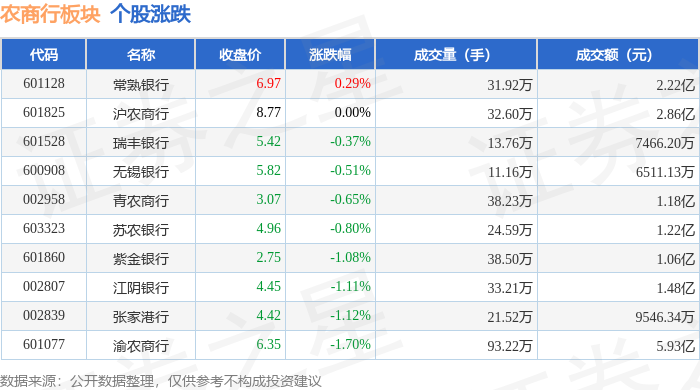
Group 1 - The agricultural commercial bank sector experienced a decline of 0.64% on January 16, with Yunnan Agricultural Commercial Bank leading the drop [1] - The Shanghai Composite Index closed at 4101.91, down 0.26%, while the Shenzhen Component Index closed at 14281.08, down 0.18% [1] - The trading volume and turnover for various agricultural commercial banks are detailed, with Changshu Bank closing at 6.97, up 0.29%, and Yunnan Agricultural Commercial Bank closing at 6.35, down 1.70% [1] Group 2 - The net outflow of main funds from the agricultural commercial bank sector was 6.1766 million yuan, while retail funds saw a net outflow of 12.6 million yuan [1] - The table shows the net inflow and outflow of funds for individual banks, with notable figures such as 14.69% net inflow for Shanghai Agricultural Commercial Bank from main funds [2] - Jiangyin Bank had a significant net outflow of 30.1445 million yuan from main funds, indicating a 20.35% decrease [2]





A股上市银行或迎最年轻董事长!青岛农商行新任掌门什么来头?
凤凰网财经· 2026-01-15 14:52
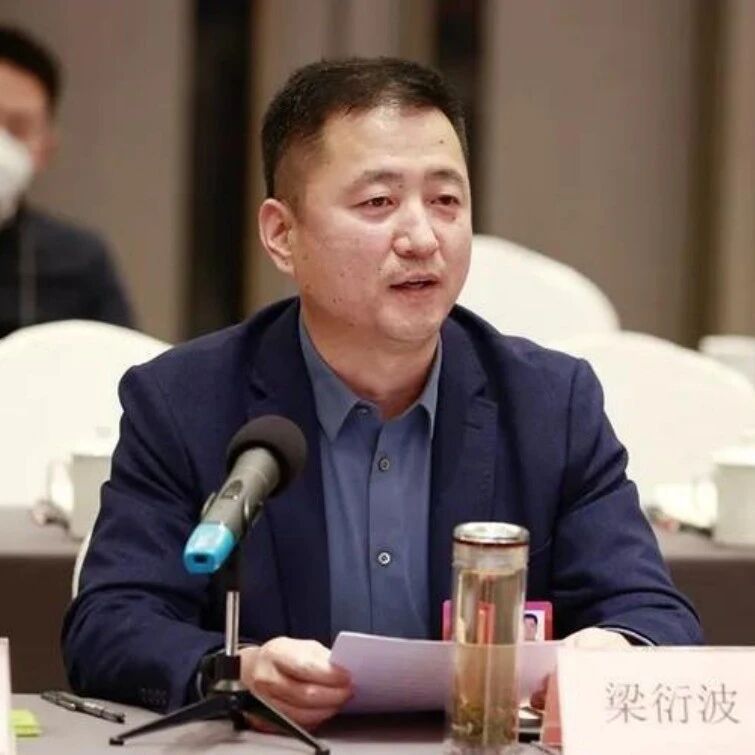
来源丨 凤凰网财经《银行财眼》 山东 省 最大的农商行 " 空降 " 一位 " 75 后"新掌门。 1 月 14 日, 青岛农商银行发布公告,提名 47 岁的梁衍波为执行董事候选人。 2025 年末 ,梁衍波已出任该行党委书记。按照 常规流程 ,在履行 完相关程序后,他 或将被董事会选举为 董事长。 这位深耕山东农信系统多年的 "老将", 还有望 成为 A 股上市银行中最年轻的董事长。 对于 梁衍波 来讲 , 即将执掌的青岛 农商行正处于一个微妙时刻:一方面是 资产规模站上 5000 亿的新纪录,另一方面则是 业绩 和资产质量双重 承压的现实挑战。 01 从"农信老兵"到"空降少帅" 凤凰网财经《银行财眼》梳理 梁衍波的履历 发现 , 他的职业生涯与农信系统捆绑颇深。 2025 年 12 月,梁衍波被任命为青岛农商行党委书记,实现了从管理省内农信机构到执掌 A 股上市银行的职场跨越。作为多家农商行"一把手",梁 衍波同样实现了机构规模上的逐级跃升,从枣庄农商行的百亿规模到济南农商行的千亿规模,再到如今青岛农商行超过 5000 的规模,同时也是山东 公开资料显示,梁衍波出生于 1978 年 8 月 , 现年 4 ...
银行治理结构20年大变革:首席合规官接棒监事会,“硬制衡”取代“软监督”
Xin Lang Cai Jing· 2026-01-15 14:14
Core Viewpoint - The governance structure of Chinese commercial banks, which has been in place for over 20 years, is undergoing significant changes as the supervisory board is being replaced by Chief Compliance Officers (CCOs) in response to regulatory requirements [3][32][57] Group 1: Regulatory Changes - The "Compliance Management Measures for Financial Institutions" was released on December 25, 2024, mandating the establishment of CCO positions at financial institutions [4][32] - By March 1, 2025, all financial institutions must complete the appointment of CCOs and related compliance structures, marking the end of the supervisory board's role [4][32] - As of early 2026, at least 56 financial institutions have had their CCO qualifications approved by regulators, with over 20 banks and branches already in compliance [3][6][35] Group 2: Transition from Supervisory Board to CCO - The supervisory board, which has been in place for over 20 years, is officially being phased out, leaving only the board of shareholders and the board of directors [3][32] - The transition signifies a shift from "soft supervision" to "hard checks and balances" within the governance framework of Chinese commercial banks [3][32][57] - The responsibilities of the supervisory board will now be taken over by the CCO, who will have enhanced authority and independence [4][32] Group 3: CCO Responsibilities and Powers - CCOs are tasked with compliance risk monitoring, internal audits, and ensuring compliance with new products and business strategies [4][32] - The CCOs will have significant independence, with the authority to access all internal documents and data necessary for compliance assessments [21][25] - CCOs will also have the power to halt operations on projects that pose compliance risks and will be involved in the performance evaluations of business line leaders [23][25] Group 4: Historical Context and Need for Change - The effectiveness of the supervisory board has been questioned, as it has not met the expectations of policymakers regarding compliance oversight [8][39] - Regulatory scrutiny has intensified since 2018, with a shift in focus from growth to compliance, leading to increased penalties for violations [10][39] - The transition to CCOs is seen as a necessary evolution to address the shortcomings of the previous governance structure [8][39][48]

农商行板块1月15日跌0.94%,沪农商行领跌,主力资金净流出4296.1万元
Zheng Xing Xing Ye Ri Bao· 2026-01-15 08:59
Group 1 - The agricultural commercial bank sector experienced a decline of 0.94% on January 15, with Hu Nong Commercial Bank leading the drop [1] - The Shanghai Composite Index closed at 4112.6, down 0.33%, while the Shenzhen Component Index closed at 14306.73, up 0.41% [1] - The trading volume and turnover for various agricultural commercial banks are detailed in a table, showing mixed performance among individual stocks [1] Group 2 - The net outflow of main funds from the agricultural commercial bank sector was 42.961 million yuan, while retail funds saw a net outflow of 56.997 million yuan [1] - The table of fund flows indicates that some banks, like Changshu Bank and Zhangjiagang Bank, had positive net inflows from retail and speculative funds, while others like Yunnan Agricultural Bank and Jiangyin Bank faced significant outflows [2] - Specific data shows that Changshu Bank had a main fund net inflow of 8.1314 million yuan, while Yunnan Agricultural Bank had a net outflow of 25.5857 million yuan [2]


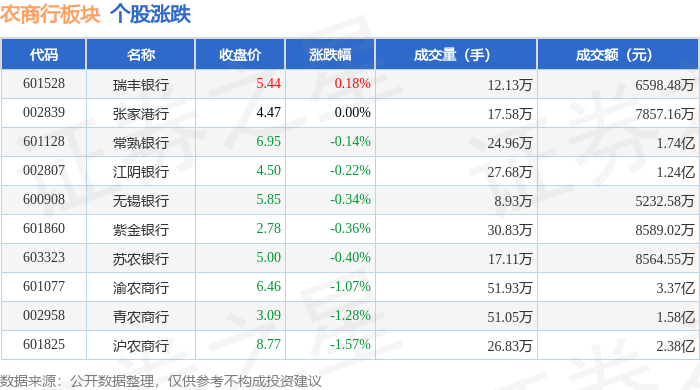
农商行板块1月14日跌1.28%,瑞丰银行领跌,主力资金净流入1.14亿元
Zheng Xing Xing Ye Ri Bao· 2026-01-14 08:58
Core Viewpoint - The rural commercial bank sector experienced a decline of 1.28% on January 14, with Ruifeng Bank leading the drop, while the Shanghai Composite Index fell by 0.31% and the Shenzhen Component Index rose by 0.56% [1] Group 1: Market Performance - The closing price of Qingnong Commercial Bank was 3.13, unchanged from the previous day, with a trading volume of 645,900 shares and a transaction value of 202 million yuan [1] - Zijin Bank closed at 2.79, down 0.71%, with a trading volume of 498,600 shares and a transaction value of 140 million yuan [1] - Changshu Bank's closing price was 6.96, also down 0.71%, with a trading volume of 569,400 shares and a transaction value of 398 million yuan [1] - Wuxi Bank closed at 5.87, down 0.84%, with a trading volume of 183,700 shares and a transaction value of 108 million yuan [1] - The overall rural commercial bank sector saw a net inflow of 114 million yuan from main funds, while retail investors experienced a net outflow of 1.41 billion yuan [1] Group 2: Fund Flow Analysis - Changshu Bank had a main fund net inflow of 22.95 million yuan, accounting for 5.77% of its total, while retail investors had a net outflow of 5.30 million yuan [2] - Yunnan Agricultural Commercial Bank saw a main fund net inflow of 20.12 million yuan, representing 4.30%, but a retail net outflow of 34.64 million yuan [2] - Zhangjiagang Bank recorded a main fund net inflow of 15.78 million yuan, with a retail net outflow of 29.95 million yuan [2] - Wuxi Bank had a main fund net inflow of 12.01 million yuan, which is 11.10% of its total, while retail investors faced a net outflow of 9.00 million yuan [2] - Ruifeng Bank experienced a main fund net inflow of 3.60 million yuan, with a retail net outflow of 9.82 million yuan [2]


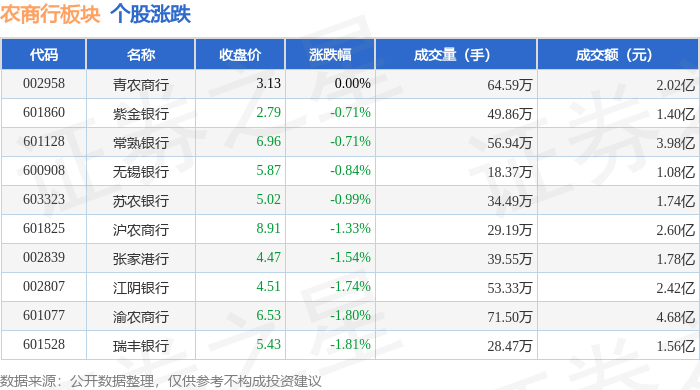
农商行板块1月13日涨0.62%,渝农商行领涨,主力资金净流入5648.9万元
Zheng Xing Xing Ye Ri Bao· 2026-01-13 09:06
Core Viewpoint - The agricultural commercial bank sector experienced a rise of 0.62% on January 13, with Chongqing Rural Commercial Bank leading the gains, while the Shanghai Composite Index fell by 0.64% and the Shenzhen Component Index dropped by 1.37% [1] Group 1: Market Performance - Chongqing Rural Commercial Bank (601077) closed at 6.65, up by 2.15% with a trading volume of 813,100 shares and a transaction value of 540 million yuan [1] - Other notable banks included Zijin Bank (601860) with a closing price of 2.81, up by 0.72%, and Qingnong Bank (002958) at 3.13, up by 0.64% [1] - The overall trading volume for the agricultural commercial bank sector was significant, with total net inflow of main funds amounting to 56.49 million yuan [1] Group 2: Fund Flow Analysis - Main funds saw a net inflow of 17.50 million yuan into Chongqing Rural Commercial Bank, while retail investors experienced a net outflow of 47.08 million yuan [2] - Jiangyin Bank (002807) had a net inflow of 13.55 million yuan from main funds, but retail investors withdrew 8.41 million yuan [2] - The fund flow data indicates a mixed sentiment among retail and institutional investors, with main funds generally showing positive interest in several banks while retail investors were more cautious [2]
江阴银行:截至2026年1月9日股东户数为47460户
Zheng Quan Ri Bao· 2026-01-12 12:51
Group 1 - The core point of the article is that Jiangyin Bank reported a total of 47,460 shareholders as of January 9, 2026 [2]

农商行板块1月12日跌0.14%,渝农商行领跌,主力资金净流出5928.29万元
Zheng Xing Xing Ye Ri Bao· 2026-01-12 09:04
Market Overview - The agricultural commercial bank sector experienced a decline of 0.14% on January 12, with Yunnan Agricultural Commercial Bank leading the drop [1] - The Shanghai Composite Index closed at 4165.29, up 1.09%, while the Shenzhen Component Index closed at 14366.91, up 1.75% [1] Individual Bank Performance - Zijin Bank closed at 2.79, with an increase of 0.72% and a trading volume of 386,600 shares, totaling a transaction value of 107 million yuan [1] - Su Nong Bank closed at 5.06, up 0.40%, with a trading volume of 204,900 shares, totaling 104 million yuan [1] - Ruifeng Bank closed at 5.51, up 0.36%, with a trading volume of 181,100 shares, totaling approximately 99.28 million yuan [1] - Qing Nong Bank closed at 3.11, up 0.32%, with a trading volume of 422,100 shares, totaling 131 million yuan [1] - Yunnan Agricultural Commercial Bank closed at 6.51, down 0.91%, with a trading volume of 690,100 shares [1] Capital Flow Analysis - The agricultural commercial bank sector saw a net outflow of 59.28 million yuan from institutional investors, while retail investors contributed a net inflow of 49.11 million yuan [1] - The table of capital flow indicates that Changshu Bank had a net inflow of 7.30 million yuan from institutional investors, while it faced a net outflow of 22.43 million yuan from speculative funds [2] - Yunnan Agricultural Commercial Bank experienced a net outflow of 21.20 million yuan from institutional investors, but a net inflow of 42.56 million yuan from speculative funds [2]

过渡期收官在即,银行业首席合规官密集就位
Mei Ri Jing Ji Xin Wen· 2026-01-11 12:29
Core Insights - The banking industry is undergoing a restructuring wave in risk and compliance systems due to tightening regulatory rules and a complex risk environment [1][2] - A surge in appointments for Chief Risk Officers (CROs) and Chief Compliance Officers (CCOs) is expected by the end of 2025 and early 2026, with over 20 banks and branches already approved for relevant positions since the beginning of 2025 [1][2] Regulatory Changes - The "Measures for Compliance Management of Financial Institutions" requires financial institutions to establish a CCO at their headquarters, who will be classified as a senior management position [2] - The transitional period for compliance with this regulation is set to expire one year after its implementation on March 1, 2025 [2] Appointment Trends - A variety of banks, including Ping An Bank, Industrial Bank, and Minsheng Bank, have announced the appointment of CCOs as the transitional deadline approaches [2] - The trend shows a mix of large, medium, and small institutions moving forward with these appointments [2] Governance Models - Two governance models are emerging: "one person holding multiple roles" and "independent separation" for CCOs and CROs [3] - The "one person holding multiple roles" model is prevalent among smaller banks, allowing for unified decision-making in risk and compliance management [3] - The "independent separation" model is more common in larger banks, emphasizing specialized development and independent oversight in risk management [3][4] Talent Acquisition Challenges - The establishment of CCO and CRO positions presents new challenges for talent acquisition, with a preference for candidates possessing a combination of frontline business experience, cross-regional vision, and professional qualifications [6] - Some banks are adopting market-based recruitment strategies for CCOs, breaking traditional selection models [6] Compensation Trends - The compensation for CCOs is rising, with annual total income expected to be no less than the average for senior management positions [6] - Reports indicate that the reference monthly salary for these positions can reach between 100,000 to 130,000 yuan [6] Compliance Management Evolution - Effective compliance management is evolving from a "cost center" to a "value guardian," playing a crucial role in mitigating credit, market, and liquidity risks [7] - The compliance governance system is expected to become more institutionalized and refined, with clearer responsibilities and a growing demand for composite compliance talent [7][8] Core Competencies for CCOs - The core competencies for CCOs are identified as business insight, regulatory interpretation, execution capability, and cross-departmental collaboration [8] - These competencies are essential for CCOs to effectively support governance and create compliance value [8]