Constellation Energy

Search documents
全线大涨!美国突传大消息!
天天基金网· 2025-10-29 01:13
Core Viewpoint - The article discusses significant developments in the nuclear power sector in the United States, driven by the increasing electricity demand from artificial intelligence (AI) and the strategic partnerships formed between the government and private companies to enhance nuclear energy production [3][5][10]. Group 1: Government Actions and Agreements - The U.S. government has signed an $80 billion agreement with Westinghouse Electric Company to build nuclear reactors to meet the growing electricity demand from AI [5][10]. - This partnership involves Brookfield Asset Management and Canadian uranium producer Cameco Corp, which recently acquired Westinghouse for approximately $7.9 billion [5][6]. - The plan aims to solidify the U.S. position as a nuclear power leader and increase the global export of Westinghouse nuclear technology [7][8]. Group 2: Job Creation and Economic Impact - Each AP1000 nuclear power plant with two units is expected to create or maintain 45,000 manufacturing and engineering jobs across 43 states, with over 100,000 construction jobs nationwide [6][8]. - The initiative is part of a broader strategy to revitalize the nuclear energy sector, which includes regulatory reforms and increased investment in nuclear technology [8]. Group 3: Corporate Involvement and Projects - Major tech companies like Google and Microsoft are entering agreements to restart closed nuclear power plants to meet their energy needs for AI data centers [10][11]. - Google has signed a 25-year power purchase agreement with NextEra to restart the Duane Arnold Energy Center in Iowa, with a projected cost exceeding $1.6 billion and expected to begin operations in 2029 [10][11]. - Microsoft has also reached a similar agreement to restart the Three Mile Island nuclear plant in Pennsylvania, highlighting a trend of tech companies opting to revive existing facilities rather than building new ones [11]. Group 4: Safety Concerns and Criticism - Critics caution that efforts to restart decommissioned nuclear plants must adhere to strict regulatory standards, emphasizing the need for careful consideration of safety, especially for aging reactors [12]. - Concerns have been raised regarding the Duane Arnold plant, which suffered significant damage during a storm and shares design similarities with the Fukushima reactor that experienced a meltdown in 2011 [12].


深夜全线大涨,美国突传大消息
Zheng Quan Shi Bao· 2025-10-28 23:58
Core Viewpoint - The U.S. government has signed an $80 billion agreement with Westinghouse to build nuclear reactors to meet the growing electricity demand driven by artificial intelligence, leading to a surge in nuclear power stocks [1][3][4]. Group 1: U.S. Nuclear Power Developments - The U.S. government has partnered with Westinghouse, Cameco Corp, and Brookfield Asset Management to accelerate nuclear power deployment, with plans to construct reactors worth at least $80 billion [3][4]. - Each AP1000 nuclear power plant, equipped with two units, is expected to create or maintain 45,000 manufacturing and engineering jobs across 43 states, with over 100,000 construction jobs nationwide [3][4]. - The initiative aims to solidify the U.S. position as a nuclear power leader and enhance the global export of Westinghouse nuclear technology [4]. Group 2: Technology Companies' Involvement - Google has reached an agreement with NextEra to restart the Duane Arnold Energy Center in Iowa, which has been closed for five years, to address the electricity demand from AI [7][8]. - The Duane Arnold plant, with a capacity of 615 megawatts, is expected to have a restart cost exceeding $1.6 billion and is planned to begin supplying power in 2029 [7][8]. - Microsoft has also partnered with Constellation Energy to restart the Three Mile Island nuclear plant in Pennsylvania, indicating a trend among tech companies to collaborate with nuclear firms to revive old reactors rather than waiting for new technologies [7][8]. Group 3: Regulatory and Safety Considerations - The Trump administration is expected to assist Westinghouse in obtaining land and permits for reactor construction, potentially providing loan guarantees [4][5]. - Concerns have been raised regarding the safety of restarting older reactors, particularly the Duane Arnold plant, which suffered significant damage from a storm in 2020 [9]. - Analysts suggest that reviving idle nuclear plants is more cost-effective and quicker than building new facilities from scratch, although critics emphasize the need for strict regulatory compliance [8][9].
深夜,全线大涨!美国,突传大消息!
Zheng Quan Shi Bao Wang· 2025-10-28 23:48
Core Insights - The U.S. government has signed an $80 billion agreement with Westinghouse to build nuclear reactors to meet the increasing electricity demand driven by artificial intelligence [1][2] - Major U.S. tech companies, including Google and Microsoft, are collaborating with energy firms to restart closed nuclear power plants to address the surge in electricity needs [5][6] Group 1: U.S. Nuclear Power Developments - The agreement with Westinghouse involves partnerships with Brookfield Asset Management and Cameco Corp, aiming to accelerate nuclear power deployment across the U.S. [2][3] - Each AP1000 nuclear power plant, equipped with two units, is expected to create or maintain 45,000 manufacturing and engineering jobs across 43 states, with over 100,000 construction jobs nationwide [2][4] Group 2: Tech Companies' Involvement - Google has partnered with NextEra to restart the Duane Arnold Energy Center in Iowa, which has been closed for five years, under a 25-year power purchase agreement [5][6] - Microsoft has also reached a similar agreement with Constellation Energy to restart the Three Mile Island nuclear plant in Pennsylvania [5][6] Group 3: Economic and Employment Impact - The restart of idle nuclear plants is viewed as more cost-effective and quicker than building new facilities from scratch, which is why tech companies are opting for this approach [6] - The Duane Arnold plant's restart is projected to cost over $1.6 billion and is expected to begin supplying power in 2029 [5][6]
深夜,全线大涨!美国,突传大消息!
券商中国· 2025-10-28 23:33
Core Viewpoint - The article highlights significant developments in the U.S. nuclear power sector, driven by the increasing electricity demand from artificial intelligence (AI) and the strategic partnerships formed between the government and private companies to enhance nuclear energy production [1][2]. Group 1: U.S. Government Actions - The U.S. government signed an $80 billion agreement with Westinghouse Electric Company to construct nuclear reactors to meet the growing electricity demand from AI [1][2]. - This partnership involves Brookfield Asset Management and Canadian uranium producer Cameco Corp, aiming to accelerate nuclear power deployment across the U.S. [2]. - The initiative is expected to create or maintain 45,000 manufacturing and engineering jobs across 43 states, with over 100,000 construction jobs nationwide [2]. Group 2: Nuclear Stock Market Reaction - Following the announcement, U.S. nuclear stocks surged, with Cameco Corp experiencing a peak increase of over 27% during trading [2]. - Other companies like Energy Fuels and Uranium Energy also saw significant gains, reflecting investor optimism regarding the nuclear sector's future [2]. Group 3: Technology Companies' Involvement - Major tech companies are also taking steps to address the clean energy needs for AI data centers, with Google partnering with NextEra to restart the Duane Arnold Energy Center in Iowa, which has been closed for five years [6]. - Google signed a 25-year power purchase agreement for the 615 MW nuclear plant, with a restart cost exceeding $1.6 billion, expected to begin operations in 2029 [6]. - Microsoft has similarly partnered with Constellation Energy to restart the Three Mile Island nuclear plant in Pennsylvania, indicating a trend among tech firms to revitalize older nuclear facilities rather than building new ones [7]. Group 4: Regulatory and Strategic Implications - The plan aims to solidify the U.S. position as a nuclear power leader and enhance the global export of Westinghouse nuclear technology [3]. - The Trump administration is expected to assist Westinghouse in obtaining land and permits for reactor construction, potentially providing loan guarantees [3]. - Previous executive orders signed by Trump aimed to expedite reactor testing and reform the Nuclear Regulatory Commission (NRC) to increase nuclear power output significantly over the next 25 years [4].

Lightning Round: Don't buy these uranium companies, says Jim Cramer
CNBC Television· 2025-10-23 00:01
It is time for the light of the course and then the lightning round is over. Are you ready. Keep that right start with Venat in Arkansas.Venat. >> Hey Jim, first time caller and new club member. I want to begin by saying thank you for all that you do for the retail investor.>> Uh thank you partner. That's what I want. That's who I'm out here working for and now we're going to work together.What do we have. >> Yeah. I'm calling about a stock that's been a real loser in my portfolio.Uh I wanted to get your op ...

A Once-in-a-Decade Investment Opportunity: 1 Vanguard Index Fund to Buy for the AI Boom
The Motley Fool· 2025-10-17 07:45
Core Insights - U.S. electricity demand is projected to increase significantly, driven by artificial intelligence and other trends, marking the fastest growth since the 1990s [2][6] - The utilities sector has outperformed the S&P 500 year to date, with a 23% increase, suggesting a potential investment opportunity [3][4] Electricity Demand Trends - Goldman Sachs estimates a 2.4% annual increase in U.S. electricity consumption through 2030, influenced by electrification, industrial reshoring, and AI [2][6] - The utilities sector's performance is expected to continue improving as electricity demand rises [3] Vanguard Utilities ETF - The Vanguard Utilities ETF tracks 69 U.S. utility companies, primarily electric utilities, and has an expense ratio of 0.09% [4][5] - The ETF has achieved a total return of 186% over the last decade, averaging 11% annually, compared to the S&P 500's 300% return [8] Major Utility Companies - Key holdings in the Vanguard Utilities ETF include NextEra Energy (10.3%), Constellation Energy (6.8%), and Southern Company (6.6%), with Constellation Energy showing an 81% stock increase year to date [7] - The majority of the top 10 holdings have outperformed the S&P 500 this year, indicating strong market performance [4][7] Investment Strategy - The Vanguard Utilities ETF is recommended to be held alongside AI stocks and S&P 500 index funds for diversified exposure [8][9] - The S&P 500 has a significant number of companies mentioning AI in earnings calls, highlighting its relevance in the current market [10]
Is NextEra Energy Overvalued After Its 18% 1-Month Surge?
Yahoo Finance· 2025-10-15 10:05
Core Insights - NextEra Energy has experienced an 18% gain over the past month, outperforming the S&P 500's 1% increase and the Utilities Select Sector SPDR Fund's 8% rise, marking its best one-month performance since June 2024 [1][6] - NextEra Energy is the largest utility company by market capitalization, valued at $172 billion, which is nearly 50% larger than its closest competitor, Constellation Energy, valued at approximately $115 billion [2] - Despite recent gains, NextEra has lagged behind the utility sector and broader market over various time frames, ranking 18th out of 31 utility sector members with a 19% year-to-date gain and 25th out of 31 with a 24% return over the past five years [3] Financial Performance - NextEra's five-year return has been largely driven by dividends, which have increased annually since 2006, resulting in a current dividend yield of 2.7%, slightly above the utility sector's average yield of 2.5% [4] - The company's forward price-to-earnings ratio stands at 23.5, the sixth-highest among 31 utility stocks, while its price-to-sales ratio of 9.1 makes it the most expensive in that regard [5] Market Position - Following a period of underperformance, NextEra's recent rally has attracted investor interest, particularly from those seeking growth and income, although it is not the cheapest utility stock available [6]

新能源及工业周报:铀期货价格触及今年高点,IEA将2030年美国可再生能源容量增长的预期下调50%-20251013
Haitong Securities International· 2025-10-13 00:02
Investment Rating - The report suggests a focus on the nuclear power sector as a significant energy type for AI consumption, highlighting investment opportunities in companies like Entergy, Talen Energy, and Constellation Energy [5] Core Insights - The report indicates that the global infrastructure and construction equipment sector is seeing strong demand for data centers, with AMD supplying chips to OpenAI for AI infrastructure [1] - The International Energy Agency (IEA) has revised down its 2030 renewable energy capacity growth forecast for the US by 50% compared to last year's estimates, while globally, renewable energy generation capacity is expected to double by 2030 [1] - The report emphasizes the ongoing energy transition, with a balanced supply-demand scenario in the natural gas market, suggesting investment in companies like WMB and KMI [5] Summary by Sections Global Infrastructure and Construction Equipment - The vacancy rate for data centers in major North American markets has reached a historic low of 1.6%, indicating strong demand [8] - The average price for cabinets in data centers has increased by 2.5% for 250 to 500 kW cabinets and by 19% for those over 10 MW due to high demand and limited power supply [8] Global Electrical and Intelligent Equipment - The gas turbine price index increased by 3.43% year-on-year as of August 2025, while the electrical and special transformer production price index remained stable [17][31] - The report notes a significant increase in transformer exports from China, with a year-on-year growth of 18% in August 2025 [40] Global Energy Industry - The average spot price for electricity in major US regions decreased by 19.57% week-on-week, while natural gas futures prices rose by 3.7% [3] - The report highlights that the US electricity demand growth forecast has been revised upward, with an expected increase of 15.8% by 2029 [24] Global New Materials - The global spot price for uranium reached $82.63 per pound in September 2025, reflecting a 10% increase month-on-month [4] - The report tracks the dynamics of heavy rare earths, with prices for dysprosium and terbium remaining stable [4] Key Company Updates - GE Vernova has launched a new platform for utilities to monitor and control their infrastructure, supported by Verizon [45] - Hitachi has announced a strategic partnership with OpenAI to supply power distribution equipment for AI applications [45] - ABB has signed an agreement to provide automation solutions for the production and storage of green ammonia [45]
Tariff pricing will be interesting to hear in earnings reports, says FL Putnam's Ellen Hazen
CNBC Television· 2025-10-09 19:13
Ellen Hazen has some big ideas for you into all of it. She is chief market strategist and portfolio manager at FL Putnham Investment Management down from Boston and joins us now. Ellen, good to have you on set again.Thanks for having me. Yeah. Why, before we get to some individual things that you like, why do you think the market is not responding more to day nine of a partial government shutdown.I think there have been a lot of shutdowns over the years. We've had 20 shutdowns since 1970. Most of them were ...

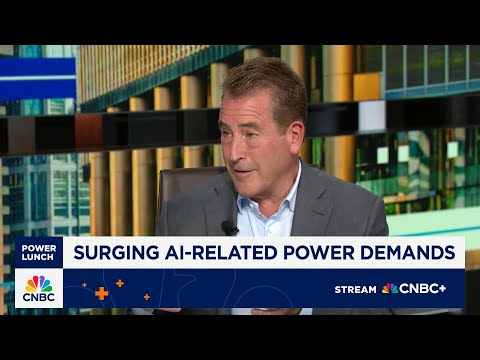
New megawatts will have to supply AI not current excesses, says Energy Capital's Doug Kimmelman
CNBC Television· 2025-10-09 19:11
Market Dynamics & Growth Drivers - Power has become a hot commodity due to its critical role in AI and overall economic function [2] - Increased demand for electricity is driven by AI, LNG exports, cryptocurrency mining, and onshoring of manufacturing [13] - Open AI's potential deals represent massive electricity needs, equivalent to millions of homes [9][10] Electricity Prices & Costs - In New Jersey, power generation accounts for roughly 30% of electricity bills, with transmission and distribution comprising 50% [5] - Transmission costs have increased significantly, with a 300% increase over the last 15 years due to infrastructure upgrades [6][7] - Power generation prices have decreased by 40-50% over the last 15 years, but overall electricity costs are expected to rise faster than inflation [4][8] Power Generation & Capacity - The US has approximately 1200 gigawatts (12 million megawatts) of power generation capacity [11] - Data centers currently consume about 2% (25 gigawatts) of US power generation, with potential to increase to 10% (additional 100 gigawatts) [11] - Nuclear and coal power generation has decreased from 70% to 40% and could potentially lose 150 gigawatts [12] Infrastructure & Reliability - Renewables are often located in remote areas, requiring thousands of miles of expensive transmission lines [8] - Aging power lines (60-75 years old) are prone to failure and pose a reliability risk [7] - Public Service Electric & Gas has invested and plans to invest billions in transmission and distribution upgrades (20-30 billion already, another 30 billion planned) [6]