Grab

Search documents
法拉第未来新车型将接入特斯拉超充网络;零跑D19前备厢规格曝光:内置220V电源、排水通道丨汽车交通日报
创业邦· 2025-11-13 10:12
Group 1 - Faraday Future announced that its future models, starting from 2026, will be equipped with NACS (North American Charging Standard) interface, allowing access to Tesla's Supercharger network, which includes over 28,000 stations across the US, Canada, Japan, and South Korea [2] - WeRide and Grab received approval from Singapore's Land Transport Authority to conduct autonomous driving tests in the Punggol area, with the Ai.R service expected to begin public operations in early 2026 [2] - Leap Motor revealed specifications for the D19's front trunk, which includes a 220V power supply and a drainage channel, enhancing storage space and user convenience [2] Group 2 - Toyota is recalling over 126,000 vehicles in the US due to potential engine shutdowns and power loss issues in certain models equipped with the V35A engine [4]


软银要参与罢免GoTo的CEO,为和Grab合并铺路?
Sou Hu Cai Jing· 2025-11-12 07:49
Core Insights - The merger negotiations between Grab and GoTo have resurfaced, with significant involvement from major shareholders like SoftBank pushing for changes in GoTo's leadership [1][3][5] - GoTo's CEO Patrick Walujo is facing potential removal due to perceived opposition to the merger, amidst a backdrop of declining company valuation [3][5][7] - The Indonesian government is actively participating in the merger discussions, which may influence the approval process and public sentiment regarding the acquisition [8][9] Company Developments - SoftBank, Provident Capital Partners, and Peak XV are advocating for a special shareholders' meeting to vote on Walujo's removal, citing a 40% drop in GoTo's market value since his appointment [3][5] - GoTo's stock has plummeted over 80% since its IPO, raising concerns about its future and the potential benefits of a merger with Grab [5][7] - The merger could enhance operational efficiency and investor returns, given the overlapping business models of Grab and GoTo [7] Government Involvement - The Indonesian government, through its sovereign wealth fund Danantara, is now involved in the merger discussions, which may facilitate smoother regulatory approval [8][9] - The local sentiment towards the acquisition is sensitive, as GoTo is viewed as a "national tech champion," raising concerns about foreign control [9] Market Position - If Grab successfully acquires GoTo, it would solidify its dominance in Southeast Asia's ride-hailing and food delivery markets [10] - Grab's current market capitalization is approximately $24 billion, while GoTo's is around $4.6 billion, with Grab previously proposing a $7 billion valuation for the acquisition [11] - The merger could reduce competition and alleviate subsidy burdens, allowing Grab to focus on new business developments [11]


远程驾驶初创公司Vay获Grab战略投资,总额有望达4.1亿美元
机器人圈· 2025-11-11 09:57
Core Viewpoint - The autonomous driving industry is gaining momentum, providing more financing opportunities for startups, exemplified by Vay's upcoming investment from Grab of up to $60 million [1][4]. Group 1: Investment and Business Expansion - Vay, a Berlin-based startup focused on remote-controlled car rentals, is set to receive an investment from Grab, pending regulatory approval, expected to be completed by the end of the year [1]. - Following the initial investment, Grab may invest an additional $350 million based on agreed mileage targets within a year [1][4]. - Vay plans to leverage Grab's investment to expand its operations in the U.S. market, having already launched services in Las Vegas in January 2024 [1][4]. Group 2: Market Competition and Strategy - The remote driving sector in the U.S. is becoming increasingly competitive, with companies like Waymo announcing new autonomous taxi services in multiple cities [4]. - Grab's investment in Vay is part of its strategic initiative to support the development of remote driving technology, despite Grab not having a direct presence in the U.S. market [4]. - Vay positions its remote driving rental service as a complement to autonomous taxi services, targeting consumers who prefer not to own a car [4]. Group 3: Cost Efficiency and User Experience - Vay's service allows users to utilize vehicles without ownership, requiring only a driver's license, and alleviating parking concerns [4]. - The operational model and lightweight hardware system enable Vay to offer services at approximately half the cost of traditional ride-hailing services [4]. Group 4: Future Vision and Collaborations - Vay aims to create a "global remote driving platform," expanding beyond electric vehicle rentals into commercial and enterprise services [6]. - The company has partnered with Kodiak Robotics for autonomous truck services and has previously raised $131.8 million from various investors [6]. - Grab's collaboration with Vay is also focused on data accumulation and AI training, which could accelerate advancements in autonomous driving technology [5].

X @Bloomberg
Bloomberg· 2025-11-11 03:29
EXCLUSIVE: SoftBank has joined a push to oust GoTo's CEO, paving the way for a potential acquisition by Grab https://t.co/EL6Oa2gLhF ...
X @Bloomberg
Bloomberg· 2025-11-11 03:26
SoftBank has joined a push to oust GoTo's CEO, paving the way for a potential acquisition by Grab https://t.co/360qdXsrEr ...
远程驾驶初创公司Vay获Grab战略投资,总额有望达4.1亿美元
Huan Qiu Wang Zi Xun· 2025-11-11 03:05
Core Insights - The autonomous driving industry is gaining momentum, providing more financing opportunities for startups, exemplified by Vay's announcement of a $60 million investment from Grab [1][3] - Vay, a Berlin-based startup, specializes in remotely controlled rental cars and plans to launch operations in Las Vegas in January 2024, despite not yet operating in Germany due to regulatory uncertainties [3][4] - The investment from Grab is part of a strategic move to support remote driving technology, with potential for an additional $350 million investment based on performance metrics in the U.S. market [1][3] Company Overview - Vay operates a hybrid model combining technology and human operation to remotely control rental vehicles, allowing users to drive without owning a car while eliminating parking concerns [4] - The service costs approximately half that of traditional ride-hailing services due to Vay's lightweight hardware system and operational model [4] - Vay aims to create a global remote driving platform and has expanded into commercial services, partnering with Kodiak Robotics for autonomous trucking [4][5] Market Context - The U.S. remote driving sector is becoming increasingly competitive, with companies like Waymo launching autonomous taxi services in multiple cities [3] - Grab, while publicly listed on NASDAQ, has not directly entered the U.S. market, and its investment in Vay is seen as a strategic initiative to enhance its capabilities in remote driving technology [3][5] - Grab has also invested in several autonomous driving startups, indicating a growing interest in the sector, as highlighted by NVIDIA's recent $500 million investment in the UK startup Wayve [5]
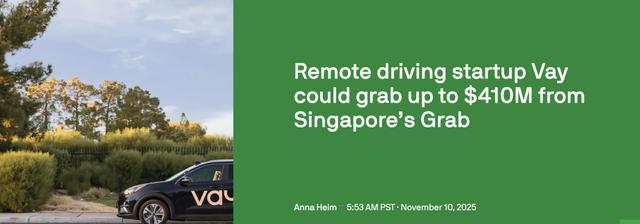
Remote driving startup Vay could grab up to $410M from Singapore’s Grab
Yahoo Finance· 2025-11-10 13:53
Core Insights - The investment landscape for autonomous vehicles is becoming more favorable for smaller companies, exemplified by Vay's $60 million investment from Grab, with potential for an additional $350 million based on performance milestones [1][2][3] Company Overview - Vay is a Berlin-based startup that utilizes technology and human operators to remotely drive rental cars, currently operational in Las Vegas and planning to expand in the U.S. [2][3] - Grab, a Singaporean tech company, is investing in Vay to support its growth, despite not operating in the U.S. market [4] Investment Details - The initial investment from Grab is $60 million, with the possibility of an additional $350 million contingent on Vay achieving specific milestones in the U.S. [1][3] - Milestones include the number of U.S. cities covered, regulatory approvals, and overall consumer revenue [3] Market Context - The U.S. market is experiencing increased competition in remote driving services, with companies like Waymo expanding their robotaxi services [3] - Vay's service is positioned as a cost-effective alternative to ride-hailing, costing about half the price due to its hybrid approach [5] Strategic Synergies - Both companies are exploring synergies, particularly in Southeast Asia, where Grab's super-app offers a wide range of services [6] - Grab has also invested in other autonomous driving tech startups, indicating a broader strategy to enhance its mobility offerings [7]
Grab:6000万美元投资Vay,或增至4.1亿美元
Sou Hu Cai Jing· 2025-11-10 13:17
Group 1 - Grab is investing $60 million in remote driving service company Vay to enhance its presence in the autonomous vehicle technology sector [1] - The investment could increase to $410 million within a year if Vay meets certain milestones, pending regulatory approval, with the transaction expected to be completed in Q4 [1] - Vay's service model operates between traditional taxis and fully autonomous vehicles, where a remote operator controls the vehicle until it reaches the customer, who then takes over driving [1] Group 2 - Grab is not the only ride-hailing platform preparing for the future of autonomous driving, as its U.S. counterparts Uber and Lyft are also collaborating with technology suppliers and fleet operators for global deployment [1]

X @Bloomberg
Bloomberg· 2025-11-10 11:52
Investment & Technology - Grab, Southeast Asia's largest ride-hailing provider, is investing $60 million in remote-driving service Vay [1] - The investment aims to enhance Grab's capabilities in technologies for driverless vehicles [1]
50元的外卖服,被户外中产抢疯了
创业邦· 2025-11-10 10:34
Core Viewpoint - The article discusses the trend of outdoor enthusiasts, particularly the middle class, opting for affordable alternatives to high-end outdoor gear, specifically using delivery rider uniforms as a practical and cost-effective solution for outdoor activities [5][18][39]. Group 1: Shift in Outdoor Gear Preferences - The middle class has shifted from expensive outdoor gear to cheaper alternatives, such as delivery rider uniforms, which can be purchased for as low as 50 to 300 yuan [7][18]. - The trend began in international ski resorts where delivery riders were seen wearing these uniforms, leading to their adoption by outdoor enthusiasts [7][10]. - The delivery uniforms are praised for their practicality, warmth, and durability, making them suitable for various outdoor conditions [19][22]. Group 2: Perception and Acceptance - Wearing delivery uniforms has become socially acceptable in outdoor settings, with many outdoor enthusiasts embracing the look for its functionality rather than its fashion [22][32]. - The bright colors of the uniforms, originally seen as a drawback, are now viewed as beneficial for visibility and safety in outdoor environments [24][32]. - The article highlights that these uniforms have gained a reputation for being reliable and professional-grade gear among outdoor enthusiasts [19][31]. Group 3: Economic Considerations - The rising costs of traditional outdoor gear have made it difficult for many to participate in outdoor activities, leading to a search for more affordable options [39]. - The article notes that the financial burden of maintaining high-end outdoor gear has deterred some from engaging in outdoor sports, making the delivery uniforms an attractive alternative [39]. - The trend reflects a broader cultural shift where practicality and cost-effectiveness are prioritized over brand prestige in outdoor activities [35][39].