
TikTok

Search documents
X @The Economist
The Economist· 2025-11-15 06:40
Mobsters in Italy are exploiting social media to normalise their image, mythologise their culture and even to launder money, a study of 6,200 TikTok posts found https://t.co/dPT4uBwsLQ ...
White House likely taking a look at Alibaba use in the U.S., says cyber expert Christopher Krebs
Youtube· 2025-11-14 21:24
Group 1 - The report highlights concerns regarding the intelligence sharing between Chinese firms, such as Alibaba, and the Chinese Communist Party, which is mandated by national security laws [1][2] - Alibaba, as a major global cloud provider, has access to sensitive data that could be of interest to security services, raising questions about the implications of this access [2] - The U.S. government is likely to take actions to limit Alibaba's activities in the U.S., particularly concerning defense and government contracts, which may involve executive or legislative measures [4][5] Group 2 - The discussion includes the competitive landscape of AI, with concerns that Chinese firms like Alibaba are striving to match U.S. firms in this area, leading to an AI arms race [5][6] - There are reports indicating that Chinese intelligence services are utilizing U.S. AI technologies, raising concerns about the use of modern technology for economic warfare and espionage [7] - Companies are increasingly making risk assessments regarding the use of Chinese technology in their operations, focusing on how to segment global operations to mitigate risks associated with China [9]


White House claims Alibaba is helping Chinese military target the U.S.
Youtube· 2025-11-14 21:20
Core Viewpoint - Alibaba is allegedly providing technological support to the Chinese military for operations targeting the United States, as reported by the Financial Times, citing a national security memo circulating within the White House [1][2]. Group 1: Allegations Against Alibaba - The report claims that Alibaba supplies the People's Liberation Army with access to sensitive customer data, including IP addresses, Wi-Fi information, and payment records, along with AI-related services [2]. - It is alleged that employees of Alibaba have transferred knowledge regarding zero-day cyber exploits to the Chinese military [2]. Group 2: Alibaba's Response - Alibaba has denied these allegations, stating that the claims are based on leaked US intelligence and are "complete nonsense" [3]. - The company argues that the report is an attempt to manipulate public opinion and malign its reputation [4]. Group 3: Context of Chinese Law - Chinese law mandates that companies must share information with the government upon request, which has led to skepticism among US officials regarding Chinese firms that handle large amounts of American data [4]. - This legal framework has been in place since 2017, contributing to ongoing concerns about data security and privacy [4]. Group 4: Broader Implications - The situation reflects ongoing debates regarding other Chinese-owned firms, such as TikTok, and their operations in the US, highlighting fears about potential propaganda opportunities for the Chinese government [5]. - The US administration's efforts to negotiate a deal with TikTok have faced challenges, with the Chinese side remaining non-committal despite US assertions that a deal is likely [6].

突发,提前两年征税,低价红利在欧洲市场终结了
3 6 Ke· 2025-11-14 12:14
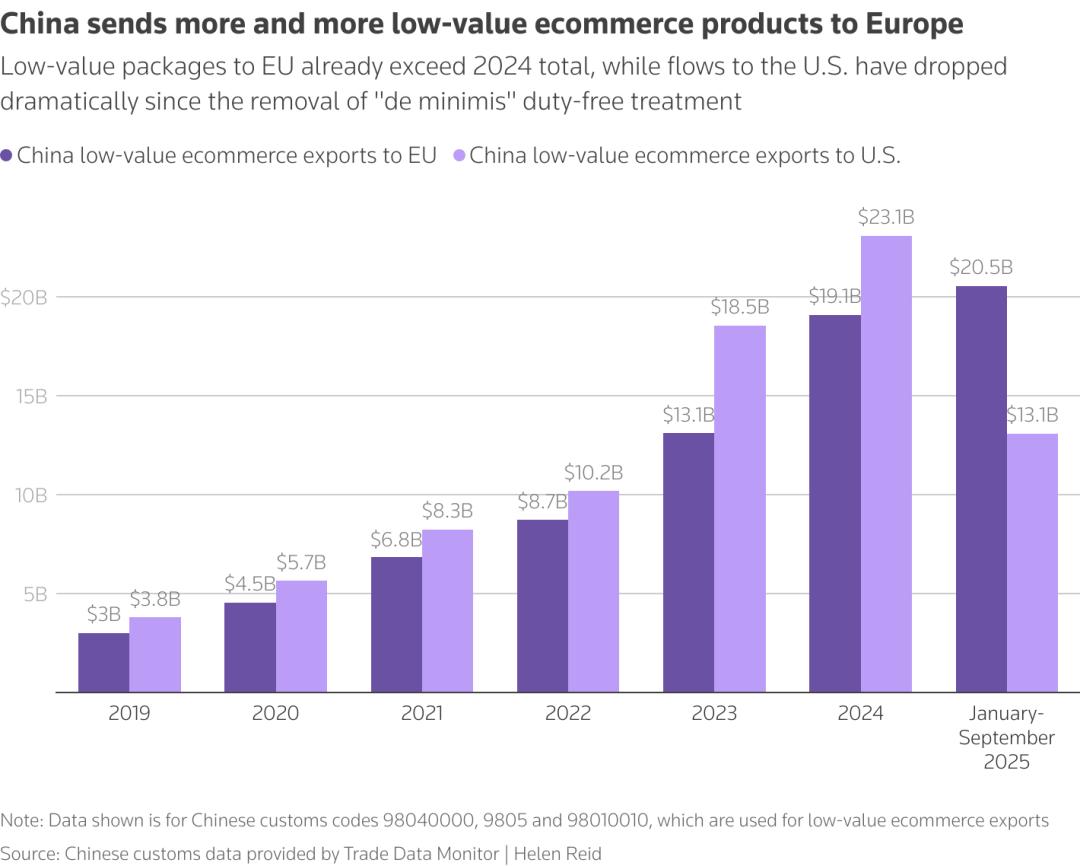
Core Points - The EU has reached an agreement to eliminate the tax exemption for packages valued under €150 by 2026, two years earlier than previously proposed [1][2] - A simplified transitional plan will be introduced starting in 2026, which includes a proposed fee of approximately €2 per small package [1][2] - The agreement is expected to be formalized in legal terms at the next European finance ministers' meeting on December 12 [2] Group 1: Industry Reactions - The early cancellation of the tax exemption has received broad support from European businesses, with German online retailer Zalando and the Italian fashion industry emphasizing the importance of this change for their sectors [3] - However, some retail representatives criticize the €2 fee, arguing it will not significantly deter consumers or alter market dynamics [4] - The Belgian individual entrepreneurs' association suggests a higher tax rate of €20 would be more effective in influencing consumer behavior [4] Group 2: Market Dynamics - The number of low-value e-commerce packages arriving in the EU has doubled to 4.6 billion, with over 90% originating from China, prompting pressure on the EU to act [4] - In 2024, China's low-priced e-commerce exports to the EU are projected to reach $19.1 billion, surpassing exports to the US, which are expected to be $23.1 billion [5] - Following the US's cancellation of its tax exemption, platforms like Temu and SHEIN have shifted focus to the European market, increasing their advertising expenditures significantly [8] Group 3: Strategic Shifts - Temu has rapidly expanded in the EU, covering 25% of the population within two years, with projected growth rates of 60%-100% in 2024-2025 [9] - SHEIN is also reallocating resources to Europe, with expectations that its revenue in Europe will exceed that in the US for the first time, growing by 30.7% to $17.9 billion [10] - The cancellation of the tax exemption will challenge the low-price strategies of these platforms, necessitating a shift towards localization and differentiation in product offerings [13][14]
高端美妆消费者指数:引领美国美妆消费者的下一个前沿
科尔尼管理咨询· 2025-11-14 09:49
Core Insights - The high-end beauty industry has experienced significant growth over the past decade, with the overall beauty market reaching $124 billion and high-end categories showing strong compound annual growth rates: fragrances at 7%, skincare at 5%, and hair care at 4% [2][3] - The next decade is expected to be different, with growth slowing as high-end beauty's share of consumer spending stabilizes and competition intensifies [4] Consumer Behavior - Nearly 46% of surveyed consumers plan to reduce discretionary spending, yet beauty expenditures are often prioritized due to their emotional value [5] - Five consumer archetypes have been identified: Minimalist Rationalists, Habitual Loyalists, Balanced Aesthetes, High-End Purists, and Confident Trendsetters, each with distinct spending habits and motivations [6] Loyalty and Expectations - Brand loyalty is shifting from emotional attachment to rational choices based on product efficacy and value, with 48% of consumers prioritizing product quality over brand heritage [8][10] - The rise of "value-for-money" culture indicates that price and efficacy have surpassed traditional brand loyalty, with 56% of consumers having tried alternative products that they believe perform equally well [10] Efficacy and Innovation - Efficacy is now a baseline expectation rather than a differentiating factor, with 85% of respondents considering high-quality ingredients important [13] - Consumers express dissatisfaction with product efficacy across categories, particularly in hair care (39% dissatisfied) and skincare (36% dissatisfied) [15] Health and Self-Identity - Consumers expect beauty products to enhance not only appearance but also mental and physical well-being, with health being a key attribute of beauty products [21][23] - For younger generations, beauty serves as a means of self-expression and identity, with over 52% of Gen Z respondents viewing beauty as a crucial aspect of their self-identity [25] Channel Dynamics - Amazon has emerged as a dominant player in beauty shopping, leading in discovery, research, purchase, and repurchase stages [27] - Consumers evaluate beauty shopping channels based on four core pillars: curation, community, convenience, and experience [31] Strategic Implications for Brands - Brands must redefine loyalty by focusing on effective products and quality platform experiences, emphasizing scientific validation and innovation [12][20] - To remain relevant, brands should integrate health and self-expression into their narratives while ensuring a seamless experience across all channels [26][38]

X @Nick Szabo
Nick Szabo· 2025-11-14 06:33
RT Harrison H. Smith ✞ (@HarrisonHSmith)Trump is having trouble defending 600k Chinese students in America because it’s not actually in our interest.It was a concession made by Trump so that China would sell TikTok to Israelis. https://t.co/UdAxZGE6M6 ...
North Carolina jury orders TikTok influencer to pay $1.75 million to her manager’s ex-wife
NBC News· 2025-11-13 18:46
A modern-day Montyu feud gone viral >> and it was nothing. >> North Carolina Tik Tocker Bnee Canard ordered to pay $1.75% million after a jury found her liable for having an affair with her manager Tim Montigue, characterized under North Carolina law as criminal conversation and alienation of affection. Montigue's ex-wife, Akira, suing Canard for her deliberate interference in the marriage, including wrongful and malicious acts, saying in a court filing, Canard engaged in behavior designed to seduce him.The ...

X @TechCrunch
TechCrunch· 2025-11-13 16:39
TikTok launches its own version of Instagram’s broadcast channels https://t.co/GWR5mumZ09 ...
Google to pay millions to South African news outlets: Watchdog
TechXplore· 2025-11-13 15:30
Core Points - Google will pay over $40 million to support South African news media, addressing challenges faced in the digital age [1][3] - The funding package includes $4 million for national publishers and broadcasters, $2.6 million annually for AI innovation, and $2.2 million for community and small media outlets over three years [3] - The agreement follows a 16-month investigation by the Competition Commission, which found that Google searches favored international news over local outlets [2][4] Funding Details - The total funding amount agreed upon is 688 million rand, equivalent to approximately $40.4 million [3] - Specific allocations include $4 million for content on Google News and $2.6 million annually for AI innovation [3] - Community and small media outlets will receive $2.2 million over three years to aid in digital transformation [3] Regulatory Context - The Competition Commission had previously recommended that Google pay up to $27 million annually for five years due to anti-trust practices affecting local media [2] - Similar funding arrangements have been established in other countries like Taiwan, Canada, Australia, and the United States amid regulatory pressures [5] - Social media platform X, owned by Elon Musk, did not reach a settlement and is required to make monetization programs available to local publishers [6]

X @Nick Szabo
Nick Szabo· 2025-11-13 03:56
RT Glenn Greenwald (@ggreenwald)Netanyahu said -- correctly -- that the most important success in Israel's war for control of US social media was the forced sale of TikTok to a consortium led by Larry Ellison.Before it's finalized, there's already an explosion of censorship for Israel on the platform: ...