成都银行

Search documents
解密主力资金出逃股 连续5日净流出568股


Zheng Quan Shi Bao Wang· 2025-10-21 09:04
Group 1 - As of October 21, a total of 568 stocks in the Shanghai and Shenzhen markets have experienced net outflows of main funds for five consecutive days or more [1] - The stock with the longest continuous net outflow is Dayu Ming, with 26 days of outflows, followed by Tianma Technology with 25 days [1] - The largest total net outflow amount is from Northern Rare Earth, with a cumulative outflow of 5.277 billion yuan over six days [1] Group 2 - Shanghai Electric follows with a net outflow of 3.698 billion yuan over eight days [1] - The stock with the highest proportion of net outflow relative to trading volume is Yongxin Zhicheng, which has seen a 9.22% decline over the past six days [1] - The cumulative decline percentages for several stocks with significant net outflows include: Sanzi Gaoke at -12.87%, and Lansi Technology at -13.59% [1]
中国银行业-市场反馈:板块轮动是投资者关注的关键-China Banks-Marketing feedback sector rotation a key investor watch
2025-10-21 01:52
Summary of Key Points from the Conference Call Industry Overview - **Industry**: China Banks - **Investor Sentiment**: There is decent investor interest in China banks amid market consolidation, with approximately 80% of institutions met being long-only funds [2][3] Core Insights and Arguments - **Sector Rotation**: Investors are more focused on sector rotation rather than fundamentals, with potential buying flows expected from insurers. The sustainability of dividend payouts (DPS) is a key concern [2][3] - **Dividend Yield**: A 6% dividend yield in the H-share banks universe is viewed as a good entry point for investors [2] - **Macro Trends**: Overall sentiment is stabilizing, with less concern about the property downturn and local government financing vehicle (LGFV) debt risk. The upcoming 4th Plenary Session and interest rate outlook are frequently discussed, although policy expectations remain low [3] - **Positive Upside Cases**: Investors are looking for potential upside cases, including government initiatives to combat economic stagnation, migration of retail deposits to stock markets, and positive wealth effects from strong stock markets [3] Bank-Specific Insights - **Fundamentals**: Investors are less bearish on banks following asymmetric rate cuts in May, which positively impacted net interest margins (NIM). Concerns over asset quality related to developer loans and LGFV debt have eased [4] - **China Merchants Bank (CMB)**: Investor opinions are divided; some are optimistic about the rebound of retail deposit CASA ratios, while others are concerned about earnings growth being on par with state-owned enterprises (SOEs) and the lack of an increase in payout ratios [4] - **Preferred Banks**: Analysts remain constructive on defensive names, expecting SOE banks to report positive year-over-year growth in revenue and earnings in Q3. Preferred banks include CITIC-H, CCB-H, BOC-H, and ICBC-H [5] Risks Identified - **Asset Quality**: Deterioration in asset quality remains a significant risk, influenced by a soft macro environment and domestic property market activity [8] - **Capital Adequacy**: Risks related to capital adequacy and potential dilution from refinancing are highlighted [8] - **Interest Rate Pressure**: Downside risks in interest rates could pressure bank profitability [8] Additional Important Points - **Investor Focus**: There is a notable shift in investor focus towards defensive names due to ongoing macro uncertainties and trade tensions [5] - **Market Dynamics**: The report indicates that the market is currently in a phase where banks are being evaluated based on their dividend yields and potential for growth, rather than solely on traditional financial metrics [4][5] This summary encapsulates the key points discussed in the conference call regarding the China banking sector, highlighting investor sentiment, macroeconomic factors, bank-specific insights, and identified risks.



城商行板块10月20日跌0.32%,江苏银行领跌,主力资金净流入2317.93万元
Zheng Xing Xing Ye Ri Bao· 2025-10-20 08:27
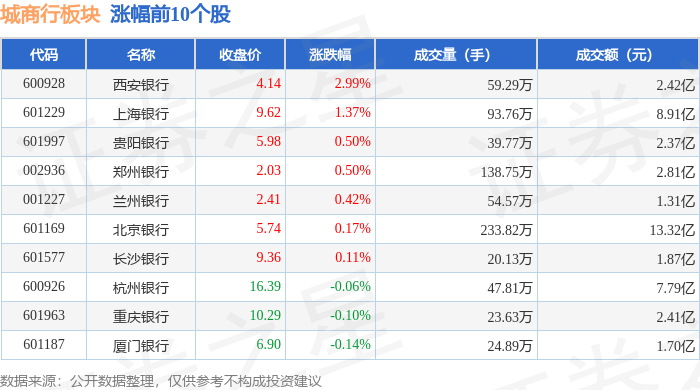
Core Insights - The city commercial bank sector experienced a decline of 0.32% on October 20, with Jiangsu Bank leading the drop [1] - The Shanghai Composite Index closed at 3863.89, up 0.63%, while the Shenzhen Component Index closed at 12813.21, up 0.98% [1] Stock Performance - Xi'an Bank (600928) closed at 4.14, up 2.99% with a trading volume of 592,900 shares and a transaction value of 242 million [1] - Shanghai Bank (601229) closed at 9.62, up 1.37% with a trading volume of 937,600 shares and a transaction value of 891 million [1] - Jiangsu Bank (616009) closed at 10.79, down 1.82% with a trading volume of 1,603,000 shares and a transaction value of 173.3 million [2] Capital Flow - The city commercial bank sector saw a net inflow of 23.18 million from institutional investors, while retail investors contributed a net inflow of 52.95 million [2] - The sector experienced a net outflow of 76.12 million from speculative funds [2] Individual Stock Capital Flow - Qilu Bank (601665) had a net inflow of 63.84 million from institutional investors, while it faced a net outflow of 17.01 million from speculative funds [3] - Shanghai Bank (601229) saw a net inflow of 54.98 million from institutional investors, with a net outflow of 18.63 million from speculative funds [3] - Ningbo Bank (002142) recorded a net inflow of 51.83 million from institutional investors, while speculative funds had a net outflow of 45.06 million [3]





12连阳!农业银行市净率一度突破1倍,将逆袭宇宙行
Guan Cha Zhe Wang· 2025-10-20 07:58
Core Viewpoint - The recent rebound in bank stocks, particularly Agricultural Bank of China, indicates a potential recovery in the banking sector after a period of decline, with Agricultural Bank's stock price showing significant strength and a return to a price-to-book (PB) ratio above 1 [1][2][3]. Group 1: Stock Performance - On October 20, major stock indices rose collectively, with Agricultural Bank's stock price reaching 7.74 CNY per share, marking a 1.57% increase and achieving a 12-day consecutive rise [1]. - Agricultural Bank's market capitalization fluctuated around 2.712 trillion CNY, at times surpassing that of Industrial and Commercial Bank of China [1]. - The stock price of Agricultural Bank hit a new high of 7.69 CNY, exceeding its mid-year net asset value of 7.65 CNY, before closing at 7.62 CNY [2]. Group 2: Valuation Metrics - Agricultural Bank's PB ratio has returned to above 1, ending a prolonged period of trading below book value for state-owned banks [2]. - Among 42 listed banks, only four, including Agricultural Bank, have a PB ratio above 0.9, while many others remain below 0.4 [2]. Group 3: Market Dynamics - The recent increase in Agricultural Bank's PB ratio is attributed to liquidity-driven factors, with the overall banking sector still in a valuation recovery phase [3]. - Since July, bank stocks have faced a downturn, but have rebounded post-National Day, with the China Securities Banking Index rising by 4.77% while the Shanghai Composite Index fell by 0.43% [3]. - Investors are seeking "safe havens" in bank stocks due to their low valuations, high dividend yields, and stable operations, especially during market volatility [3]. Group 4: Future Outlook - Analysts expect that the upcoming quarterly reports for banks will show a stable performance, with positive trends in interest margins and stable non-performing loan generation [4]. - The banking sector is anticipated to see a significant increase in attractiveness due to dividend value and the potential for asset revaluation as macro-prudential management expands [4]. - Short-term prospects are favorable for quality small and medium-sized banks with performance potential, while long-term views favor resilient state-owned banks and regional leaders amid increasing market concentration [4].


12连阳,总市值2.6万亿元的农业银行,市净率估值修复到1倍PB以上
Di Yi Cai Jing· 2025-10-20 07:35
Core Viewpoint - The performance of bank stocks showed divergence on October 20, with Agricultural Bank of China (ABC) continuing to rise, marking a 12-day consecutive increase in its stock price, while the overall banking index declined slightly [1] Group 1: Stock Performance - As of the midday break, the China Securities Banking Index fell by 0.41%, with 9 stocks rising and 29 stocks declining [1] - ABC's A-shares rose by 0.79%, reaching a price of 7.68 CNY per share, with an intraday high of 7.74 CNY, setting a new record [1] - ABC's total market capitalization is now 2.61 trillion CNY, surpassing that of Industrial and Commercial Bank of China (ICBC) at 2.51 trillion CNY [2] Group 2: Valuation Metrics - ABC's price-to-book ratio (PB) has returned to above 1 for the first time in a long while, ending the long-standing situation of state-owned banks trading below book value [2] - As of last Friday's close, the median PB ratio for 42 listed banks in A-shares was around 0.6, with only four banks, including ABC, having a PB ratio above 0.9 [2] - The lowest PB ratio among state-owned banks, excluding ABC, was 0.55 for Bank of Communications [2] Group 3: Financial Performance - In the first half of the year, the six major banks reported positive year-on-year revenue growth, with three major banks showing positive growth in net profit attributable to shareholders [3] - ABC led with a net profit growth rate of 2.66%, while the top three banks by revenue were ICBC (427.09 billion CNY), China Construction Bank (394.27 billion CNY), and ABC (369.94 billion CNY) [3] - The top three banks by net profit were ICBC (168.10 billion CNY), China Construction Bank (162.08 billion CNY), and ABC (139.51 billion CNY) [3]
12连阳!总市值2.6万亿元的农业银行,估值修复到1倍PB以上
Di Yi Cai Jing· 2025-10-20 05:23
结束了国有大行长期以来的破净局面。 周一(10月20日)银行股表现分化,农业银行A股继续上涨。截至午间休盘,中证银行指数跌0.41%,9 只个股上涨,29只个股下跌。 其中,农业银行A股涨0.79%,股价报7.68元/股,日线录得12连阳。盘中,该行股价一度触及7.74元/ 股,续创新高。 对于农业银行估值重新回到1倍以上,有机构人士对记者表示,主要是流动性驱动,相对于整个板块代 表性有限,行业估值修复进程还有待观察。 截至上周五收盘,A股42家上市银行的市净率中位数仍在0.6倍左右,仅农业银行、招商银行、成都银 行、杭州银行4家银行市净率在0.9倍以上,另有多家银行市净率不足0.4倍。其中,国有大行除农业银行 外,市净率均低于0.8倍,最低为0.55倍(交通银行)。 7月以来,伴随市场风格转换,银行股整体陷入回调,直至国庆假期后迎来持续反弹,其间中证银行指 数累计涨4.77%,上证指数跌0.43%。 回顾来看,自7月10日中证银行指数触及8570.16点高位至9月底,农业银行是42家A股上市银行中唯一一 家股价上涨的个股,涨幅接近10%,同期板块回调超过14%。 财报数据显示,上半年六大行营收均实现同比正增 ...
区域银行高管互换那些事儿
3 6 Ke· 2025-10-20 02:59
Core Viewpoint - The article discusses the recent trend of leadership exchanges among major banks in China, particularly focusing on the mutual appointments of top executives between Chengdu Bank and Chengdu Rural Commercial Bank, as well as similar movements in Beijing and Shanghai banks, suggesting a potential industry trend towards such leadership rotations [1][15][22]. Group 1: Leadership Changes - Chengdu Bank and Chengdu Rural Commercial Bank announced a mutual exchange of their top executives, with Wang Hui resigning from Chengdu Bank and Huang Jianjun taking over as chairman [15][17]. - In Beijing, multiple executives have shifted roles among major banks, with significant movements including Mao Wenli's appointment as vice president of Beijing Bank from Beijing Rural Commercial Bank [2][7]. - Shanghai banks, including Shanghai Rural Commercial Bank and Shanghai Bank, have also seen leadership changes, with Wang Ming moving from Shanghai Bank to Shanghai Rural Commercial Bank as president [8][10]. Group 2: Executive Backgrounds - Wang Hui, former chairman of Chengdu Bank, has a long history in the banking sector, having joined in 2005 and led the bank to significant growth, including its listing on the stock exchange [18][20]. - Huang Jianjun, the new chairman of Chengdu Bank, has extensive experience within the bank, having held various positions before his recent appointment [20][22]. - In Shanghai, Gu Jianzhong, the new chairman of Shanghai Bank, has a deep understanding of the bank's operations, having worked there for over a decade before moving to Shanghai Rural Commercial Bank [10][12].


银行三季报业绩增长可期
Xiangcai Securities· 2025-10-19 12:11
Investment Rating - The industry rating is maintained at "Overweight" [10][34] Core Views - The banking sector is expected to see positive growth in Q3, with revenue growth of 1.0% and net profit growth of 0.8% in the first half of the year, indicating a stabilization trend [8][32] - Credit growth has been slowing down due to a significant decrease in bill financing, reflecting a weakened demand for scale expansion among banks [8][32] - The introduction of new policy financial tools is anticipated to support medium to long-term corporate loans, improving the loan structure [8][33] - Deposit growth remains strong, which is expected to help stabilize funding costs and potentially lead to a recovery in net interest margins [8][33] Summary by Sections Industry Performance - The banking sector's performance has shown a relative return of 2.3% over the past month, with an absolute return of 1.5% [7] - The banking index increased by 4.89% during the period from October 13 to October 19, outperforming the CSI 300 index by 7.12 percentage points [12] Financial Metrics - The net interest margin decreased by 8 basis points in the first half of the year, but is expected to stabilize in the second half [8][33] - Non-interest income is projected to remain stable, supported by growth in intermediary business income and favorable market conditions for capital markets [9][32] Investment Recommendations - The report suggests focusing on state-owned banks for their stable high dividend yield and potential valuation recovery opportunities in joint-stock and regional banks [10][34] - Specific banks recommended include CITIC Bank, Jiangsu Bank, Chengdu Bank, Shanghai Rural Commercial Bank, Chongqing Rural Commercial Bank, Changshu Bank, and Suzhou Bank [10][34]
金融行业双周报(2025/10/3-2025/10/16):关税扰动再起,银行红利价值凸显-20251017
Dongguan Securities· 2025-10-17 10:00
Investment Ratings - Banking: Overweight (Maintain) [1] - Securities: Market Weight (Maintain) [1] - Insurance: Overweight (Maintain) [1] Core Insights - The banking sector is seen as a safe haven amid rising market uncertainties, with high dividend yield assets becoming increasingly attractive [1][41] - The securities sector is benefiting from a surge in trading volumes and increased stamp duty revenues, indicating strong performance in upcoming quarterly reports [1][43] - The insurance sector is experiencing significant growth in investment income and new business value, driven by increased equity market exposure and favorable policy support [1][45] Summary by Sections Market Review - As of October 16, 2025, the banking index increased by 5.53%, the securities index decreased by 0.57%, and the insurance index rose by 6.27%, while the CSI 300 index fell by 0.48% [11] - Among the sub-sectors, Chongqing Bank (+15.90%), GF Securities (+8.98%), and New China Life Insurance (+12.21%) showed the best performance [11] Valuation Situation - As of October 16, 2025, the banking sector's price-to-book (PB) ratio is 0.73, with state-owned banks at 0.79, joint-stock banks at 0.62, city commercial banks at 0.73, and rural commercial banks at 0.65 [22] - The securities sector's PB ratio is 1.59, indicating potential for valuation recovery [24] - Insurance companies' price-to-earnings value (PEV) ratios are as follows: New China Life (0.74), China Pacific Insurance (0.59), Ping An (0.69), and China Life (0.72) [25] Recent Market Indicators - As of October 16, 2025, the one-year Medium-term Lending Facility (MLF) rate is 2.0%, and the one-year and five-year Loan Prime Rates (LPR) are 3.0% and 3.50%, respectively [29] - The average daily trading volume in the A-share market is 22,359.31 billion, showing a decrease of 13.57% [33] - The total social financing scale reached 437.08 trillion yuan, with a year-on-year growth of 8.7% [41] Company Announcements - New China Life Insurance expects a net profit of 29.986 billion to 34.122 billion yuan for the first three quarters of 2025, representing a year-on-year increase of 45% to 65% [45] - Shanghai Bank announced a cash dividend of 0.30 yuan per share, totaling 4.263 billion yuan [41]





城商行板块10月17日跌0.17%,上海银行领跌,主力资金净流出4.03亿元
Zheng Xing Xing Ye Ri Bao· 2025-10-17 08:35
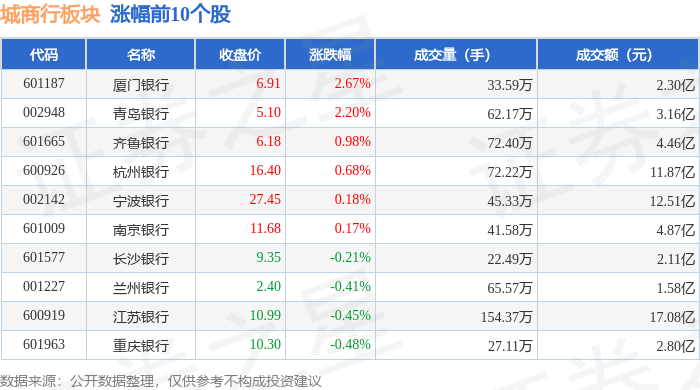
Market Overview - The city commercial bank sector experienced a decline of 0.17% on October 17, with Shanghai Bank leading the drop [1] - The Shanghai Composite Index closed at 3839.76, down 1.95%, while the Shenzhen Component Index closed at 12688.94, down 3.04% [1] Individual Bank Performance - Xiamen Bank saw a closing price of 6.91, with an increase of 2.67% and a trading volume of 335,900 shares, amounting to a transaction value of 230 million [1] - Qingdao Bank closed at 5.10, up 2.20%, with a trading volume of 621,700 shares and a transaction value of 316 million [1] - In contrast, Shanghai Bank closed at 9.49, down 1.04%, with a trading volume of 768,900 shares and a transaction value of 734 million [2] Capital Flow Analysis - The city commercial bank sector saw a net outflow of 403 million from institutional investors, while retail investors contributed a net inflow of 308 million [2] - The table indicates that Suzhou Bank had a net inflow of 24.27 million from institutional investors, while it faced a net outflow of 14.17 million from speculative funds [3] - Jiangsu Bank experienced a net outflow of 24.10 million from institutional investors but had a net inflow of 1.78 million from retail investors [3]