沪农商行

Search documents
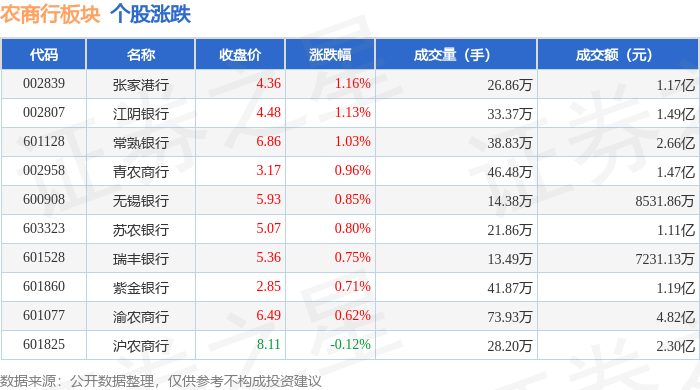
农商行板块10月10日涨0.52%,张家港行领涨,主力资金净流出179.78万元
Zheng Xing Xing Ye Ri Bao· 2025-10-10 08:46
Core Viewpoint - The rural commercial bank sector experienced a slight increase of 0.52% on October 10, with Zhangjiagang Bank leading the gains, while the overall market indices, including the Shanghai Composite Index and Shenzhen Component Index, saw declines of 0.94% and 2.7% respectively [1] Group 1: Market Performance - On October 10, the Shanghai Composite Index closed at 3897.03, down 0.94%, and the Shenzhen Component Index closed at 13355.42, down 2.7% [1] - The rural commercial bank sector's individual stock performance showed varying degrees of increase, with Zhangjiagang Bank rising by 1.16% to a closing price of 4.36 [1] Group 2: Trading Volume and Capital Flow - The trading volume for Zhangjiagang Bank was 268,600 shares, with a transaction value of 117 million yuan [1] - The rural commercial bank sector saw a net outflow of 1.7978 million yuan from main funds and a net outflow of 21.0196 million yuan from speculative funds, while retail investors contributed a net inflow of 22.8173 million yuan [1] Group 3: Individual Stock Capital Flow - For the stocks analyzed, the main capital inflow was observed in Hu Nong Bank with 16.1411 million yuan, while the largest outflow was from Changshu Bank at 13.5807 million yuan [2] - Retail investors showed a significant net inflow in Changshu Bank, amounting to 23.4478 million yuan, despite the main and speculative funds showing outflows [2]





上海农商行副董事长、行长汪明任职资格获核准
Zhong Guo Jing Ying Bao· 2025-10-10 08:13
Core Viewpoint - Shanghai Rural Commercial Bank has received approval from the Shanghai Regulatory Bureau of the National Financial Supervision Administration for the qualifications of its new Vice Chairman and President, Wang Ming, and Chief Auditor, Luo Ying [1] Group 1: Management Appointments - Wang Ming has been approved as the Vice Chairman and President of Shanghai Rural Commercial Bank [1] - Luo Ying has been approved as the Chief Auditor of Shanghai Rural Commercial Bank [1] Group 2: Background of Wang Ming - Wang Ming was born in April 1975 and holds a bachelor's degree in economics [1] - His previous positions include Deputy General Manager of the Corporate Finance Department at Shanghai Bank, Deputy General Manager and General Manager of the Key Client Department, and various leadership roles at Shanghai Bank [1]
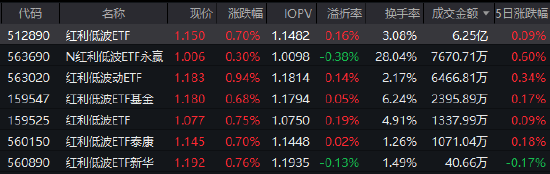
逆市收涨!红利低波ETF成震荡市“避风港”单日成交6.25亿元居同类首位
Xin Lang Ji Jin· 2025-10-10 08:12
Core Viewpoint - The A-share market is experiencing a consolidation phase, with the Shanghai Composite Index falling below 3900 points, down 0.94%, and the ChiNext Index declining by 4.55%. In contrast, the Dividend Low Volatility ETF (512890) rose by 0.70%, indicating strong investor interest despite the overall market downturn [1]. Fund Performance - The Dividend Low Volatility ETF (512890) has shown resilience with a current price of 1.150 and a 5-day increase of 0.09%. The fund's trading volume reached 6.25 billion CNY, with a turnover rate of 3.08% [2][3]. - Over the past 10 trading days, the ETF has seen a net inflow of 420 million CNY, with a total net inflow of 1.272 billion CNY over the last 60 trading days. As of October 9, 2025, the ETF's circulating scale has reached 20.203 billion CNY [2][3]. Institutional Insights - Guosen Securities suggests that the current performance downturn may be nearing its end, with expectations for improvement in the industry fundamentals next year. They recommend focusing on banks with stable asset quality and low provisioning pressure, such as Chengdu Bank and Changsha Bank [4]. - Western Securities anticipates a potential turnaround for the insurance sector in October, driven by a combination of alleviated negative sentiment and policy catalysts. They recommend continued investment in the banking sector, which is currently undervalued [4]. Historical Performance - The Dividend Low Volatility ETF (512890), established in December 2018, has achieved a cumulative return of 128.10% as of October 9, 2025, outperforming its benchmark and ranking 93rd among 502 similar products. It is suggested as a stable income tool for investors during market volatility [4].
反洗钱宣传月 | 全民反洗钱 护航新生活(一)
中泰证券资管· 2025-10-10 07:02
Core Viewpoint - The newly revised Anti-Money Laundering Law of the People's Republic of China was passed by the Standing Committee of the National People's Congress and will take effect on January 1, 2025, marking a significant milestone in the development of China's anti-money laundering efforts [3]. Group 1: Definition and Scope - Anti-money laundering refers to measures taken to prevent activities that conceal or disguise the source and nature of criminal proceeds [6]. - The law addresses various types of crimes, including organized crime, drug-related crime, terrorism, smuggling, financial fraud, and corruption [6]. Group 2: Implementation and Oversight - The People's Bank of China is responsible for nationwide anti-money laundering supervision and management, with other relevant departments fulfilling their supervisory roles within their respective responsibilities [10][11]. - Financial institutions are required to establish internal control systems for anti-money laundering, appoint dedicated personnel, and conduct regular risk assessments [17]. Group 3: Customer Due Diligence - Financial institutions must conduct customer due diligence, including verifying the identity of customers and understanding the purpose of business relationships and transactions [19]. - Institutions are prohibited from providing services to unidentified customers or opening anonymous accounts [21]. Group 4: Reporting Obligations - Financial institutions must report large transactions and suspicious activities to the anti-money laundering monitoring and analysis agency [27]. - They are required to develop and optimize monitoring standards to effectively identify and analyze suspicious transactions [27]. Group 5: Special Measures and Confidentiality - All units and individuals must comply with special preventive measures against money laundering as required by national authorities, including stopping services to sanctioned individuals [33]. - Customer identity and transaction information obtained for anti-money laundering purposes must be kept confidential and not disclosed without legal authorization [35].

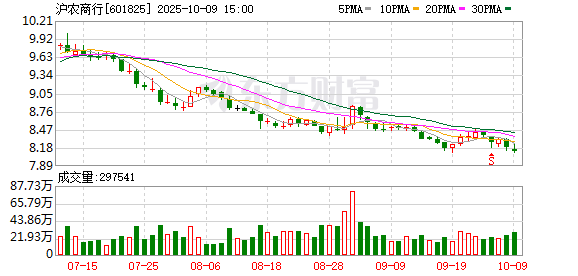
沪农商行10月9日获融资买入761.63万元,融资余额1.82亿元
Xin Lang Cai Jing· 2025-10-10 01:30
Group 1 - The core point of the news is the performance and financial metrics of Shanghai Rural Commercial Bank, including stock price movement, financing activities, and business segments [1][2][3] Group 2 - On October 9, Shanghai Rural Commercial Bank's stock price decreased by 0.73%, with a trading volume of 242 million yuan [1] - The bank's financing buy-in amount on the same day was 7.62 million yuan, while the financing repayment was 4.67 million yuan, resulting in a net financing buy-in of 2.94 million yuan [1] - As of October 9, the total financing and securities lending balance for the bank was 191 million yuan, with a current financing balance of 182 million yuan, representing 0.24% of the market capitalization [1] - The bank's securities lending activities included a repayment of 55,200 shares and a sale of 21,500 shares, with a total selling amount of 174,600 yuan [1] - The bank's main business segments include corporate banking (44.82%), personal banking (38.79%), financial market business (14.49%), and other businesses (1.90%) [1] Group 3 - As of June 30, the number of shareholders for Shanghai Rural Commercial Bank was 73,400, a decrease of 13.35% from the previous period [2] - The bank reported a net profit of 7.01 billion yuan for the first half of 2025, reflecting a year-on-year growth of 0.60% [2] Group 4 - Since its A-share listing, Shanghai Rural Commercial Bank has distributed a total of 18.84 billion yuan in dividends, with 13.44 billion yuan distributed over the past three years [3] - As of June 30, 2025, Hong Kong Central Clearing Limited has exited the list of the top ten circulating shareholders of the bank [3]
上海农商行行长汪明任职资格获批 前任行长顾建忠已赴任上海银行
Mei Ri Jing Ji Xin Wen· 2025-10-09 14:28
Core Points - Shanghai Rural Commercial Bank announced the approval of Wang Ming's appointment as Vice Chairman and President by the Shanghai Bureau of the National Financial Regulatory Administration [2] - Wang Ming has extensive experience in the banking sector in Shanghai, previously serving as Vice President of Shanghai Bank before his current role [2] - The former President of Shanghai Rural Commercial Bank, Gu Jianzhong, resigned on April 25, and has since taken on the role of Chairman at Shanghai Bank [3][4] Summary by Sections Appointment of Wang Ming - Wang Ming, born in April 1975, holds a bachelor's degree in economics and is currently the Deputy Secretary of the Party Committee at Shanghai Rural Commercial Bank [2] - His previous roles include various senior positions at Shanghai Bank, such as Deputy General Manager of Corporate Finance and Vice President [2] Transition of Gu Jianzhong - Gu Jianzhong's tenure at Shanghai Rural Commercial Bank was characterized by diligence and adherence to national economic policies, contributing to the bank's high-quality development [3] - After leaving Shanghai Rural Commercial Bank, Gu Jianzhong was appointed as Chairman of Shanghai Bank, marking a return to his former employer [4]

上海农商行行长汪明任职资格获批
Xin Lang Cai Jing· 2025-10-09 14:21
上海农商行公告称,汪明的公司副董事长、行长任职资格已获核准。汪明长期在上海银行业工作,此前 任上海银行副行长,5月已辞职。上海农商行前任行长顾建忠于今年4月辞职,前往上海银行任董事长。 ...
上海农商行:副董事长、行长汪明 总审计师罗瑛任职资格获批
Bei Jing Shang Bao· 2025-10-09 14:19
10月9日,上海农商行发布公告,该行近日收到《国家金融监督管理总局上海监管局关于汪明上海农村 商业银行股份有限公司副董事长、行长任职资格的批复》和《国家金融监督管理总局上海监管局关于罗 瑛上海农村商业银行股份有限公司总审计师任职资格的批复》,国家金融监督管理总局上海监管局已核 准汪明的该行副董事长、行长任职资格和罗瑛的该行总审计师任职资格。 (文章来源:北京商报) ...
上海农商行:副董事长、行长汪明,总审计师罗瑛任职资格获批
Bei Jing Shang Bao· 2025-10-09 13:53
北京商报讯(记者 宋亦桐)10月9日,上海农商行发布公告,该行近日收到《国家金融监督管理总局上 海监管局关于汪明上海农村商业银行股份有限公司副董事长、行长任职资格的批复》和《国家金融监督 管理总局上海监管局关于罗瑛上海农村商业银行股份有限公司总审计师任职资格的批复》,国家金融监 督管理总局上海监管局已核准汪明的该行副董事长、行长任职资格和罗瑛的该行总审计师任职资格。 ...
区域银行冲向科技金融
券商中国· 2025-10-09 11:16
Core Viewpoint - The article emphasizes the importance of fintech as a leading business segment for banks and financial institutions, highlighting the proactive approach of these entities in embracing technological advancements [1]. Group 1: Development of Fintech in Regional Banks - Many regional banks, particularly city and rural commercial banks, are following the lead of larger banks in developing fintech, although their progress may be limited by resources [2]. - Zhejiang Rural Commercial Bank has reported that since launching its fintech pilot in Jiaxing, the proportion of technology enterprise loans has exceeded 30% of corporate loans, covering 7,200 tech enterprises [2]. - Various county-level rural commercial banks in Jiaxing have begun to establish specialized mechanisms for fintech, such as dedicated departments and service models [3]. Group 2: Challenges and Strategies - The development of fintech is challenging for regional banks, which need to root their efforts in local economic structures and overcome internal limitations [5]. - A listed rural commercial bank indicated that it had been considering fintech since 2017, but only completed team formation in 2021, reflecting the long-term commitment required [4]. Group 3: Growth in Technology Loans - Despite smaller loan scales compared to larger banks, regional banks are accelerating their technology loan offerings, with significant growth rates reported [6]. - For instance, Jiangsu Bank's technology loan balance reached 2,740 billion yuan, growing by 17.80% year-on-year, while Hangzhou Bank's technology loans increased by 21.77% [7]. - Other regional banks, such as Qilu Bank and Qingdao Bank, also reported substantial growth in technology loans, with increases of 17.60% and 20.85% respectively [7]. Group 4: Organizational Structure and Specialization - Banks are adapting their organizational structures to support fintech, with many establishing dedicated departments and specialized branches [9]. - For example, Ningbo Bank has set up a technology finance department to provide comprehensive services to tech enterprises, while Qingdao Bank has developed a specialized mechanism for fintech [10]. - Hangzhou Bank has created a well-structured fintech system with multiple regional centers and specialized institutions [11].