红利低波

Search documents
3月本土机构投资者调查-A股-地缘-油价怎么看
2026-04-01 09:59
Summary of Conference Call Notes Industry Overview - The conference call discusses the A-share market and investor sentiment in the context of geopolitical tensions and inflation concerns [1][2]. Key Points and Arguments 1. **Market Consensus on Index Bottom**: The consensus among investors is that the Shanghai Composite Index's bottom is between 3,700 and 3,800 points, aligning with the annual line at approximately 3,740 points, indicating a prevailing "bullish mindset" [1][2]. 2. **Investor Positioning**: Overall investor positions are low, with a stronger inclination among absolute return investors to increase their positions compared to relative return investors [2][3]. 3. **Concerns Affecting Investment Decisions**: Investors express concerns about geopolitical conflicts and potential stagflation or recession, which dampen their willingness to increase positions despite a neutral outlook on the market [3][4]. 4. **Economic Growth Expectations**: The GDP growth target for 2026 is projected to be between 4.6% and 4.7%, with annual return and profit growth expectations concentrated in the 5% to 10% range [1][3]. 5. **Liquidity and Oil Price Expectations**: The market anticipates that the Federal Reserve will likely cut interest rates at least once in 2026, with oil prices expected to stabilize between $90 and $100 per barrel [1][4]. 6. **Investment Style and Focus**: There is a consensus on balanced asset allocation with an emphasis on value, focusing on "new and old energy" sectors, including upstream resources and new manufacturing [5][6]. 7. **Performance Expectations for Q1 2026**: AI computing power, particularly in North America and domestic chains, is viewed as the most certain sector for exceeding performance expectations, along with certain upstream resources and non-ferrous metals [7]. 8. **Investor Sentiment on Hong Kong Market**: Most investors believe that the Hong Kong stock market will struggle to outperform the A-share market in 2026, with a low willingness to increase allocations to Hong Kong stocks [8]. Additional Important Insights - The survey included over 260 fund managers and researchers from more than 140 domestic core institutions, with a significant representation from public funds and insurance asset management [2]. - Despite concerns about geopolitical risks, the prevailing view is that these factors are short-term disturbances rather than significant threats to the fundamentals [3][4]. - There is a notable expectation of a divergence in performance between sectors perceived as defensive and those expected to exceed earnings forecasts, particularly in the context of geopolitical tensions [7].
金融工程:AI识图关注银行、金融、公用事业、红利低波
GF SECURITIES· 2026-03-29 14:08
- The report utilizes Convolutional Neural Networks (CNN) to model price-volume data and future prices, mapping learned features to industry theme sectors[1][75] - The latest configuration themes include banking, finance, utilities, and low volatility dividends, specifically covering indices such as the CSI Bank Index, CSI 800 Bank Index, SSE 180 Financial Stock Index, CSI All Share Utilities Index, and CSI Dividend Low Volatility Index[1][75][77] - The report provides detailed configuration information for the CNN industry themes, including specific dates and index codes[76] **Quantitative Models and Construction Methods** 1. Model Name: Convolutional Neural Network (CNN) - Construction Idea: Use CNN to model price-volume data and future prices, mapping learned features to industry theme sectors[1][75] - Detailed Construction Process: - Standardize price-volume data into charts for each stock within a window period - Apply CNN to these charts to learn features - Map the learned features to industry theme sectors - Evaluation: The model effectively identifies and maps features to relevant industry themes, providing actionable insights for sector allocation[1][75] **Model Backtesting Results** 1. CNN Model, Banking Theme, CSI Bank Index[76] 2. CNN Model, Banking Theme, CSI 800 Bank Index[76] 3. CNN Model, Financial Theme, SSE 180 Financial Stock Index[76] 4. CNN Model, Utilities Theme, CSI All Share Utilities Index[76] 5. CNN Model, Low Volatility Dividends Theme, CSI Dividend Low Volatility Index[76]
金融工程:AI识图关注红利低波、银行、地产
GF SECURITIES· 2026-03-23 06:31
- The report utilizes convolutional neural networks (CNN) to model the relationship between charted price-volume data and future prices, mapping learned features to industry thematic indices[74][75] - The thematic indices configured using CNN include the CSI Dividend Low Volatility Index, CSI Bank Index, CSI 800 Bank Index, CSI Mainland Real Estate Thematic Index, and CSI 800 Real Estate Index[75] - The CNN-based approach focuses on standardizing price-volume data into charts for analysis, as referenced in prior deep learning studies like "AI Recognition and Classification of Stock Price Trends Based on Convolutional Neural Networks"[74]
值得收藏!极简策略:红利低波+纳指100+债券+黄金
雪球· 2026-03-20 13:01
Group 1 - The article discusses a simplified investment strategy focusing on building a diversified index fund portfolio that includes low volatility dividend stocks, Nasdaq 100, bond funds, and gold [4][8][31]. - It emphasizes the high volatility of A-shares and suggests selecting stable indices like CSI 300 and CSI A500 to mitigate risks [10][11]. - The article highlights the historical performance of U.S. stocks, particularly the Nasdaq 100, as a growth-oriented investment option, while cautioning about potential market downturns [15][18][21]. Group 2 - The discussion on bond funds includes strategies for selecting bonds based on duration and type, emphasizing the importance of stability and yield in the long term [23][25]. - It addresses the role of gold and commodities as hedging tools against extreme market risks, noting that current gold returns are above historical averages, making it a less favorable time for investment [27][29][30]. - The article outlines initial weight setting and rebalancing principles for the proposed asset allocation, referencing established investment strategies like Harry Browne's Permanent Portfolio and Ray Dalio's All Weather Strategy [32][34][36].


分红早知道丨2025财年首家分红派息实施公告出炉!最近24小时内,沃华医药、浙江黎明等2家A股上市公司发布分红派息实施公告
Xin Lang Cai Jing· 2026-02-27 10:42
Group 1 - The Low Volatility Dividend Index (H30269.CSI) includes 50 securities with good liquidity, continuous dividends, moderate payout ratios, positive growth in dividends per share, high dividend yields, and low volatility, with a one-year dividend yield of 4.61% as of February 26 [1][3] - The Low Volatility Dividend ETF (华夏, 159547) tracks this index and has the lowest comprehensive fee among ETFs, with quarterly evaluations for dividends [1][3] - The Quality Dividend Index (931468.CSI) consists of 50 securities that provide continuous cash dividends, have high payout ratios, and exhibit strong profitability, with a one-year dividend yield of 2.93% as of February 26 [1][3] Group 2 - Wohuayi Pharmaceutical plans to distribute a cash dividend of 1.46 yuan per 10 shares (including tax), with the record date on March 4, 2026, and the ex-dividend date on March 5, 2026 [1][3] - Zhejiang Liming will distribute a cash dividend of 0.07 yuan per share (including tax), with the record date on March 4, 2026, and the ex-dividend date on March 5, 2026 [2][4]

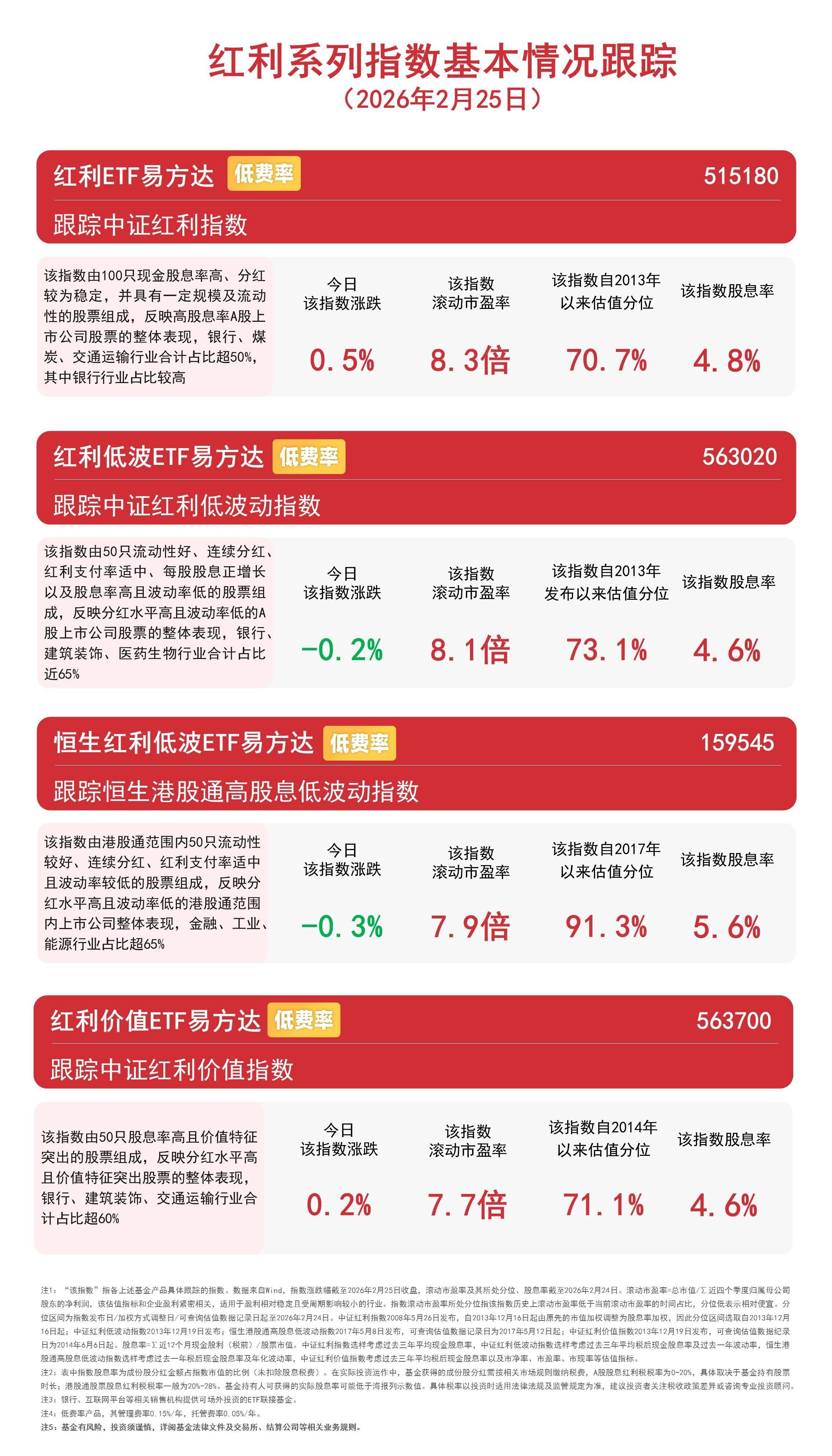
红利板块震荡分化,关注红利低波ETF易方达(563020)、恒生红利低波ETF易方达(159545)等产品布局机会
Sou Hu Cai Jing· 2026-02-25 11:53
Group 1 - The core index performance shows that the CSI Dividend Index increased by 0.5%, while the CSI Dividend Value Index rose by 0.2%. Conversely, the CSI Dividend Low Volatility Index decreased by 0.2%, and the Hang Seng Hong Kong Stock Connect High Dividend Low Volatility Index fell by 0.3% [1][4][8] - The E Fund's dividend low volatility ETFs, including the E Fund Dividend Low Volatility ETF (563020) and the E Fund Hang Seng Dividend Low Volatility ETF (159545), have seen a net inflow of funds totaling 120 million yuan and 190 million yuan respectively over the past two trading days [1] - E Fund is currently the only fund company that implements low fee rates for all its dividend ETFs, with a management fee rate of 0.15% per year for products such as the E Fund Hang Seng Dividend Low Volatility ETF (159545), E Fund Dividend ETF (515180), and others [1] Group 2 - The CSI Dividend Low Volatility Index is composed of 50 stocks that have good liquidity, continuous dividends, moderate dividend payout ratios, positive growth in earnings per share, and low volatility, reflecting the overall performance of A-share listed companies with high dividend levels and low volatility. The banking, construction decoration, and pharmaceutical industries account for a total of 65% [3] - The Hang Seng Dividend Low Volatility Index consists of 50 stocks within the Hong Kong Stock Connect that have good liquidity, continuous dividends, moderate dividend payout ratios, and low volatility, reflecting the overall performance of listed companies in the Hong Kong Stock Connect with high dividend levels and low volatility. The financial, industrial, and energy sectors account for over 65% [7]
2月13日港股通红利低波ETF华宝(159220)份额增加1400.00万份
Xin Lang Cai Jing· 2026-02-24 07:23
Group 1 - The Hong Kong Stock Connect Low Volatility Dividend ETF managed by Huabao (159220) experienced a decline of 0.78% with a trading volume of 31.58 million yuan on February 13 [1] - The ETF's shares increased by 14 million to a total of 458 million shares, although there was a reduction of 18 million shares over the past 20 trading days [1] - The latest net asset value of the ETF is calculated to be 293 million yuan, with a benchmark performance based on the adjusted return of the S&P Hong Kong Stock Connect Low Volatility Dividend Index [1] Group 2 - Since its establishment on April 29, 2025, the ETF has achieved a return of 27.90%, while the return over the past month is 4.43% [1] - The fund is managed by Huabao Fund Management Co., Ltd., with managers Yang Yang and Hu Yijiang [1]
分红早知道|最近24小时内,安迪苏等1家A股上市公司发布分红派息实施公告!
Mei Ri Jing Ji Xin Wen· 2026-02-13 01:33
Group 1 - The Low Volatility Dividend Index (H30269.CSI) selects 50 securities with good liquidity, continuous dividends, moderate payout ratios, positive growth in dividends per share, high dividend yields, and low volatility, with a dividend yield of 4.54% as of February 12 [1] - The Low Volatility Dividend ETF (华夏 159547) tracks this index and has the lowest comprehensive fee rate among ETFs, with quarterly assessments for dividends [1] - The Quality Dividend Index (931468.CSI) includes 50 listed companies that consistently pay cash dividends, have high payout ratios, and exhibit strong profitability, with a dividend yield of 2.83% as of February 12 [1] Group 2 - The Quality Dividend ETF (159758) is the only ETF tracking the Quality Dividend Index, with associated connection funds A (016440), C (016441), and D (024263) [1] - The company Andisoo announced a cash dividend of 0.051 yuan per share (tax included), with the record date on February 26, 2026, and the ex-dividend date on February 27, 2026 [1] - Andisoo is categorized under the primary industry of basic chemicals and is part of the non-Low Volatility Dividend Index and non-Quality Dividend Index components [1]

连涨3日的红利低波,要调整了吗?
Mei Ri Jing Ji Xin Wen· 2026-02-12 06:07
Group 1 - The core viewpoint of the news indicates a shift in market sentiment towards dividend stocks, as evidenced by the positive signal from the dividend style timing model released by Guotai Haitong, which shows a factor value of 0.09, up from -0.08 the previous week [1][2] - The CSI Dividend Low Volatility Index (H30269) has shown a recent decline of 0.86% as of February 12, 2026, despite a cumulative increase of 0.95% over the previous three days [1] - The market is currently in a phase of stock game, with institutional funds showing caution and a lack of consensus, while retail investors are driving localized activity, leading to increased market volatility [1][2] Group 2 - Institutional funds are experiencing net outflows from technology and cyclical manufacturing sectors, while there is a concentrated inflow into the consumer sector, indicating a structural divergence in capital flows [2] - The CSI Dividend Low Volatility Index, which includes 50 securities with good liquidity and consistent dividend payments, has a one-year dividend yield of 4.50% as of February 11, 2026 [2] - The Huaxia Dividend Low Volatility ETF (159547) is noted for having the lowest comprehensive fee rate among ETFs tracking this index, with quarterly assessments for potential dividends [2]

“银行螺丝钉”:基民怎样才能真正赚到钱
和讯· 2026-02-06 10:19
Core Viewpoint - The article discusses the current state of the stock market and investment strategies, emphasizing the risks associated with high market valuations and the importance of cautious investment approaches for ordinary investors [2][24]. Group 1: Market Conditions and Investment Strategies - "Banking Screw" has completely suspended the subscription of stock-related fund advisory portfolios, indicating a belief that the current stock market is relatively high, with potential volatility risks of 20-30% for new investors [2][24]. - Ordinary investors are advised to consider low-volatility dividend index funds as a more suitable entry point due to their relative stability compared to high-volatility sectors like the Sci-Tech Board and Growth Enterprise Market [4][12]. - The article highlights the importance of understanding market cycles, suggesting that in a bull market's later stages, investors should be cautious and consider dividend strategies, while growth stocks may be more suitable during bear market recovery phases [18][19]. Group 2: Investor Behavior and Fund Performance - A significant portion of fund investors have experienced losses despite overall fund profitability, with 37% of investors losing money even in a bull market as of September 2025 [9][10]. - The primary reasons for investor losses include chasing market trends and frequent trading, which lead to higher transaction costs and lower average returns [10][11]. - The article notes that the growth of dividend funds has been accelerated by declining interest rates, making their cash flow more attractive compared to traditional savings [13][14]. Group 3: Key Signals for 2026 - Two critical signals for 2026 include the Federal Reserve's interest rate cycle and the recovery of corporate earnings, which could significantly impact market conditions [5][30]. - The article emphasizes the need to monitor the recovery of earnings growth to historical averages, as this could provide a positive push for the overall market [37][38]. - The potential tightening of global liquidity due to the end of the Fed's rate-cutting cycle is highlighted as a risk factor that could affect previously high-performing assets [33][34].