BMW

Search documents
2025全球汽车座椅腰部调节系统行业Top5 生产商排名及市场占比
QYResearch· 2026-01-22 05:57
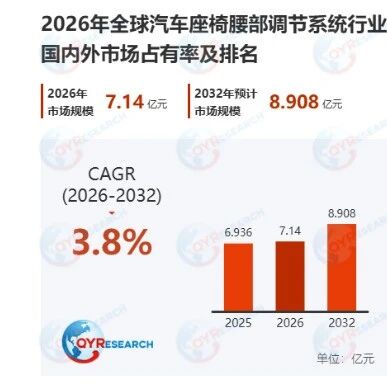
Core Viewpoint - The automotive seat lumbar adjustment system is evolving from a high-end feature to an essential comfort module in vehicles, driven by increasing consumer demand for comfort during long drives and the rise of smart cabins in electric vehicles [2][10]. Market Overview - The global market for automotive seat lumbar adjustment systems is projected to reach $131 million by 2032, with a compound annual growth rate (CAGR) of 3.8% from 2026 to 2032 [2][17]. - The top three manufacturers are expected to hold approximately 38.0% of the market share by 2025 [6]. Industry Chain Analysis - The system consists of core components such as actuators and control units, utilizing pneumatic or electromechanical solutions for lumbar support [7]. - Key upstream suppliers include Parker Hannifin, Bosch, and TE Connectivity, which provide essential components that influence the system's performance and cost structure [7]. - The midstream phase focuses on system integration and functionality, requiring a balance between support effectiveness and long-term stability [8]. Application and Customer Base - The lumbar adjustment system is increasingly used in both passenger and commercial vehicles, becoming a vital feature in mid to high-end models and long-distance driving scenarios [9]. - Major customers include Toyota, Volkswagen, Ford, General Motors, BMW, Mercedes-Benz, and several Chinese automakers [9]. Industry Development Opportunities - The main drivers for the industry include the upgrade of automotive consumption and the growing demand for driving comfort, with the lumbar support feature expanding from high-end to more mainstream vehicles [10]. - Technological advancements in pneumatic control precision and sensor technology are creating favorable conditions for performance optimization and cost control [10]. Industry Challenges - The industry faces challenges related to increased system complexity and cost pressures, requiring high levels of system integration and quality control [11]. - The long verification cycles for stability and durability pose challenges for smaller suppliers in terms of financial investment and engineering capabilities [11]. Future Trends - The lumbar adjustment system is expected to evolve towards higher precision, greater intelligence, and deeper integration with other cabin features, enhancing personalized comfort experiences [12]. - Modular design and automated assembly are anticipated to improve consistency and production efficiency, leading to broader application across various vehicle models [12].

CNBC Daily Open: A trade 'bazooka' against Trump's Greenland tariffs is in the cards for the EU
CNBC· 2026-01-20 07:45
Group 1: Trade Tensions and Tariffs - The European Union is considering imposing tariffs worth 93 billion euros ($108 billion) on the U.S. in response to President Trump's threats regarding trade with Greenland [2] - The EU's "Anti-Coercion Instrument" aims to deter economic coercion affecting trade and investment, with potential repercussions extending beyond tariffs to financial restrictions and limits on public procurement [3][4] - The auto industry, luxury brands, and pharmaceutical companies are among the sectors most exposed to the potential impact of U.S. tariffs [5] Group 2: Market Reactions - Markets reacted negatively to the news of potential tariffs, with Dow Jones futures indicating a drop of over 600 points and European stocks falling [7] - Safe-haven assets like gold and silver surged to new highs following the announcement of tariffs, indicating increased market volatility and investor concern [7] Group 3: Specific Industry Impacts - French wine and champagne are particularly targeted by President Trump, facing a potential 200% tariff due to political disagreements with French President Macron [6]

2026 中国新能源汽车与动力电池手册_从自动驾驶到人工智能-2026 China EV & EV Battery Handbook_ From Autonomous Driving to AI
2026-01-20 01:50
Summary of Key Points from the Conference Call Industry Overview: Greater China Auto, EV, and EV Battery Industry Forecasts - **China's Auto Industry**: Expected to face challenges in 2026 with a forecasted decline in auto wholesales by **1.6% YoY** compared to a **10% YoY** increase in 2025. This decline is attributed to front-loaded demand in 2025 [1] - **Domestic EV Sales**: Anticipated to grow only **7% YoY** in 2026 due to a **5% increase in purchase tax** and reduced trade-in subsidies [1] - **Export Sales**: Projected to increase by **12% YoY**, reaching **7.9 million units** in 2026, with EV exports expected to surge by **40% YoY** [1] - **Competition Dynamics**: Shift from price competition to configuration-based competition, necessitating more investment in autonomous driving (AD) and smart cabin technologies [1] Key Automotive/EV Themes for 2026 Theme 1: Export Growth - **Export Growth**: Companies like Chery and BYD are expected to benefit significantly from exports, especially with the EU's minimum EV price replacing tariffs [2] Theme 2: Autonomous Driving Development - **ADAS to AD Transition**: L3 permits issued to Changan and BAIC, with highway/city NOA penetration expected to exceed **40%** in 2026 and **85%** by 2030. L4/L5 penetration is projected to reach **8%** by 2030 [3] Theme 3: Cost Concerns - **Battery and Memory Costs**: Rising costs and supply stability of memory are key concerns for auto OEMs [3] Key Battery Themes for 2026 Theme 1: Energy Storage Systems (ESS) - **ESS Demand**: Global battery ESS installations expected to grow by **33% YoY** in 2026, with shipments increasing by **41% YoY** [4] Theme 2: Global Expansion - **Overseas Capacity Expansion**: Chinese battery manufacturers are accelerating their overseas capacity expansion, particularly in Europe and Southeast Asia, in response to rising tariffs and trade tensions [4] Theme 3: VAT Rebate Changes - **Export VAT Rebate Cut**: Anticipated to lead to a rush in battery production and shipment in Q1 2026, potentially increasing raw material prices and exerting cost pressure on battery makers and auto OEMs [5] Theme 4: Technological Innovation - **Sodium-Ion Battery**: Launch of Gen-2 sodium-ion battery expected, with ASSB (all-solid-state battery) small-batch production anticipated to start in 2027 and scale up significantly post-2029 [5] Investment Recommendations - **Top Picks**: - **XPeng**: Launch of Mona SUV and HR in 2H26, with a focus on AI-related businesses [6] - **CATL**: Growth driven by CEV, ESS, and overseas capacity despite short-term cost pressures [6] - **Tuopu**: Major supplier for humanoid robots with overseas expansion [6] - **Minth**: Resilient earnings growth supported by high overseas market exposure [6] - **Hesai**: Increased LiDAR adoption in China alongside L3 ADAS development [6] Additional Insights - **Market Dynamics**: The shift in competition and the focus on technological advancements highlight the evolving landscape of the automotive and EV sectors in China, emphasizing the need for companies to adapt to changing consumer preferences and regulatory environments [1][3][4][5]






Is Driving A BMW Instead Of A Toyota A Sign Of Upper-Middle-Class Life? Here's Why That Assumption Often Doesn't Hold
Yahoo Finance· 2026-01-19 21:01
Group 1 - The discussion on Reddit highlights the misconception that owning luxury items, like a BMW, equates to being upper middle class, while many argue that true upper middle class individuals often prioritize financial stability over flashy spending [2][3]. - Personal finance expert Dave Ramsey supports the idea that most millionaires do not drive expensive cars, favoring more economical brands like Ford, Honda, or Toyota instead [4]. - Wealthier families often choose modest vehicles not out of necessity but due to a focus on value, with many high-income professionals opting for older, reliable cars [5]. Group 2 - The Reddit thread emphasizes that upper-middle-class living is defined by financial margin, which includes the ability to make choices, invest in the future, and maintain a work-life balance rather than by luxury brand ownership [6]. - For individuals seeking to improve their financial stability, working with a financial planner can provide guidance on investment planning and retirement strategies, steering clear of lifestyle markers that may not contribute to true wealth [7].
European stocks fall sharply after Trump threatens tariffs over Greenland
New York Post· 2026-01-19 18:33
Market Reaction - European stocks experienced a sharp decline, with the Stoxx Europe 600 index falling 1.2% as investors reacted to President Trump's tariff threats [1][4] - Germany's DAX dropped 1.3% to its lowest level in nearly two weeks, while France's CAC 40 fell 1.8%, heavily impacted by losses in luxury stocks [2][8] - London's FTSE 100 saw a more modest decline of 0.4%, supported by its exposure to defensive sectors [4] Sector Impact - Luxury and automotive sectors were among the hardest hit, with major companies like LVMH, BMW, and Volkswagen facing concerns over potential sales declines in the US market due to new tariffs [4][5] - Defense stocks, however, showed resilience, with shares of Saab, Rheinmetall, and Dassault Aviation rising over 2% as investors anticipated increased military spending in Europe amid rising tensions [6] Tariff Details - Trump announced a 10% tariff on goods from Denmark, Norway, Sweden, France, Germany, the UK, the Netherlands, and Finland, set to increase to 25% by June if negotiations over Greenland fail [5][10] - The tariff threats have raised concerns about the impact on margins and demand for luxury and automotive products in the US, a critical market for European exporters [5] Investor Sentiment - The selloff in European markets was accompanied by a flight to safe-haven assets, with gold prices reaching a new record of $4,672.49 an ounce, reflecting investor anxiety [8] - US futures indicated a rough opening on Wall Street, with S&P 500 and Nasdaq contracts down about 1% as traders anticipated potential retaliatory measures [9] Political Response - European leaders expressed concerns that the tariff threats could escalate tensions, with French President Macron advocating for a strong EU response, potentially restricting US access to the EU market [11][12] - German Chancellor Friedrich Merz emphasized the need for a unified EU position in response to the tariffs, acknowledging differing impacts among member states [12]


Europe’s auto supplier industry faces big job losses – CLEPA
Yahoo Finance· 2026-01-19 12:54
Core Insights - The European automotive supplier sector is experiencing significant job losses, with over 100,000 jobs lost in the past two years, indicating a structural reset that has not been adequately addressed by policy support [1][2] Job Losses and Creation - Job losses in the European automotive supply industry reached 104,000, with 54,000 in 2024 and an additional 50,000 announced for 2025 [1] - Only 7,000 new positions were created in 2025, highlighting a severe shortfall in job creation compared to the number of job losses [2] Policy and Regulatory Environment - The European Commission's recent Automotive Package is seen as a positive initial step, but further development is necessary to enhance flexibility and competitiveness without increasing complexity and costs [3] - The EU is urged to lower energy prices and reduce administrative burdens, along with targeted measures to maintain critical production capacities in the region [4] Industry Impact and Challenges - The automotive supply chain is under pressure, with over 100,000 individuals affected by job losses, equating to 140 families impacted daily [5] - Potential new tariffs on shipments to the US, including a threatened 10% additional import tariff, could further strain the European automotive industry [6][7] - Major companies with significant sales to the US, such as Mercedes, BMW, Volvo Cars, and Jaguar Land Rover, may see their profit margins negatively affected by these tariffs [8]
US Futures Slide on MLK Day Amidst Fresh Tariff Threats, Global Markets React
Stock Market News· 2026-01-19 11:07
Market Overview - U.S. stock markets are closed on January 19, 2026, for Martin Luther King Jr. Day, with no cash equity trading or after-hours sessions occurring [1] - U.S. equity futures are experiencing notable declines, with E-mini S&P 500 futures down approximately 0.7% to 0.9%, Nasdaq 100 futures down between 1% and 1.2%, and Dow Jones Industrial Average futures sliding by about 0.6% to 0.7% [2] Geopolitical Developments - President Trump announced a 10% tariff on imports from eight European countries, effective February 1, which could escalate to 25% by June 1 if no agreement is reached regarding the U.S. acquisition of Greenland [3] - European leaders are considering retaliatory measures, including activating the EU's Anti-Coercion Instrument, in response to the tariff threats [3] Safe-Haven Assets - Investors are flocking to safe-haven assets, with gold futures surging to a record high above $4,670 an ounce and silver futures reaching a new record above $94 an ounce [4] Global Market Performance - European equity markets are broadly lower, with the STOXX Europe 600 index down approximately 0.9%, Germany's DAX declining by 1.1%, and France's CAC 40 down 1.3% [5] - Asian markets show mixed results, with Japan's Nikkei 225 dipping by 0.7% to 0.8%, while China's economy expanded by 4.5% year-on-year in Q4 2025, despite disappointing retail sales figures [6] Upcoming Market Events - Key economic data and corporate earnings reports are expected to influence market sentiment upon the reopening of U.S. markets [7] - The Personal Consumption Expenditures (PCE) price index and a further estimate of third-quarter GDP growth are scheduled for release, which will be vital for assessing the U.S. economy [8] Earnings Season - The fourth-quarter earnings season is underway, with major companies such as Netflix, Intel, Visa, 3M, Johnson & Johnson, Procter & Gamble, and NextEra Energy set to report their results [10] Major Stock News - BRC Group Holdings reported a significant turnaround with a net income of $89.1 million in Q3, contrasting with a loss in the same period last year [14] - Goldman Sachs shares increased by 4.6% due to record-setting equity trading revenue [14] - European defense stocks are gaining amidst geopolitical tensions, while European car manufacturers are seeing declines due to fears of increased U.S. tariffs [14]

Here are the European exporters most exposed if Trump’s Greenland tariffs kick in
CNBC· 2026-01-19 10:53
Tariff Threats and Economic Impact - U.S. President Donald Trump has announced plans to impose 10% tariffs on several European countries, escalating to 25% by June 1, as part of a strategy to acquire Greenland [2] - European political leaders are preparing for emergency talks to discuss potential retaliatory measures and broader economic policies in response to the tariffs [3] Affected Sectors Automotive - The automotive sector is highly vulnerable to the proposed tariffs due to globalized supply chains and reliance on North American manufacturing [4] - Major European car manufacturers, including Volkswagen, BMW, and Mercedes-Benz, experienced stock declines of over 2.5% following the announcement [5] - The tariffs are expected to negatively impact Germany's economic outlook, which is heavily reliant on the automotive industry [7][8] Luxury Goods - Luxury stocks, previously insulated from trade tensions, are now facing potential declines due to the tariffs, particularly affecting French companies like LVMH and Kering [9] - Shares of LVMH and Kering fell approximately 3.5% and 2.6%, respectively, following the tariff threats [10] Pharmaceuticals - The pharmaceutical sector could see significant repercussions, as it represents the EU's largest export to the U.S., with exports valued at €84.4 billion ($98.1 billion) in the first three quarters of the previous year [11] - Major pharmaceutical companies, including Novo Nordisk, Roche, and Sanofi, experienced slight declines in stock prices due to the tariff threats [12] Energy - The energy sector may be indirectly affected by the tariffs, with concerns over weaker global demand and lower crude prices impacting stock performance [13] - Energy stocks like Equinor, TotalEnergies, Shell, and BP saw declines ranging from 1% to 3.4% following the announcement [14] Broader Economic Implications - Analysts predict that the tariffs will have a widespread impact across various sectors, affecting oil prices, commodity prices, equity markets, and debt markets [16]


Auto giant shares tumble on Trump's tariff threat over Greenland
CNBC· 2026-01-19 08:12
Core Viewpoint - Shares of major European car manufacturers fell sharply due to U.S. President Trump's announcement of impending tariffs on several European countries, impacting the automotive sector significantly [1][3]. Group 1: Market Reaction - Europe's Stoxx Automobiles and Parts index decreased by 2.3% around 8:18 a.m. London time [1]. - Major car manufacturers such as Volkswagen, BMW, and Mercedes-Benz saw their shares drop between 2.5% to 4% shortly after the market opened [2]. - Ferrari's shares listed in Milan fell approximately 2% in early trading, while Stellantis shares also decreased by 2% [2]. Group 2: Tariff Details - Trump announced a 10% tariff on the U.K., Denmark, Norway, Sweden, France, Germany, the Netherlands, and Finland, effective by February 1 [3]. - The tariff is set to increase to 25% starting June 1 [3]. Group 3: Industry Vulnerability - The automotive sector is considered highly vulnerable to tariffs due to the globalization of supply chains and reliance on manufacturing operations in North America [4].

Mangrove Lithium announces $85-million USD financing to power critical mineral refinement for EVs
BetaKit· 2026-01-16 19:04
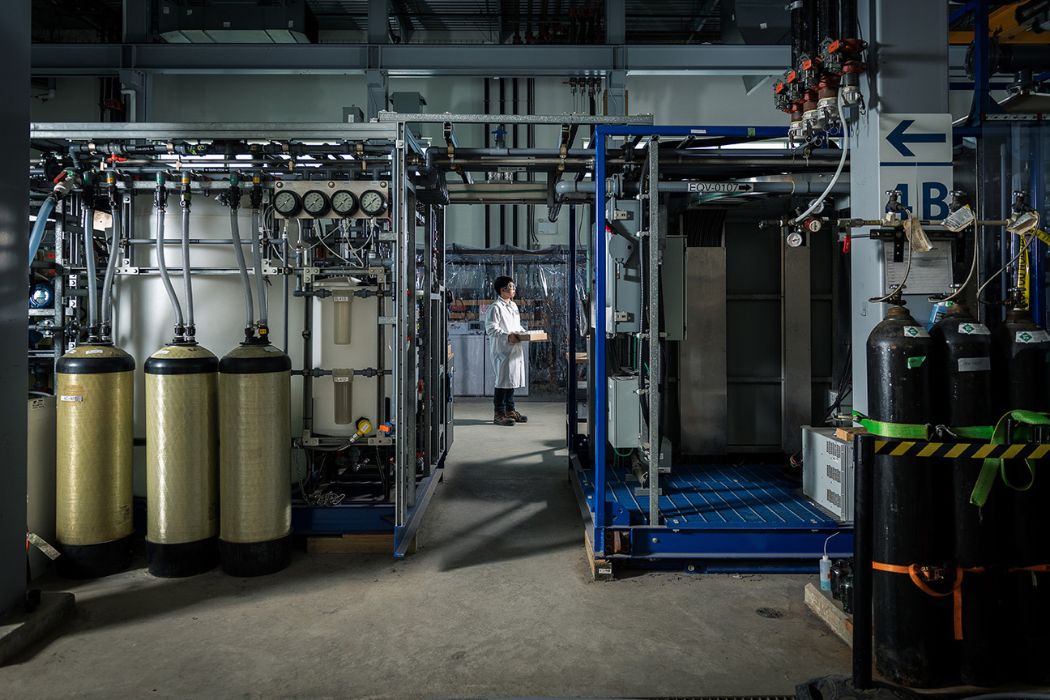
Core Insights - Mangrove Lithium has secured up to $85 million USD ($118 million CAD) in structured financing to advance its lithium refinement technology for electric vehicles (EVs) [1][6] - The Canada Growth Fund is contributing up to $65 million USD ($90 million CAD) to this financing round, with participation from existing investors including Bill Gates' Breakthrough Energy Ventures and BMW iVentures [1][6] Funding and Development Plans - National Bank of Canada is underwriting a $9 million CAD loan backed by a Clean Technology Manufacturing Investment Tax Credit, which will support the establishment of Mangrove's first commercial lithium refinement facility in Delta, BC [2] - The Delta facility is expected to produce enough battery-grade materials to power 25,000 EVs annually, with plans for a second, larger plant that could eventually power 500,000 EVs per year [2][3] Technology and Market Position - Founded in 2017, Mangrove has developed patented electrochemical lithium refining technology that is claimed to be more cost-effective, produce less waste, and require fewer chemicals than traditional methods [4] - The company has been recognized on the Global Cleantech 100 list for four consecutive years, indicating its strong position in the cleantech sector [4][5] Strategic Importance - This financing is part of the Canadian government's broader initiative to enhance the country's critical minerals capabilities and reduce reliance on China, thereby ensuring Canadian sovereignty in the sector [6]