LSEG

Search documents
Activist Irenic builds a stake in Workiva, hoping to gain a voice on the software company's board
CNBC· 2025-10-04 12:43
Company Overview - Workiva is a provider of cloud-based reporting solutions that address financial and non-financial business challenges, integrating financial reporting, ESG, and GRC into a secure, audit-ready platform [1][4] - The platform is built primarily on Amazon Web Services and connects data from various enterprise systems, enhancing reporting capabilities for clients [1] Activist Involvement - Irenic Capital Management has acquired a roughly 2% stake in Workiva and is advocating for improved operating efficiency, strategic alternatives, and enhanced corporate governance [2][3][6] - Irenic is pushing for the addition of two new board members, including one of its executives, and has indicated a willingness to nominate directors if no agreement is reached [3][17] Financial Performance - Workiva derives over 40% of its revenue from its SEC filing service, with a strong customer base including 95% of the Fortune 100 [4] - Despite projected revenue exceeding $1 billion by 2026, Workiva has yet to achieve profitability, leading to its shares trading at a 25% discount compared to peers [5][6] Governance Issues - The company operates under a dual-class share structure controlled by its three founders, resulting in a staggered board with limited relevant experience [7][14] - Irenic is advocating for the collapse of the dual-class structure and a reconstitution of the board with qualified directors [8][9] Operational Challenges - Workiva's sales and marketing expenses account for 43% of revenue, significantly higher than the 31% average for peers, contributing to margin pressure [9][10] - The company has an 18% revenue growth rate but could improve profitability by reducing sales force spending while maintaining double-digit growth [10] Strategic Alternatives - Irenic suggests that if Workiva cannot improve its governance and operational efficiency, the board should consider a strategic review, including a potential sale of the company [11] - Workiva's strong market position and client base make it an attractive target for potential acquirers, with previous interest from private equity firms [12][14] Valuation Insights - Comparable transactions indicate a forward revenue multiple of 7 to 8 times for financial acquirers, suggesting a potential upside of 40% to 60% based on projected revenues [13]



RWA Tokenization: Preview Of A Bubble Or The Next Big Thing?
Yahoo Finance· 2025-09-24 21:30
Core Insights - The tokenization of real-world assets (RWAs) is gaining significant institutional interest, potentially transforming global finance [1][2] - The RWA market has experienced a substantial growth from $29.6 billion to $72.85 billion over the past year, representing a 143% increase [2] - Institutional players are increasingly recognizing the potential of tokenized assets, bridging traditional finance with blockchain ecosystems [3][4] Market Dynamics - The surge in the RWA market is linked to increased stablecoin supply and interest from traditional finance institutions, exemplified by PayPal's stablecoin on the SEI blockchain and the launch of tokenized stocks by Robinhood and Ondo [4][5] - The London Stock Exchange Group (LSEG) has introduced a Digital Markets Infrastructure (DMI) platform that tokenizes private funds, enhancing their lifecycle management through distributed ledger technology [5][6] - The interoperability of LSEG's platform with both traditional systems and new blockchains positions it as a bridge between traditional finance and decentralized finance [6] Liquidity and Institutional Trust - RWAs traditionally suffer from illiquidity, but tokenization via DMI could facilitate secondary trading, enhancing liquidity [7] - LSEG's established reputation among banks, asset managers, and regulators may encourage more institutional players to view tokenized RWAs as legitimate investments [7] - The total value locked (TVL) in RWA protocols currently stands at $15.79 billion, indicating a growing interest in this asset class [7]
财富专业洞察:从市场噪音到投资逻辑,AI在智能投资中的角色
Refinitiv路孚特· 2025-09-19 06:03
Core Insights - The wealth management industry is undergoing a significant transformation driven by the rise of artificial intelligence (AI) and increasingly complex investor behavior [1][2][4] Group 1: Impact of AI on Wealth Management - AI will play a crucial role in enhancing advisor-client relationships by taking over tedious tasks such as tax planning, legal matters, and portfolio management, allowing advisors to focus more on client interactions [2][4] - The use of AI tools can help advisors and portfolio managers gain insights into market dynamics, including trending topics and sentiment analysis, which is essential for understanding market events [3][4] Group 2: Importance of Narrative Intelligence - Narrative intelligence is becoming a key differentiator, helping advisors interpret market sentiment and guide clients through emotional decision-making [4][7] - By leveraging sentiment analysis and natural language processing, advisors can help clients understand market events, reducing the likelihood of panic selling or irrational investment decisions [5][6] Group 3: Ensuring Trust in AI Tools - Trust in AI tools depends on transparency and multi-layered validation, with companies needing to adopt best practices to ensure the reliability and relevance of insights [4][6] - Practical measures include ensuring AI tools can trace information sources and employing prompt engineering to improve the quality of outputs from AI systems [6][7]

如何优化AI金融数据:工具、技术和用例
Refinitiv路孚特· 2025-09-16 09:05
Core Viewpoint - Artificial Intelligence (AI) is rapidly transforming the financial services landscape, with a strong emphasis on the importance of data quality for the success of AI models [3][4][62]. Group 1: Importance of Data in AI - The performance of AI models is entirely dependent on the quality of the data they absorb, as highlighted by LSEG's CEO David Schwimmer [3]. - Financial data is complex, fragmented, and often subject to regulatory constraints, encompassing both structured and unstructured formats [3][4]. - Optimizing financial data for AI requires domain expertise, robust infrastructure, and meticulous governance [3][4]. Group 2: Challenges in Financial AI - Up to 85% of financial AI projects fail due to data quality issues, talent shortages, and strategic misalignment [4]. - Gartner predicts that 30% of generative AI projects will be abandoned after the proof-of-concept phase due to poor data quality [4]. Group 3: Data Categories and Optimization Techniques - **Macroeconomic Data**: Includes indicators like CPI, GDP, and unemployment rates, crucial for predictive models and trading signals [9]. - Optimization techniques involve using point-in-time (PIT) and real-time data to avoid biases from historical corrections [11]. - **Pricing Data**: Forms the basis for security valuation, including real-time quotes and historical prices [14]. - Risks include misleading models due to lagged and revised data [15]. - **Reference Data**: Provides descriptive details about securities and entities, essential for filtering trading eligibility and detecting anomalies [20]. - Optimization techniques include creating master mapping tables and tracking data lineage [24]. - **Symbol Mapping**: Involves using identifiers like ISIN and CUSIP to map and stitch datasets together [27]. - Risks include identifier changes due to corporate actions [29]. - **Unstructured Text**: Comprises news, research reports, and records, rich in insights but challenging to process [35]. - Techniques include using natural language processing for summarization and sentiment analysis [38]. - **Company Data**: Includes structured financial data and unstructured disclosures, vital for valuation and ESG analysis [42]. - Risks involve misinformation and misinterpretation [43]. - **Risk Intelligence Data**: Encompasses sanctions, politically exposed persons, and negative news, critical for compliance and fraud detection [49]. - Optimization techniques focus on standardizing names and addresses [51]. - **Analysis**: Used for valuation, hedging, and risk metrics, potentially involving local or cloud-based computing engines [57]. - Techniques include automating anti-money laundering and fraud detection [59]. Group 4: Conclusion on AI Readiness - The success of AI in financial institutions hinges not only on sophisticated algorithms but also on the integrity and readiness of the underlying data [62]. - Optimizing financial data is an ongoing task requiring collaboration among data engineers, domain experts, and AI practitioners [62].

穿透噪音:将全球讨论转化为可执行的股票信号
Refinitiv路孚特· 2025-09-15 06:02
Core Viewpoint - The article emphasizes the importance of filtering noise in today's interconnected markets, where wealth managers and advisors need tools to extract valuable signals from the overwhelming amount of information generated by AI, social media, and automated comments [1][2]. Group 1: Market Dynamics - The article discusses how narratives can dominate investor psychology, with 2025's investor sentiment influenced by trade war rhetoric, new tariffs, advancements in China's AI capabilities, and dollar depreciation [1]. - It highlights the rapid response of stock prices to these narratives, with winners' stock prices soaring while losers lag behind, indicating the need for portfolio managers to identify sentiment changes early [1][2]. Group 2: Signal Identification - The article outlines the necessity of early signal identification for emerging macro and thematic drivers, such as tariffs or AI developments, to pinpoint stocks that may benefit or suffer before the market fully reacts [2][9]. - It stresses the importance of using sentiment-driven rankings to favor high-confidence stocks and avoid underperformers, thereby improving risk-adjusted returns [2][9]. Group 3: Data Processing and Analysis - LSEG MarketPsych employs robust news and social media analysis tools to convert unstructured text into structured signals, collecting millions of articles and posts daily, categorized by company or asset class and over 200 economic and behavioral themes [4][10]. - The system scores mentions based on intensity and direction, generating minute-level sentiment and thematic indices for over 100,000 global stocks, which can be easily visualized for advisors and clients [4][10]. Group 4: Predictive Evidence - Quantitative tests of sentiment scores indicate that media and social sentiment not only describe but also predict stock performance, with the top decile of stocks by media sentiment outperforming the bottom decile significantly over three months [5][8]. - This predictive power has been observed globally, with a notable increase in the influence of media on stock prices over the past five years [5][8]. Group 5: Practical Applications - The article describes practical applications for wealth advisors, including theme monitoring for tariff or AI-related sentiment spikes, enabling quick assessments of portfolio risks [9]. - It also discusses idea generation and portfolio construction strategies, suggesting overweighting high-sentiment stocks and underweighting low-sentiment peers to enhance risk-adjusted returns [9]. - Risk management is highlighted, where sudden declines in overall sentiment can serve as early warning signals for profit-taking or underperformance [9]. Group 6: Integration with Fundamental Analysis - The article concludes that sentiment and thematic data should complement fundamental analysis and valuation, providing measurable advantages in a world where the signal-to-noise ratio is deteriorating [10]. - Wealth managers, traders, and investors rely on LSEG MarketPsych's analysis and models to penetrate noise and extract actionable insights, especially during periods of heightened market volatility [10].

监控时代:通过创新推动变革
Refinitiv路孚特· 2025-08-19 06:03
Core Viewpoint - The global trade monitoring sector is undergoing significant transformation, evolving from a compliance-driven function to a dynamic, data-driven discipline that impacts business operations [1][2]. Group 1: Evolution of Compliance and Monitoring - Compliance and monitoring functions are transitioning into strategic advisors for risk management, becoming integral to understanding markets, managing data, and controlling risks [2]. - Nearly half of forex companies view trade monitoring and preventing market abuse as key areas for managing or reducing risk exposure, indicating a shift in compliance's role within organizations [2]. - Compliance is now embedded in various business functions, with professionals at all levels taking on more monitoring and risk responsibilities [2][3]. Group 2: Influence of Compliance in Decision-Making - A survey during the LSEG webinar revealed that most participants believe compliance teams now have greater influence in corporate decision-making processes, reflecting a cultural shift where compliance is seen as a driver of business development rather than a hindrance [3][6]. Group 3: Key Drivers of Monitoring Landscape - The monitoring landscape is influenced by three key drivers: 1. Explosive growth in data volume, with market trading volumes and reporting expected to reach historical highs by 2025 [7]. 2. Evolving regulatory requirements, with stricter expectations from regulators regarding data governance and operational resilience [9]. 3. Increasing complexity of market structures, necessitating advanced analytical technologies and unified data sources for effective monitoring [10]. Group 4: Challenges in Trade Monitoring - A significant challenge in trade monitoring is the prevalence of false positives generated by monitoring tools, which can overwhelm teams with irrelevant information [12]. - Companies are encouraged to adopt a tactical approach by utilizing regulatory datasets designed for market abuse detection and calibrating alert mechanisms to capture extreme behaviors [12][13]. Group 5: Role of AI and Innovation - Advances in AI and natural language processing are enabling companies to shift from reactive detection to proactive prevention, allowing for real-time behavior correction [15][16]. - Some companies are deploying AI solutions to educate employees in real-time during potentially inappropriate conversations, marking a new phase in monitoring that emphasizes proactive compliance [16]. Group 6: Integration of Trade and Communication Monitoring - The integration of trade monitoring with communication monitoring is becoming increasingly important, as communication can reveal intentions not reflected in trade data [17]. - LSEG collaborates with Global Relay to provide a unified compliance archiving solution that integrates communication monitoring data from various sources, enhancing the ability to respond to regulatory inquiries [17][18]. Group 7: Conclusion on Monitoring's Role - Monitoring has evolved from a backend burden to a forefront discipline in risk management and organizational culture, offering significant competitive advantages when leveraged effectively [18].

在动荡时期驾驭跨资产波动
Xin Lang Cai Jing· 2025-08-18 06:29
Core Insights - Recent political and economic turmoil, such as tariff increases and central bank policy shifts, have led to significant volatility in stock, bond, and commodity markets [3][4] - Cross-asset awareness is essential as asset classes no longer move in isolation; investors must assess global correlations and industry sensitivities [4][6] Market Dynamics - The rapid shift in market sentiment was highlighted by the Trump administration's tariff announcements, which caused nearly $6.6 trillion in market value to evaporate from U.S. stocks within two trading days, followed by a 9.5% rebound in the S&P 500, marking the largest single-day gain in over a decade [4] - Current market volatility is driven not only by economic fundamentals but also by political agendas, presenting both risks and opportunities for agile investors [4][10] Investment Strategies - Investors must accurately grasp key factors, timing, and effective decision-making to capture opportunities amid market dislocations [5][10] - Understanding cross-asset correlations, such as how tariff announcements impact sectors like automotive, semiconductors, or consumer goods, is becoming a core competitive advantage in stock investing [7][9] Data Utilization - The ability to focus on critical information amidst data overload is increasingly valuable; tools like LSEG's Morning Bid help investors filter out noise and provide actionable insights [8][10] - Decision-makers are relying on data-driven signals to focus on key indicators, such as analyst sentiment changes and earnings forecast adjustments, to identify potential opportunities during market dislocations [8][11] Agile Decision-Making - The integration of real-time news, market data, and analytical tools is crucial for investors to quickly adjust strategies and capitalize on market opportunities [9][10] - Maintaining agility in decision-making processes is essential for adjusting exposure to sensitive sectors and reallocating resources to relative beneficiaries [9][10]

AI吞噬软件!GPT-5发布后,本周欧美软件股崩了
Hua Er Jie Jian Wen· 2025-08-15 07:01
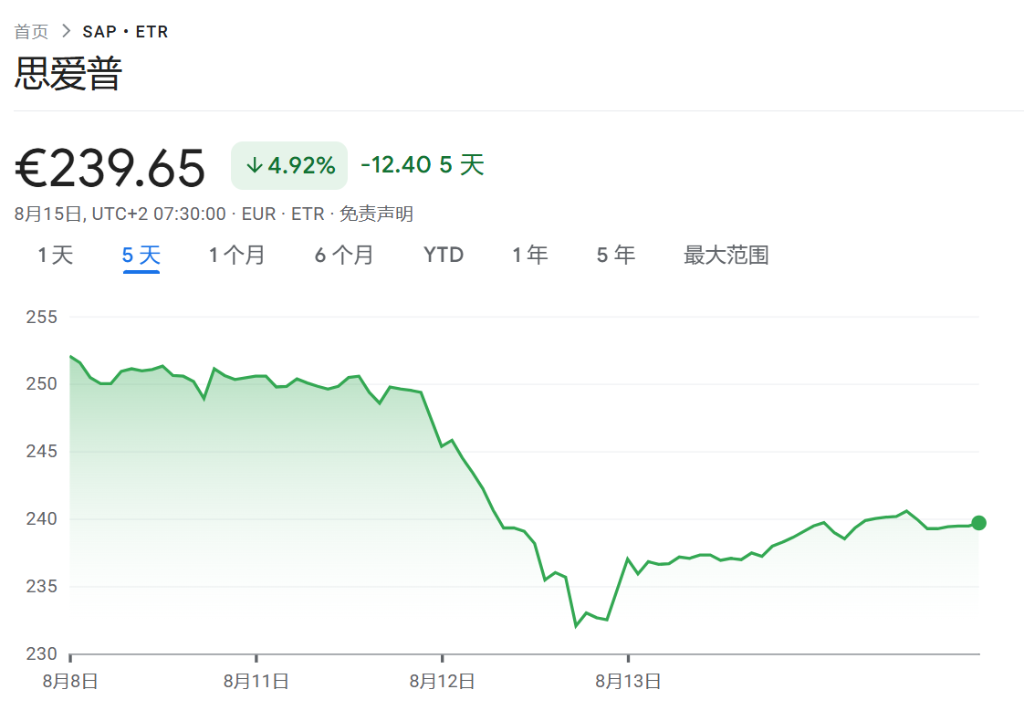
Core Viewpoint - The market is experiencing significant panic selling in the software sector due to concerns that artificial intelligence (AI) will replace traditional software solutions, particularly following the release of advanced AI models like GPT-5 and Claude [1][4][10] Group 1: Market Reaction - European software stocks faced a sharp decline, with SAP's stock dropping 7.1%, resulting in a market value loss of nearly €22 billion, marking the largest single-day drop since late 2020 [1] - Other companies like Dassault Systèmes and Sage Group also saw substantial declines, with many software stocks losing double digits since mid-July [1][4] - In the U.S., Monday.com experienced a 30% drop, while Salesforce and Adobe have seen declines of over 25%-30% this year [5] Group 2: AI Impact - The rapid iteration of AI models is perceived as a direct threat to the core business models of software and data service companies, including financial data providers and data analytics platforms [4][8] - Fund managers are increasingly aware that each new generation of AI models could significantly outperform previous versions, challenging existing business logic [4] Group 3: Valuation Sensitivity - The software sector's high valuations are amplifying the impact of negative sentiment, with the average P/E ratio of STOXX600 around 17 times, while SAP's P/E ratio is close to 45 times [9] - High valuations make these companies particularly sensitive to any potential negative news [9] Group 4: Long-term Outlook - Despite the prevailing narrative that AI will consume software, some analysts believe that not all software will be replaced, especially those deeply integrated into customer workflows and possessing unique proprietary data [9][10] - Companies like Experian, which have unique data and are embedded in financial processes, are seen as having strong competitive advantages [9]

X @Bloomberg
Bloomberg· 2025-08-01 08:03
Euronext CEO Stephane Boujnah answers "yes" when asked if he would buy the London Stock Exchange if its parent, LSEG, put it on the market https://t.co/rUlgvjBv5V https://t.co/LjnCybh1Lf ...
报名倒计时|探索外汇、固收及贵金属领域量化交易新机遇
Refinitiv路孚特· 2025-07-29 06:03
Core Insights - The article emphasizes the capabilities of Tick History, a cloud-based historical real-time pricing data service that provides access to over 45PB of standardized data from more than 500 trading venues and third-party quote providers [3][4]. Group 1: Tick History Overview - Tick History encompasses over 1 billion tools and has historical data spanning 25 years, amounting to more than 87 trillion transactions [2]. - The service allows users to access and analyze vast amounts of data in minutes, supported by Google® BigQuery [5]. - Tick History Workbench aids in analyzing market microstructure, trading strategies, and execution quality using standard tools [6]. Group 2: MarketPsych Analysis and Models - MarketPsych offers a comprehensive suite of AI-based natural language processing (NLP) solutions, providing data feeds and predictive insights from real-time, multilingual news, social media, and financial documents [8]. - The collaboration with MarketPsych leverages cutting-edge language analysis technology to deliver superior historical coverage and market-leading timestamped data [8]. Group 3: Key Services - The service includes data digitization, converting sentiments and meanings from major countries, commodities, currencies, cryptocurrencies, and stocks into machine-readable values and signals [9]. - An emotional framework is established to measure sentiments (e.g., optimism, anger) and financial language (e.g., price predictions) from extensive news and social media content [10]. - Applications of these services include creating and enhancing trading strategies and volatility predictions [11].