
Blue Owl Capital

Search documents
ORCL Class Action Notice: Robbins LLP Reminds Investors of the Lead Plaintiff Deadline in the Oracle Corporation Class Action
Globenewswire· 2026-02-09 21:00
SAN DIEGO, Feb. 09, 2026 (GLOBE NEWSWIRE) -- Robbins LLP reminds stockholders that a class action was filed on behalf of all investors who purchased or otherwise acquired Oracle Corporation (NYSE: ORCL) common stock between June 12, 2025 and December 16, 2025. Oracle is a technology company that provides, among other things, infrastructure for operating artificial intelligence (“AI”) programs. For more information, submit a form, email attorney Aaron Dumas, Jr., or give us a call at (800) 350-6003. The All ...



X @Bloomberg
Bloomberg· 2026-02-09 14:50
Blue Owl Capital’s record-setting stock plunge was triggered by doubts about its private credit investments. Now its founders’ loans are threatening to bring more instability to the shares https://t.co/3hbsKSLqeS ...
Equinix Is The DC KING You Can Buy At A Reasonable Price (NASDAQ:EQIX)
Seeking Alpha· 2026-02-09 11:12
With all the interest and hype around the massive requirement for data centers (DCs), many investors are looking for ways to quickly profit from the phenomenon. Risk is, however, emerging in the ecosystem as companies like Blue Owl Capital (I'm an optimist. I look forward to a brighter future. As the world evolves so must our investment style. Opportunities are everywhere but having the right mindset, being humble and having a can do, never stop learning attitude is critical to success. We can beat the mark ...



Equinix Is The DC King You Can Buy At A Reasonable Price
Seeking Alpha· 2026-02-09 11:12
Group 1 - The growing demand for data centers (DCs) is attracting significant investor interest, but risks are emerging within the ecosystem [1] - Companies like Blue Owl Capital are highlighted as part of the evolving investment landscape in the data center sector [1] Group 2 - The investment approach emphasizes the importance of a positive mindset, humility, and a commitment to continuous learning for success in a volatile market [1]

AI冲击波从软件业蔓延至债市:最大债主Ares、KKR股价重挫,违约率恐飙至13%
Hua Er Jie Jian Wen· 2026-02-09 06:21
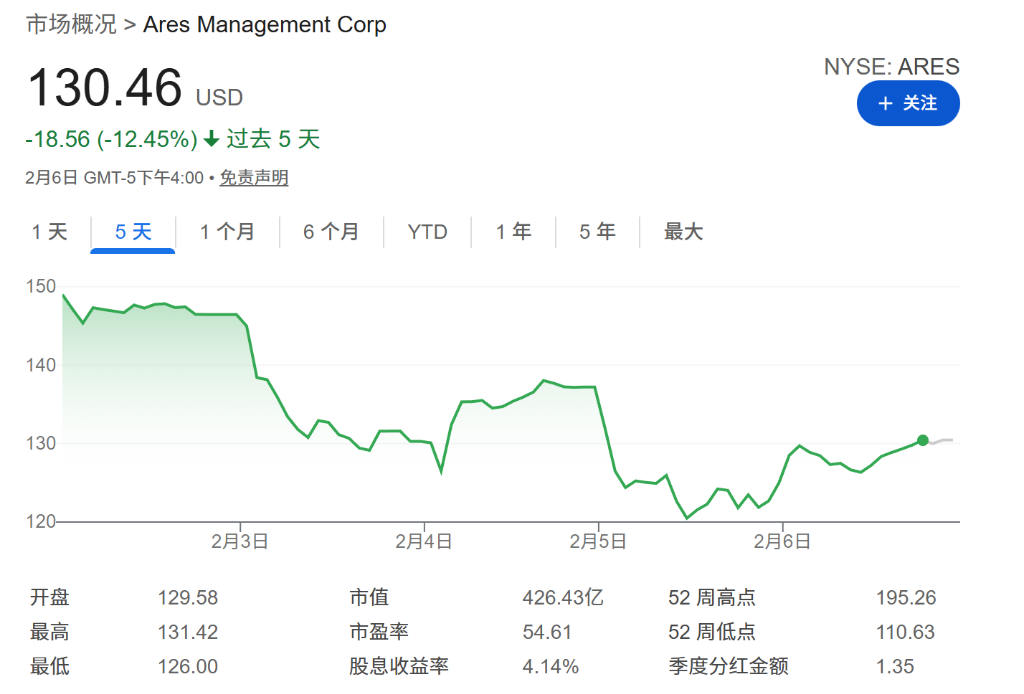
Core Insights - The disruptive wave of artificial intelligence (AI) technology is spreading from the software industry into the financial markets, creating unprecedented uncertainty in the private credit bond market, which is valued at approximately $3 trillion [1][12] - The release of a new AI tool by Anthropic has triggered a sell-off in software data supplier stocks, leading to significant declines in asset management companies heavily invested in private credit bonds [1][8] Group 1: Market Impact - The stock prices of major asset management firms with substantial private credit bond operations have experienced sharp declines, with Ares Management down over 12%, KKR down nearly 10%, Blue Owl Capital down over 8%, and TPG down about 7%, while the S&P 500 index only slightly decreased by approximately 0.1% during the same period [1][3] - Investors are increasingly uneasy about their exposure to the private credit bond market, particularly due to the software industry's significant concentration in this sector, which amplifies any disturbances [8][9] Group 2: Credit Quality Concerns - UBS has issued a stern warning that if the disruptive effects of AI accelerate beyond the adaptability of borrowing companies, the default rate in the U.S. private credit bond market could soar to 13% under aggressive scenarios, significantly higher than their estimates for leveraged loans (8%) and high-yield bonds (4%) [8][9] - The private credit bond market's heavy reliance on the software industry raises concerns about the quality of these assets, as any downturn in the software sector could lead to significant issues within investment portfolios [9][10] Group 3: Structural Risks - The structure of loans, particularly Payment-in-Kind (PIK) loans, exacerbates potential risks, as these loans allow borrowers to defer cash interest payments, which can become problematic if the borrower's financial situation deteriorates [10] - Moody's Analytics warns that the opacity of the private credit bond market complicates comprehensive risk assessment, highlighting the rapid growth of AI-related lending, rising leverage, and lack of transparency as significant warning signs [10][11] Group 4: Systemic Concerns - The market reassessment triggered by AI occurs against a backdrop of existing scrutiny of the private credit bond industry, which has long been criticized for high leverage and valuation opacity [12] - The private credit bond market, which has favored corporate software companies since 2020, must now prepare for the disruptive impacts driven by AI technology, prompting investors to reevaluate financing transactions that involve opaque, illiquid loans, especially those exposed to technological change risks [12]

Private credit worries resurface in $3 trillion market as AI pressures software firms
CNBC· 2026-02-09 04:41
Core Viewpoint - The private credit markets are experiencing increased uncertainty due to the emergence of AI-driven tools that may disrupt traditional software business models, particularly affecting software companies that are significant borrowers in the private lending space [1][2]. Group 1: Impact of AI on Software Companies - AI tools developed by Anthropic are designed to perform complex tasks that many software companies currently charge for, raising concerns about the potential weakening of traditional software business models [2]. - The software sector, which has been a favored area for private credit lenders since 2020, is now facing pressure as AI adoption could accelerate faster than companies can adapt [5][7]. - Software companies account for approximately 17% of loans held by U.S. business development companies, making them a significant focus for private credit lenders [6]. Group 2: Market Reactions and Financial Implications - Shares of major asset managers with substantial private credit franchises have declined significantly, with Ares Management falling over 12%, Blue Owl Capital losing over 8%, and KKR declining almost 10% [3]. - UBS Group has warned that default rates in U.S. private credit could rise to 13% in an aggressive disruption scenario, which is notably higher than the projected stress for leveraged loans and high-yield bonds [7]. - The private credit industry, valued at $3 trillion, is facing concerns over leverage, opaque valuations, and the risk of isolated problems becoming systemic issues [9]. Group 3: Credit Risk and Future Outlook - The potential for credit risk varies among software and services sector borrowers, depending on their position relative to AI advancements [10]. - Payment-in-kind (PIK) loans, which allow borrowers to defer interest payments, are prevalent among software companies, posing risks if their financial situations deteriorate [11]. - Experts indicate that while the private credit industry may currently absorb losses, ongoing credit growth could lead to significant credit problems in the future [13].


X @Bloomberg
Bloomberg· 2026-02-05 18:43
Blue Owl Capital’s management told investors that its software lending portfolio is in “pristine” condition, dismissing risks from the AI-driven sell off, even as its shares continued to be punished on Thursday https://t.co/P9WkA75zeP ...
Billions wiped off ‘shadow banks’ as AI threatens wave of defaults
Yahoo Finance· 2026-02-05 15:02
Group 1: Market Impact - Billions have been wiped off "shadow banks" due to fears that AI will trigger loan defaults at software companies, with major US lenders losing over $2 billion in value this week [1] - The S&P Business Development Companies index, tracking 44 private credit funds, has lost about $2.2 billion in value since Monday amid fears of a software sector meltdown [5] - Shares of Hercules Capital, managing $5.5 billion, plunged 8.4% during this period, indicating significant market distress [5] Group 2: Company-Specific Developments - Blue Owl Capital, a major player in the private credit sector, saw its share price decline by 6.9%, while its tech-focused fund, Blue Owl Technology Finance, fell by 6.6% [6] - Software stocks have been particularly affected after Anthropic, a $350 billion AI lab, introduced a new legal and accounting tool that threatens existing software services [2] Group 3: Industry Concerns - The shadow banking sector is increasingly viewed as vulnerable, especially following the collapse of two major US companies last year, raising concerns over lax lending standards [7] - UBS predicts that AI disruption could lead to loan defaults rising to 13% in private credit, with 25% to 33% of the private credit universe exposed to AI-related disruptions [7][8] - The introduction of Anthropic's new AI tool, which can perform tasks with minimal prompts, raises alarms about the future of traditional software services [8]
ORCL INVESTOR ALERT: Oracle Corporation Investors with Substantial Losses Have Opportunity to Lead the Oracle Class Action Lawsuit – RGRD Law
Globenewswire· 2026-02-04 23:23
Core Viewpoint - The Oracle class action lawsuit alleges that Oracle Corporation and its executives made misleading statements regarding the company's financial health and AI infrastructure strategy, leading to significant stock price declines during the class period from June 12, 2025, to December 16, 2025 [1][3]. Group 1: Allegations and Financial Impact - The lawsuit claims that Oracle's AI infrastructure strategy would lead to substantial increases in capital expenditures without corresponding near-term revenue growth, raising concerns about the company's debt and credit rating [3]. - On September 24, 2025, S&P Global Ratings indicated that OpenAI could account for over a third of Oracle's total revenues by fiscal 2028, which posed risks related to OpenAI's ability to meet contractual obligations [4]. - Following negative analyst coverage from Rothschild & Co. Redburn on September 25, 2025, which set a $175 price target for Oracle, the stock price fell over 5% [5]. - Oracle's financial results announced on December 10, 2025, showed revenue growth below expectations and negative free cash flow exceeding $10 billion, resulting in an almost 11% drop in stock price [6]. - Reports on December 12, 2025, indicated delays in data center completion for OpenAI due to labor and material shortages, further suggesting potential revenue growth delays for Oracle [7]. - On December 17, 2025, it was reported that Blue Owl Capital withdrew funding for a $10 billion Oracle data center project, leading to an additional decline of over 5% in Oracle's stock price [8]. Group 2: Legal Process and Firm Background - The Private Securities Litigation Reform Act of 1995 allows any investor who purchased Oracle common stock during the class period to seek appointment as lead plaintiff in the lawsuit [9]. - Robbins Geller Rudman & Dowd LLP, the firm handling the case, has a strong track record, having recovered over $916 million for investors in 2025 alone, and is recognized as one of the largest plaintiffs' firms globally [11].

X @Bloomberg
Bloomberg· 2026-02-04 19:03
A fund managed by Blue Owl Capital sold a warehouse in Pennsylvania to the Department of Homeland Security for nearly $120 million. https://t.co/47oACQv5SY ...