
新型AI工具

Search documents
投资者直面AI引发的“打地鼠”式市场震荡
Xin Lang Cai Jing· 2026-02-13 12:00
Core Viewpoint - Investors in the US stock market are on alert for further volatility due to fears of AI disruption, while assessing the sustainability of sector rotation and focusing on the upcoming Walmart earnings report and economic data [1][2]. Market Performance - The S&P 500 index closed down 0.2% year-to-date, masking significant volatility within specific sectors [1][2]. - Software stocks have declined this month, raising concerns about the impact of new AI tools on various industries, including insurance and wealth management [1][2]. - The technology sector, which has been a primary driver of the bull market since October 2022, has seen a cumulative decline of over 4% this year [2][6]. Sector Rotation - There is a noticeable shift in market leadership, with four sectors—energy, consumer staples, materials, and industrials—each rising at least 10% in 2026 [2][6]. - Investors are moving into previously underperforming sectors, indicating a fundamental change in market dynamics [2][6]. - Despite the weakness in tech stocks, the participation of more sectors in the market rally is viewed positively for overall market health [2][6]. Upcoming Earnings and Economic Data - Walmart's quarterly earnings report is anticipated to be a focal point for investors, providing key insights into consumer spending trends [3][7]. - Walmart's stock has risen 20% this year, with its market capitalization recently surpassing $1 trillion, making it the largest company in the consumer staples sector, which has gained 15% this year [3][8]. - Upcoming economic data includes preliminary Q4 GDP, monthly consumer confidence surveys, and key inflation indicators such as the Personal Consumption Expenditures Price Index [3][8].
日本股市屡创新高 但这波涨势或许“十分脆弱”
Xin Lang Cai Jing· 2026-02-11 07:28
Group 1: Market Performance and Political Influence - The Japanese stock market, represented by the Nikkei 225 index, has recently reached record highs, surpassing 56,000, 57,000, and approaching 58,000 points, primarily driven by the "Kishida trade" following Prime Minister Kishida's overwhelming election victory [1][6] - The Nikkei index has increased approximately 15% year-to-date, with political optimism being a significant pillar of this rally, as investors anticipate expanded spending, tax cuts, and a more aggressive economic agenda [1][6] - Analysts warn that the market's enthusiasm has outpaced the clarity of policy funding sources, indicating a growing disconnect between the stock market and economic fundamentals [1][6] Group 2: Economic Indicators and Debt Concerns - Japan's economy contracted by 0.4% quarter-on-quarter for the first time in six quarters, with an annualized decline of 1.8% reported in November [1][6] - The International Monetary Fund indicates that Japan has the highest debt levels globally, with a projected debt-to-GDP ratio nearing 230% by 2025, suggesting that increased fiscal spending may exacerbate the debt burden [7][8] Group 3: Currency and Global Market Sensitivity - The Japanese yen has depreciated significantly, with a reported decline of approximately 3.67% against the US dollar over the past six months, which has implications for the stock market as many companies rely on exports [10][11] - Moody's economist Stefan Angrick notes that the current market valuation is driven by global stock trends, making it sensitive to fluctuations in technology enthusiasm and currency movements [10][11] Group 4: Future Outlook and Structural Reforms - Despite concerns about market sustainability, experts believe that recent structural reforms in Japan, particularly in corporate governance and shareholder returns, provide a foundation for continued growth [12][13] - Asset management firms assert that the overall fundamentals of Japanese companies remain supportive, provided that expectations for reforms are met [13] - There is a cautionary note that if the pace of reforms slows, it could lead to downside risks for the market [14]
AI冲击波从软件业蔓延至债市:最大债主Ares、KKR股价重挫,违约率恐飙至13%
Hua Er Jie Jian Wen· 2026-02-09 06:21
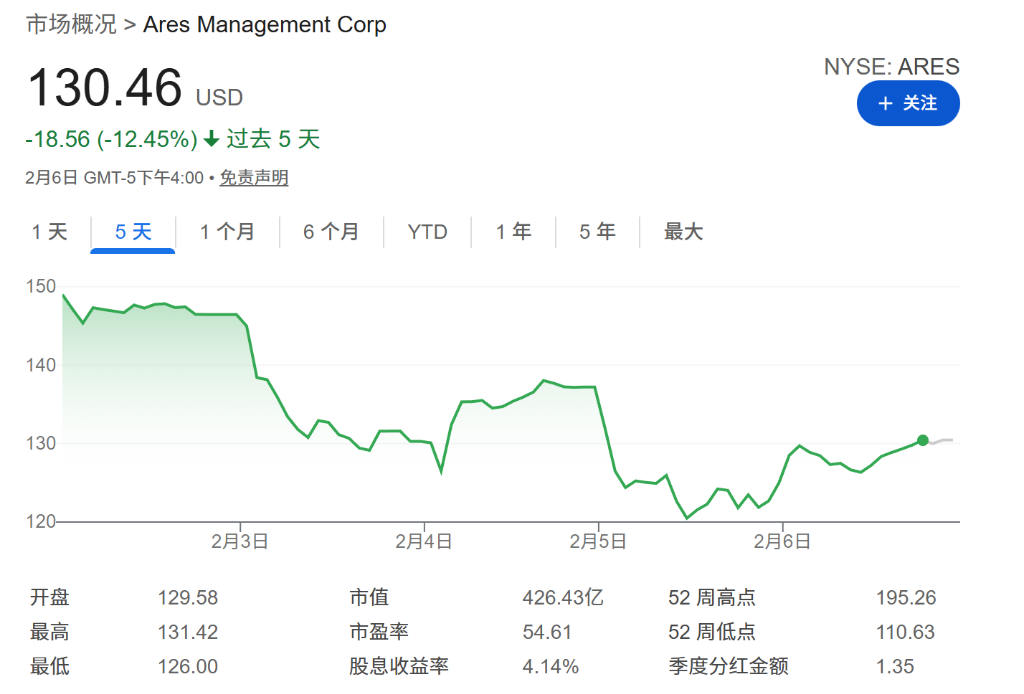
Core Insights - The disruptive wave of artificial intelligence (AI) technology is spreading from the software industry into the financial markets, creating unprecedented uncertainty in the private credit bond market, which is valued at approximately $3 trillion [1][12] - The release of a new AI tool by Anthropic has triggered a sell-off in software data supplier stocks, leading to significant declines in asset management companies heavily invested in private credit bonds [1][8] Group 1: Market Impact - The stock prices of major asset management firms with substantial private credit bond operations have experienced sharp declines, with Ares Management down over 12%, KKR down nearly 10%, Blue Owl Capital down over 8%, and TPG down about 7%, while the S&P 500 index only slightly decreased by approximately 0.1% during the same period [1][3] - Investors are increasingly uneasy about their exposure to the private credit bond market, particularly due to the software industry's significant concentration in this sector, which amplifies any disturbances [8][9] Group 2: Credit Quality Concerns - UBS has issued a stern warning that if the disruptive effects of AI accelerate beyond the adaptability of borrowing companies, the default rate in the U.S. private credit bond market could soar to 13% under aggressive scenarios, significantly higher than their estimates for leveraged loans (8%) and high-yield bonds (4%) [8][9] - The private credit bond market's heavy reliance on the software industry raises concerns about the quality of these assets, as any downturn in the software sector could lead to significant issues within investment portfolios [9][10] Group 3: Structural Risks - The structure of loans, particularly Payment-in-Kind (PIK) loans, exacerbates potential risks, as these loans allow borrowers to defer cash interest payments, which can become problematic if the borrower's financial situation deteriorates [10] - Moody's Analytics warns that the opacity of the private credit bond market complicates comprehensive risk assessment, highlighting the rapid growth of AI-related lending, rising leverage, and lack of transparency as significant warning signs [10][11] Group 4: Systemic Concerns - The market reassessment triggered by AI occurs against a backdrop of existing scrutiny of the private credit bond industry, which has long been criticized for high leverage and valuation opacity [12] - The private credit bond market, which has favored corporate software companies since 2020, must now prepare for the disruptive impacts driven by AI technology, prompting investors to reevaluate financing transactions that involve opaque, illiquid loans, especially those exposed to technological change risks [12]


每日投资策略-20260204
Zhao Yin Guo Ji· 2026-02-04 02:00
Market Performance - The Hang Seng Index closed at 26,835, up 0.22% for the day and up 4.70% year-to-date [1] - The Shanghai Composite Index closed at 4,068, up 1.29% for the day and up 2.49% year-to-date [1] - The US markets saw declines, with the Dow Jones down 0.34% and the S&P 500 down 0.84% [1] Sector Performance - The Hang Seng Financial Index rose by 0.99% with a year-to-date increase of 7.80% [2] - The Hang Seng Real Estate Index increased by 1.65%, showing a year-to-date growth of 14.84% [2] - The Hang Seng Technology Index fell by 1.07%, with a year-to-date decline of 0.88% [1][2] Chinese Stock Market Insights - The Chinese stock market rebounded, with materials, industrials, and defense sectors leading gains, while information technology and telecommunications sectors declined [3] - Southbound capital saw a net inflow of HKD 952 million, with Tencent, China Mobile, and Xiaomi being the top net buyers [3] - Concerns over potential VAT increases on financial and internet services led to declines in internet platform stocks, although these rumors were debunked by experts [3] Aluminum Industry Analysis - The global supply of electrolytic aluminum is expected to remain tight until 2026, supporting higher aluminum prices, projected to increase by 15% year-on-year [4] - China's electrolytic aluminum capacity utilization is nearing saturation, with a forecasted capacity limit of 45 million tons by December 2025 [4] - The report initiates coverage on Innovation Industries (2788 HK) with a "Buy" rating and a target price of HKD 32, citing cost advantages from green energy and expansion in Saudi Arabia [7] Insurance Industry Insights - The insurance sector in China is projected to see premium income growth, with life insurance premiums expected to reach CNY 3.56 trillion, a year-on-year increase of 11.4% [5] - December saw a recovery in premium income, with life insurance premiums growing by 10.1% year-on-year [5] - The report maintains a positive outlook on the insurance sector, recommending stocks like China Ping An (2318 HK) and AIA Group (1299 HK) with target prices of HKD 90 and HKD 89, respectively [7]